Echoes of Mystralia Lore & Story Explained: Deep History and Rift Mechanics Analysis
When Borealys Games brings players back to Mystralia with Echoes of Mystralia, it is immediately obvious that this is not simply another chapter built around the ideas of Mages of Mystralia. The 2026 game takes the familiar fantasy setting and twists it into something much stranger: a world where history itself has become hostile.
That distinction is important.
The original Mages of Mystralia built its identity around classic high-fantasy adventure, magical experimentation, and the journey of Zia, a young mage living in a world where magic had been outlawed. Echoes of Mystralia keeps the franchise’s fascination with spellcraft but throws it into a much darker action-RPG roguelite structure.
At first glance, the comparison to games such as Hades or Wizard of Legend is almost unavoidable. You fight through dangerous areas, collect resources, experiment with increasingly ridiculous magical combinations, die, return to a safe hub, upgrade your character, and head back into the nightmare.
But there is a major difference here, and it is the part of the game that makes the lore genuinely interesting.
The loop is the story.
Death isn’t simply a convenient gameplay reset. The repeated runs are tied directly to the central catastrophe consuming Mystralia. The kingdom has been fractured by a mysterious cosmic anomaly known as the Rift, and the consequences are far more disturbing than ordinary physical destruction. Time, memory, history, and identity are all being dragged into the same collapsing cycle.
The deeper I look at the premise, the more it feels like Borealys Games is using the roguelite structure as an actual storytelling device rather than simply putting a familiar gameplay formula around a fantasy setting.
The Rift: When History Becomes a Prison
The Rift is the central mystery behind Echoes of Mystralia.
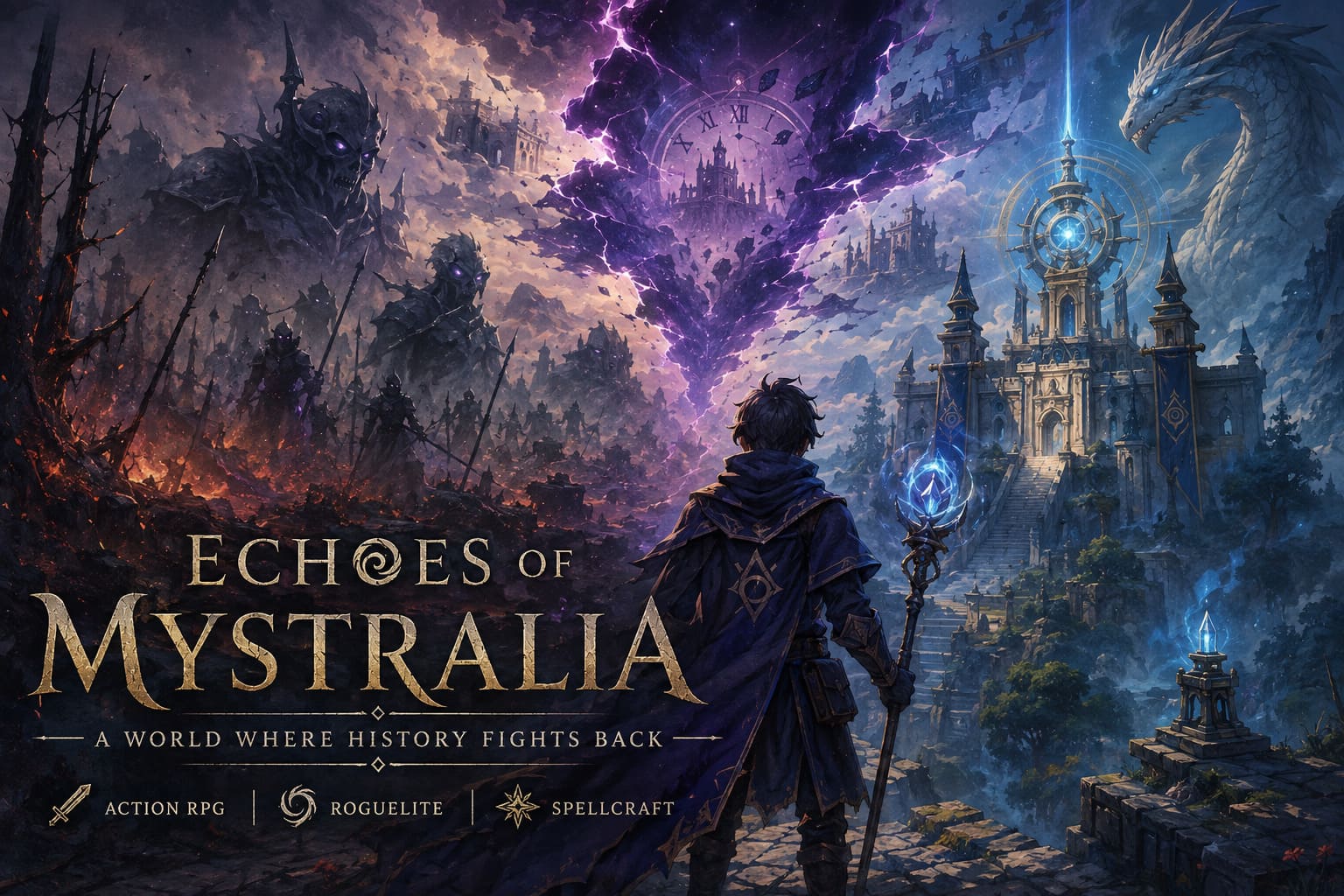
It isn’t just a giant magical crack destroying castles, forests, and villages. Its real target is much more fundamental: the world’s relationship with time and memory.
Under the influence of the Rift, Mystralia is forced to revisit its own past. Historical disasters don’t remain buried where they belong. Wars, fires, personal tragedies, forgotten conflicts, and ancient deaths continue repeating as though the world has become trapped inside its worst memories.
That gives the setting an unsettling quality.
Imagine walking into a battlefield where the soldiers have been dead for centuries, only to discover that they are still fighting the same battle. Walk deeper into a ruined settlement and you may find people reliving the moment their home was destroyed. The past isn’t being remembered. It is happening again.
This is where the game’s enemies, known as the Shadows of the Past, become particularly important.
They aren’t just monsters designed to fill combat encounters. They are manifestations of historical trauma. Their existence is connected to the memories and suffering embedded inside the fractured world.
That concept gives even routine combat encounters additional context. Every enemy Mazarim cuts through can be viewed as another symptom of a world that simply cannot move on.
And honestly, that’s a much more interesting explanation for a roguelite enemy army than “evil creatures spawned from a portal.”
Who Is Mazarim?
Players take control of Mazarim, an apprentice protector who carries the title of Watcher.
The Watchers are guardians responsible for observing and protecting something known as the Cycle of Memories. This mystical structure maintains the balance between the universe’s past, present, and future.
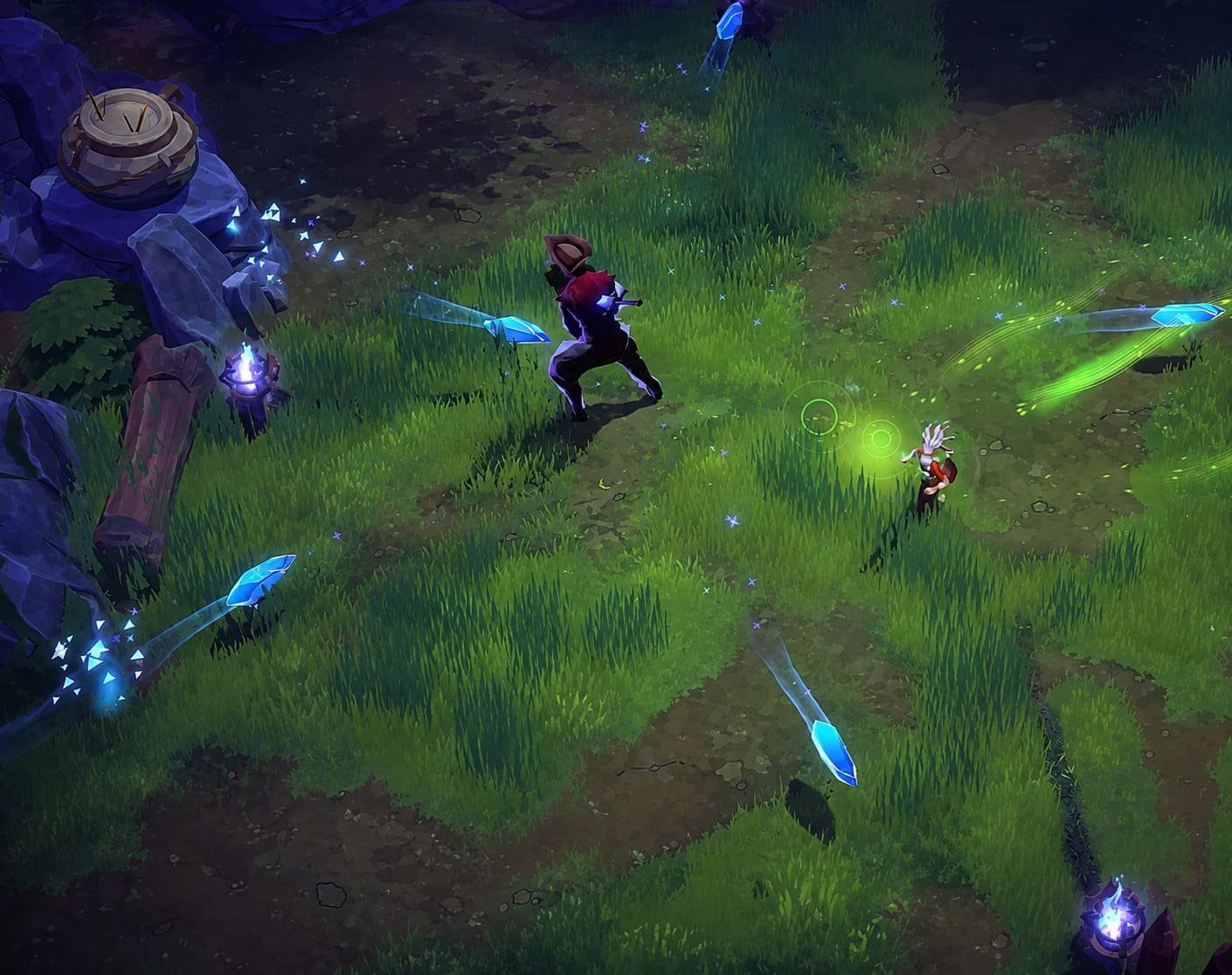
Naturally, things have gone horribly wrong by the time Mazarim’s journey begins.
The Cycle is destabilized. The Rift continues spreading. Mystralia’s memories are becoming corrupted, and the entire world risks being swallowed by something referred to as Oblivion.
Mazarim isn’t introduced as an all-powerful hero who can simply walk into the problem and delete it with one oversized spell. He’s an apprentice dealing with a catastrophe much larger than himself.
That distinction matters because the progression system mirrors his character development.
Every run teaches him something.
Every failure gives him information.
Every recovered memory makes him stronger.
And every return to the Azimuth Temple represents another attempt to understand a world that is falling apart.
The Azimuth Temple and the Meaning of Death
The Azimuth Temple serves as Mazarim’s sanctuary between expeditions.
It exists outside the normal flow of the corrupted timeline, which makes it the perfect location for the game’s roguelite loop. When Mazarim falls during an expedition, his consciousness returns to the temple rather than the character simply dying and restarting for arbitrary gameplay reasons.
This is one of the smartest ideas in Echoes of Mystralia’s narrative structure.
The player understands that a failed run isn’t necessarily meaningless. Mazarim has been there. He has seen what happened. He has learned. The world below may reset or continue repeating, but the Watcher’s understanding of it becomes more refined.
Inside the temple, Mazarim can interact with surviving Watchers and seek guidance from an ancient goddess dragon, a being that has existed for thousands of years and functions as one of his most important spiritual sources of knowledge.
The temple therefore becomes much more than a standard roguelite hub.
It represents the one place where the protagonist can step outside the nightmare and actually process what he has discovered.
| Lore Element | Role In The Story |
|---|---|
| Rift | Fractures time, memory, and history |
| Mazarim | Apprentice Watcher fighting to restore the Cycle |
| Azimuth Temple | Safe haven outside the corrupted flow of time |
| Cycle of Memories | Maintains balance between past, present, and future |
| Shadows of the Past | Manifestations of historical suffering |
| Oblivion | The ultimate threat to Mystralia’s existence and memory |
The Shadows of the Past Are Mystralia’s Forgotten Wounds
The Shadows of the Past are probably one of the most important pieces of the game’s atmosphere.
In many fantasy RPGs, ancient history exists mainly through books, NPC dialogue, statues, and environmental storytelling. Echoes of Mystralia takes the opposite approach.
Here, history can literally attack you.
The creatures Mazarim encounters are connected to events that happened long before his journey. Their presence is a reminder that the Rift has removed the natural separation between “what happened” and “what is happening.”
That creates some fantastic possibilities for environmental storytelling.
A village isn’t simply abandoned because everyone left.
A battlefield isn’t merely an old ruin.
A forest isn’t just a dangerous dungeon.
These locations can represent memories trapped in an endless replay.
The inhabitants caught inside these regions can also repeat dialogue, actions, or traumatic situations. The effect is deliberately melancholic. Instead of simply asking the player to defeat enemies and move forward, the game constantly reinforces the idea that Mazarim is walking through somebody else’s nightmare.
The objective is therefore bigger than survival.
He needs to discover what keeps these memories alive, confront the forces maintaining the temporal loops, and close the localized Rift anomalies before the entire world disappears into Oblivion.
The Ash Forest and Therakan
The first major region introduced in the game’s Early Access structure is the Ash Forest.
It is exactly the kind of location that tells you what sort of game Echoes of Mystralia wants to be.
This isn’t a bright fantasy woodland filled with cheerful villages and colorful magical creatures. The forest has been reduced to a blackened, oppressive landscape carrying the remains of an ancient inferno.
The environment itself feels like a memory of destruction.
The souls trapped inside the forest are caught in the chaos of the original fire. Their fear and suffering have become part of the Rift’s repeating cycle.
Deep within this region waits Therakan, the first primordial Guardian.
Therakan isn’t simply a boss positioned at the end of the first biome because the developers needed something large and dangerous to fight. The Guardian represents the force keeping the Ash Forest’s historical trauma intact.
In other words, beating Therakan is both a gameplay milestone and a lore victory.
Mazarim isn’t just defeating a powerful creature.
He’s breaking the mechanism that forces an entire region to relive its destruction.
The Other Biomes: History Told Through Ruins
The Ash Forest is only the beginning.
As Mazarim moves farther into fractured Mystralia, the environments begin revealing different periods of the kingdom’s history. The architecture, ruins, landscapes, and enemies all contribute to the feeling that players aren’t moving through a conventional fantasy world.
They’re moving through different pieces of a civilization’s memory.
Each biome is guarded by a primordial entity connected to that region’s history. These Guardians function as both mechanical challenges and narrative locks.
The pattern is particularly effective because the boss at the end of a region can be interpreted as the ultimate manifestation of everything that went wrong there.
The environment tells the story.
The enemies reinforce it.
The Guardian embodies it.
And Mazarim has to defeat it before the memory can finally begin to change.
That is a much stronger connection between level design and narrative than simply giving every biome a different color palette and a bigger boss.
Spellcrafting Is More Than a Combat System
If there is one feature that fans of Mages of Mystralia will immediately recognize, it is the spellcrafting system.
Borealys Games has once again made magical experimentation a major part of the experience, but Echoes of Mystralia gives the system an important lore connection.
Magic is built around Memories.
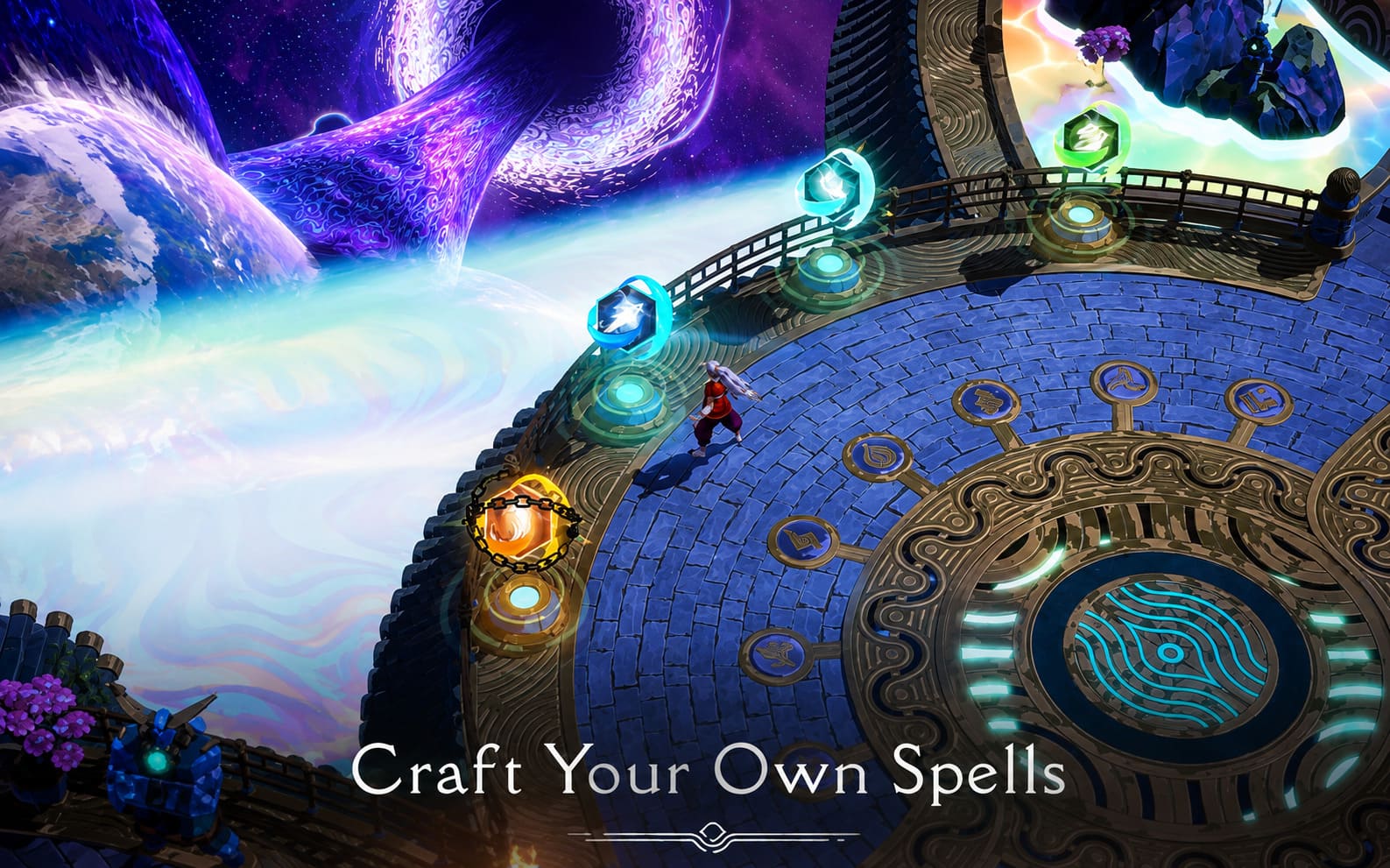
At launch, the game features more than 110 unique Memories, which can be combined into an enormous number of spell configurations. Players can create everything from thunder-based attacks and freezing tornadoes to enormous fire vortices and unusual hybrid effects.
From a gameplay perspective, this is the kind of system that can eat hours of your life.
You start with a spell that works.
Then you discover another modifier.
Then you wonder what happens if you combine it with something else.
Suddenly you’ve spent twenty minutes in the menu trying to turn a normal lightning attack into some completely unreasonable magical death machine.
That’s the fun.
But the lore explanation makes it even better.
Mazarim doesn’t simply find a spellbook and learn “Lightning Explosion.” He collects fragments of memory from the fractured world and processes them through his Watcher abilities.
The memories become magical components.
Their arrangement determines how the spell behaves.
A memory associated with sudden impact might turn a lightning element into a concentrated electrical blast. Another memory representing continuous movement could transform the same basic element into a sweeping beam or orbiting attack.
The result is a rare case where the gameplay mechanic and narrative concept actually reinforce each other.
Mazarim is literally weaponizing the history of Mystralia to prevent Mystralia’s history from disappearing.
That’s a killer premise.
Echo Fragments and Permanent Progression
The roguelite formula becomes even more interesting when you look at what happens after failure.
Mazarim loses temporary resources during his expeditions, but his overall progression doesn’t simply disappear. His experience as a Watcher accumulates through Echo Fragments, a permanent progression currency tied to Watcher Duties and various tactical challenges.
These fragments are taken back to the Altar within the Azimuth Temple.
There, players can invest them into permanent improvements such as:
- Core attribute upgrades.
- New abilities and advanced skills.
- Additional starting spell options.
- Long-term improvements that make future expeditions more effective.
The developers reportedly reworked aspects of this progression between the Steam Next Fest demo and Early Access, making Echo Fragments a more clearly defined part of the permanent progression structure.
From a narrative standpoint, this system works because it explains why Mazarim becomes stronger despite repeatedly entering timelines that can collapse.
The world forgets, but the Watcher learns.
That’s essentially the philosophical heart of the progression system.
A failed run isn’t necessarily wasted time. Even when Mazarim falls, something remains with him.
Why the Darker Direction Actually Works
One of the biggest community discussions surrounding Echoes of Mystralia is the game’s visual and tonal departure from Mages of Mystralia.
The original game leaned much more heavily into colorful high fantasy. Echoes is sharper, darker, and more influenced by modern anime-inspired action design.
Some longtime fans are understandably going to look at the new direction and wonder whether this still feels like Mystralia.
I think the answer depends on whether you view the visual change as a stylistic replacement or as part of the story.
The world is broken.
Time is broken.
Memory is broken.
The people inside these memories are trapped in their worst moments.
So why should Mystralia look exactly like it did before?
The fractured aesthetic actually makes sense when viewed through the lens of the Rift. The visual language reflects a world being distorted by something that is attacking its own history.
That’s much more compelling than changing the art direction simply because the sequel wanted to look “cooler.”
The Roguelite Loop Is Canon
This may ultimately become the most important part of Echoes of Mystralia’s lore.
In a lot of roguelites, death is just death. The player restarts because that’s the genre’s structure, while the narrative quietly pretends the previous attempt never happened.
Echoes of Mystralia takes a different route.
The repeated attempts are part of the story.
Mazarim enters the fractured world.
He fights.
He discovers memories.
He fails.
He returns to the Azimuth Temple.
He becomes stronger.
Then he goes back in.
The cycle repeats because the world itself is trapped in a cycle.
That makes every death potentially meaningful. Mazarim isn’t simply grinding for better stats. He’s gathering knowledge about a catastrophe that cannot be solved in a single attempt.
For a roguelite fan, this is exactly the kind of narrative justification I want to see. Give me a reason why my character can die twenty times and still make sense as a story. Make the repetition part of the mythology instead of something the player has to mentally ignore.
Echoes of Mystralia appears to understand that.
Echoes of Mystralia Best Spell Combinations Guide: Overpowered Builds to Destroy Your Foes
What the Lore Could Mean for the Future
The Early Access structure leaves plenty of room for the game’s mythology to become considerably larger.
The central mysteries surrounding the Rift, the Watchers, the Cycle of Memories, the goddess dragon, the primordial Guardians, and Oblivion are clearly designed to support a broader narrative.
The biggest question is what actually caused the Rift in the first place.
Was it an accident?
Was it created intentionally?
Is the Cycle of Memories itself responsible for some part of the catastrophe?
And perhaps most importantly: what happens if restoring the world’s memory isn’t the same thing as saving the world?
That is the kind of question that could push Echoes of Mystralia’s story beyond a straightforward “defeat the evil cosmic force” plot.
If Borealys Games continues expanding the narrative alongside the Early Access development cycle, the fragmented-history concept gives the developers a lot of room to reveal information gradually. A character introduced as a simple ally could turn out to be part of an ancient memory. A Guardian could have a completely different identity before the Rift corrupted it. Even the Azimuth Temple may have secrets that Mazarim doesn’t initially understand.
Echoes of Mystralia Spellcrafting Guide: How to Craft Your Own Spells
Final Thoughts: Mystralia’s Past Is the Real Enemy
Echoes of Mystralia has one of the more interesting excuses for a roguelite loop I’ve seen in a fantasy setting.
The Rift doesn’t merely threaten Mystralia’s future. It corrupts the kingdom’s relationship with its past. The Shadows of the Past give physical form to forgotten suffering, the Guardians embody the tragedies of individual regions, and Mazarim’s spellcrafting turns recovered memories into weapons.
That combination gives the game a surprisingly coherent thematic identity.
The combat can be fast and chaotic. The spellcrafting can become wonderfully ridiculous. The progression loop encourages another run immediately after a defeat. But underneath all of that is a darker story about memory, trauma, history, and the fear of being forgotten.
The most compelling idea is also the simplest:
Mazarim cannot save Mystralia by simply changing its future. He has to understand its past first.
And if Borealys Games manages to follow through on that premise as Echoes of Mystralia expands through Early Access, the Rift could become much more than the explanation for why players keep restarting runs.
It could become the defining piece of Mystralia’s entire mythology.