Witcher 3 Next-Gen Gem Farming: How to Farm Flawless Rubies and Runestones Fast
If there is one thing The Witcher 3 does exceptionally well, it is making you feel rich right before you discover that your next crafting project needs another pile of expensive materials. You can walk into Novigrad with thousands of Crowns, feel like Geralt finally has his finances under control, and then a single high-level crafting recipe can empty your purse in seconds.
Flawless Rubies, Runestones, and other high-tier crafting materials are particularly annoying because they are not always available when you actually need them. This becomes even more noticeable when you start working toward Mastercrafted or Grandmaster gear, upgrading swords, or experimenting with expensive enchantments. The Next-Gen version does not completely change the old Witcher economy, but some of the most useful farming routines are easy to overlook.
After spending far too much time checking blacksmith inventories and dismantling junk that looked valuable, I would strongly recommend treating gemstone farming as a planned route rather than something you do randomly while exploring. Once you know which merchants to visit, what level you need, and when to refresh inventories, Flawless Ruby farming becomes much less painful.
When Do Flawless Rubies Start Appearing?
There is an important level requirement that can save you a ridiculous amount of wasted travel. Character Level 20 is the key milestone if you are specifically hunting for Flawless Rubies in merchant inventories.

Before reaching that point, you can spend ages visiting blacksmiths and armorers only to find regular Rubies, flawed gems, dust, or completely unrelated crafting materials. That does not necessarily mean the merchant is bugged or that you are using the wrong location. In many cases, Geralt simply isn’t high enough level yet.
| Requirement | What It Means |
|---|---|
| Level 18–19 | Merchant inventories may contain lower-tier gems instead of Flawless Rubies. |
| Level 20+ | Flawless Rubies can reliably appear in high-level merchant inventories. |
| High Crowns | Useful if you want to buy gems instead of relying on dismantling. |
| Master/Grandmaster crafting access | Helpful for getting maximum value from dismantling expensive jewelry. |
So if you are level 19 and keep reloading Hattori’s inventory hoping for the perfect gem, I would stop. Level up first. The extra contracts and quests will probably make you more money than repeatedly wasting time checking the same shop.
The Best Way to Farm Flawless Rubies
There are two approaches I actually consider worthwhile: dismantling valuable jewelry and buying Flawless Rubies from specific merchants. Which one makes more sense depends on whether Geralt has more time than money or more money than patience.

Method 1: Dismantle Gold Ruby Jewelry
This is one of those Witcher 3 systems that becomes much more useful once you stop thinking of junk as junk. Jewelry that looks like something you would normally sell can sometimes be more valuable as a crafting source.
Monster nests are a good place to start. Clear nests around Velen and Skellige, then make sure you actually loot everything. Gold Ruby Rings, Ruby Amulets, and other valuable jewelry can eventually turn into useful crafting components when dismantled.
There is also a second part to this route that is easy to ignore: shells. Coastal areas around Velen and Novigrad are packed with Drowners, and killing them can give you Sea Shells and Black Sea Shells. Take those to a capable blacksmith and dismantle them rather than automatically selling every piece of junk.
The general idea is simple:
- Clear monster nests and loot every container.
- Collect valuable ruby-based jewelry rather than immediately selling it.
- Farm shells from coastal enemies when you need additional dismantling materials.
- Use a high-level blacksmith to break down valuable items.
Hattori in Novigrad is particularly useful for this kind of crafting work. Later in the game, the Grandmaster smith in Beauclair is another excellent option when you are already operating in Toussaint.
Just keep in mind that dismantling results depend on the item. Not every Ruby Ring is going to magically turn into the exact Flawless Ruby you need. Still, if you already have a stash full of jewelry and relic gear, dismantling can be considerably more efficient than buying every component individually.
Method 2: Buy Flawless Rubies From Merchants
If you have been doing contracts, clearing bandit camps, and selling unwanted weapons, there is a good chance you have enough money to skip the slow route. Personally, this is the method I prefer when I am already sitting on a healthy pile of Crowns. Time is worth something too.
Condyle Abandoned Site
One useful farming location is the Abandoned Site north of the Condyle area in Velen, around the region associated with the refugee camp and Clondyke. Clear the enemies and liberate the location. Once the settlement is restored, a merchant becomes available there.
This vendor can sell up to two Flawless Rubies at a time, with a reported price of roughly 1,142 Crowns per Ruby. That sounds expensive until you compare it with the amount of time you can waste searching random inventories.
Est Taylar Merchant
Another location worth adding to your route is the Abandoned Site directly east of Est Taylar in eastern Redania. Clear the location and restore the settlement, then check the merchant who appears there.
The reported price for a Flawless Ruby is around 1,162 Crowns. Prices can make the difference feel insignificant, but the important part is that you now have another reliable vendor to check rather than depending on random loot.
| Farming Option | Main Advantage | Best For |
|---|---|---|
| Monster Nests | Free loot and jewelry | Players who enjoy exploration |
| Dismantling | Converts unwanted gear into materials | Players with large junk inventories |
| Condyle Merchant | Direct Flawless Ruby purchases | Fast farming with spare Crowns |
| Est Taylar Merchant | Another reliable source | Building a repeatable merchant route |
How to Refresh Merchant Inventories
This is where the farming loop becomes much more interesting. Once you have purchased everything useful from a vendor, you do not necessarily need to wait around hoping the inventory changes naturally.
Meditation can refresh merchant inventories. A commonly used approach is to move away from the shop, open the menu, and meditate for approximately five full in-game days. In practical terms, that means roughly 120 hours of game time.
After the time passes, return to the merchant and check the inventory again. The vendor can replenish the gemstone stock, allowing you to repeat the process.
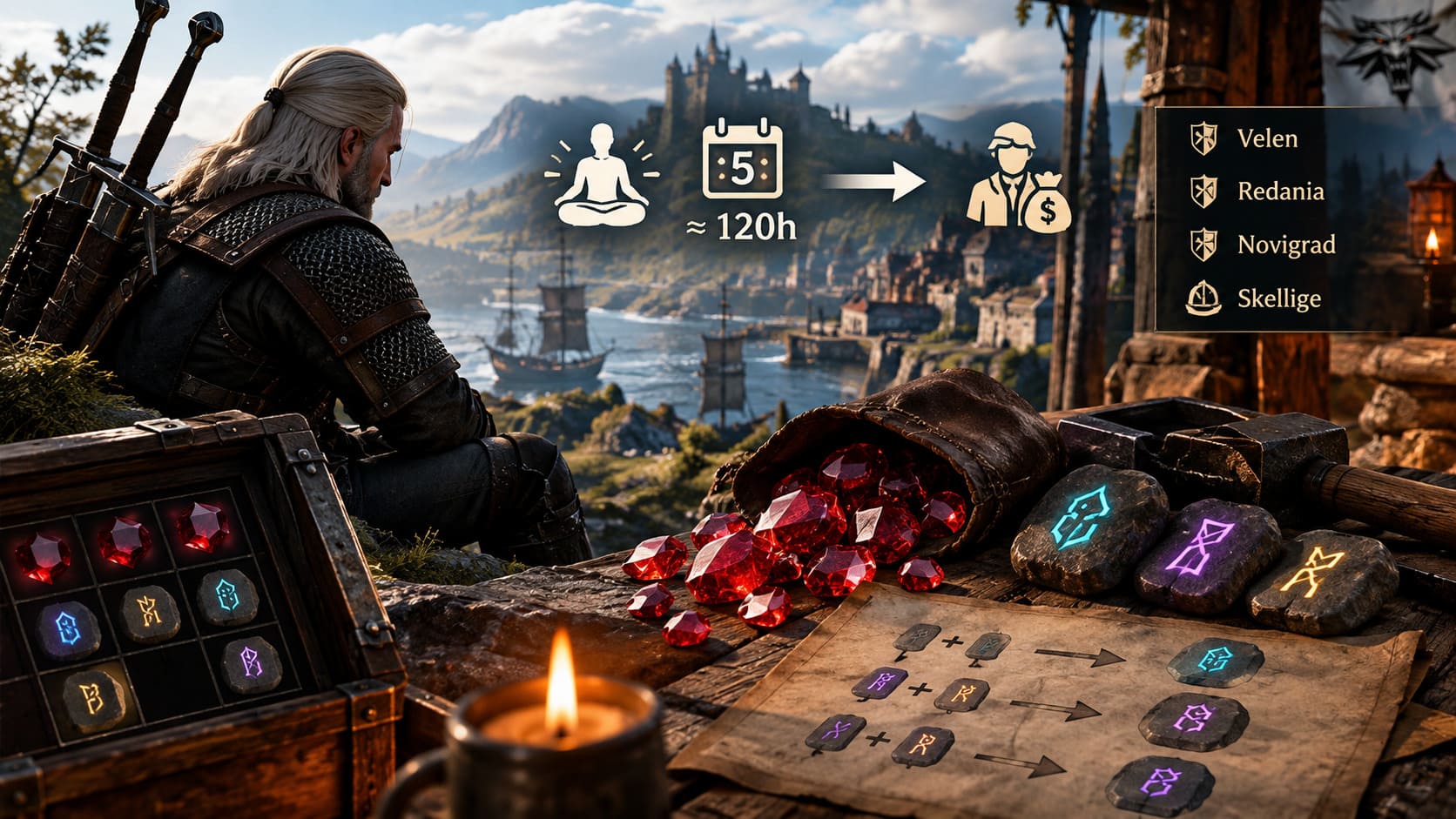
You can build a simple route around vendors such as:
- Condyle-area merchant in Velen.
- Est Taylar merchant in Redania.
- Hattori in Novigrad.
- Kaer Trolde blacksmith in Skellige.
I would not turn this into a completely mindless five-day meditation marathon, though. The Witcher 3 gives you plenty of other ways to make money while you are exploring. If you are short on Crowns, run a few contracts or clear some bandit camps between farming sessions instead of endlessly sitting through the meditation screen.
Farming Runestones Without Burning Through Your Crowns
Flawless Rubies are only half the crafting headache. Runestones and Glyphs can become brutally expensive once you start looking for higher tiers, especially if you want enough of them to properly customize multiple swords and armor sets.
Greater Runestones can cost well over 1,500 Crowns, with some purchases pushing toward the 2,000-Crown range. Buying them one at a time works, but it is hardly an efficient long-term strategy.
The better approach is to think of Runestones as a crafting ladder.
Start With the Diagrams
Before worrying about mass production, make sure you have access to the relevant crafting diagrams. Depending on your progression, check the appropriate alchemy and crafting vendors, including the alchemist located east of Novigrad near the Oxenfurt Gate and Gremist in Skellige after progressing through his questline.
Once you have the required recipes, you can start turning lower-tier materials into higher-tier Runestones rather than constantly purchasing finished products.
The Runestone Upgrade Chain
The basic concept is extremely straightforward: combine lower-tier Runestones to build higher-tier versions.
- Collect or purchase Lesser Runestones such as Lesser Chernobog or Perun stones.
- Use the crafting interface at a suitable blacksmith.
- Combine two matching Lesser Runestones into a standard Runestone.
- Combine two standard Runestones to create the corresponding Greater Runestone.
It is not glamorous farming, but it is much easier to control than relying on random drops. Once you have a reliable source of basic components, you can gradually build the exact effects you want for your weapons.
Watch Out for the Next-Gen Inventory Bug
There is one irritating issue worth remembering when crafting large batches. Some players have encountered a UI/inventory counting problem where found and crafted Runestones are not always represented correctly by the interface.
A practical workaround is to move existing found Runestones into your stash or temporarily drop them before creating a new batch. Then craft the fresh Runestones and check the inventory again.
It is not exactly the sort of polished solution you expect from a game this famous, but The Witcher 3 has always had a few inventory quirks that can make crafting feel stranger than it should.
How to Get the Materials for Endless Crafting
Once you start crafting lots of Runestones, you will eventually run into the next problem: materials. This is where Skellige’s Smuggler’s Caches become extremely useful.
The infamous waters around Skellige are packed with floating loot. Yes, sailing around those islands to collect dozens of caches can feel like a second job, but the rewards add up quickly. Relic weapons, armor, magical materials, and other valuable items can be dismantled instead of sold.
Take unwanted equipment to an armorer and inspect what dismantling provides. Depending on the item, you can obtain materials such as Infused Dust and other rare crafting components. Instead of looking at every relic sword as another few hundred Crowns, start looking at it as raw material for your next crafting project.
The Witcher 3 Remastered Best Builds Guide: Geralt Setups For 2026
My Recommended Witcher 3 Gem Farming Route
If I were starting a fresh playthrough specifically with Mastercrafted and Grandmaster gear in mind, I would not spend hours farming Flawless Rubies immediately. I would build the economy first and then switch to targeted farming once Geralt reaches the appropriate level.
My preferred routine would look something like this:
- Reach Level 20. This removes a major obstacle for Flawless Ruby availability.
- Clear Abandoned Sites. Unlock the Condyle and Est Taylar merchants.
- Build up a Crowns reserve. Witcher contracts, treasure hunts, and unwanted gear are all useful here.
- Check the gemstone vendors. Buy Flawless Rubies whenever they are available.
- Meditate for several days. Return and check the merchants again.
- Dismantle valuable jewelry. Do not automatically sell every Ruby Ring you find.
- Use Skellige caches for crafting materials. Dismantle unwanted high-tier equipment to support your crafting economy.
- Craft Runestones from lower tiers. This is generally more sensible than repeatedly paying full price for Greater versions.
How to Fix The Witcher 3 Remastered Lighting Flickering: Next-Gen Shadow & DX12 Fixes
Final Thoughts
The biggest mistake with Witcher 3 crafting is treating every rare component as something you have to find randomly. You don’t. Once you understand the relationship between merchant inventories, character level, dismantling, meditation, and crafting tiers, the whole system becomes much more manageable.
For Flawless Rubies, I would prioritize the merchant route once Geralt reaches Level 20, especially if you already have plenty of Crowns. Dismantling is the better alternative when your inventory is overflowing with jewelry and relic loot. There is no reason to sell everything just because the game labels it as junk.
For Runestones, the crafting ladder is the real long-term solution. Stock up on lower-tier stones, gather materials from exploration and Smuggler’s Caches, and build Greater Runestones yourself. It takes a little preparation, but it saves a surprising amount of money once you start upgrading several pieces of high-end gear.
And honestly, that is the part I like about this system. The Witcher 3 rewards players who actually pay attention to what they are picking up. A ring, shell, relic sword, or random stash of Lesser Runestones might look worthless in isolation, but once you are preparing a full endgame build, all of that junk suddenly has a purpose.
Farm smart, dismantle aggressively, and save your Crowns for the truly expensive Grandmaster projects. Geralt has monsters to kill and contracts to finish. Spending half the game standing in front of a blacksmith because you bought every crafting component at full price is not how I want to spend my time in 2026.