The Witcher 3 Remastered Best Builds Guide: Geralt Setups For 2026
After all these years, The Witcher 3: Wild Hunt still has one of the most satisfying character-building systems in any open-world RPG. The funny thing is that you can finish the game with a fairly simple sword-and-Quen setup and never worry too much about optimization. But once you start playing Death March, New Game Plus, or pushing the Blood and Wine endgame, the difference between a random collection of skills and a properly designed build becomes massive.
The Next-Gen update made that gap even more interesting. Quick Sign Casting changed the rhythm of combat, new armor bonuses encouraged more specialized builds, and mutations gave late-game Geralt another layer of customization. Suddenly, building around one school or one weapon type wasn’t just a role-playing choice. It could completely change how a fight played out.
I’ve always preferred builds that have an actual gameplay loop instead of simply stacking every damage bonus available. A good Witcher 3 build should make you feel like you’re playing differently, not just watching bigger numbers appear above an enemy’s head.
With that in mind, these are four The Witcher 3 Remastered best builds for 2026 that cover very different playstyles: a Sign-heavy Griffin setup, a brutally fast Feline damage build, a defensive Ursine tank, and a hybrid Forgotten Wolven configuration.
The Best Witcher 3 Builds at a Glance

| Build | School | Playstyle | Best For |
|---|---|---|---|
| Sign Master | Griffin | Signs, crowd control, Yrden | Death March and groups |
| Crimson Whirl | Feline | Fast attacks, crits, alchemy | Maximum DPS |
| Immortal Juggernaut | Ursine | Heavy attacks, Quen, defense | Survival and bosses |
| Forgotten Wolven Hybrid | Wolven | Yrden, Aard, swordplay | Flexible combat |
What Actually Matters in the Next-Gen Witcher 3 Meta?
Before throwing skills into every available slot, it’s important to understand why these builds work. The Next-Gen version isn’t simply the old game with prettier lighting. Several systems interact differently once you start combining armor bonuses, mutations, Signs, adrenaline, and alchemy.
Quick Sign Casting is probably the biggest quality-of-life improvement for Sign-focused Geralt. Switching between Yrden, Aard, Igni, and Quen without constantly stopping to open the radial menu makes Signs feel like part of the actual combat system rather than separate abilities.
Alchemy is another major piece of the puzzle. Toxicity management matters much more when your build depends on decoctions and potions. Instead of drinking everything you own before every fight, it’s generally better to decide which effects actually support your build and leave enough room for emergency potions.
Then there are Grandmaster armor bonuses. Once you reach the late game, these bonuses can define the entire build. A strong armor set isn’t just about resistances. Its bonuses can dictate which Signs, attacks, or defensive mechanics you should build around.
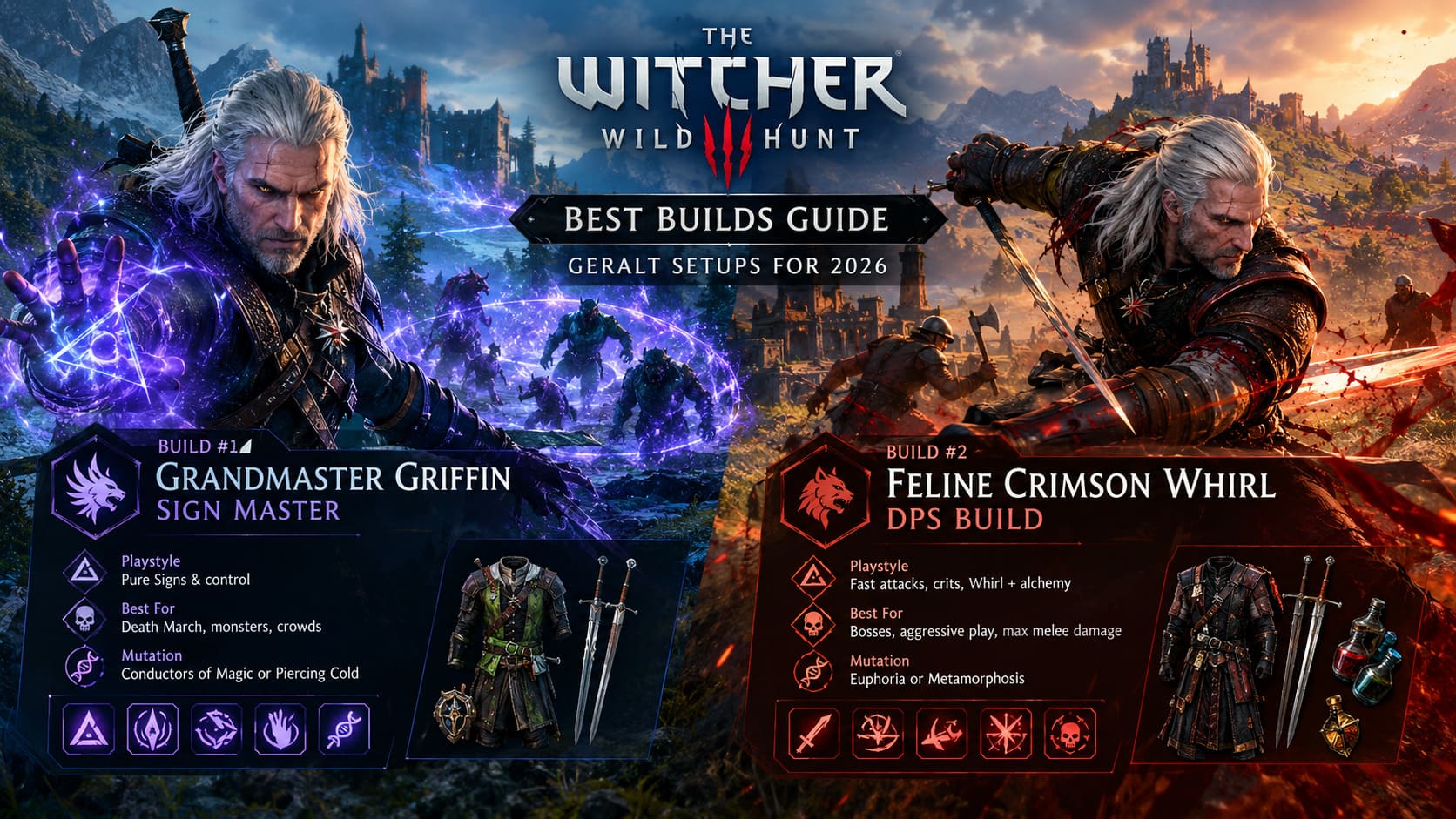
Build #1: Grandmaster Griffin Sign Master
Playstyle: Pure Signs and battlefield control
Best For: Death March, monster groups, crowd control
Primary Mutation: Conductors of Magic or Piercing Cold
If you want Geralt to feel less like a traditional swordsman and more like a walking magical artillery piece, the Grandmaster Griffin build is the one I’d start with.
Yrden is the heart of the setup. Once enemies are trapped inside your Sign zone, the entire fight becomes easier to control. Geralt gets better stamina regeneration and increased Sign effectiveness while the enemies themselves become much easier targets.
The beauty of this build is that it doesn’t require perfect swordplay. You create a dangerous area, manipulate the battlefield, and then destroy anything unfortunate enough to remain inside it.
Core Skills
- Razor Focus for stronger adrenaline generation.
- Resolve to reduce adrenaline loss.
- Sustained Glyphs for longer Yrden duration.
- Magic Trap for additional Yrden utility and projectile control.
- Melt Armor and Firestream for Igni-focused damage.
- Aard Sweep for large-area crowd control.
- Exploding Shield for additional Quen utility.
- Synergy to strengthen your mutagen bonuses.
The obvious centerpiece is the 6-piece Grandmaster Griffin Set. The set is designed around Sign usage, and its bonuses become particularly nasty when you consistently fight inside your Yrden zones.
For enchantments, Entanglement is particularly interesting because it can create additional Yrden traps when your Magic Trap interacts with enemies. Suddenly one Sign placement can control a much larger section of the battlefield.
My favorite part of this setup is how naturally it flows. Drop Yrden, move enemies into the zone, throw out Aard or Igni, and use Quen whenever something gets through. It doesn’t have the raw spectacle of Whirl, but on Death March it can make chaotic encounters feel surprisingly controlled.
Build #2: Feline Crimson Whirl DPS Build
Playstyle: Fast attacks, critical hits, Whirl and alchemy
Best For: Bosses, aggressive players, maximum melee damage
Primary Mutation: Euphoria or Metamorphosis
This is the build for players who don’t want Geralt standing ten meters away casting Signs. You want to get in, start cutting, and watch an enemy’s health bar disappear.
The Grandmaster Feline setup remains one of the most entertaining ways to play melee-focused Geralt. Light armor keeps you mobile, fast attacks generate damage quickly, and Whirl turns groups of enemies into a blender if you manage your stamina and positioning correctly.
Core Skills
- Muscle Memory for fast attack damage.
- Precise Blows for critical hit chance and damage.
- Whirl as the main sustained attack.
- Razor Focus for faster adrenaline generation.
- Sunder Armor to reduce enemy resistance.
- Acquired Tolerance for additional toxicity capacity.
- Synergy to improve mutagen bonuses.
- Killing Spree for stronger critical-hit potential during multi-enemy fights.
Severance is one of the most useful enchantments here. Extending the range of Whirl changes the ability dramatically. You can hit enemies from farther away while maintaining the aggressive playstyle that makes the Feline build so much fun.
For weapons, Aerondight is the obvious late-game silver sword choice, while the Toussaint Knight’s Steel Sword is an excellent partner for a high-damage melee setup.
Alchemy is where this build gets ridiculous. Water Hag, Ekimmara, and Ekhidna decoctions can complement different parts of the combat loop. Water Hag rewards maintaining full health, Ekimmara provides sustain through damage, and Ekhidna can reward stamina expenditure.
Personally, this is the build I’d choose when I want combat to feel fast rather than methodical. You have to dodge, reposition, and pay attention, but when everything clicks, Geralt looks like an absolute machine.
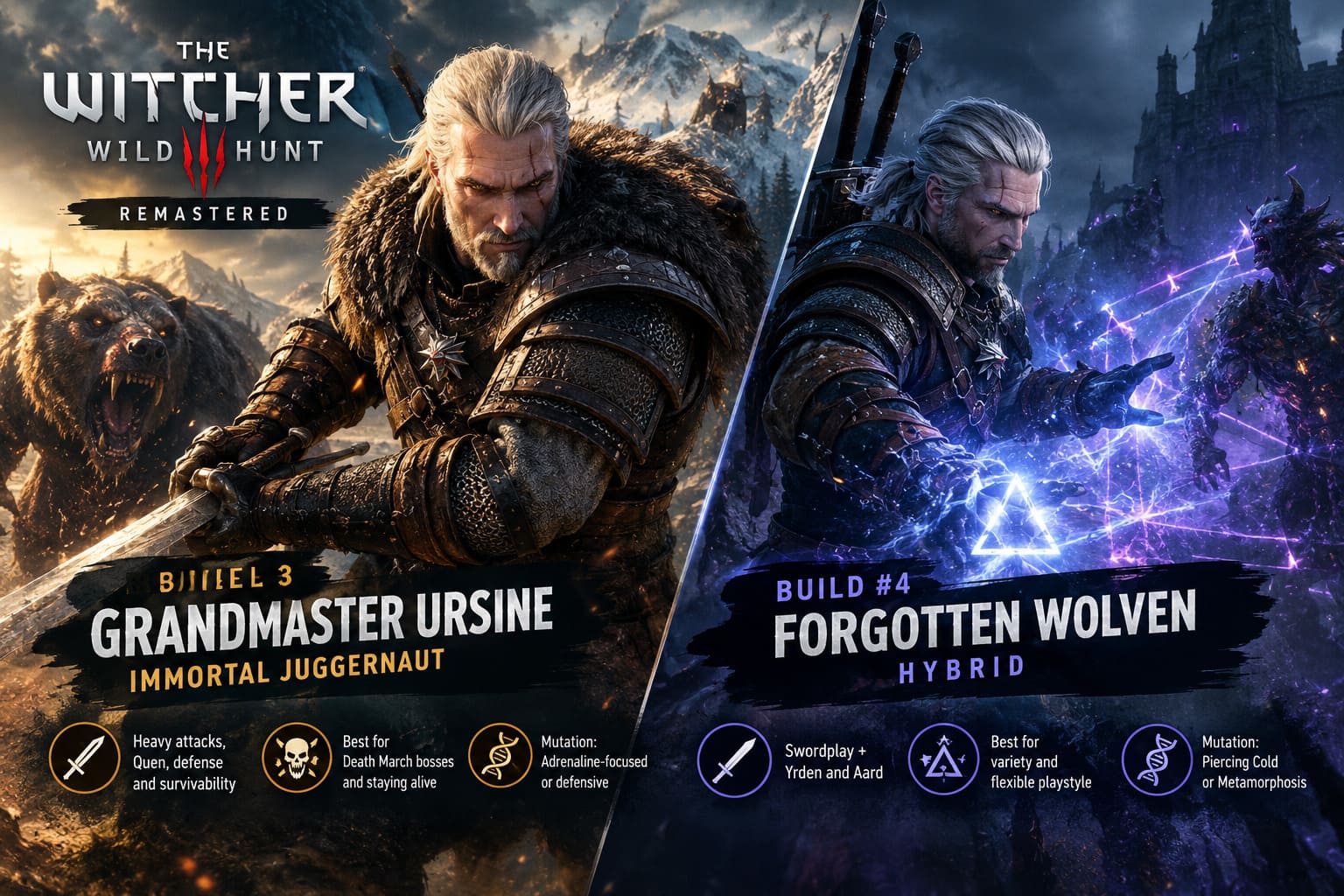
Build #3: Grandmaster Ursine Immortal Juggernaut
Playstyle: Heavy attacks, Quen, defense and survivability
Best For: Death March bosses and players who hate dying
Primary Mutation: Adrenaline-focused or defensive mutation setups
Not every Witcher 3 player wants to play like a glass cannon. Sometimes you just want Geralt to walk directly toward a monster, get hit, shrug it off, and answer with a gigantic sword strike.
That’s where the Grandmaster Ursine build comes in.
The Bear School is built around heavy armor and survivability. Instead of relying on constant dodging and lightning-fast attacks, you can absorb punishment while setting up devastating heavy attacks.
Core Skills
- Strength Training for stronger heavy attacks.
- Crushing Blows for heavy-attack critical potential.
- Rend for huge charged strikes.
- Resolve for better adrenaline retention.
- Undying as an emergency survival tool.
- Quen Intensity for stronger shields.
- Quen Discharge for additional defensive damage.
- Active Shield when you want healing through Quen.
- Protective Coating for additional defense against oiled enemy types.
The 6-piece Grandmaster Ursine Set is the natural foundation. It turns Quen into an even more important part of the build and rewards a slower, deliberate combat rhythm.
I’d also recommend learning to dodge instead of constantly rolling. Heavy armor already encourages a more controlled approach, and staying close to an enemy can make it much easier to punish openings with Rend.
Deflection is particularly useful if ranged enemies are annoying you. Meanwhile, Severance can give Rend additional reach, which is exactly the kind of quality-of-life improvement a heavy-attack build appreciates.
This isn’t the most exciting build on paper, but it is extremely satisfying in practice. There is something wonderfully Witcher-like about preparing the correct oil, casting Quen, walking toward a monster and then smashing it with one carefully charged attack.
Build #4: Forgotten Wolven Hybrid
Playstyle: Swordplay combined with Yrden and Aard
Best For: Players who want variety
Primary Mutation: Piercing Cold or Metamorphosis
The Forgotten Wolven build is probably my favorite option for anyone who doesn’t want to specialize too hard. It gives you a reason to use Signs while still keeping swordplay at the center of combat.
The idea is simple: use Yrden to control the battlefield, then capitalize on enemies trapped inside the Sign with Aard and your weapons.
It’s a rhythm-based build. You’re constantly moving between setting up the fight and cashing in on the setup.
Recommended Skills
- Muscle Memory and Precise Blows for fast attacks.
- Whirl for sustained melee damage.
- Razor Focus for adrenaline generation.
- Sustained Glyphs to maintain Yrden zones.
- Magic Trap for additional battlefield control.
- Aard Sweep for area damage and crowd control.
- Shock Wave for additional Aard damage.
- Acquired Tolerance and Synergy for the alchemy side.
The six-piece Forgotten Wolven setup is built around combining Yrden with Aard. Once enemies are trapped and slowed, your Aard casts become considerably more threatening.
This is also the build I’d recommend to players who get bored with pure specialization. You aren’t forced to spam one ability for the entire game. You can open with Yrden, hit Aard, switch to fast attacks, activate Quen, and return to Signs whenever the situation changes.
That’s a big part of why The Witcher 3’s combat remains enjoyable. The strongest setup isn’t necessarily the one with the biggest spreadsheet number. It’s the one that gives you enough tools to react to what the game throws at you.
Mutations and Alchemy: The Part You Shouldn’t Ignore
Once you enter the Blood and Wine endgame, mutations can completely change what your build is capable of. Don’t treat the mutation system as something you unlock and forget about.
Euphoria remains attractive for combat-alchemy hybrids, while Conductors of Magic fits Sign-heavy setups. Piercing Cold can also create a very different approach to Aard-focused combat.
The important thing is matching your mutation to your actual playstyle. There is little point in choosing an alchemy-focused mutation if your build barely uses potions or decoctions.
The same principle applies to mutagens. Matching skill colors around the appropriate mutagen can provide a substantial boost, so don’t leave random skills sitting around a Greater Mutagen simply because you like the individual abilities.
Don’t Forget Aerondight
If you’re building an endgame Geralt in Blood and Wine, Aerondight deserves special attention.
Its unique scaling mechanic means it can continue growing with your character instead of becoming another weapon that gets replaced after a few levels. That makes it one of those rare pieces of gear that remains relevant long after you first obtain it.
Even if you’re primarily playing a Sign build, having a properly developed silver sword gives you a reliable answer when a monster isn’t particularly vulnerable to your preferred magical approach.
How to Fix The Witcher 3 Remastered Lighting Flickering: Next-Gen Shadow & DX12 Fixes
Which Witcher 3 Build Should You Actually Use?
| If You Like… | Use This Build |
|---|---|
| Signs, Yrden and crowd control | Griffin Sign Master |
| Fast attacks and enormous DPS | Feline Crimson Whirl |
| Heavy armor and survivability | Ursine Juggernaut |
| A mixture of Signs and swordplay | Forgotten Wolven Hybrid |
For pure melee aggression, I’d lean toward Feline. If you want the safest experience on Death March, Ursine is much more forgiving. Griffin is fantastic when you want Signs to become the centerpiece of combat, while Forgotten Wolven sits in the middle and gives you the most room to improvise.
The Witcher 3 Next-Gen Remastered: Best NVIDIA Control Panel & RTX Graphics Settings (2026 Guide)
Final Thoughts on the Best Witcher 3 Remastered Builds
The best thing about The Witcher 3 Remastered is that there isn’t just one way to build Geralt. You can turn him into a Sign-slinging battlefield controller, a hyper-aggressive Feline swordsman, a walking Ursine fortress, or a hybrid fighter who constantly switches between magic and steel.
And honestly, that’s why I wouldn’t recommend chasing a so-called perfect build too early. The most powerful setup on paper isn’t necessarily the one you’ll enjoy playing for 50 hours.
Start with the combat style you naturally enjoy. If you love dodging and attacking constantly, build around Feline. If you prefer preparation and controlled fights, Ursine gives you plenty of room for that. If Signs are the reason you enjoy being a Witcher in the first place, Griffin is an obvious choice. And if you want a little bit of everything, Forgotten Wolven makes a strong middle ground.
Once your core skills, armor bonuses, mutations, mutagens, and alchemy all support the same idea, that’s when Geralt really starts to feel overpowered. Not because you’ve simply stacked the biggest numbers possible, but because every part of the build is working toward the same combat loop.
That’s still the magic of The Witcher 3 in 2026. After hundreds of hours across different playthroughs, I still find myself changing builds just to make another run through the Continent feel different. And when a build finally clicks on Death March, there are few RPG combat systems that feel quite as satisfying.