Echoes of Mystralia Best Spell Combinations Guide: Overpowered Builds to Destroy Your Foes
If there is one thing that immediately stood out to me in Echoes of Mystralia, it is how much freedom the spellcrafting system gives you. This is not one of those roguelites where you simply pick “+20% damage” and move on. Here, you can actually sit down, connect memories, change how a spell behaves, and suddenly realize that the ridiculous thing you just created is somehow extremely effective.
That is exactly why I wanted to put together this Echoes of Mystralia best spell combinations guide.
The game is built around the idea that memory is power, with Mazarim using crafted magic to fight through a world threatened by the Rift. The flexibility of the spellcrafting system is easily the most interesting part of the combat system. Since Echoes of Mystralia is launching into Early Access on August 11, 2026, I also expect the strongest combinations to evolve as players discover more interactions and the game receives balance changes. So rather than pretending there is one permanently unbeatable build, I am focusing on combinations that make sense mechanically and, more importantly, feel ridiculously good to use.
How Spellcrafting Works in Echoes of Mystralia
Before copying any of the builds below, it helps to understand the basic structure of spell creation.
Your spell is essentially built by combining different types of memories and modifiers. The important thing is not simply picking the strongest individual component. The real power comes from how those components interact.
You can think about your spell in three broad layers:
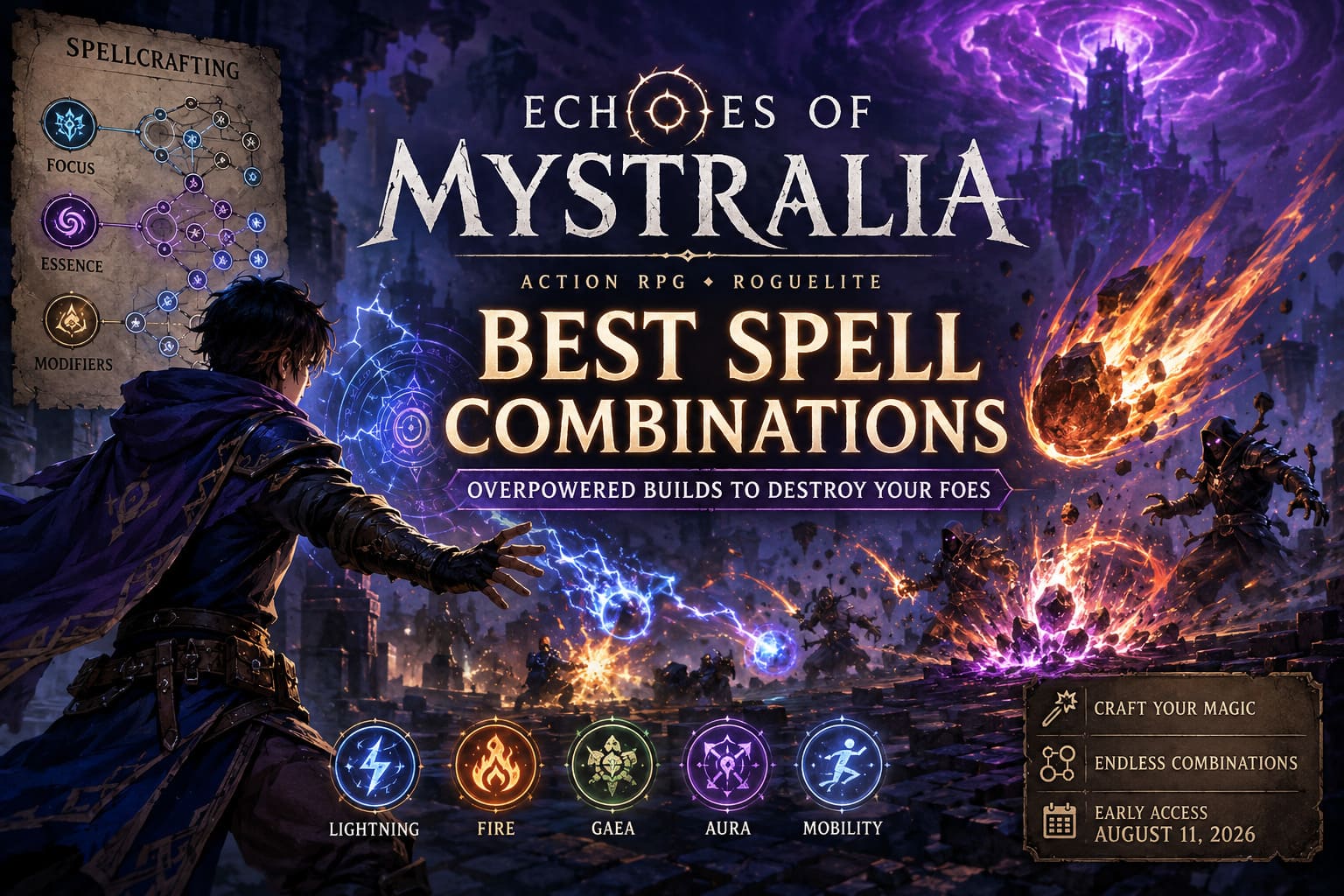
| Component | What It Does | My Advice |
|---|---|---|
| Focus | Defines the basic behavior of the spell | Start here |
| Essence | Gives the spell its elemental identity | Match it to your goal |
| Modifiers | Changes movement, size, quantity, timing, or triggers | This is where builds become crazy |
And honestly, this is where Echoes of Mystralia becomes addictive. You start with something simple, add one modifier, test it, add another, and suddenly you are staring at your spell diagram wondering whether you have accidentally invented a weapon of mass destruction.
1. Lightning Storm — My Favorite Room-Clearing Build
Focus: Actus
Essence: Aura
Core Modifiers: Move, Duplicate, Size, Homing, Random, Time, At Once
If you just want something that makes enemies disappear, this is the first combination I would experiment with.

The basic idea is simple: start with an Actus projectile spell and give it the Aura lightning essence. From there, you want to increase the number and effectiveness of projectiles rather than relying on one massive hit.
Duplicate is especially important because it lets the spell produce more threats. Size makes those projectiles considerably harder to ignore, while Homing gives the spell much better consistency against moving enemies.
The part I particularly like is adding Time and At Once to the chain.
Instead of carefully aiming every projectile, you are essentially turning your spell into a burst of magical tracking missiles.
And that is exactly what you want in a roguelite.
There is something extremely satisfying about entering a room, pressing one button, and watching your lightning spread across the screen while you concentrate on movement.
Why I like it:
- Excellent against groups.
- Homing reduces the need for precise aiming.
- Duplicate dramatically increases battlefield coverage.
- Works particularly well when enemies are constantly moving.
- Great choice when you want offense without standing still.
The only catch is that stacking modifiers can make your spell more expensive, so don’t blindly add everything available.
2. Fire Nuke — The “I Don’t Want to Deal With This Room” Spell
Focus: Immedi
Essence: Igni
Core Modifiers: Teleport, Size, Overcharge, Time, Explosion
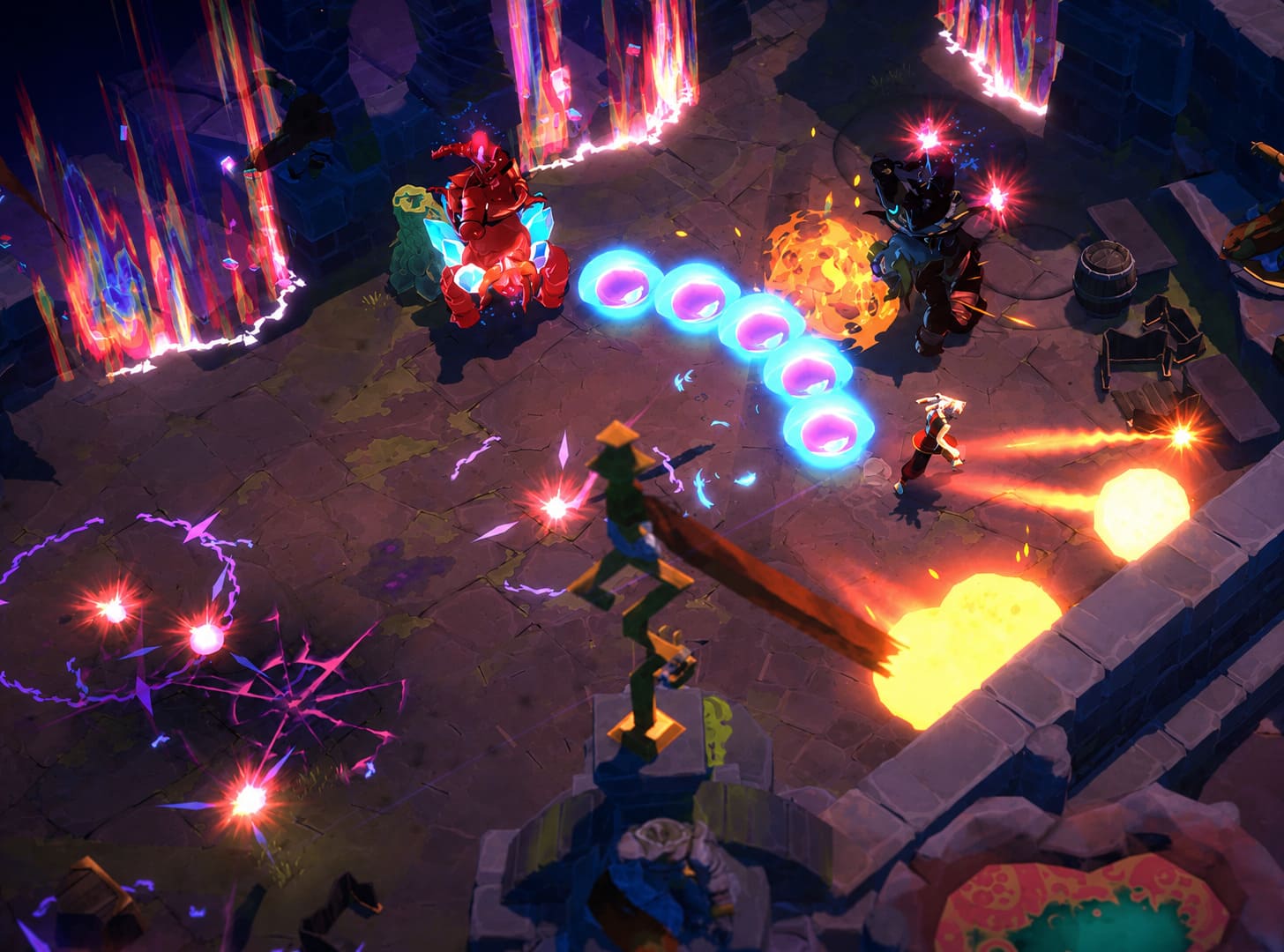
This one is much more straightforward, but I think that is actually its biggest strength.
Immedi gives you the foundation for a close-range spell. Normally, that means you have to be fairly close to whatever you want to hit. Teleport changes the entire equation.
Suddenly, your explosive attack can be delivered where you actually need it.
Add Igni, increase the Size, and build around Explosion and Overcharge, and you have the magical equivalent of throwing a grenade into a crowd.
This is the build I would recommend to players who don’t want a complicated spell tree but still want enormous burst damage.
It is especially useful when a group of enemies is surrounding you or when you need to remove a dangerous elite quickly.
The important thing is timing. Don’t waste your biggest explosion on three weak enemies if you know a tougher encounter is coming.
My preferred approach is to save it for moments when several enemies overlap.
That is when the large area of effect really starts paying for the additional complexity.
3. Automated Fire Rain — The Lazy Build That Somehow Works
Focus: Creo + Immedi Chain
Essences: Igni + Aura
Core Modifiers: Rain, Proximity, Size, Move, Impact
Okay, this is probably the build that best represents why I enjoy games with ridiculous customization systems.
The goal here isn’t simply to make a stronger fire spell.
The goal is to create a spell that keeps doing the work after you have already cast it.
Start with Creo and combine it with Igni. Add Rain and Size to create a large area where fire attacks continue to fall.
Then comes the fun part.
Use Proximity to connect this primary spell to a secondary Immedi-based attack. Give that second spell Aura and configure it around an explosive or high-impact effect.
Now enemies entering your fire zone can trigger additional attacks.
You cast the field, start moving, and let the spell chain do its thing.
For me, this is one of the most attractive styles for difficult roguelite encounters because positioning becomes more important than raw button mashing.
You can establish your kill zone and then focus on surviving.
And survival matters. A theoretically stronger spell doesn’t mean much if you have to stand in front of every enemy to use it.
4. Rolling Fire Wave — Excellent for Corridors
Focus: Actus → Actus
Essence: Igni
Core Modifiers: Move, Duplicate, Size, Periodic, Directional Modifiers
This is a completely different type of fire build.
Instead of creating a single giant explosion, you create a moving wall of fire.
Start with an Actus fire projectile and use Move, Duplicate, and Size to increase the amount of space your spell controls.
Then connect a Periodic trigger to another version of the spell.
From there, directional modifiers can be used to create movement patterns that send the projectiles in different directions.
The result is a rolling wave that travels across the battlefield.
I especially like this concept in tight spaces. Corridors naturally limit enemy movement, which means your projectiles have fewer opportunities to miss.
This is one of those builds that might not look spectacular in a spreadsheet, but once you see a whole wave of enemies walking directly into a moving wall of fire, you understand why it works.
5. Lightning Dash — Don’t Forget Mobility
Focus: Ego
Essence: Aura or None
Core Modifiers: Move, Time, Duplicate
One mistake I think players can easily make in a game like this is becoming obsessed with damage.
Don’t.
A powerful movement spell can be just as valuable as another attack.
Ego provides the foundation for defensive and movement-oriented magic, and adding Move can turn that defensive concept into something much more mobile.
Throw Time into the mix and you can push the movement effect further.
I would personally keep this spell relatively simple rather than turning it into a giant modifier tree.
Why?
Because mobility is something you want available consistently.
You don’t necessarily need an elaborate dash that does twelve different things. Sometimes you just need to get out of the way of a boss attack immediately.
And in a roguelite, surviving another ten seconds can be worth more than dealing another 10,000 damage.
6. Avalanche Shield — Defense That Hits Back
Focus: Ego → Actus
Essence: Gaea
Core Modifiers: At Once, Periodic, Duplicate, Size, Move, Random
If you want a defensive build that doesn’t feel passive, this is the one I’d try.
The main Ego spell acts as the defensive component. From there, use triggers to activate a secondary Actus spell.
That second spell uses Gaea and a collection of modifiers designed to send multiple heavy projectiles outward.
The result is basically a defensive button that also creates an offensive response.
That makes it particularly interesting against melee-heavy groups.
Instead of thinking about your shield as something that merely absorbs attacks, you are turning it into a space-control tool.
And that’s a much more useful way to approach defensive spells in Echoes of Mystralia.
Echoes of Mystralia Spellcrafting Guide: How to Craft Your Own Spells
Which Spell Combination Should You Use?
If you’re still deciding where to start, this is how I would rank these builds based on general usefulness rather than theoretical maximum damage.
| Build | Damage | Safety | Crowd Control | Difficulty |
|---|---|---|---|---|
| Lightning Storm | ★★★★★ | ★★★★☆ | ★★★★★ | Medium |
| Fire Nuke | ★★★★★ | ★★★☆☆ | ★★★★☆ | Easy |
| Automated Fire Rain | ★★★★☆ | ★★★★★ | ★★★★★ | Hard |
| Rolling Fire Wave | ★★★★☆ | ★★★★☆ | ★★★★★ | Medium |
| Lightning Dash | ★★☆☆☆ | ★★★★★ | ★★☆☆☆ | Easy |
| Avalanche Shield | ★★★★☆ | ★★★★★ | ★★★★☆ | Hard |
For a first serious run, I’d personally start with Lightning Storm or Fire Nuke. They are easier to understand and don’t require you to manage an enormous chain of interactions.
Once you become comfortable with the spellcrafting system, that’s when I would start experimenting with automated triggers.
Echoes of Mystralia 2-Player Co-Op Guide: How to Setup, Play, and Master Spellcrafting Together
Don’t Make Every Spell Overcomplicated
This is probably my biggest piece of advice.
It is incredibly tempting to keep adding modifiers because the game lets you.
Don’t.
Every additional effect should have a purpose.
If your spell already clears normal enemies reliably, adding another three modifiers just because they are available might make it more expensive without giving you a meaningful advantage.
I prefer having a few spells with clearly defined jobs:
- Primary damage spell for clearing normal enemies.
- Burst spell for elites and bosses.
- Movement or defensive spell for surviving dangerous situations.
- Optional utility or automated spell for controlling space.
That gives you a much more flexible loadout than having four different versions of the same attack.
Watch Your Mana and Trigger Costs
The most impressive spell on paper is useless if you cannot comfortably use it during a real run.
This becomes particularly important when stacking Duplicate, Size, Time, and other behavior-changing modifiers.
Before committing to a complicated build, test how it actually feels.
Ask yourself:
- Can I cast it often enough?
- Does it clear enemies quickly?
- Does it leave me vulnerable?
- Does the trigger activate when I expect?
- Is the extra damage worth the additional resource cost?
I would rather use a slightly weaker spell that I can cast constantly than a ridiculous “ultimate” that empties my resources after two uses.
Experimentation Is Still the Best Meta
One reason I’m excited about Echoes of Mystralia is that the game is built around experimentation rather than simply following a fixed character build.
The spellcrafting system is designed around combining and reorganizing memories to create different magical effects, and that really is the heart of the experience.
The community is obviously going to find stronger combinations over time, especially now that the game is entering Early Access. The current build has already generated considerable interest among players, which suggests there is plenty of room for the community to test the system and discover unexpected interactions.
So don’t treat any “best build” list as a permanent law.
Treat it as a starting point.
Take Lightning Storm and replace one modifier.
Change the fire explosion into a triggered spell.
Turn your defensive ability into a source of projectiles.
That is where the real fun begins.
Final Thoughts
The best Echoes of Mystralia spell combinations aren’t necessarily the ones with the biggest damage number. For me, the best builds are the ones that make combat feel completely different.
Lightning Storm turns Mazarim into a walking artillery platform. Fire Nuke gives you a panic button capable of deleting groups. Automated Fire Rain lets you control an entire section of the battlefield while concentrating on movement. Meanwhile, Lightning Dash and Avalanche Shield remind you that surviving a run is just as important as killing everything on screen.
And honestly, that is what makes the spellcrafting system so appealing.
You aren’t simply choosing a class and following somebody else’s build.
You are building the weapon yourself.
With Echoes of Mystralia now arriving in Early Access, I expect the community’s understanding of these interactions to grow rapidly. For now, these combinations are a great foundation, but I’d strongly recommend taking them apart and rebuilding them around your own playstyle.
Because the most satisfying moment in a spellcrafting game isn’t copying a powerful build.
It’s accidentally creating something completely absurd yourself — and realizing it actually works.