Witcher 3 Next-Gen Alchemy Build: Best Perks for Infinite Toxicity
There are plenty of ways to build Geralt in The Witcher 3: Wild Hunt, but some of them feel much more satisfying than others. You can stack raw sword damage, build around Signs, turn Igni into a flamethrower, or create a defensive setup that makes Death March considerably less painful.
Then there is Alchemy.
A properly built Alchemy Geralt doesn’t simply drink a potion before a fight and wait for the effect to disappear. He turns toxicity into a resource, manipulates potion uptime, combines it with mutations, and basically walks around Toussaint looking like the game forgot to put a limit on him.
That’s why the Infinite Toxicity build is still one of my favorite endgame concepts in The Witcher 3 Next-Gen. It takes some preparation, requires Blood and Wine, and isn’t something I’d recommend for a fresh character. But once everything comes together, the gameplay loop is ridiculous.
The idea is simple: keep your toxicity high enough to maintain long-lasting potion effects while using Alchemy perks, mutations, and Manticore gear to turn that toxicity into damage, survivability, and utility.
And yes, on Death March, it can make Geralt feel completely unfair.

Why an Alchemy Build Works So Well in The Witcher 3 Next-Gen
Alchemy builds have always been powerful, but the Next-Gen version makes the whole system much more interesting.
The important thing is that toxicity isn’t just a punishment for drinking too many potions. With the right skills, it becomes another stat you can actively build around.
There are essentially two things you need to think about:
| Mechanic | What It Does | Why It Matters |
|---|---|---|
| Potion Toxicity | Comes from regular potions | Keeps your combat buffs running |
| Decoction Toxicity | Comes from decoctions | Provides long-duration passive effects |
| Maximum Toxicity | Determines your safe capacity | Gives you more room to stack effects |
| Alchemy Perks | Modify toxicity and potion mechanics | Makes the entire build possible |
| Mutations | Add powerful Blood and Wine effects | Pushes the build into endgame territory |
The trick is not simply having the highest possible toxicity.
You need to control it.
That’s where the build starts getting interesting.
Delayed Recovery Is the Heart of the Build
If I had to pick one skill that defines this entire setup, it’s Delayed Recovery.
This is the perk that changes how you think about potion duration. Instead of constantly watching your potion timers and drinking another bottle every few seconds, you can maintain the required toxicity level and prevent certain potion effects from expiring.
That’s a huge difference.
Normally, a potion such as Superior Blizzard is something you use for a particular phase of a fight. You drink it, enjoy the effect, and eventually it runs out.
With the right Alchemy setup, however, the timer can effectively stop while your toxicity remains above the required threshold.
This is where the build starts feeling borderline broken.
Imagine entering a difficult encounter with Superior Tawny Owl, Superior Maribor Forest, Superior Blizzard, and another combat potion already active. Instead of treating those buffs as temporary bonuses, you’re building your entire combat strategy around keeping them alive.
And Blizzard is particularly fun.
When its conditions are met, it can dramatically alter the pace of combat. If you’ve already built up adrenaline, Geralt can chain attacks and combat abilities with far less concern about stamina management.
For a Whirl-focused build, that’s exactly the kind of interaction you want.
The Alchemy Skills I Would Prioritize
You don’t need every Alchemy skill in the tree to make this work. In fact, spreading points everywhere is one of the easiest ways to make an otherwise strong build feel mediocre.
These are the perks I’d concentrate on first.
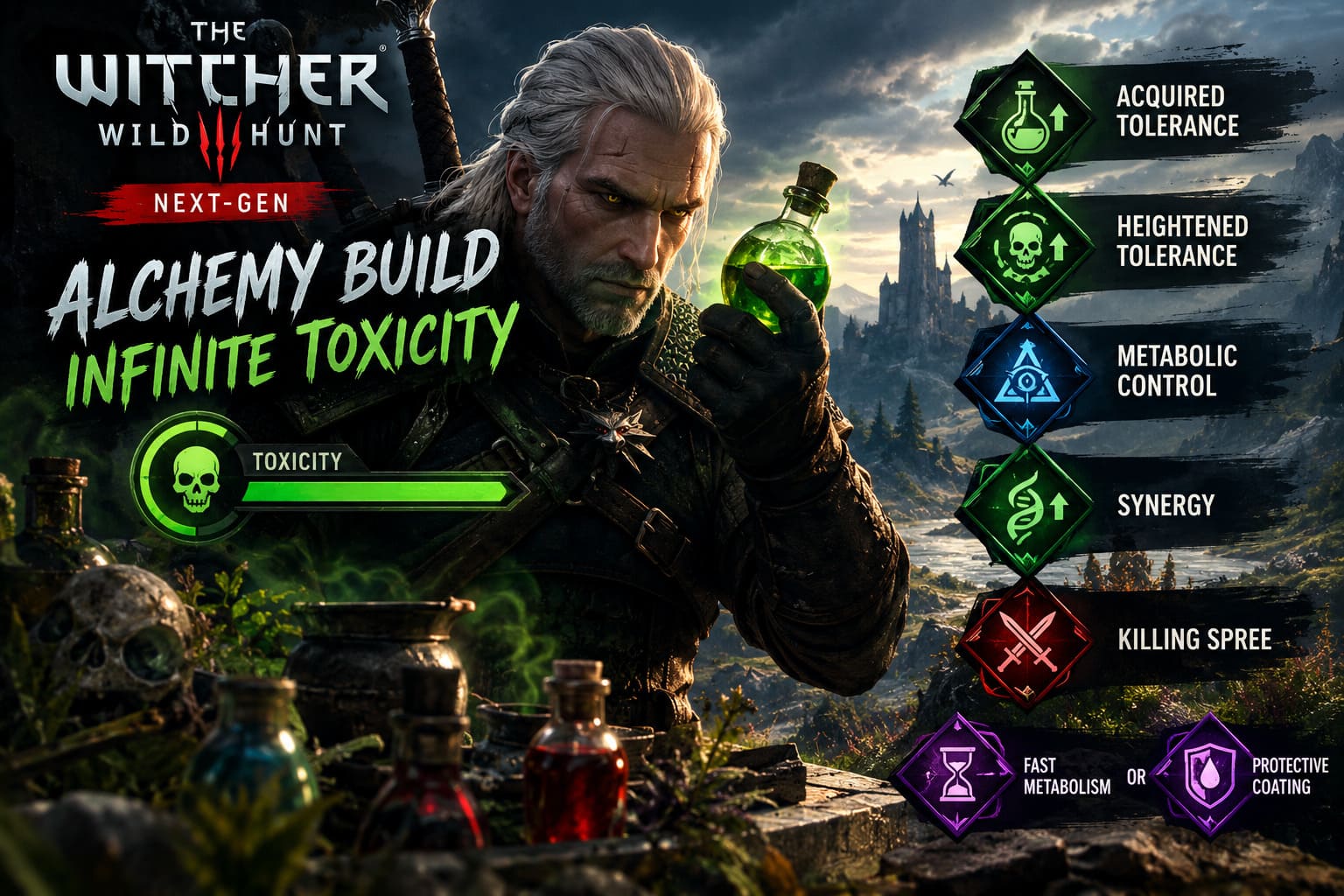
1. Acquired Tolerance
Acquired Tolerance is one of the most important skills for a toxicity-focused character.
It increases your maximum toxicity based on the number of Alchemy formulas you’ve discovered. That means exploration suddenly becomes part of your character progression.
Every time you find another potion, bomb, oil, or decoction recipe, you’re potentially making your Geralt stronger.
This is one of those skills that gets better naturally as your save file develops.
If you’re serious about this build, don’t ignore random Alchemy recipes during your travels.
2. Heightened Tolerance
Heightened Tolerance gives you more room to operate before toxicity becomes genuinely dangerous.
That’s extremely important because this build deliberately keeps Geralt at high toxicity.
You don’t want to create a character that can maintain several powerful potion effects only to lose half his health because he crossed the wrong threshold.
For Death March, the extra safety is especially valuable.
3. Metabolic Control
Metabolic Control comes from the General skill tree and provides another boost to maximum toxicity.
On its own, it doesn’t look particularly exciting.
In this build, though, every extra point matters.
The entire strategy revolves around maintaining a specific toxicity state, so increasing your total capacity gives you more flexibility when combining potions, decoctions, gear, and mutations.
4. Synergy
Synergy is one of those perks that becomes better the more committed you are to Alchemy.
It improves the bonuses provided by mutagens, allowing your green mutagens to contribute much more to your overall stats.
And you don’t have to turn Geralt into a pure potion specialist.
That’s what I like about this setup.
You can combine Alchemy with Combat skills and still get serious physical damage out of the character.
5. Killing Spree
If you’re fighting groups of enemies, Killing Spree can get nasty very quickly.
The basic idea is straightforward: as Geralt racks up kills, his critical-hit potential increases during the fight.
Against groups of bandits, monsters, or other weaker enemies, this can turn the final stages of an encounter into a complete massacre.
It also fits the general philosophy of the build: the more enemies you fight, the more opportunities you have to snowball your advantages.
6. Fast Metabolism or Protective Coating
This is where I’d actually leave some room for personal preference.
Fast Metabolism is useful if you want to clear toxicity faster once the fight is over.
Protective Coating, meanwhile, is much more attractive if you’re building specifically for difficult monster encounters.
The latter works particularly well with a prepared oil setup, giving you another defensive layer against the enemy type you’re about to fight.
Personally, I’d change this depending on what I’m doing. There is no reason to stubbornly use one option everywhere.
Metamorphosis vs. Euphoria: Which Mutation Fits the Build?
Blood and Wine is where the Alchemy build really becomes ridiculous.
Once you’ve unlocked the mutation system through Turn and Face the Strange, two options immediately stand out for this kind of character: Metamorphosis and Euphoria.
They serve different purposes.

| Mutation | Main Idea | Best Use |
|---|---|---|
| Metamorphosis | Triggers random decoctions from critical effects | Experimental, utility-heavy builds |
| Euphoria | Converts toxicity into offensive power | Maximum combat damage |
Metamorphosis
Metamorphosis is the more interesting choice if you enjoy experimenting.
Critical effects can trigger random decoctions from your collection without requiring you to manually consume them in the usual way.
That means your Geralt can gradually accumulate additional benefits during a fight while leaving your normal toxicity resources available for potions.
It’s chaotic, but that’s part of the fun.
You don’t always know exactly what combination you’re going to get, and long encounters can become surprisingly entertaining as the build starts stacking effects.
Euphoria
If you don’t care about experimentation and simply want to make your sword hurt, Euphoria is the obvious direction.
Euphoria rewards high toxicity by increasing your offensive potential.
This creates a very clean gameplay loop:
More toxicity → stronger offensive bonuses → stronger attacks → easier fights.
For a player who wants to squeeze maximum damage out of a high-toxicity Geralt, it’s extremely difficult to ignore.
I personally prefer Metamorphosis when messing around with different builds, but Euphoria makes the overall concept much easier to understand and optimize.
My Preferred Potion Rotation
The exact rotation can change depending on the encounter, but there is a basic sequence I like to use when preparing for a serious fight.
- Superior Tawny Owl — improves stamina regeneration and helps maintain access to Signs and combat abilities.
- Superior Maribor Forest — gives you an adrenaline boost and helps generate more adrenaline.
- Superior Blizzard — the centerpiece of the combat setup when you’re fighting multiple enemies.
- Superior Thunderbolt or Superior Swallow — choose damage or survivability depending on the encounter.
I wouldn’t treat this as an absolute rule.
That’s one mistake I’ve made with highly optimized Witcher builds: trying to follow a spreadsheet instead of reacting to the actual fight.
Against a monster that hits like a truck, Swallow can be far more useful than squeezing out another chunk of damage.
Against weaker enemies, Thunderbolt can make the opening seconds much more aggressive.
The build is powerful because it gives you options, not because you have to press the same buttons every time.
Manticore Gear Is Practically Made for This Build
If you’re going all-in on toxicity, the Grandmaster Manticore set is the obvious armor choice.
The set is heavily associated with Alchemy and toxicity, which makes it a natural match for this playstyle.
The real advantage isn’t just looking like an Alchemist who wandered into a monster fight.
The set helps support the exact statistics this build cares about, including toxicity and critical-hit interactions.
For weapons, Severance is an excellent option if you enjoy Whirl and Rend.
Increasing the effective range of those abilities sounds like a small quality-of-life improvement until you actually start fighting groups.
Then you realize Geralt is spinning through enemies from a distance where they really shouldn’t be getting hit.
And that’s when the build starts feeling silly.
How the Complete Build Plays
The biggest difference between this setup and a traditional Witcher build is that you stop thinking of potions as temporary consumables.
They’re part of your character’s permanent combat state.
Before a major encounter, you prepare your toxicity.
Then you activate the potions that matter.
Once your toxicity reaches the required level for Delayed Recovery, you can focus on the fight instead of constantly checking potion timers.
Your mutations provide additional bonuses.
Your Manticore equipment supports the toxicity economy.
Your Alchemy skills increase the size and effectiveness of that system.
And your Combat skills turn all of those bonuses into actual damage.
The result is a Geralt who can maintain an absurd number of advantages simultaneously.
The Witcher 3 Remastered: FSR 2 vs. DLSS Quality and Performance Comparison (2026 Guide)
The Build’s Biggest Weakness
There is one thing I’d keep in mind before calling this a perfect build.
It requires preparation.
A pure Combat build is much easier to understand. Put points into sword skills, equip appropriate armor, sharpen your blade, and start killing things.
The toxicity setup asks more from you.
You need recipes.
You need mutations.
You need appropriate equipment.
You need to understand toxicity thresholds.
You need to manage your potions.
And if you’re still early in the game, most of the build simply isn’t available yet.
So I wouldn’t recommend forcing this concept onto a low-level Geralt.
It really starts making sense once you’re approaching the late game and especially once Blood and Wine enters the picture.
The Witcher 3 Remastered: Best Combat Tree Skills to Unlock First (Next-Gen Guide)
Final Thoughts
The best thing about the Infinite Toxicity concept isn’t simply that it makes Geralt powerful.
It’s that it makes Alchemy feel like an actual build rather than a collection of consumables.
That’s something The Witcher 3 has always done surprisingly well. You can take a mechanic that most players treat as secondary and build an entire character around it.
With Delayed Recovery, high maximum toxicity, the right Alchemy perks, Blood and Wine mutations, and Manticore gear, Geralt becomes a completely different kind of monster hunter.
If you want straightforward sword damage, go with an Euphoria-focused setup.
If you like unpredictable interactions and free decoction effects, Metamorphosis is much more entertaining.
Either way, once you start keeping powerful potion effects active for far longer than they were originally intended to last, going back to a basic Witcher build can feel painfully ordinary.
And honestly, that’s probably the biggest compliment I can give this build.