Diablo 4 World Tier 3 Leveling and Material Farming Guide: Best Zones & Routes
World Tier 3 is where Diablo 4 finally starts feeling like the real game. The early campaign and World Tier 2 can prepare you for the basics, but stepping into Nightmare difficulty changes the entire rhythm of progression. Sacred items become available, Helltides open up as a serious farming tool, Nightmare Dungeons become increasingly important, and suddenly every crafting material in your inventory seems to have a purpose.
The problem is that World Tier 3 can also expose every weakness in a build.
You might kill normal enemies quickly but struggle against Elites. Your gear may technically be good enough for Nightmare difficulty, yet your damage falls apart in tougher encounters. And then there is the material problem. Forgotten Souls, Angelbreath, Veiled Crystals, Iron Chunks and other resources disappear incredibly fast once you start upgrading and enchanting Sacred equipment.
I’ve always found this part of Diablo 4 interesting because the fastest way forward isn’t simply “kill everything as quickly as possible.” The best World Tier 3 farming route combines XP, gear, crafting materials and progression in the same loop. Once you understand that, leveling becomes much smoother.
Here is how I would approach World Tier 3 in 2026.
Helltides Should Be Your Main Farming Priority
If I had to choose only one activity for a fresh World Tier 3 character, it would be Helltides.
They offer something that most other activities cannot match: you can earn experience, equipment, crafting materials and event rewards while moving through a relatively concentrated area. You aren’t just grinding one type of reward.
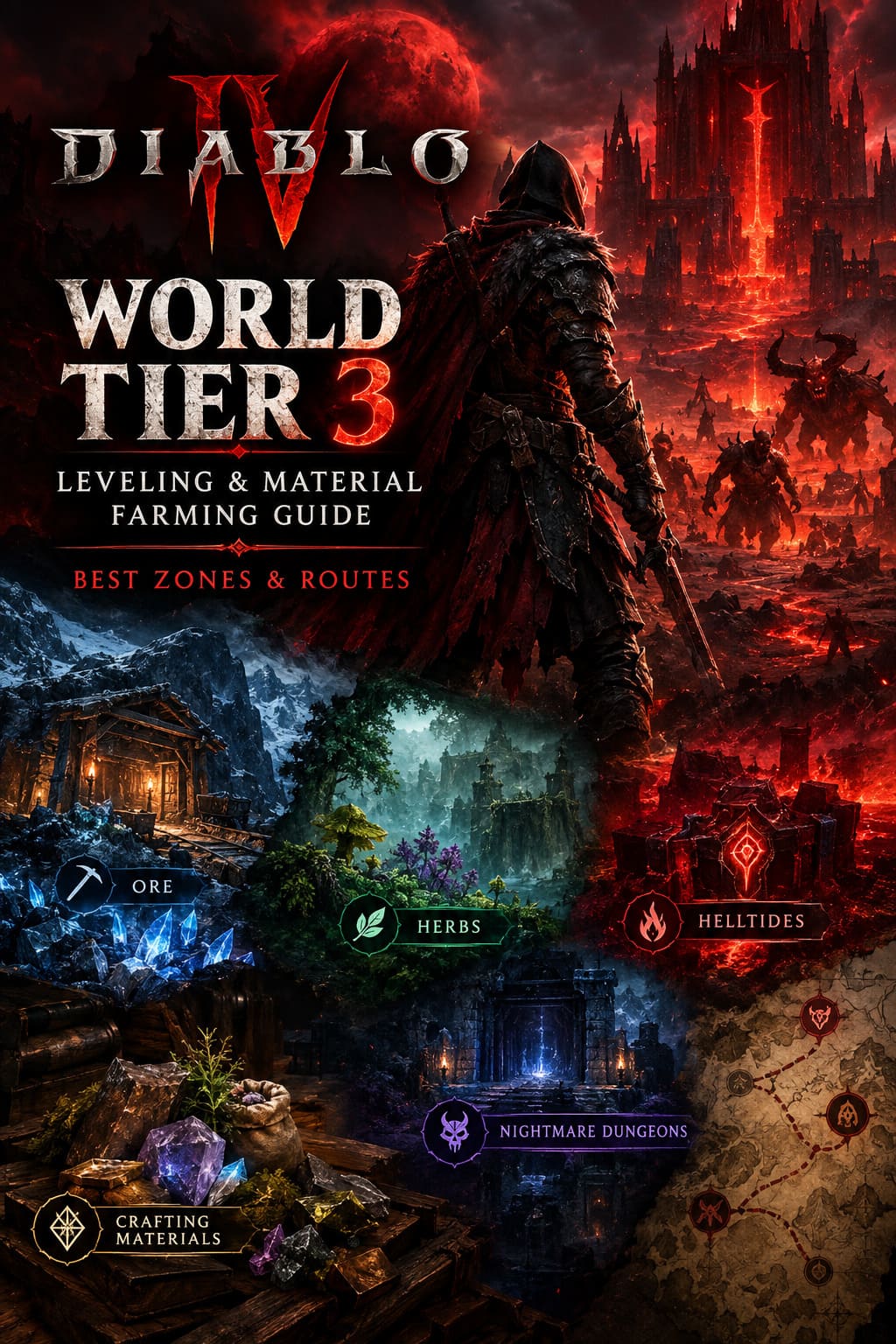
The monster density is also a huge advantage. When a Helltide is active, the open world becomes much more aggressive, with Elite packs and other encounters appearing frequently enough to keep your build constantly engaged.
And this is where I think Helltides become especially good: you can combine them with other progression systems instead of treating them as a separate activity.
For example, if a Tree of Whispers objective appears inside or near the active Helltide region, there is little reason not to work toward both objectives at once.
What I Farm in Helltides
| Resource | Why It Matters |
|---|---|
| Forgotten Souls | Enchanting and upgrading valuable endgame gear |
| Angelbreath | Elixirs, crafting and various upgrades |
| Fiend Rose | Helltide-related crafting requirements |
| Aberrant Cinders | Opening Tortured Gifts |
| Legendary & Rare Gear | Salvaging, upgrades and build improvements |
The big mistake is wandering around the entire Helltide without a plan. I prefer finding two nearby event locations and repeatedly moving between them. Events create concentrated combat, enemies respawn naturally, and your Threat Meter continues climbing.
Once your Threat gets high enough, the activity becomes even more rewarding as stronger enemies and Hellborne encounters start appearing.
For me, that is the sweet spot: constant combat without wasting time traveling across the entire map.
Domhainne Tunnels: Still Fantastic for Fast XP
Helltides are my first choice for overall progression, but sometimes I simply want to turn my brain off and kill an absurd number of monsters.
That’s where Domhainne Tunnels comes in.
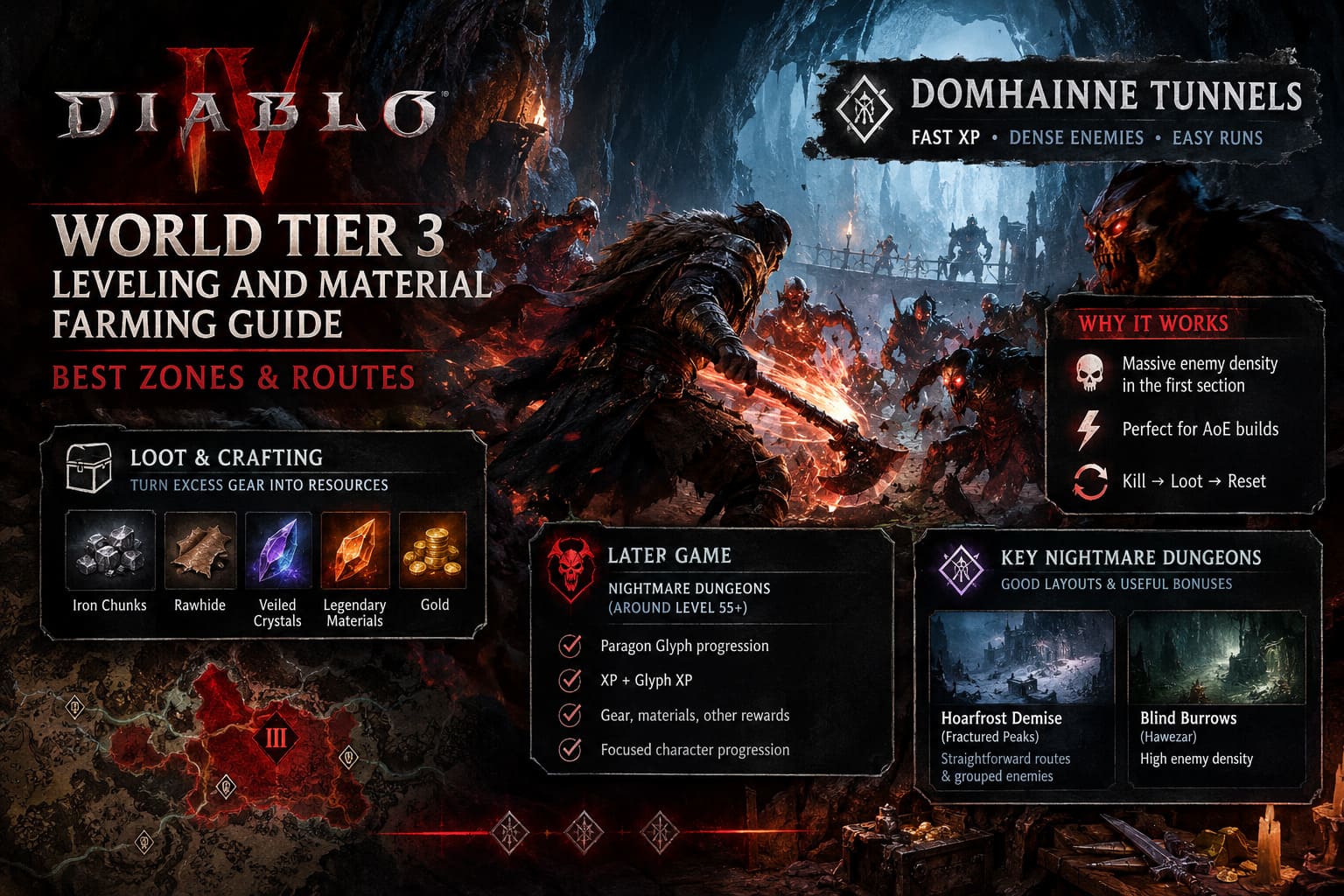
The dungeon has become famous for a reason. Its opening section contains dense groups of enemies packed into relatively convenient spaces, making it extremely comfortable for AoE-heavy builds.
And honestly, this is one of those Diablo 4 farming spots where the simplicity is the attraction.
You enter.
You destroy everything.
You collect the loot.
You reset.
You do it again.
There is no complicated strategy required.
Why Domhainne Tunnels Works
The first section is particularly useful because you don’t have to spend your entire run completing slower objectives. If your build can clear the opening area extremely quickly, you can prioritize kills, XP and loot density rather than worrying about finishing every part of the dungeon.
The loot itself is another reason I like this method. Even when a dungeon isn’t directly dropping the rare material you desperately need, the sheer quantity of weapons and armor can indirectly solve your resource problems.
Salvage unwanted equipment and turn that mountain of loot into crafting components.
This is especially useful for:
- Iron Chunks
- Rawhide
- Veiled Crystals
- Legendary salvage materials
- Gold from unwanted equipment
So while Domhainne Tunnels isn’t my first recommendation for Forgotten Souls, it can be excellent when your inventory is empty and your crafting stash looks even worse.
Nightmare Dungeons Become More Important Around Level 55+
There comes a point where farming random enemies starts feeling inefficient.
For me, that point is usually somewhere around the mid-50s to mid-60s, depending on how strong the build is.
That’s when Nightmare Dungeons become a much bigger part of the World Tier 3 routine.
The biggest reason is obvious: Paragon Glyph progression.
You can have strong Sacred equipment and good damage, but eventually your character’s scaling depends heavily on how well you’ve developed your Paragon setup. Nightmare Dungeons are therefore not just another XP source. They’re part of the actual progression path.
I recommend approaching them differently from Helltides.
Helltides are about flexible farming.
Nightmare Dungeons are about focused character progression.
You get XP, Glyph XP, gear, materials and other rewards during the same run, but the main goal becomes improving the build itself.
Nightmare Dungeon Features Worth Watching
Depending on the current systems and modifiers available to your character, prioritize dungeon runs that give you useful progression bonuses rather than blindly running every key.
Good dungeon layouts are also worth remembering. Hoarfrost Demise in Fractured Peaks, for example, can feel comfortable for builds that prefer straightforward routes and tightly grouped enemies. Blind Burrows in Hawezar can also be attractive because of its enemy density.
The exact “best” dungeon can change with balance updates and build performance, though. A supposedly perfect dungeon is useless if your character takes twice as long to clear it.
That’s something I learned the hard way.
Don’t Ignore the Open World Material Routes
There is another part of World Tier 3 farming that is easy to overlook.
Sometimes you don’t need another dungeon.
You need materials.
If your stash is overflowing with gear but you’re constantly running out of basic crafting components, spending a few minutes collecting nodes can actually save time later.
Dry Steppes for Ore
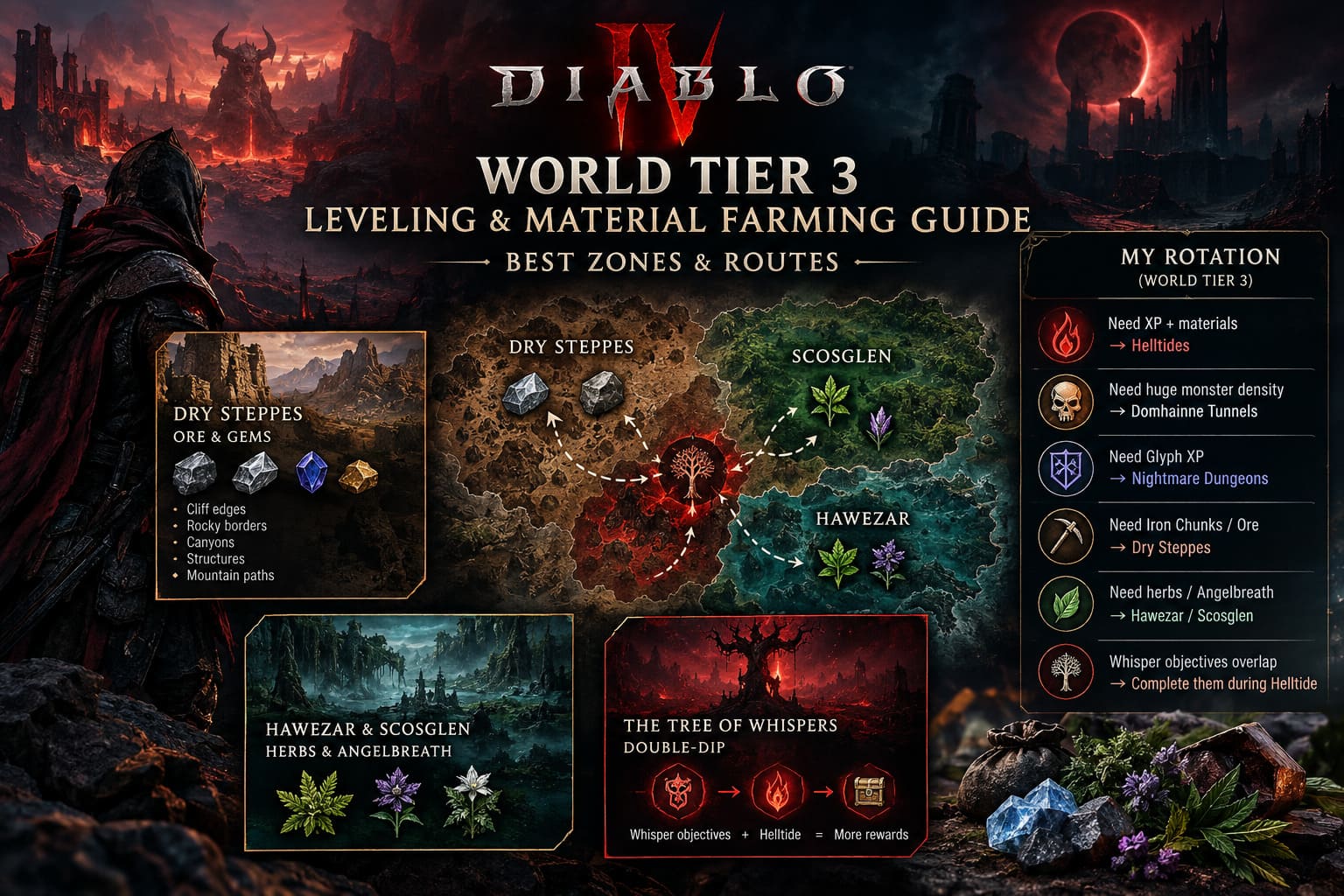
When I need Iron Chunks, Silver Ore or gem-related resources, I tend to pay more attention to the Dry Steppes.
Don’t simply follow the main roads. Instead, look around:
- Cliff edges
- Rocky borders
- Canyons
- Structures
- Mountain paths
Movement speed makes a huge difference here. A fast character can turn an otherwise boring resource run into a surprisingly efficient material circuit.
It’s not glamorous, but Diablo 4 has a habit of making you appreciate basic materials right when you run out of them.
Hawezar and Scosglen for Herbs
Herbs become increasingly important once you’re regularly using elixirs and other consumables.
Hawezar and Scosglen are useful regions to keep in mind when you’re looking for herb nodes and Angelbreath.
I usually collect these while traveling between objectives rather than making an entire session exclusively about herbs.
That is an important distinction.
You don’t always need to stop what you’re doing and start a dedicated gathering expedition. If you’re already traveling through an area, grabbing nearby nodes is practically free value.
The Tree of Whispers Is Your Best Double-Dip
One of the easiest ways to improve World Tier 3 efficiency is simply to stop treating activities as isolated systems.
The Tree of Whispers is perfect for this.
If Whisper objectives overlap with a Helltide, take advantage of it. You can kill Helltide enemies, complete events, work toward Grim Favors and then turn those favors in for additional rewards.
This kind of overlap is exactly what makes Diablo 4’s open-world systems work well when you plan around them.
Instead of thinking:
“I need to farm Helltide.”
Think:
“What can I complete while I’m already inside this Helltide?”
That small change makes a surprisingly big difference.
My Simple World Tier 3 Farming Rotation
If I were starting a new character today, I wouldn’t stay in one activity for hours. I’d rotate based on what my character currently needs.
| Situation | Activity I Would Prioritize |
|---|---|
| Need XP + materials | Helltides |
| Need huge monster density | Domhainne Tunnels |
| Need Glyph XP | Nightmare Dungeons |
| Need Iron Chunks / Ore | Dry Steppes |
| Need herbs / Angelbreath | Hawezar / Scosglen |
| Whisper objectives overlap | Complete them during Helltide |
This keeps the progression from becoming stale while also preventing the classic Diablo problem of realizing you’ve spent two hours farming the wrong resource.
How to Link Battle.net Account to Xbox Live for Diablo 4 (2026 Guide)
Small Habits That Make a Big Difference
A few simple habits can make your World Tier 3 progression noticeably smoother.
Keep an elixir active. The experience bonus adds up over a long farming session, and there is little reason to leave that XP on the table.
Salvage aggressively. Don’t let your inventory become a museum of mediocre weapons. If an item isn’t useful for your build and doesn’t deserve to be stored, turn it into materials.
Watch your deaths. Faster isn’t always better. If pushing harder causes repeated deaths or forces you to slow down dramatically, you’ve probably gone beyond your efficient farming difficulty.
Use your movement tools. Mobility is extremely valuable in open-world farming. The less time you spend running between packs, the more time you spend earning XP and loot.
Don’t tunnel-vision one material. You may enter Helltide thinking you desperately need Forgotten Souls, only to realize later that you’re actually short on basic salvage materials or Angelbreath. Efficient farming means building the entire resource stockpile.
How to Fix Diablo 4 High Latency Lag and Rubberbanding on US Servers (2026 Guide)
Final Thoughts
World Tier 3 is where Diablo 4’s progression loop finally starts clicking for me.
You have enough systems unlocked that almost everything can contribute to your character, but that also means inefficient farming becomes much easier to notice. Running random activities without a purpose can leave you with plenty of loot while somehow still lacking the one material you actually needed.
My preferred approach is straightforward: use Helltides as the foundation, Domhainne Tunnels when I want fast and uncomplicated XP, and Nightmare Dungeons once Glyph progression becomes the priority. Between those activities, use the open world to collect herbs and ore rather than making dedicated gathering feel like a chore.
Most importantly, don’t obsess over a single “perfect” route.
Your best farming route is the one that matches your current build, your current materials and the progression system you need most. If your character is clearing Helltides comfortably, stay there. If your gear is weak, use dense dungeons and salvage everything. If your Paragon Glyphs are falling behind, shift into Nightmare Dungeons.
World Tier 3 doesn’t need to be a wall. With the right farming loop, it can be the stage where your character starts snowballing toward World Tier 4 and the harder endgame content.