Hell Let Loose Vietnam Helicopter Guide: Flight Controls, Tactics, and LZ Mechanics
If you thought Hell Let Loose: Vietnam was simply going to take the familiar 50v50 formula, throw it into a jungle, and call it a day, the helicopters are here to prove you wrong. The arrival of fully operational U.S. helicopters changes the rhythm of the battlefield in a way that ground players immediately feel.
The August 13, 2026 launch of Hell Let Loose: Vietnam, developed by Expression Games and published by Team17 on Unreal Engine 5, brings the franchise into a completely different kind of war. The open fields and recognizable battle lines of World War II are replaced by dense jungle, rivers, mountain passes, hidden positions, and terrain that can turn a simple infantry advance into a miserable crawl.
And then there is the Huey.
The Bell UH-1 Iroquois is not some arcade helicopter that you jump into, point toward the enemy, and start farming kills. Honestly, that’s one of the best things about it. In Vietnam, helicopters are primarily mobility and logistics machines. They move squads, deliver supplies, establish forward positions, and create opportunities for attacks that would otherwise take several minutes of exhausting footwork.
But flying one badly is an excellent way to turn an entire squad’s carefully planned assault into a smoking crater.
Why Helicopters Change the U.S. Battlefield
The aerial game in Hell Let Loose: Vietnam is deliberately asymmetrical. U.S. forces get operational helicopters, while the North Vietnamese Army and Viet Cong have access to their own strategic advantages, particularly underground tunnel networks.
That difference matters.
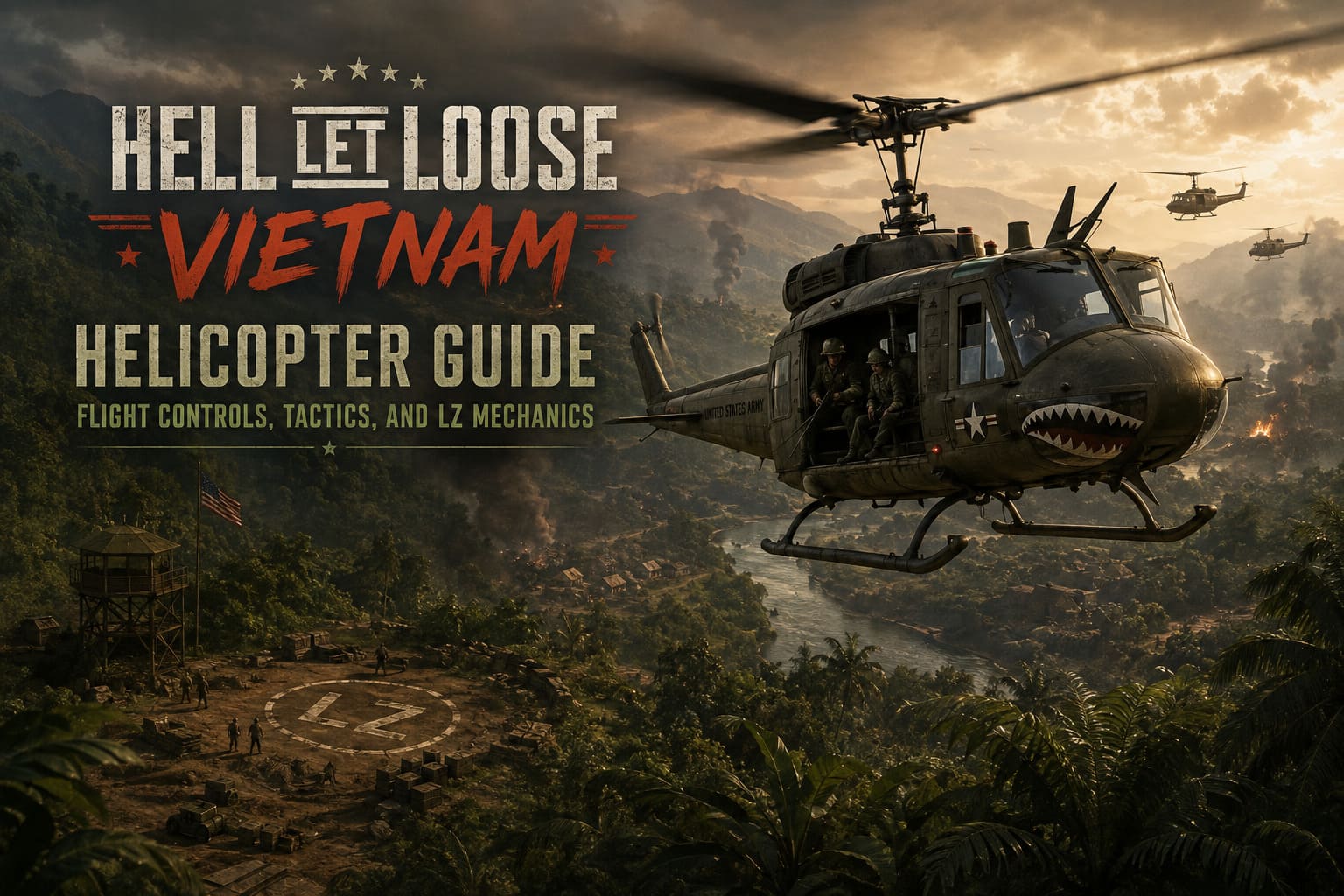
The American side can move infantry rapidly across terrain that would otherwise be painfully slow to traverse. A squad can suddenly appear on the other side of a river, supplies can reach engineers much faster, and commanders can pressure positions that previously looked almost impossible to attack.
The catch is that helicopters are loud, visible, and vulnerable to well-prepared defenders.
The Vietnamese factions don’t necessarily need to shoot down every aircraft. Sometimes forcing a pilot to take a longer route or making a landing zone too dangerous is enough to disrupt the American team’s momentum.
That creates an interesting cat-and-mouse game. The Huey gives you speed, but it doesn’t give you permission to be careless.
Helicopter Flight Controls Explained
Learning the controls is the first serious hurdle. The helicopter has several separate movement systems, and beginners often try to control everything at once. Don’t.
Think about the aircraft as three primary control layers: collective, cyclic, and yaw.
| Control | Typical Input | What It Does |
|---|---|---|
| Collective | W / S | Controls lift and altitude |
| Pitch | Mouse Forward / Back | Controls forward and backward movement |
| Roll | Mouse Left / Right | Banks the helicopter |
| Yaw | A / D | Rotates the nose left or right |
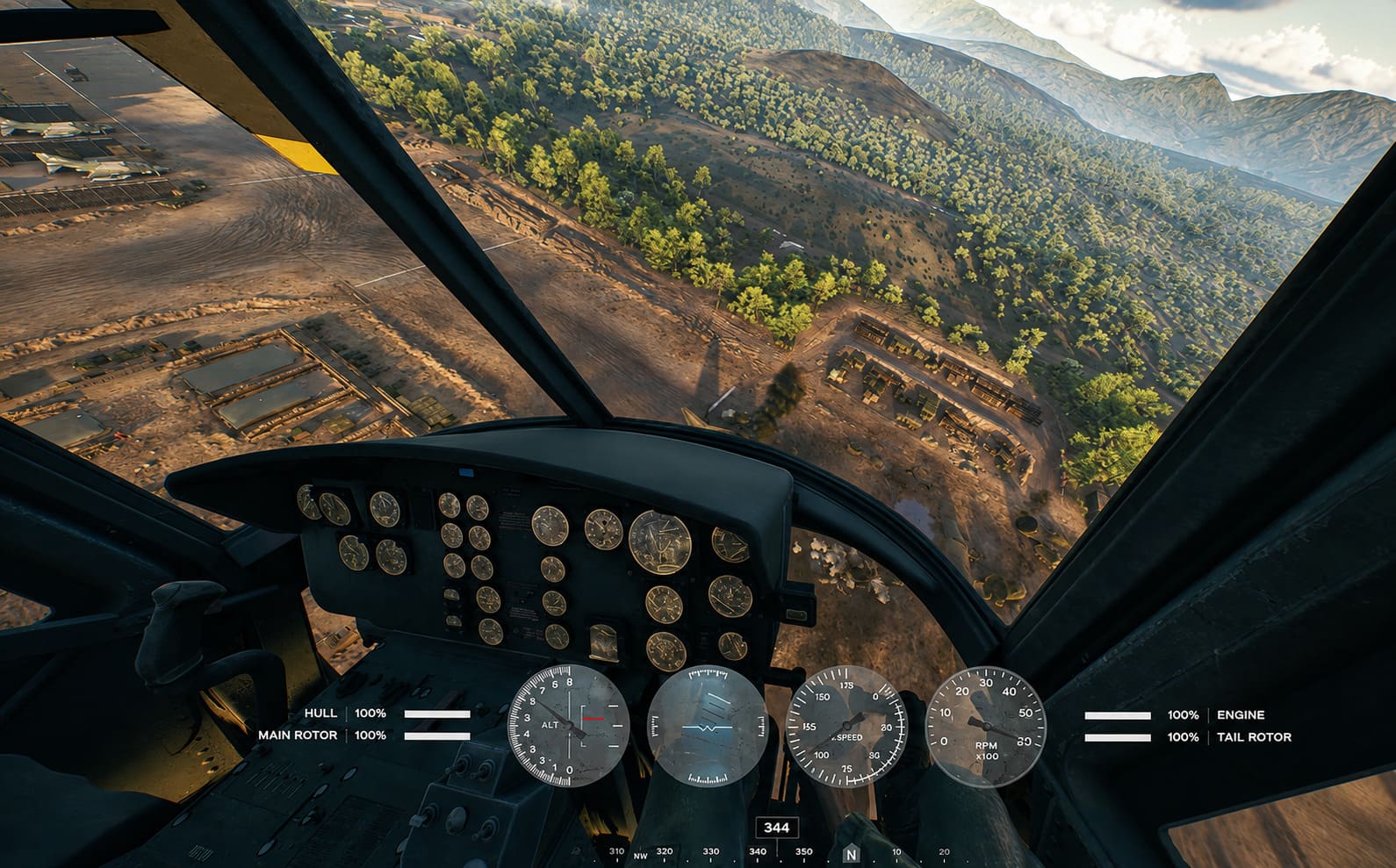
The collective is your altitude tool. Increasing it generates more lift, while reducing it allows the aircraft to descend. This isn’t simply a traditional throttle, so treating W as “go faster” is a quick route to confusion.
The cyclic controls the helicopter’s attitude. Push forward and the nose drops, converting some of your lift into forward movement. Pull back and the aircraft pitches upward, reducing forward speed.
Then you’ve got yaw, controlled through the anti-torque pedals. This changes the helicopter’s heading without necessarily banking the entire aircraft.
The important part is that these systems work together.
A common rookie mistake is making enormous mouse movements because the Huey feels slow to respond. Then the aircraft finally reacts, the pilot panics, overcorrects in the opposite direction, and suddenly the entire machine is wobbling around like it has forgotten what gravity is.
Smooth inputs are everything.
If your controls feel overly twitchy, spend time adjusting sensitivity before joining a serious match. A helicopter pilot who can make tiny corrections is far more valuable than one who constantly wrestles with the aircraft.
Altitude: Don’t Treat the Sky Like Your Playground
One of the easiest ways to make your helicopter vulnerable is to fly at a predictable altitude for too long.
The game imposes an altitude ceiling of roughly 900 meters, so climbing endlessly isn’t an option. More importantly, flying extremely high isn’t automatically safer. You’re visible against the sky, your approach becomes predictable, and you’re giving the enemy plenty of time to understand where you’re going.
For long-distance travel, a cruising altitude around 150–300 meters provides a useful compromise.
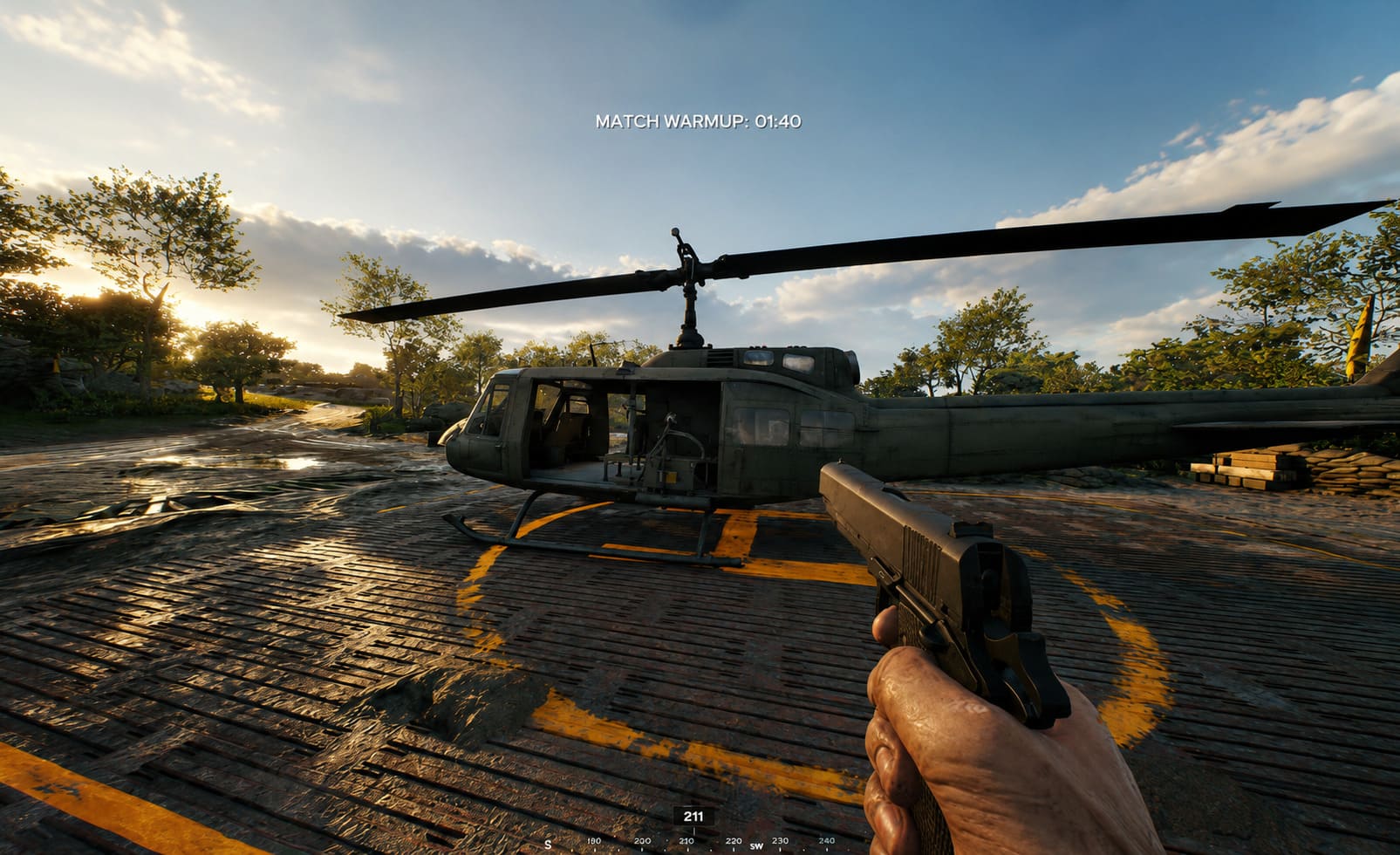
You’re high enough to clear much of the terrain, but not so high that you’re completely exposed.
Near the objective, however, your flight profile should change. That’s where terrain becomes your friend.
Trees, ridges, hills, and other terrain features can break enemy sightlines. You don’t want to spend the entire trip scraping treetops, but using the landscape intelligently can make the difference between arriving with a full squad and arriving as debris.
How to Take Off Without Embarrassing Yourself
Before you even leave the ground, give the helicopter a moment.
At the U.S. base or designated spawn area, the aircraft begins powered down. Once you’re in the pilot’s seat, start the engine and allow the rotor system to reach operational speed.
This is not the moment to immediately yank the collective.
Wait for the aircraft to be ready.
While the engine is spinning up, this is also the perfect opportunity to figure out where you’re going. Check the tactical map. Confirm the destination. Talk to the squad leader. Find out whether the intended landing zone is actually usable.
Once you’re ready, increase collective gradually and lift vertically.
Keep the cyclic relatively neutral during the initial climb. You don’t want to introduce unnecessary forward or sideways movement while you’re still close to the ground.
Clear nearby obstacles first.
After reaching a safe altitude, begin feeding in forward pitch. The helicopter will gradually transition from climbing to forward flight. As speed builds, adjust the collective to maintain the altitude you actually want.
It sounds simple on paper.
In practice, the first few attempts can feel hilariously awkward.
That’s normal.
The Flare Is Your Best Friend
If there is one helicopter technique you absolutely need to learn, it’s the flare.
Trying to land while carrying significant forward speed is a terrible idea. The aircraft has momentum, and simply reducing collective doesn’t magically erase that momentum.
Instead, start your flare before reaching the landing zone.
As you approach, pull back on the cyclic and raise the nose. This converts the helicopter’s attitude into a powerful braking maneuver and rapidly reduces forward airspeed.
At the same time, manage the collective carefully.
This is where the finesse comes in.
Pull too hard without controlling lift and you may climb. Drop collective too aggressively and you can descend far faster than intended. Keep too much forward speed and you’ll overshoot the landing zone.
Once you’re down around 15 knots or less, level the aircraft and begin settling onto the LZ.
The goal isn’t to make the most dramatic landing imaginable. The goal is a boring landing.
Boring is good.
If your passengers can step out without immediately hearing an explosion, you’ve done your job.
Landing Zones Are Tactical Decisions, Not Just Empty Patches of Ground
A landing zone shouldn’t be selected simply because it looks flat.
Before committing to an LZ, consider enemy positions, likely RPG angles, trees, structures, terrain, and the amount of time your helicopter will have to remain exposed.
A perfect landing zone is useless if an enemy anti-tank player has a clear shot from 200 meters away.
This is why communication with infantry and squad leaders matters so much.
The pilot shouldn’t be making every decision alone.
A squad leader can identify where troops need to be delivered. Ground players can report enemy activity. A commander can provide broader information about the tactical situation.
The helicopter crew then turns that information into an actual flight plan.
Helicopters and Forward Spawn Creation
The real strategic power of the Huey appears when you stop thinking about it as transportation.
Certain U.S. squad leadership roles can use helicopters to establish forward spawn capabilities, turning the aircraft into a tool for rapid battlefield positioning.
This can completely alter an attack.
Instead of forcing an infantry squad to spend several minutes walking through hostile jungle, a coordinated crew can move them much closer to the objective and establish a useful forward position.
The best pilots aren’t necessarily the ones flying the most aggressively.
They’re the ones who understand where the team needs to be five minutes from now.
That’s a much harder skill.
The Hot-Zone Landing
One of the riskiest but most rewarding helicopter plays is the rapid insertion near an active combat area.
The idea is straightforward: approach a suitable clearing, reduce speed using a controlled flare, land quickly, allow the squad leader to establish the required forward spawn, and get back into the air before the enemy has enough time to organize.
The execution is anything but straightforward.
The helicopter is noisy. Everyone knows something is coming when they hear it.
That means lingering is dangerous.
A good hot-zone insertion should feel almost surgical. Get in. Drop the troops or establish the position. Get out.
Don’t hover above the objective because you want to admire your piloting.
The enemy will admire it for you—with an RPG.
Surviving Enemy Fire
Helicopter pilots need to understand the difference between background fire and serious threats.
Standard small-arms fire may not immediately shred the aircraft, giving you some tolerance when crossing exposed infantry positions. But concentrated fire can still become dangerous, particularly when it is directed toward the cockpit or passengers.
Heavy machine guns and mounted weapons are much more concerning.
Then there are anti-tank rockets.
An RPG-7 is the kind of weapon that can turn a successful flight into a loading screen before you even realize what happened.
The best defense isn’t simply flying faster.
It’s being unpredictable.
Change your route. Avoid repetitive straight lines. Use terrain to break enemy sightlines. Don’t approach the same objective from exactly the same direction every time.
If an enemy gunner has watched your previous three runs, you’ve effectively trained them to shoot you down.
Crew Coordination Makes a Huge Difference
A helicopter should ideally function as a small team rather than a one-man operation.
The pilot concentrates on flying. A co-pilot or crew member can monitor the tactical map and watch for important battlefield information. Door gunners can provide suppressive fire during dangerous approaches and departures.
This division of labor matters because the pilot has enough to worry about already.
Trying to fly, scan the map, monitor enemy positions, communicate with infantry, and manage the aircraft simultaneously is a recipe for mistakes.
A coordinated crew can react much faster.
And in Hell Let Loose, seconds matter.
Hell Let Loose Vietnam Visibility Guide: Best Foliage and Line of Sight Settings (2026)
My Best Advice for New Huey Pilots
Before you volunteer to transport an entire squad into a contested objective, learn the helicopter somewhere quiet.
- Smooth collective control
- Basic hovering and turning
- Forward acceleration
- Altitude management
- Flare landings
- Rapid takeoffs
- Approach and departure routes
Don’t chase flashy maneuvers.
Don’t try to fly like you’re playing an arcade helicopter shooter.
The best Huey pilots I’ve seen in tactical games are the ones who make everything look almost effortless. They arrive when needed, put the aircraft exactly where it needs to be, unload everyone, and disappear before the enemy gets a clean firing solution.
That’s the standard worth chasing.
Hell Let Loose Vietnam Game Modes Explained: Tactical Guide (2026)
Final Thoughts
Hell Let Loose: Vietnam’s helicopter gameplay adds an entirely new layer to the franchise’s tactical formula. The Huey isn’t a killstreak reward or a flying tank. It’s a fragile but incredibly powerful battlefield asset that rewards communication, patience, and good judgment.
Master the collective. Learn the cyclic. Get comfortable with yaw. Practice the flare until landing stops feeling like a coin toss. Most importantly, learn to read the battlefield before you ever leave the ground.
A great helicopter pilot doesn’t simply move soldiers from Point A to Point B.
They create opportunities.
They open new attack routes, accelerate logistics, establish forward positions, rescue squads from bad situations, and give the U.S. team a mobility advantage that can completely reshape a match.
Just remember one golden rule:
If the Huey is making you feel invincible, you’re probably about five seconds away from an RPG.