Halloween The Game 2026: Guide to Escaping the Myers House Secret Crawlspaces
Halloween: The Game has plenty of places where survivors can hide, run, and desperately hope Michael Myers decides to chase somebody else. But after spending time learning the layout of the Myers House, I honestly think the secret crawlspaces are one of the most interesting mechanics on the map.
They can save your life.
They can also get you killed in a spectacularly embarrassing way.
That is the beauty of them.
The Myers House isn’t designed like a comfortable multiplayer map with wide hallways and obvious escape routes. It feels cramped, old, and hostile. When Michael starts slowly closing the distance, doors suddenly seem too far away, windows become risky, and those narrow hidden passages start looking like your only realistic option.
This Halloween: The Game crawlspace guide explains how to find the secret passages inside the Myers House, how to move through them quietly, which exits are safest, and what mistakes can turn your clever escape into an easy kill for The Shape.
The Myers House Crawlspaces Are More Dangerous Than They Look
The first thing players need to understand is that a crawlspace isn’t simply a hiding spot.
That’s probably the biggest mistake beginners make.
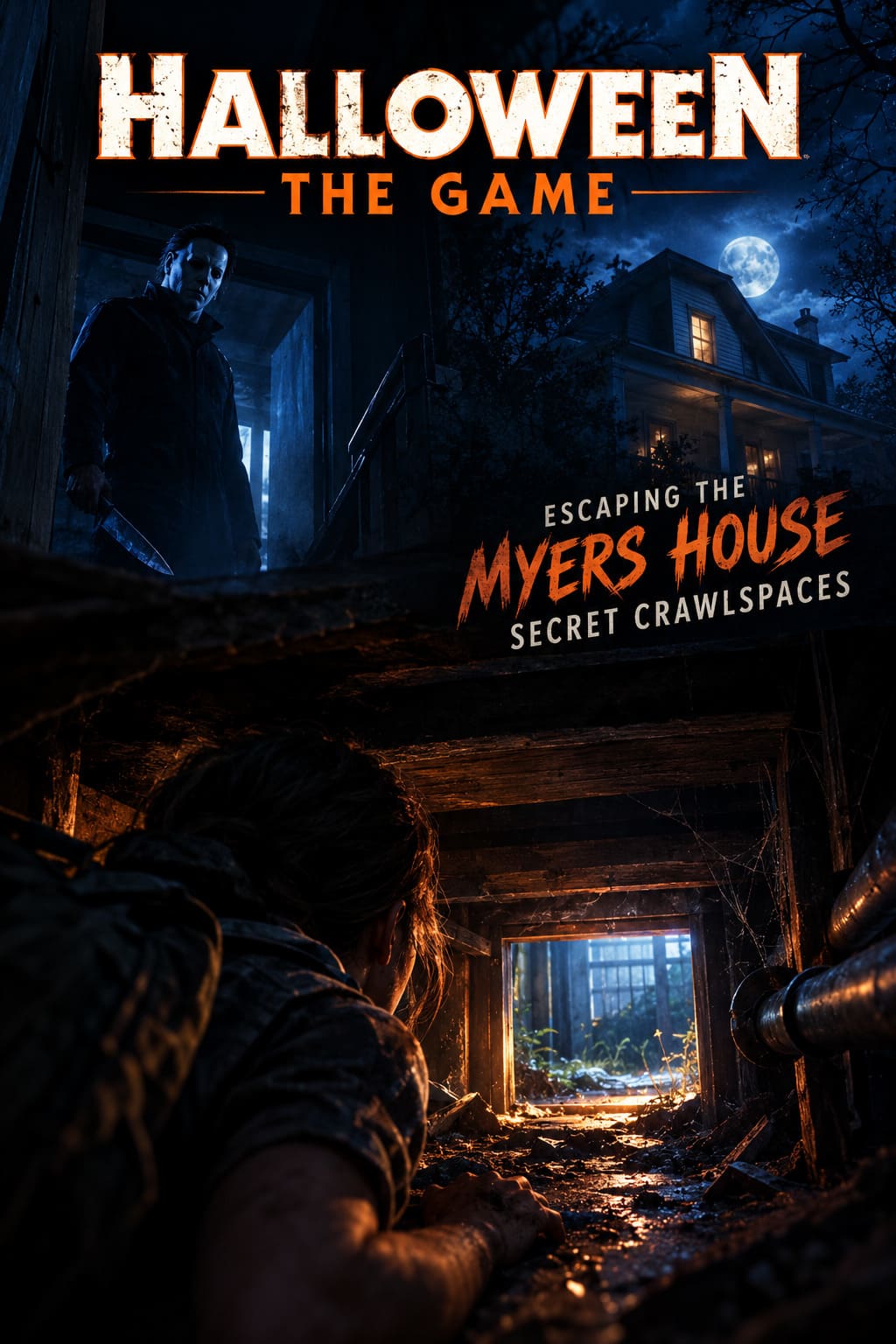
You don’t enter one, crawl into the darkness, and automatically become safe. In fact, if Michael already knows where you went, a crawlspace can become a very uncomfortable tunnel with only a few possible exits.
The real strength of the system is map knowledge.
Players who understand the crawlspace network can use it to:
- Break line of sight.
- Avoid predictable hallways.
- Reach another floor without using obvious routes.
- Find useful objective items.
- Escape toward the exterior of the property.
The key is knowing when to enter and when to leave.
If you panic and jump into the first opening you see, Michael can simply patrol the exits. If you enter with a plan, however, you can force him to waste valuable time searching the wrong part of the house.
And against Michael Myers, wasting his time is often more important than outrunning him.
Myers House Crawlspace Network: The Three Main Areas
The secret passages inside the Myers House are spread across several connected areas. Learning their general structure makes navigation much easier.

| Crawlspace Zone | Main Location | Best Use |
|---|---|---|
| Foundation Grid | Basement and lower floor | Long-distance escape routes |
| Wall Cavities | Interior rooms and hallways | Avoiding doors and stairs |
| Attic Eaves | Upper level and roof area | High-risk exterior escape |
1. The Foundation and Basement Grid
This is the section I would learn first.
The basement crawlspace network is one of the largest hidden areas beneath the Myers House. It connects sections below the living areas and can eventually provide access toward exterior escape points.
The biggest advantage here is that you can disappear from Michael’s immediate line of sight.
The downside? You’re moving through a confined space.
Once you’re inside, your vision becomes limited, your movement options shrink, and environmental sounds become extremely important. You need to listen carefully.
A random pipe sound or movement above you might not mean anything.
Or it might mean Michael is directly overhead.
That’s the fun part. And also the terrifying part.
2. Interior Wall Cavities
The wall passages are excellent for survivors who don’t want to use the predictable routes through the house.
The main staircase is an obvious danger zone. Doors can be watched. Hallways can become traps.
The hidden wall routes allow you to move between interior sections without constantly exposing yourself.
I particularly like these passages during the middle of a chase. If Michael loses visual contact with you, changing your vertical position can completely disrupt his prediction of where you’re heading next.
But don’t assume these routes are silent.
Entering and opening hidden panels can create noticeable sounds. Smart players should prepare routes early rather than waiting until Michael is already standing a few meters away.
3. The Attic and Roof Eaves
This is the risky option.
The attic crawlspace can lead survivors toward an exterior escape opportunity, including access near the backyard side of the property.
It looks fantastic from a gameplay perspective because it creates a classic horror movie situation: you’re crawling through a dark attic while the killer is somewhere below.
But the route isn’t forgiving.
You have limited room to move, fewer options if Michael predicts your destination, and potentially dangerous environmental obstacles.
Use it when you need to change the direction of the chase, not when you’re simply looking for a comfortable hiding place.
There is nothing comfortable about the Myers House attic.
How to Find Secret Crawlspace Entrances
Crawlspace entrances aren’t always obvious. Depending on the location, you may be looking for:
- Loose wooden panels.
- Broken ventilation covers.
- Low closet hatches.
- Damaged floor sections.
- Hidden openings near basement structures.
Before interacting with an entrance, take a second to check your surroundings.
That extra second can matter.
Opening a panel creates noise, and noise is dangerous when Michael is nearby. If you’ve already been spotted, interacting with an entrance may give him an extremely clear indication of your escape route.
My personal recommendation is simple: open and memorize useful entrances early in the match whenever possible.
Don’t wait for the perfect horror movie chase.
Prepare before things go wrong.
That way, when Michael eventually appears, you’re not standing there trying to remember where the nearest hidden panel was.
Move Slowly Inside the Crawlspace
Once you’re inside, speed becomes a trade-off.
Yes, moving quickly can get you farther away from Michael.
But it can also generate more noise.
The crawlspaces are filled with debris, old construction materials, pipes, and other objects that can create sound cues. Rushing blindly through the tunnels is one of the easiest ways to announce your position.
Slow crawling is usually the safer option.
Watch your stamina and noise indicators carefully. A survivor who has just finished a long chase may already be exhausted, and heavy breathing inside a confined tunnel can make stealth almost impossible.
If Michael is actively searching the area, sometimes the smartest thing you can do is absolutely nothing.
Stop.
Listen.
Wait for information.
I know that sounds boring in a multiplayer game, but surviving isn’t always exciting. Sometimes the winning play is sitting in a dark hole while Michael walks past somewhere above you.
What to Do When Michael Uses Killer Sense
Michael Myers has tracking tools specifically designed to prevent survivors from hiding forever.
That means crawlspaces are not an automatic counter to his abilities.
If you suspect Michael is using Killer Sense, staying still becomes incredibly important. Noise, panic, and unnecessary movement can potentially reveal information about your location.
This is one of those situations where players often sabotage themselves.
They hear an ability cue.
They panic.
They immediately start crawling.
And suddenly, they’ve made themselves easier to track.
Instead, try to remain calm.
Stop moving and reduce unnecessary actions.
Pay attention to the audio. Halloween games live and die by atmosphere, but the sound design also provides gameplay information. Changes in music, sudden orchestral cues, and nearby environmental sounds can tell you that Michael has entered a dangerous position.
Don’t treat the soundtrack as background noise.
Listen to it.
Watch Out for Hazards Inside the Myers House
The tunnels are not clean shortcuts.
Broken glass, nails, debris, and noisy obstacles can create serious problems. Some hazards can make noise immediately, while others can slow your movement or create additional tracking opportunities.
The biggest mistake is crawling through darkness at maximum speed.
Always look ahead.
Use available ambient lighting to identify dangerous objects. If you need to clear an obstacle, use the safer interaction method instead of rushing through it.
A few seconds spent carefully navigating debris is much better than creating a sound cue that brings Michael directly to your tunnel.
The crawlspace should be treated like a stealth route, not a racing track.
Look for Objective Items in Hidden Areas
One reason the crawlspace network is so useful is that it isn’t exclusively about escaping.
Important items can appear in hidden sections.
Depending on the match, players may find useful objective components, electrical items, keys, or other resources inside deeper sections of the network.
This creates an interesting risk-versus-reward situation.
You may find something your team desperately needs.
But picking it up takes time.
And while you’re interacting with an item, you’re vulnerable.
If possible, coordinate with another survivor. One player can monitor the entrance or nearby areas while another retrieves the objective.
Going alone isn’t always a terrible decision.
But going alone while Michael is actively hunting nearby? That’s a different story.
The Best Way to Escape a Crawlspace With Teammates
Communication makes a huge difference.
The biggest problem with many crawlspace exits is the animation. Climbing out isn’t instantaneous, which means Michael can potentially catch you during the transition.
This is where teamwork becomes incredibly valuable.
A coordinated distraction can give you the few seconds needed to escape safely.
For example, another survivor might create noise elsewhere by interacting with the environment. If Michael investigates, the pressure around your exit can disappear temporarily.
Don’t confuse distraction with sacrifice, though.
A good team shouldn’t constantly throw one player into danger. The best distractions happen naturally while everyone is working toward survival objectives.
Use voice chat or pings when possible.
A simple warning can prevent a terrible exit.
The Safest Crawlspace Exit in the Myers House
In my opinion, the external basement storm cellar route is one of the strongest exits when it is available.
Why?
Because leaving the house changes the entire chase.
Inside the Myers House, Michael has tight corridors and predictable paths. Outside, you have vegetation, wider movement space, and more opportunities to break visual contact.
Once you leave through an exterior route:
- Break line of sight immediately.
- Avoid sprinting in a predictable direction.
- Use nearby environmental cover.
- Crouch when you have successfully created distance.
- Plan your next destination instead of returning to the same entrance.
The worst thing you can do is successfully escape the house and then run in a perfectly straight line across open ground.
Michael doesn’t need supernatural intelligence to predict that.
Recommended Perks for Crawlspace Survival
A stealth-focused build makes the Myers House tunnels significantly more manageable.
The following perks are especially useful for players who frequently use hidden routes.
Low Profile
This perk is ideal for survivors who spend time crouching and crawling.
Reducing the effectiveness or visibility of movement-related indicators can make it harder for Michael to precisely identify your route.
Quiet Climber
A fantastic option for emergency escapes.
Reducing the noise created by crawlspace entrances and exits gives you more flexibility when Michael is nearby.
Cold Blooded
Panic management is extremely important.
A survivor who remains calm is usually harder to track than someone whose character is breathing heavily and constantly generating movement noise.
The combination works best for players who prefer stealth.
If you’re constantly sprinting around the map and taking aggressive risks, you may not get the same value.
What to Do During Michael’s Late-Game Blackout
The late game becomes much more dangerous when Michael gains stronger control over the map.
During a Blackout, the interior of the Myers House can become extremely difficult to navigate.
My advice here is straightforward:
Don’t immediately activate your flashlight inside a crawlspace unless you absolutely need to.
Light can create information.
Information can create a problem.
Instead, rely on your knowledge of the route and follow consistent environmental navigation patterns. Hugging one side of the crawlspace can help you maintain orientation when visibility becomes extremely limited.
The left-hand wall strategy isn’t glamorous.
But when you’re crawling through darkness and trying to remember which direction leads outside, simple strategies are often the best strategies.
Halloween The Game 2026: Full Single Player Campaign Walkthrough & Guide
Common Crawlspace Mistakes to Avoid
Even experienced players can make bad decisions under pressure.
Here are the mistakes I would avoid:
- Entering without knowing the exit.
- Moving too quickly and creating unnecessary noise.
- Panicking during Michael’s tracking abilities.
- Using the same crawlspace route repeatedly.
- Ignoring environmental hazards.
- Exiting without checking whether Michael is nearby.
The last one is especially painful.
You can successfully crawl through an entire tunnel, avoid every obstacle, escape Michael’s search, and then climb directly into him at the exit.
I’ve seen players do the equivalent of completing an escape mission only to deliver themselves straight back to the killer.
Don’t be that player.
How to Fix Halloween: The Game Network Connection Error and Server Timeout 2026
Final Thoughts: Crawlspaces Can Become Your Best Escape Tool
The Myers House secret crawlspaces in Halloween: The Game are easily one of the most interesting mechanics on the map because they reward knowledge instead of simply rewarding speed.
You don’t need to be the fastest survivor.
You need to be smarter about where you’re going.
Open important entrances early. Learn the basement network. Move slowly when Michael is searching. Avoid hazards. Listen to the soundtrack and environmental audio. And, most importantly, never enter a tunnel without thinking about where you’re going to exit.
The crawlspaces work best when you treat them as routes, not hiding spots.
That’s the difference between escaping The Shape and accidentally trapping yourself underground.
Once you know the Myers House layout, those dark tunnels stop feeling like claustrophobic death traps. They become another weapon in your survival toolkit.
And honestly, there is something incredibly satisfying about hearing Michael searching through the house above you while you quietly crawl toward an exit he didn’t expect.
That’s exactly the kind of tension I want from Halloween: The Game.