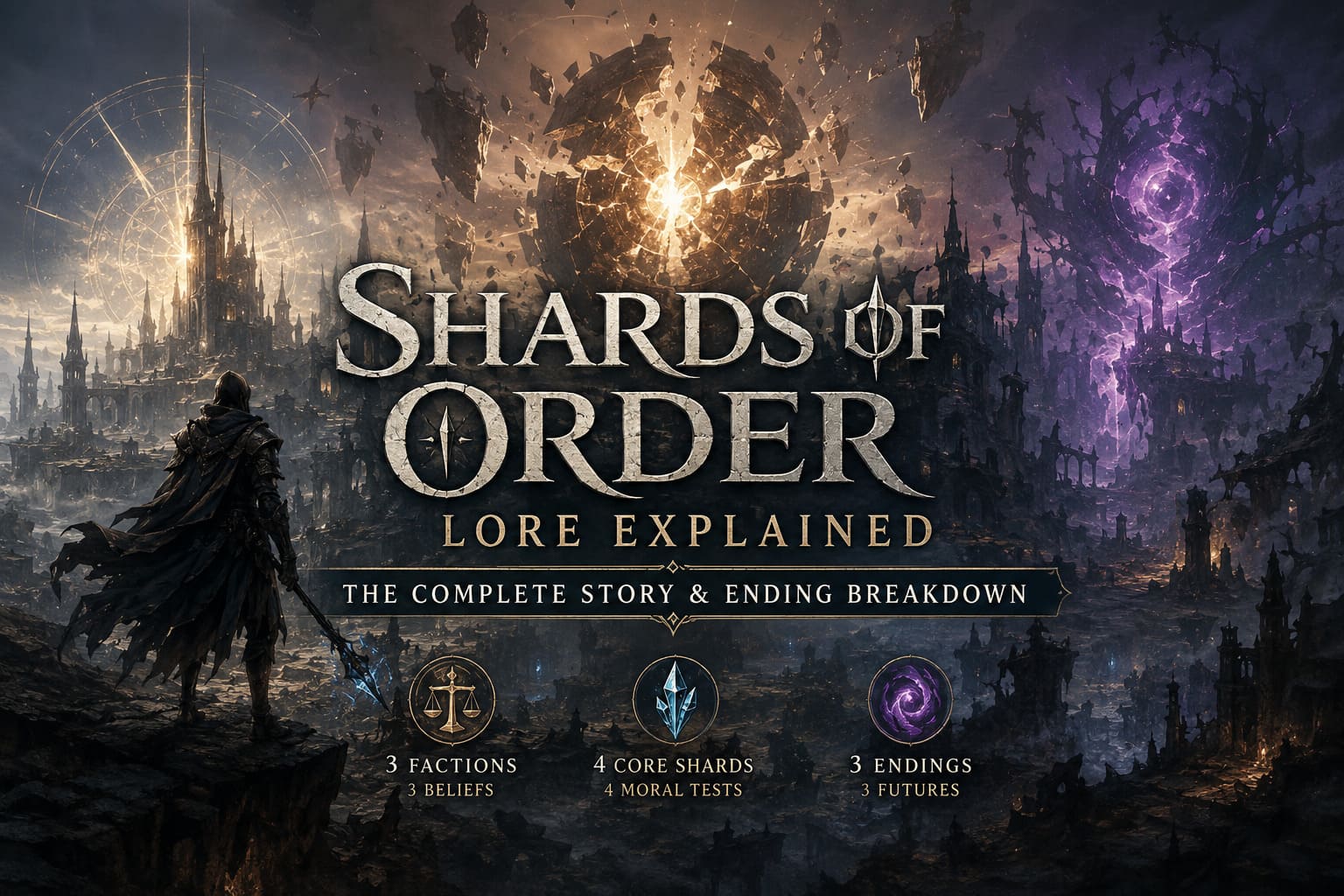
Shards of Order Lore Explained: The Complete Main Story and Ending Breakdown
When I first launched Shards of Order, I expected another dark fantasy RPG packed with mysterious ruins, oversized bosses, and plenty of cryptic dialogue. What I didn’t expect was a story that constantly made me question whether saving the world was even the right thing to do.
After finishing every major ending and spending way too much time reading environmental lore, hidden journals, and optional conversations, I came away feeling that Shards of Order isn’t really about defeating a final villain. It’s about deciding what kind of civilization deserves to exist after everything falls apart.
If you’ve finished the campaign—or don’t mind major spoilers—here’s my complete breakdown of the lore, the factions, and why I think the game’s “true” ending earns its reputation.
A World That Was Never Meant to Break
One of the smartest things the writers do is avoid dumping the entire backstory on players during the opening hours. Instead, pieces of history slowly emerge through exploration.
Long before the events of the game, the realm of Anteros wasn’t simply governed by kings or empires. Reality itself operated under an invisible framework called the Order.
Think of it as the operating system of existence.
- Time moved correctly because of it.
- Life followed natural cycles because of it.
- Space obeyed consistent physical laws because of it.
- Death wasn’t random—it was part of an enormous cosmic design.
This balance existed because ancient beings known as the Primordial Architects built and maintained these universal rules.
Then humanity decided those rules weren’t enough.
Instead of accepting mortality, ambitious scholars created the Aetheric Siphon, hoping to draw limitless energy directly from the cosmos. Predictably, everything went horribly wrong.
- The machine overloaded.
- Reality cracked.
- The Order shattered into physical relics known as Shards, permanently changing Anteros forever.
Unlike many fantasy settings where ancient disasters simply serve as background lore, the Great Cleaving still affects nearly every region you visit. Every strange biome, every impossible landscape, and every supernatural phenomenon traces back to that single catastrophic event.
Every Faction Believes They’re Saving Humanity
One thing I genuinely appreciated is that none of the major factions feel cartoonishly evil.
Everyone has a convincing argument.
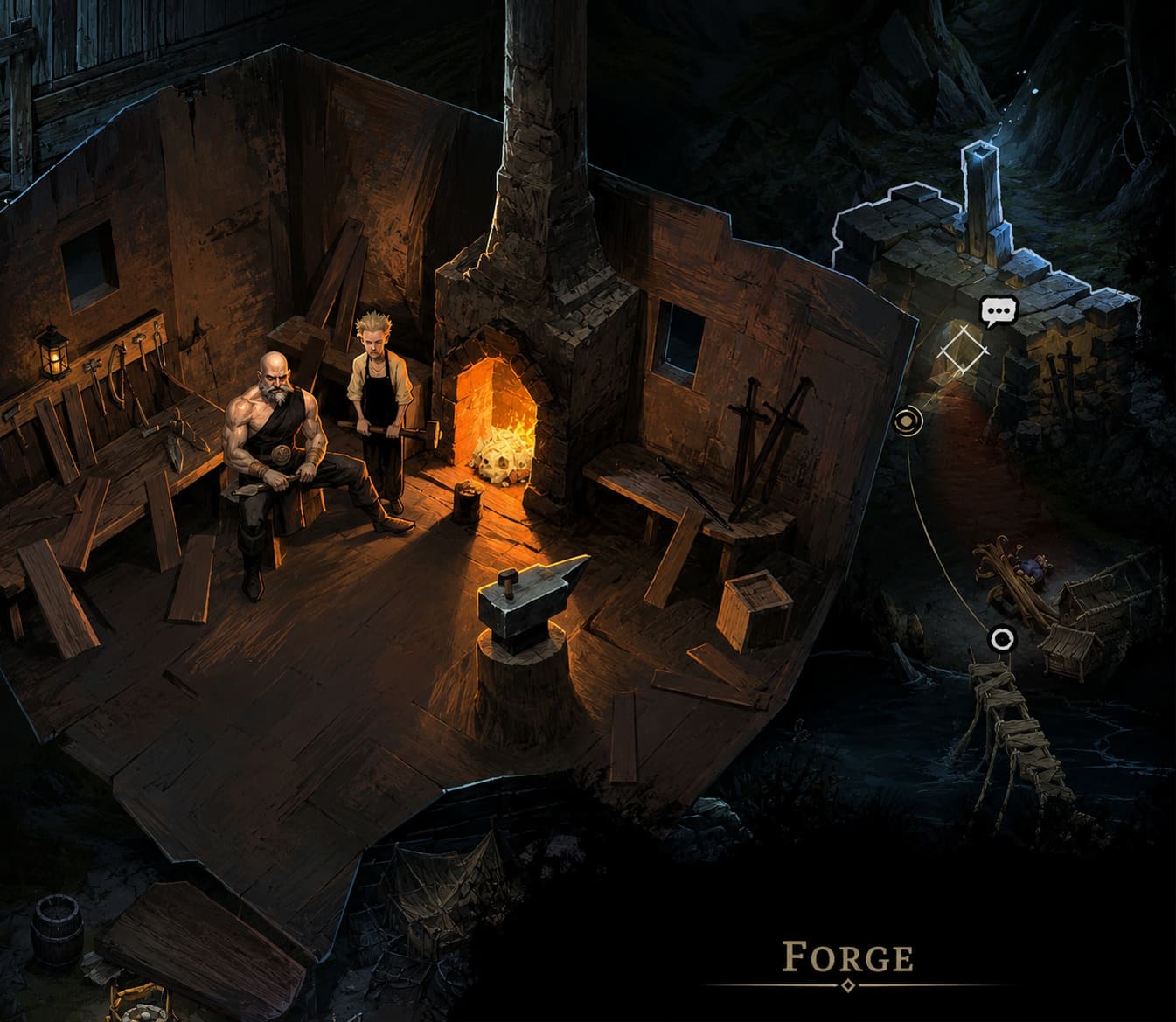
| Faction | Core Belief | Biggest Weakness |
|---|---|---|
| Sovereign Arbiters | Restore the original Order completely. | Sacrifice personal freedom. |
| Umbral Reavers | Destroy cosmic limitations forever. | Endless instability. |
| Horizon Seekers | Create a new balance using technology and Shards. | Risk repeating humanity’s mistakes. |
Normally RPGs make choosing sides fairly obvious. Here, I honestly changed my opinion several times during the campaign.
The Arbiters appear oppressive, yet they’re also the only group actively trying to prevent another apocalypse.
The Reavers sound reckless, but they’re right about one thing: absolute control created many of the world’s original problems.
Meanwhile, the Horizon Seekers often feel like idealists attempting the impossible.
Ironically, that’s exactly why they became my favorite faction.
The Echo Is More Than Just Another Silent Hero
The protagonist, known simply as the Echo, initially seems like another mysterious chosen one.
Fortunately, the story gives that concept far more depth.
Unlike ordinary people, the Echo can safely absorb unstable Shards without losing sanity or mutating into something monstrous.
At first this feels like standard fantasy logic.
Later, you discover why.
The Echo isn’t merely gifted. They’re connected to one of the original Architects responsible for shaping reality itself.
That revelation completely changed how I interpreted earlier story moments.
Many strange visions, impossible memories, and unexplained instincts suddenly make perfect sense once the game’s bigger mystery is revealed.
The Four Core Shards Are Really Four Different Moral Tests
Mechanically, every major chapter revolves around collecting another Core Shard.
Narratively, each one explores a different philosophical question.
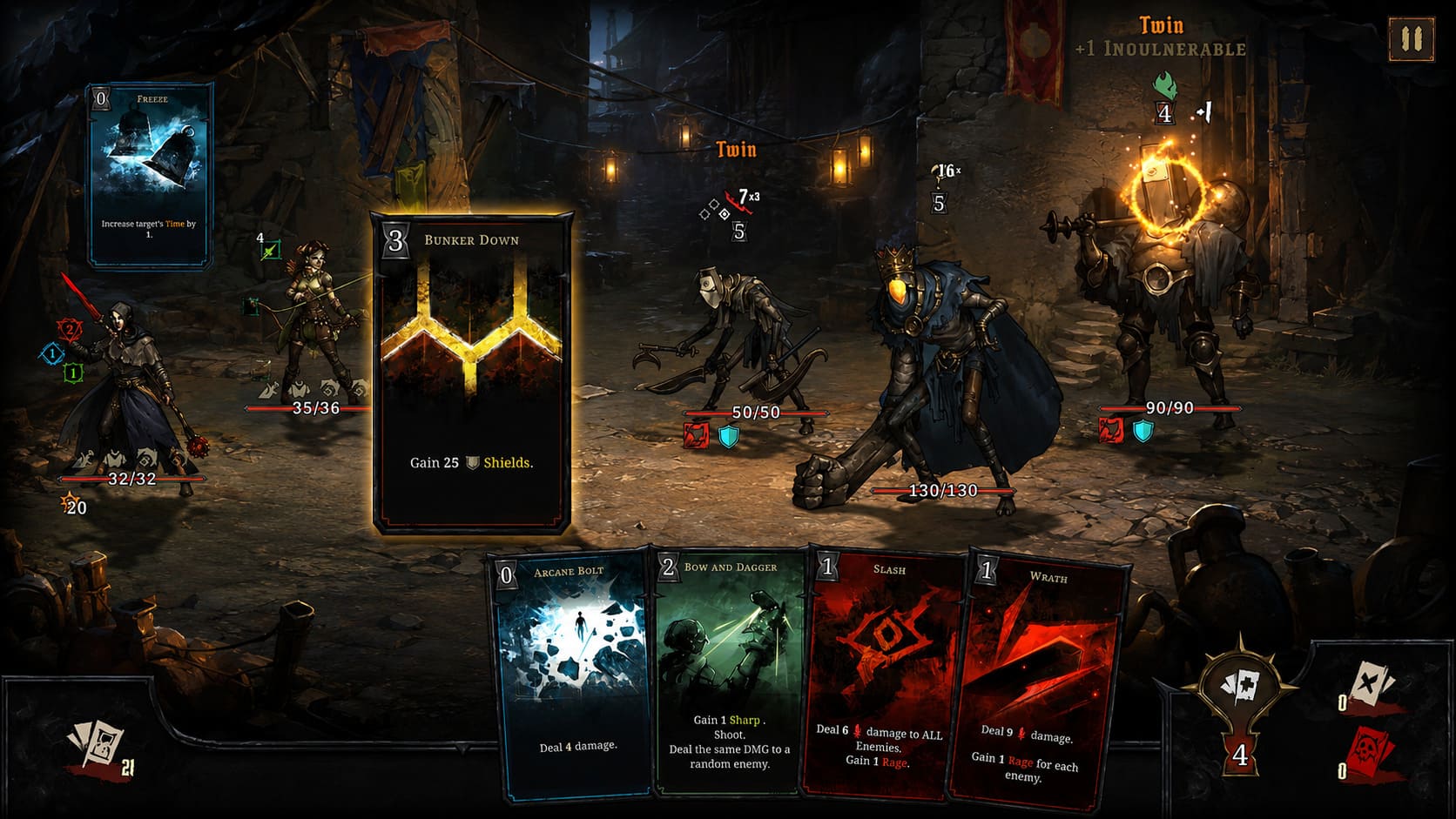
Temporal Flow
The opening region remains one of my favorite sections.
Watching an entire town unknowingly repeat the same day forever feels unsettling long before the game explains what’s happening.
When the time loop finally ends, the emotional payoff is brutal.
Yes, you save reality.
But the people sustained only by the anomaly immediately age and die.
It establishes early that “fixing” the world isn’t always merciful.
Vitality
The Whisperwood chapter leans heavily into body horror.
Instead of simple corrupted forests, nature itself has evolved without restraint.
- Plants merge with flesh.
- Animals become ecosystems.
- Entire landscapes appear alive.
Even after defeating the local leadership, the player is forced to decide whether nature should be restored—or allowed to continue evolving into something completely new.
I liked that there isn’t an obviously perfect answer.
Spatial Geometry
This chapter probably contains the most creative level design in the game.
- Buildings connect to themselves.
- Hallways fold into impossible angles.
- Entire fortresses exist inside dimensions that physically shouldn’t fit together.
It constantly reminds players that reality itself remains damaged.
At the same time, political conflict reaches its highest point, proving that people are often just as dangerous as supernatural forces.
Cognitive Essence
Everything eventually leads into the surreal Mindscape.
Rather than focusing on monsters alone, this section explores identity, regret, memory, and fear.
It’s easily the most psychological portion of the campaign.
By the end, players finally understand that humanity wasn’t solely responsible for the Great Cleaving.
Someone—or rather something—had been manipulating events from the very beginning.
The Null Is More Interesting Than a Typical Final Boss
Many RPG villains ultimately boil down to “destroy the world because evil.”
Thankfully, The Null is far more compelling.
It isn’t motivated by hatred.
It represents the complete absence of Order itself.
From its perspective, existence should naturally return to limitless chaos.
Everything the Architects built is an unnatural interruption.
That philosophical conflict makes the finale much stronger than a simple battle between good and evil.
Even Malakor’s betrayal feels believable in hindsight.
Once you revisit earlier conversations, numerous hints were hiding in plain sight.
That’s the kind of storytelling I always appreciate.
Which Ending Is Actually the Best?
Like many players online, I eventually completed all three endings.
Each one feels like a logical conclusion rather than a simple “good” or “bad” route.
The Eternal Grid
This ending delivers stability.
- Wars end.
- Anomalies disappear.
- Society becomes perfectly predictable.
Unfortunately, individuality disappears alongside uncertainty.
Watching ordinary citizens lose every trace of independent thought genuinely unsettled me more than any horror sequence in the campaign.
The Age of Discord
This path embraces total freedom.
- Magic becomes limitless.
- Reality transforms constantly.
- Anything seems possible.
But absolute freedom also means permanent instability.
Without universal rules, civilization never truly recovers.
It creates one of the most visually spectacular finales while also feeling deeply tragic.
The Synthetic Dawn
For me, this is easily the strongest conclusion.
Instead of recreating the past or destroying it completely, humanity finally accepts responsibility for shaping something new.
- Technology and magic coexist.
- The Shards become sustainable energy rather than weapons.
- People remain free without abandoning structure entirely.
It isn’t a perfect ending.
It’s simply the one that feels like genuine progress.
Comparing the Three Endings
| Ending | Result | Tone |
|---|---|---|
| The Eternal Grid | Order restored at the cost of free will. | Beautiful but dystopian. |
| The Age of Discord | Unlimited freedom through permanent chaos. | Exciting yet destructive. |
| The Synthetic Dawn | Balanced future combining Order and innovation. | Hopeful and optimistic. |
Small Details I Think Many Players Missed
Some of my favorite storytelling isn’t found in the main cutscenes at all.
- Environmental clues quietly reveal how ordinary citizens adapted before major factions ever arrived.
- Several optional journals imply that some Architects questioned the original Order long before the Great Cleaving.
- Malakor’s dialogue subtly changes after each Core Shard, foreshadowing his true identity without making it obvious.
- The architecture of later regions gradually shifts from structured symmetry toward impossible geometry, visually reflecting reality’s collapse.
- Side quests connected to the Horizon Seekers add important context that makes the final ending significantly more satisfying.
Those kinds of details reward players who slow down and actually pay attention instead of rushing objective markers.
Shards of Order Roadmap 2026: Post-Launch DLC, New Laws, and Future Content Explained
Final Thoughts
After spending dozens of hours exploring Anteros, I think Shards of Order succeeds because it trusts players to draw their own conclusions.
The story never insists that one ideology is unquestionably correct.
- Security has a cost.
- Freedom has consequences.
- Progress requires compromise.
Those themes stay consistent from the opening hours all the way to the final cinematic.
What impressed me most wasn’t the cosmic spectacle or the massive boss fights—it was how often the game challenged my assumptions about what it actually means to “save” a broken world.
In a year packed with ambitious RPG releases, Shards of Order stands out because its lore feels thoughtfully constructed rather than intentionally confusing. Every major revelation builds naturally on what came before, and every ending reflects the choices players make instead of delivering a one-size-fits-all conclusion.
Whether you finish the campaign siding with the Arbiters, embrace the Reavers’ vision of limitless chaos, or unlock the hopeful Synthetic Dawn, one thing becomes clear: the fate of Anteros was never about collecting powerful relics. It was always about deciding which imperfections humanity should carry into the future—and which ones are worth leaving behind.