How to Counter Superheavy Tanks in D.O.R.F. Real-Time Strategic Conflict: Ultimate Guide
After playing enough old-school RTS games, you start to recognize the moment when an opponent thinks they have already won. They stop building normal armor, roll out the biggest machines available, and suddenly the battlefield is full of enormous tanks that look capable of deleting your entire army in one attack. D.O.R.F. Real-Time Strategic Conflict absolutely understands that feeling. Its chunky machines, brutal explosions, elaborate production chains, and unmistakable 90s-inspired presentation make superheavy armor feel like the ultimate late-game threat.
But here’s the thing: I don’t think superheavy tanks are nearly as unbeatable as they first appear. In fact, the more I look at the way D.O.R.F. handles movement, logistics, terrain, artillery, and positioning, the more I see these monsters as expensive problems rather than unstoppable weapons. The worst thing you can do is meet them in the middle of an open field and ask your regular tanks to trade shots until somebody runs out of health. That’s exactly the fight the superheavy player wants.
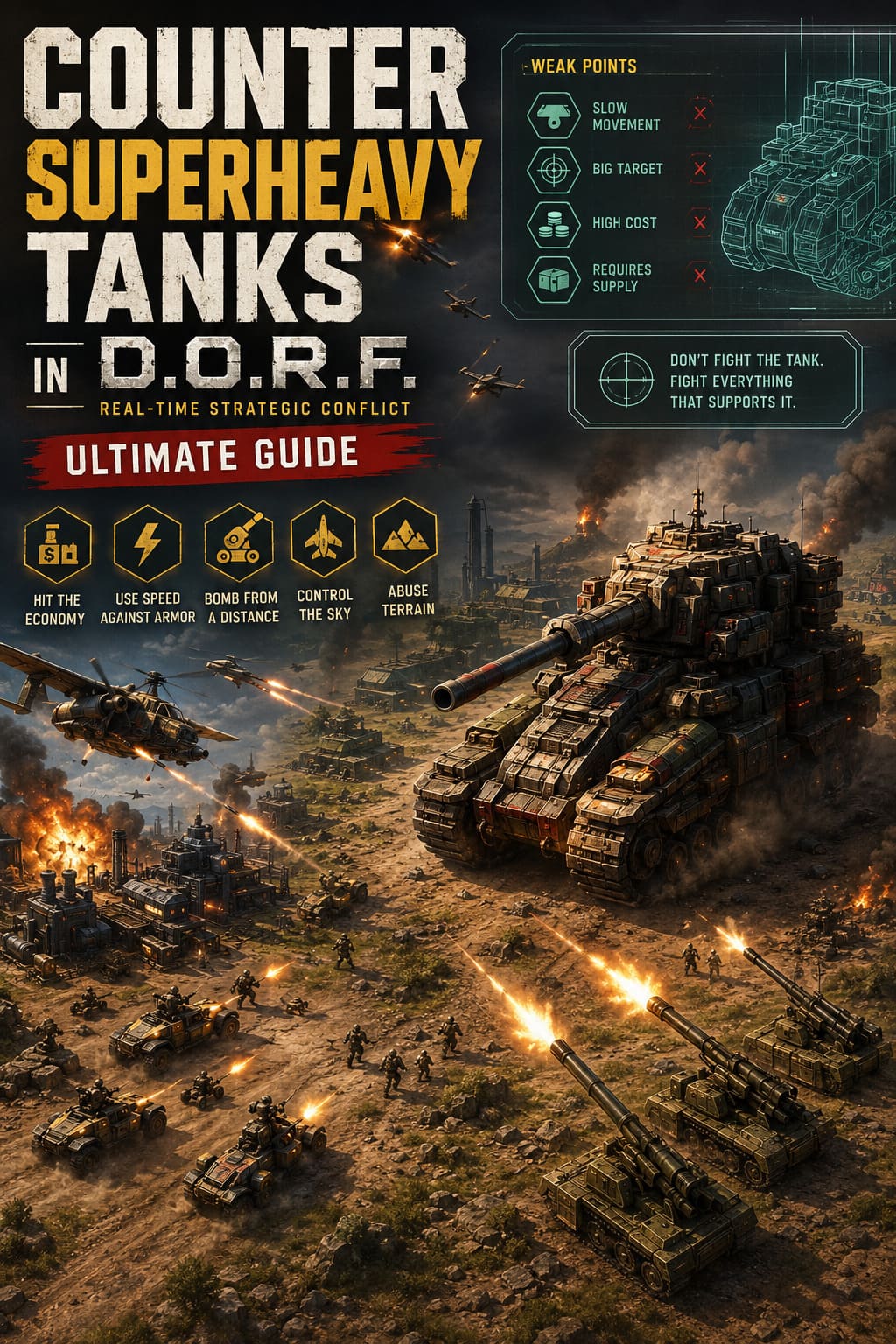
If you’re trying to figure out how to counter superheavy tanks in D.O.R.F., the answer is less about finding one magical anti-tank unit and more about attacking everything that makes those tanks dangerous. Hit their economy, abuse their poor mobility, control the terrain, attack from multiple angles, and make their massive investment work against them.
D.O.R.F. Real-Time Strategic Conflict Story Campaign: The Ultimate 90s RTS Revival Guide
Don’t Fight the Tank — Fight the Economy Behind It
This is probably the first lesson I’d give to anyone coming from classic Command & Conquer-style RTS games. When an opponent invests heavily in superheavy armor, they’ve invested heavily in their economy too. Those gigantic machines aren’t appearing out of thin air. They require production capacity, refined resources, infrastructure, power, and a logistics network capable of keeping the whole war machine running.
So why attack the strongest part of that machine?
Go around it. Fast units should be looking for harvesters, refineries, pipelines, power infrastructure, production facilities, and exposed rear bases. Even destroying a relatively small piece of the enemy’s economy can have a bigger strategic impact than damaging a superheavy tank by a few percent. If the opponent can’t afford another tank, repair their production chain, or replace their supporting units, that intimidating armored column becomes much less frightening.
- Raid resource collection points.
- Destroy vulnerable processing and power infrastructure.
- Cut supply routes whenever possible.
- Force expensive armor to fight without proper support.
I’ve always preferred this kind of RTS strategy anyway. There is something much more satisfying about watching an enemy’s gigantic attack force slowly become irrelevant because you quietly strangled the economy behind it.
Use Speed Against Armor
The biggest tank on the map usually has one obvious weakness: it isn’t going anywhere quickly. D.O.R.F.’s emphasis on physical movement makes this especially important. A huge armored vehicle isn’t going to behave like a tiny scout car, instantly rotating toward every threat that appears around it.
That’s where fast anti-armor units become extremely annoying for the superheavy player. Don’t send them directly into the tank’s strongest firing arc. Spread them out, attack from the sides, pull them away when the tank turns, and hit the rear once its main weapon is facing the wrong direction. It becomes less of a traditional tank battle and more like hunting a very angry mechanical dinosaur.
Micro matters enormously here. A single fast unit probably won’t accomplish much, but several mobile units attacking from different directions can force the superheavy tank to constantly rotate. Every second it spends turning is a second it isn’t efficiently firing at your main army.
Artillery Is Your Best Friend
One of my favorite ways to deal with ridiculously expensive armor in an RTS is simply refusing to fight it at its preferred range. If the enemy’s superheavy tank is built around devastating direct fire, make it walk through artillery shells before it ever gets close enough to use those weapons.
D.O.R.F.’s indirect fire mechanics make this especially appealing. Long-range artillery can fire over obstacles and terrain, allowing you to establish defensive positions that punish a slow armored advance. Put your artillery behind walls, bunkers, or other defensive structures, then use scouts to keep the enemy visible through the fog of war.
The important part is patience. Don’t panic when the superheavy tank starts advancing. Let the artillery do its job. Force the enemy to choose between sitting under constant bombardment or pushing forward into a prepared defensive position. Neither option is particularly comfortable.
| Counter | What It Does Best | Biggest Advantage |
|---|---|---|
| Fast Anti-Tank Units | Flank and harass | Mobility |
| Long-Range Artillery | Damage from safety | Range |
| Aircraft | Strike armored columns | Attack angle |
| Economic Raids | Stop replacements | Strategic pressure |
| Terrain Traps | Restrict movement | Positioning |
Air Power Can Turn a Tank Column Into Scrap
Air power is another option I wouldn’t ignore. Whenever a game gives me a huge ground unit with limited anti-air coverage, I’m immediately thinking about how much damage aircraft can do while the tank commander is desperately trying to react. Superheavy armor is terrifying when it’s shooting at ground targets. It is considerably less impressive when bombs and rockets start coming from above.
Of course, blindly throwing aircraft into an enemy base isn’t a strategy. The smart approach is to scout first. Find the anti-air defenses, eliminate or distract them, and then send your strike aircraft toward the superheavy formation. A coordinated bombing run can do enormous damage before the tanks even have a chance to reposition.
I especially like combining this with artillery. Artillery forces the enemy to move, while aircraft punish predictable movement. Suddenly the superheavy player isn’t deciding where to attack anymore. They’re simply trying to survive.
Make the Map Your Weapon
This is where D.O.R.F. can become particularly interesting for players who enjoy tactical RTS systems. A superheavy tank might dominate an open battlefield, but maps aren’t always designed for clean open-field battles. Cliffs, narrow passages, industrial ruins, elevated positions, and other terrain features can completely change the value of a massive vehicle.
If you’ve got a narrow corridor available, use it. If there’s a mountain route that forces the enemy column into a predictable path, exploit it. If you can build defensive structures that turn a wide route into a bottleneck, do it. You want the superheavy tank fighting the map as much as it’s fighting your army.
There’s another advantage here: big formations can become their own worst enemy. When several huge vehicles attempt to squeeze through a restricted area, they can interfere with each other’s movement and firing positions. A carefully prepared defensive position can turn that expensive deathball into a traffic jam.
High Ground and Chokepoints Are Brutal
Whenever possible, put vulnerable anti-tank units somewhere the enemy has difficulty reaching. Elevated terrain can provide better firing opportunities, while defensive structures can create artificial chokepoints that slow the enemy advance. You don’t necessarily need to destroy a superheavy tank immediately; sometimes keeping it trapped and ineffective is enough.
This is one of those situations where expendable units and structures become surprisingly valuable. A cheap wall that forces a 10,000-credit monster to take a longer route can be a fantastic trade. RTS players sometimes focus too much on the cost of individual units and forget that time and positioning are resources too.
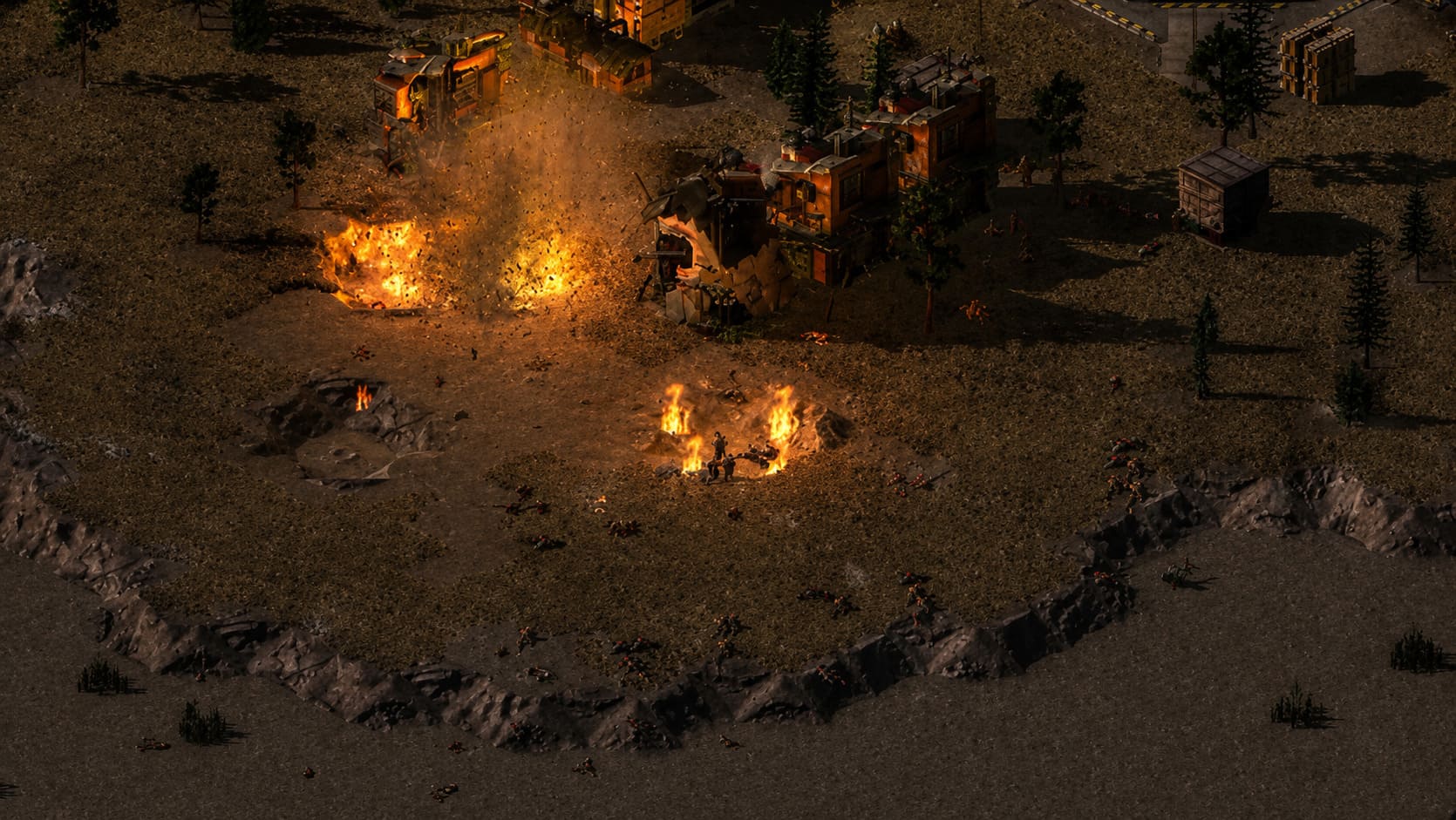
Never Forget the Battlefield After the Fight
D.O.R.F. also gives you another reason to care about where battles happen: wreckage and salvage. When a massive armored vehicle finally goes down, the battlefield isn’t necessarily finished with it. The destroyed machinery can become a valuable source of materials, which means recovering wreckage can help turn a successful defensive battle into an economic advantage.
If the enemy superheavy tank dies close to your lines, I’d absolutely prioritize recovery when the situation is safe. You don’t want to destroy an expensive enemy unit only to let the opponent reclaim valuable resources afterward. Salvage can also reinforce the broader resource war, which is particularly important in a game where advanced production chains require serious investment.
Stealing Technology Is Even Better
And then there’s the wonderfully chaotic possibility of capturing enemy infrastructure. If you can infiltrate an enemy position and take control of an advanced production facility, the entire situation can change. Instead of spending the whole game trying to figure out how to destroy the opponent’s superheavy technology, you may eventually be able to use their own production capabilities against them.
That is the kind of RTS mechanic I always appreciate. It creates stories that don’t come from a scripted campaign. One player builds an enormous armored machine, another player spends twenty minutes dismantling the economy supporting it, captures the technology, and eventually sends an upgraded version of the same nightmare back across the map. That’s much more memorable than simply clicking a counter unit and watching health bars disappear.
My Ideal Anti-Superheavy Strategy
If I were facing a late-game superheavy push, I wouldn’t rely on a single counter. I’d build an entire system around making those tanks miserable. Fast units would raid the economy, scouts would maintain vision, artillery would punish the main column, aircraft would hit exposed armor, and defensive structures would dictate where the fight happens.
The goal isn’t necessarily to destroy the superheavy tank in thirty seconds. The goal is to make every second it spends on the battlefield inefficient. If the enemy spends a fortune on a machine that spends half the battle turning around, searching for targets, sitting under artillery fire, or waiting for supplies, you’ve already won part of the engagement.
That’s ultimately what I like about countering superheavy tanks in D.O.R.F. Real-Time Strategic Conflict. It rewards players who think beyond raw damage numbers. The strongest counter isn’t always the unit with the biggest gun; sometimes it’s the tiny raiding force that cuts the pipeline, the artillery battery hidden behind a ridge, or the scout that keeps a massive armored column permanently exposed.
So when that gigantic enemy tank finally rolls onto the screen, don’t immediately start screaming for your own heavy armor. Take a breath, check the map, look at the supply network, and ask yourself where that monster doesn’t want to be. Make it turn. Make it chase. Make it walk through artillery. Make its economy collapse. A superheavy tank is terrifying when you’re playing its game. The trick is making your opponent play yours.