D.O.R.F. Real-Time Strategic Conflict Story Campaign: The Ultimate 90s RTS Revival Guide
There is something I genuinely miss about old-school real-time strategy games. Not just the graphics or the familiar sound of a tank rolling across a battlefield, but the feeling that your entire base was a machine you had to actually think about. Games like Command & Conquer, Dune 2000, Tiberian Sun, and KKnD could make a simple attack on an enemy refinery feel more important than some huge cinematic set piece in a modern strategy game.
That is exactly why D.O.R.F. Real-Time Strategic Conflict has caught my attention. Developed by DORFteam, this upcoming RTS clearly understands what made the genre so addictive in the first place. It is dirty, mechanical, violent, asymmetric, and completely uninterested in making warfare look comfortable. After spending years playing everything from classic Westwood RTS games to modern strategy experiments, I can already tell that D.O.R.F. is aiming at a very specific audience: players who want their bases to matter and their battles to leave a mess behind.
And honestly, I like that approach.
How to Fix D.O.R.F. Real-Time Strategic Conflict Crash to Desktop on PC
A Darker Kind of RTS World
The setting of D.O.R.F. immediately separates it from the cleaner science-fiction worlds we see in many modern strategy games. Earth has been wrecked by decades of warfare, genetic experiments, environmental disasters, and strange extraterrestrial phenomena. The result isn’t a shiny futuristic civilization filled with perfect buildings and glowing interfaces. It is a rust-covered, polluted nightmare where survival seems to depend on whoever can extract the last useful resources from the ruins.
That atmosphere matters more than it might seem.
I’ve played plenty of RTS games where the story feels like something that exists only between missions. D.O.R.F. appears to be taking a different route. Its campaign is built around a world where resources, territory, technology, and faction identity are all connected. The battlefield isn’t just a place where two armies happen to fight; it is part of the story.
The campaign follows three radically different factions, and that is probably one of the biggest reasons I’m interested in playing through all of it rather than simply picking whichever side has the strongest units.
Three Factions, Three Completely Different Wars
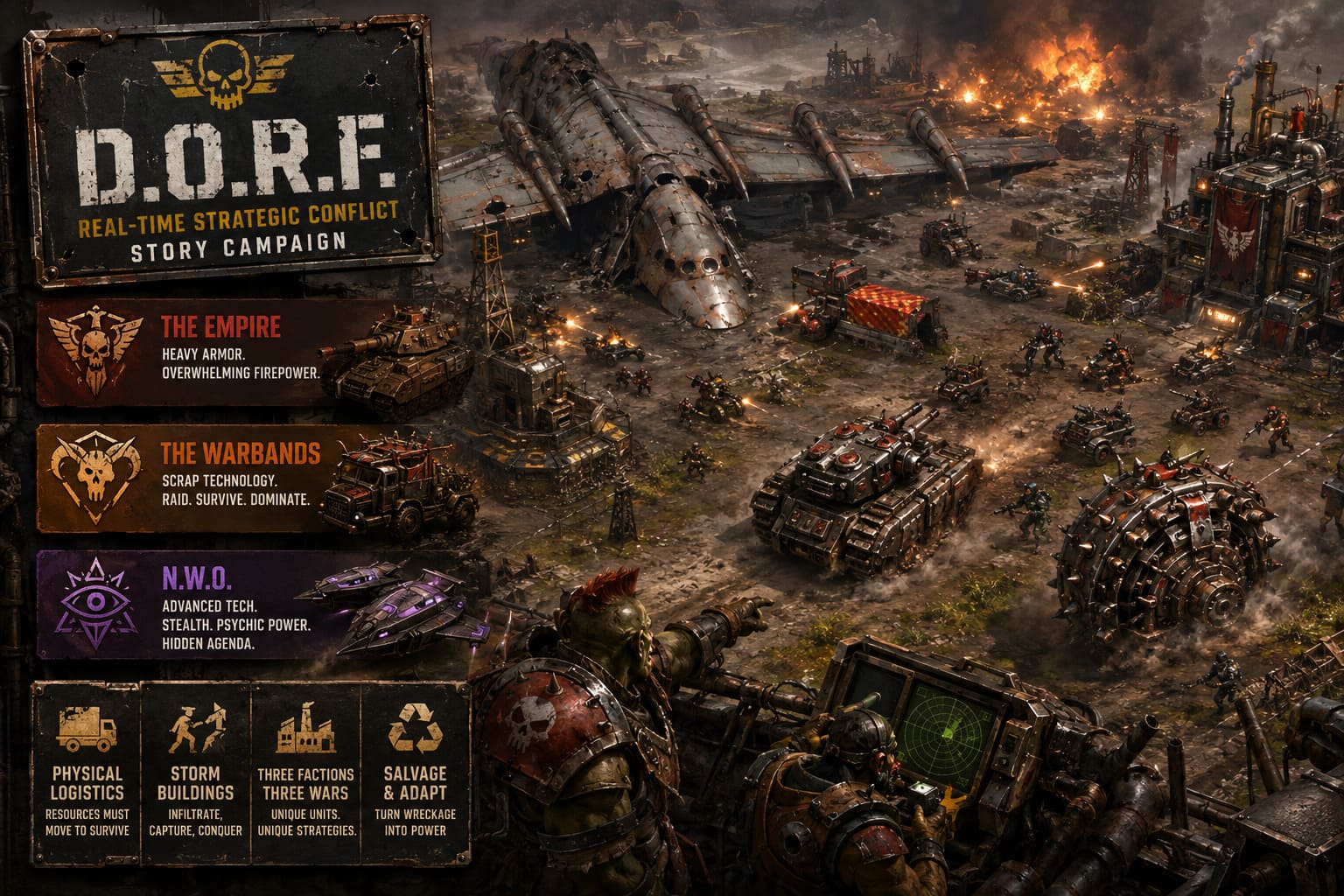
D.O.R.F.’s factions aren’t simply three variations of the same technology tree. Their identities are built around different philosophies of warfare, which is exactly what I want from a modern retro-inspired RTS.
| Faction | Battlefield Identity | Campaign Flavor |
|---|---|---|
| The Empire | Heavy armor, massive machines, overwhelming firepower | Order through military domination |
| The Warbands | Scrap technology, aggressive raids, improvised weapons | Survival in a ruined wasteland |
| N.W.O. | Advanced technology, stealth, psychic abilities | Secrets behind Earth’s mutations |
The Empire: Bigger Guns, Bigger Problems
The Empire is the faction for players who look at a massive tank and immediately think, yes, I want six of those. Their armies are based around industrial production, armor, fortified positions, and brute force.
What makes them interesting isn’t simply that they have big units. Their philosophy appears to revolve around maintaining an old order that is already falling apart. Their campaign should therefore fit naturally with their military-heavy gameplay, with heavily armored vehicles and enormous landships pushing across the battlefield.
I can already imagine the classic RTS scenario: you spend half an hour building a defensive position, slowly assembling an armored column, and then finally decide that the enemy base has had enough time to exist.
That’s my kind of strategy.
The Warbands: Absolute Scrap-Pile Chaos
The Warbands are probably the faction I’d choose first.
They come from the toxic wastelands and survive by scavenging whatever remains after battles. Their machines are improvised, ugly, and completely insane compared with the Empire’s polished military hardware.
Their economy is particularly interesting because battlefield wreckage becomes a valuable resource. That creates a gameplay loop I really like: destroying the enemy can potentially make your own economy stronger.
The Warbands also have bizarre vehicles built from junk, including enormous rolling machines designed to simply crush whatever happens to be in front of them. There is something wonderfully old-school about that design philosophy. Not every unit needs to look elegant. Sometimes you just need a giant metal ball of garbage moving toward the enemy base at terrifying speed.
N.W.O.: The Weird One
Then there is N.W.O., the faction that seems to be hiding the biggest secrets.
The New World Order relies on advanced technology, psychic manipulation, stealth systems, and mysterious anomalous technology. Their campaign is closely tied to the unanswered questions surrounding Earth’s mutations and the strange extraterrestrial events that helped shape the setting.
From a gameplay perspective, this should create the most unusual faction of the three. Cloaking tanks, energy systems, psychic units, and other high-tech abilities can completely change how a player approaches combat.
If the Empire is about force and the Warbands are about improvisation, N.W.O. seems to be about making the opponent fight a battle they don’t fully understand.
The Logistics System Could Be D.O.R.F.’s Secret Weapon
This is where D.O.R.F. becomes much more interesting than a simple nostalgia project.
A lot of classic RTS games had resource gathering, but D.O.R.F. appears to take the idea much further. Oil has to be pumped, ore has to be extracted, and battlefield wreckage can be processed for salvage. More importantly, resources don’t magically teleport into your factories.
They have to physically move through your logistical network.
That sounds like a small detail on paper, but anyone who has played a strategy game with vulnerable supply lines knows how quickly it can become the most important thing on the map.
Imagine building a giant production complex deep inside your territory. It looks practically invincible, you’ve got defensive turrets everywhere, and your factories are producing tanks constantly. Then an enemy raiding force slips around the front line and destroys the transport route feeding your production facilities.
Suddenly, that enormous base isn’t nearly as impressive.
That’s the sort of thing I want to see in an RTS. A base should have weaknesses. If every structure simply works independently and resources teleport from extractor to refinery to factory, there is much less room for clever attacks.
Storming Buildings Adds Another Layer
The infantry combat system is another feature that could make D.O.R.F. stand out.
Specialized ground troops can reportedly assault enemy structures, including bunkers, factories, and fortified positions. Instead of simply destroying a building from the outside, players can actually attempt to take it.
And if you successfully capture an enemy production facility, you can potentially use its technology yourself.
That’s a fantastic idea for campaign missions because it gives players another reason to attack specific buildings. In many RTS games, you destroy the enemy factory because, well, it’s a factory. Here, capturing it could completely change your technological options.
It also creates the possibility of some wonderfully messy battles. Tanks pounding a bunker from outside while infantry try to breach it, enemy reinforcements rushing toward the structure, supply routes getting cut in the middle of the fight — that’s much more interesting to me than simply watching two blobs of units collide.
The Visual Style Gets the Balance Right
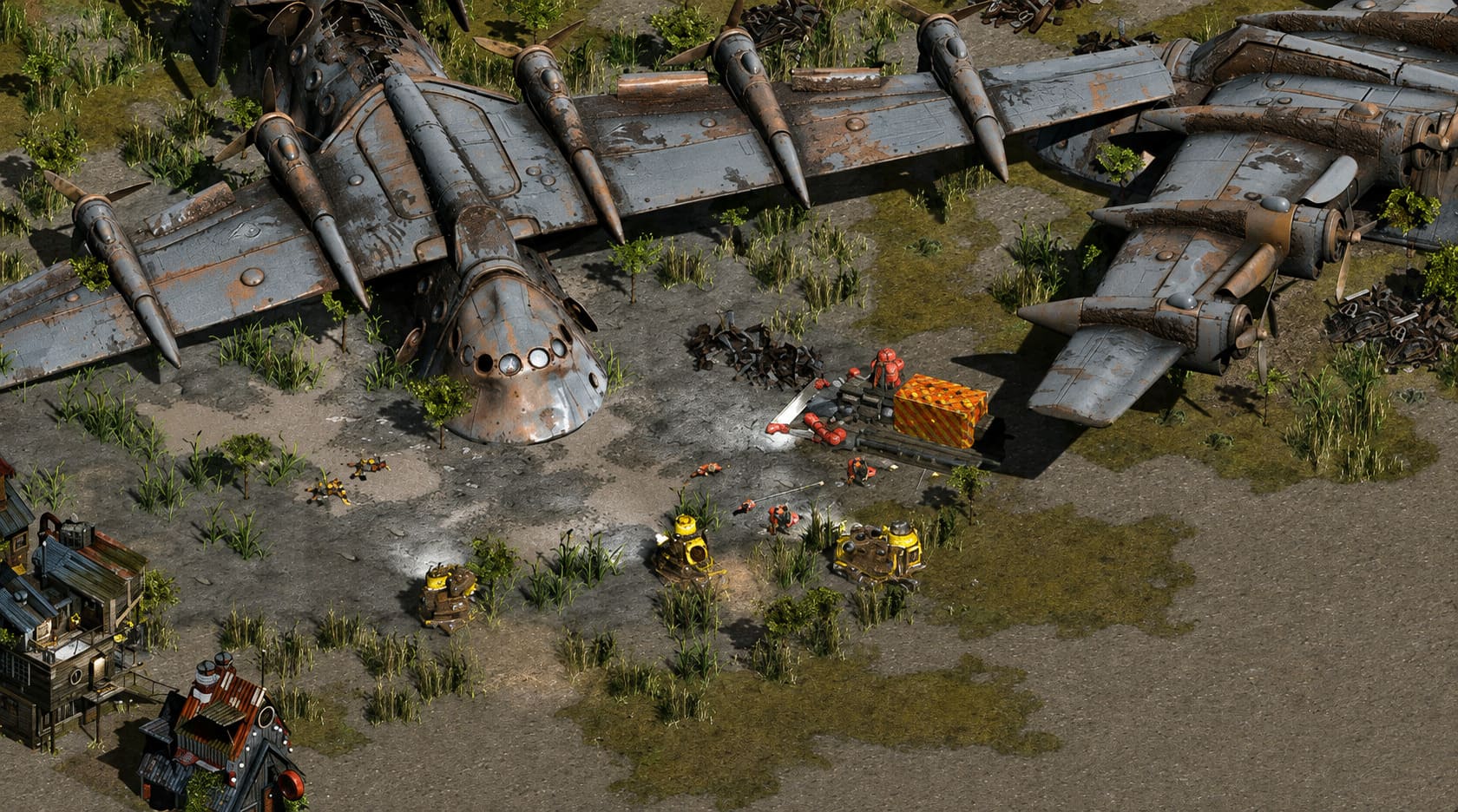
The graphics are another reason D.O.R.F. has been getting attention.
The game uses detailed 2D isometric artwork that clearly takes inspiration from the golden age of PC strategy games, but it isn’t simply copying the old visual style. Modern lighting, shadows, terrain effects, and elevation are being used to make those sprites feel considerably more alive.
Personally, I think this is a much better direction than trying to turn a retro RTS into a full 3D spectacle.
There’s a certain charm to detailed 2D units that modern RTS games rarely reproduce. You can look at a tank and immediately understand its silhouette. Buildings have character. The battlefield feels like a miniature war diorama rather than a generic collection of 3D assets.
The important part will be making sure the visual detail doesn’t hurt readability. RTS games live or die by clarity, especially when dozens or hundreds of units are fighting at once.
Why I’m More Interested in the Campaign Than Multiplayer
Multiplayer will obviously matter for a game like this, but the campaign is what has me most curious.
I’ve played enough RTS campaigns to know that simply giving players different missions isn’t enough. The best campaigns gradually teach you how a faction thinks. They introduce mechanics, force you to change your strategy, and occasionally throw a mission at you that makes you completely rethink everything you’ve learned.
D.O.R.F. seems particularly well suited to that structure.
The three factions offer different economic systems and battlefield philosophies, while the campaign setting provides plenty of opportunities for missions involving resource shortages, supply-line defense, raids, base assaults, and technological discoveries.
If the developers manage to connect those mechanics to the narrative instead of treating them as separate systems, D.O.R.F. could have one of the more memorable RTS campaigns in this current revival of the genre.
Development Is the Big Question
There is one thing I would keep in mind before getting too excited: D.O.R.F. is an ambitious indie project.
The game began as a passion project and expanded considerably as interest in it grew, including support through Kickstarter. That is great news in terms of funding and community interest, but ambition can be a dangerous thing for a small development team.
The developers have been sharing progress updates and showing off faction structures, units, pathfinding improvements, and other systems. The planned release window has been pointing toward late 2026 into 2027, so patience is going to be necessary.
Personally, I would rather wait for a polished RTS than get an unfinished game simply because everyone wants to play it immediately. Complex logistics, asymmetric factions, destructible environments, building assaults, pathfinding, and large-scale battles are exactly the sort of systems that can fall apart when rushed.
D.O.R.F. Isn’t Just Nostalgia
The easiest way to describe D.O.R.F. is probably “”a modern RTS inspired by Command & Conquer,”” but that undersells what the developers are attempting.
The interesting part isn’t the retro aesthetic. It’s the philosophy behind the mechanics.
Resources have to move. Bases have vulnerabilities. Factions actually play differently. Buildings can become tactical objectives. Battlefield wreckage can matter. Infantry can invade structures.
Those systems create opportunities for stories to emerge naturally during a match. That’s something I’ve always loved about the best RTS games. You don’t remember every scripted line of dialogue, but you remember the time a desperate tank survived with almost no health, rolled through an enemy defensive line, and somehow destroyed the refinery that was keeping their entire army alive.
That’s what D.O.R.F. needs to deliver.
If it gets the balance right, this could be much more than a nostalgic throwback for people who grew up with 1990s RTS games. It could be a genuinely modern strategy game that simply remembers why those older games were so much fun in the first place.
For now, I’m watching D.O.R.F. closely. The combination of brutal factions, physical logistics, strange technology, close-quarters assaults, and that wonderfully grimy visual style has convinced me that this is one RTS revival worth keeping on the radar.
And if the Warbands really let me build an army out of battlefield junk and send a gigantic rolling death machine toward someone’s base, I’m already sold.