Halloween The Game Multiplayers Guide: 1v4 Survival and Killer Strategies
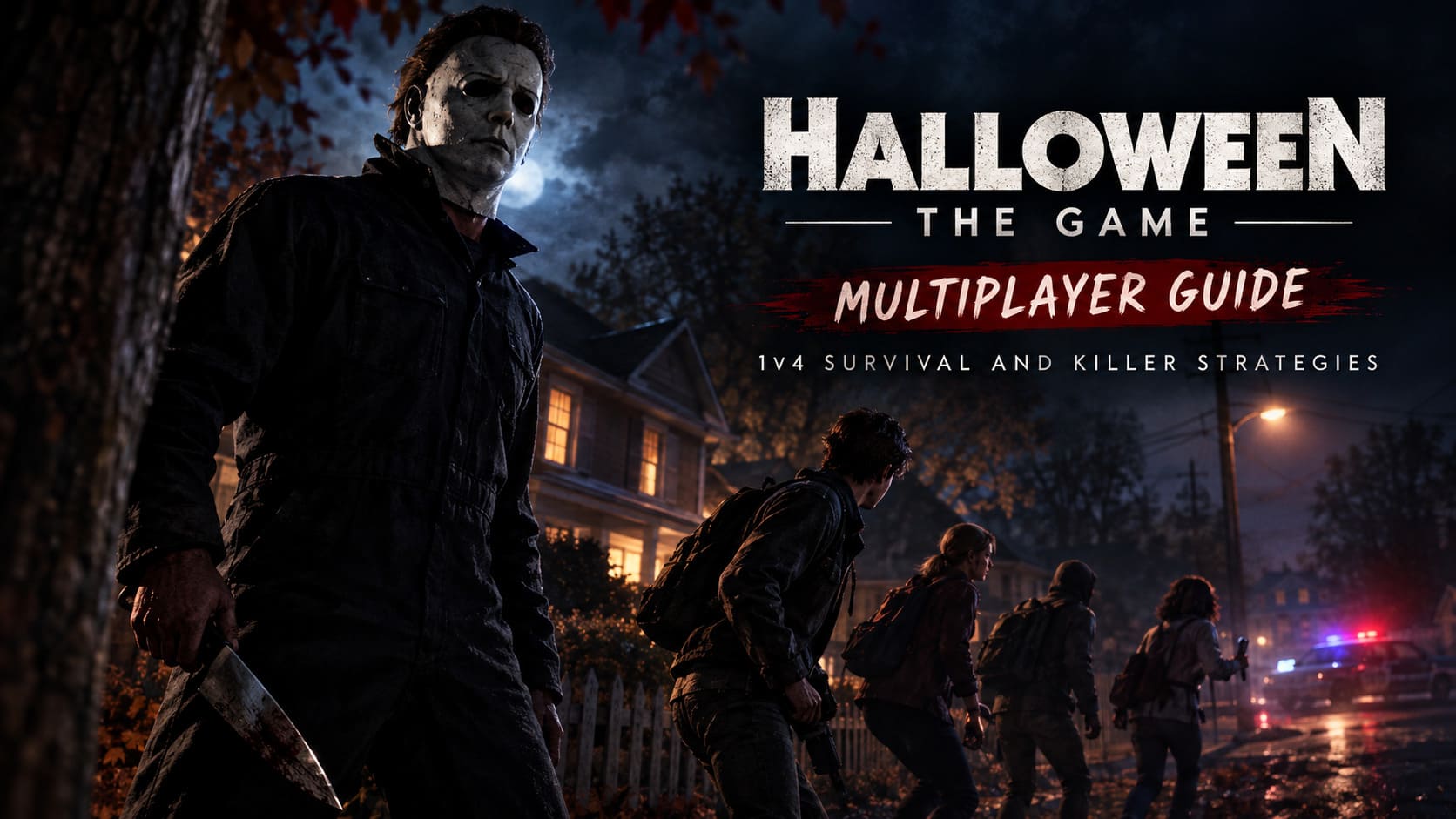
There is something wonderfully cruel about Halloween: The Game. On paper, it looks like another 1v4 horror game: four players try to survive while one player hunts them down. But after spending time thinking through how its systems work, it becomes clear that IllFonic is aiming for something much closer to the slow-burn tension of John Carpenter’s original Halloween.
This is not a game where Michael Myers should be sprinting around the neighborhood like an angry athlete. And Civilians are not supposed to spend the entire match holding down one objective button while a killer chases them in circles.
Instead, stealth, information, NPC behavior, weapons, panic and positioning all feed into the match. That is what makes the multiplayer side of Halloween: The Game interesting.
If you’re planning to play as one of Haddonfield’s terrified residents, you’ll need to understand when to run, when to hide and, more importantly, when not to fight. If you’re playing Michael, forget everything you know about traditional chase killers. The best Myers players won’t necessarily be the fastest. They’ll be the ones you don’t notice until it’s already too late.
Here’s my take on the most important Halloween: The Game multiplayer strategies, including Civilian survival tips, Michael Myers tactics, NPC management, map knowledge and progression.
Halloween: The Game Multiplayer Basics
The core setup is simple:
Four Civilian players versus one Michael Myers.
What isn’t simple is everything happening around them.
Haddonfield is populated by AI-controlled residents, houses contain useful equipment, communication systems can change the state of the match, and the neighborhood’s Panic Meter can eventually turn the entire atmosphere against Michael.
That gives both sides several competing priorities.
| Side | Main Goal | Biggest Strength | Biggest Weakness |
|---|---|---|---|
| Civilians | Survive And Escape | Teamwork And Resources | Limited Combat |
| Michael Myers | Eliminate Residents | Stealth And Stalk | Slow Movement |
| NPC Townsfolk | Survive / Assist | Numbers And Weapons | AI Behavior |
| Police Patrols | Protect Haddonfield | Firepower | Appear Later |
And this is where the game separates itself from the usual asymmetrical formula.
Civilians aren’t simply repairing generators. Michael isn’t just chasing survivors from pallet to pallet. The whole neighborhood becomes part of the match.
Playing Civilian: Survival Is About Information
The biggest mistake a new Civilian can make is assuming that running is always the answer.
It isn’t.
Running creates noise. Noise gives away information. Information gives Michael opportunities.

Your first few minutes should therefore be about learning what’s around you.
Search houses, garages and nearby buildings for useful equipment. Pay attention to NPC residents. Look for communication opportunities. And don’t immediately drag your entire team into the same street.
The goal is to build an advantage before Michael becomes fully dangerous.
Split Up, But Don’t Play Alone
I strongly prefer pairs over a four-person blob.
A group of four looks safe until Michael starts stalking from a hidden position. Suddenly, multiple players can become valuable targets at once, and you’ve effectively given the killer a free progression boost.
Two players can work together while still covering enough ground to complete objectives efficiently.
A simple approach is:
- Pair One: Search houses and collect weapons or utility items.
- Pair Two: Explore another section of the neighborhood and work toward communication objectives.
Keep track of where everyone is, but don’t make your entire team walk shoulder-to-shoulder.
The second Michael appears, your beautiful formation usually becomes four people screaming in different directions anyway.
NPC Neighbors Are More Important Than They Look
One of the mechanics I find most interesting is the ability to interact with the ordinary residents of Haddonfield.
At first, these NPCs are basically civilians living through a normal Halloween night. They don’t automatically understand what is happening. Your job is to convince them that Michael Myers is actually out there.
Once they’re convinced, they can become useful allies.
Depending on the situation, you can give them commands such as:
- Follow
- Hide
- Guard Area
You can also equip certain NPCs with weapons.
That creates some surprisingly useful tactical possibilities.
An armed group of residents can distract Michael, defend an area or potentially knock him down long enough for your team to escape.
But don’t get too attached.
NPCs aren’t a replacement for competent players. Think of them as extra resources and information sources, not super-soldiers.
And when you see a group of previously calm residents suddenly running away in panic?
Pay attention.
That can be one of your cheapest early-warning systems that Michael is close.
Fighting Michael Myers: Hit Him, Then Run
Yes, Civilians can fight back.
No, that does not mean you should turn Halloween: The Game into a beat-’em-up.

Weapons such as baseball bats, pipes, knives and heavier tools can give you a chance to interrupt Michael. A strong hit can even knock him down.
That sounds fantastic until you remember one tiny detail:
He’s Michael Myers.
A knockdown is not a kill.
When he gets back up, you’re right back where you started — except now you’ve probably wasted durability, stamina and positioning.
The correct mindset is to treat weapons as escape tools.
If Michael grabs your teammate, that’s a good moment to intervene. If he’s blocking the only route out of a house, a heavy hit can create the opening you need.
What you shouldn’t do is stand in front of him and repeatedly swing because you’ve watched too many horror movies and suddenly believe you’re the protagonist.
Hit him. Create distance. Break line of sight. Disappear.
That’s the real objective.
Calling the Police Changes Everything
One of the biggest turning points in a match is establishing outside communication.
Civilians can search houses for usable landlines or radios and work toward restoring communication with the authorities.
Once contact is established, a countdown begins.
When it expires, armed police patrols enter the neighborhood.
This is a huge shift in the balance of power.
Police can pressure Michael with gunfire, limit his movement and create safer areas for Civilians attempting to escape.
For that reason, communication objectives should not be treated as optional side quests.
They are part of your long-term win condition.
The tricky part is actually reaching them without advertising your position to Michael.
That’s why stealth and teamwork matter so much in the early game.
Michael Myers Strategy: Stop Playing Like a Traditional Killer
Playing Michael requires patience.
Honestly, if you pick Michael because you want to sprint after people and spam attacks, you’re probably going to have a bad time.
The Shape is frightening precisely because he doesn’t need to rush.
His strongest weapon is information.
Use corners, bushes, fences, darkness, windows and buildings to observe players without immediately revealing yourself.
The Stalk mechanic is central to this playstyle.
As you stalk targets, you build power and gain increasingly valuable tracking advantages. A survivor who doesn’t realize they’re being watched is effectively helping Michael prepare for the next attack.
That’s the fantasy the game should be chasing.
You see someone.
You watch them.
You wait.
They turn around.
You’re gone.
Then they hear something behind them.
That’s Michael.
Don’t Waste Your Stalk Opportunities
The best Michael players should constantly be asking one question:
“Can they see me?”
If the answer is no, there’s usually no reason to immediately attack.
Use environmental cover to build your Stalk progression. Corners, hedges, fences and elevated positions can all become observation points.
Once your power reaches higher levels, Michael becomes significantly more threatening, with stronger attack opportunities and access to brutal execution situations.
This creates a natural rhythm:
Observe → Stalk → Isolate → Attack → Disappear → Repeat
Trying to skip directly from Observe to Attack is how you end up chasing the same experienced player around a house for five minutes.
And that’s exactly what you don’t want.
The Panic Meter Can Make or Break Michael
Michael has another problem: Haddonfield itself can turn against him.
Killing residents increases the neighborhood’s Panic Meter. If panic rises too quickly, ordinary townsfolk can become armed and aggressive.
That means going on a loud killing spree immediately isn’t necessarily optimal.
I would approach the early game almost like setting a trap.
Pick off isolated NPCs.
Move quietly.
Use houses and environmental cover.
Complete Special Target objectives when appropriate.
Then attack the player-controlled Civilians when your Stalk progression and positioning are working in your favor.
The more chaotic the neighborhood becomes, the more difficult Michael’s job can become.
The irony is pretty great: the killer can become a victim of his own success.
Special Targets Are Worth Hunting
At the beginning of a match, Michael receives a list of Special Targets.
These targets should influence your route around Haddonfield.
They’re not just random people to eliminate for bragging rights. Successfully taking down designated targets can provide substantial progression benefits and help Michael reach his stronger phases faster.
Still, don’t become obsessed.
If one player is clearly an expert at escaping you, there’s nothing heroic about chasing them across half the map for several minutes.
Leave.
Find an easier target.
Build your power.
Then come back later.
That’s how a slasher should operate.
Haddonfield Maps: Learn Where People Feel Safe
Map knowledge matters enormously because every environment creates different opportunities.
Haddonfield Heights
This suburban area is packed with larger houses, backyards and fencing.
Civilian players should take advantage of upper floors and windows to break line of sight. Narrow routes between homes can also become useful defensive positions for armed NPCs.
Michael players should pay attention to balconies, rooftops and backyard sightlines. Elevated positions can give you valuable information without requiring an immediate chase.
Haddonfield Town Center
This map is much more exposed, with storefronts, parked cars and open roads.
For Civilians, staying in the middle of a large street is asking for trouble. Use buildings, shops and parked vehicles to stay out of sight.
Michael has fewer natural hiding spots here, but the tighter commercial interiors can be excellent for cutting off escape routes.
Orange Grove Estates
This is probably the environment where stealth feels most important.
Dense vegetation, hedges, trees and construction areas provide plenty of cover.
Civilians can disappear into the environment if they manage their stamina properly.
For Michael, it’s practically a playground.
If you enjoy the stalking side of Halloween, this is the kind of map where patience can pay off massively.
Matchmaking, Killer Tokens and Progression
Halloween: The Game also attempts to address one of the classic problems with asymmetrical multiplayer: everyone wants to play the killer.
Players can queue as:
- Civilian
- Michael Myers
- No Preference
Choosing No Preference can provide faster matchmaking and additional experience rewards.
The Killer Token system is particularly interesting. Players can earn tokens by completing regular matches and then spend them to gain priority access to a Michael Myers match.
That should make the killer queue considerably less frustrating, assuming the system works as intended under real launch traffic.
Progression also goes beyond simply leveling characters.
Players can unlock cosmetics, character customization, Michael Myers appearances, perk options and profile rewards.
For me, the mechanical unlocks are the most interesting part because they should give experienced players reasons to experiment with different builds instead of simply grinding toward another outfit.
My Best Multiplayer Tips
If you’re playing Civilian, remember these four things:
- Stay in pairs instead of moving as one giant group.
- Use weapons to escape, not to duel Michael.
- Watch NPC behavior for early warnings.
- Work toward police communication before the neighborhood becomes chaotic.
If you’re Michael:
- Stalk before attacking whenever possible.
- Don’t chase one skilled player forever.
- Keep Panic under control during the early game.
- Use Special Targets to accelerate your progression.
And above everything else, learn the maps.
Knowing where a window leads, where a fence can be crossed, where an NPC group is located or where a player can disappear behind a house is often more valuable than raw mechanical skill.
Halloween The Game PC Download Size, Storage & System Requirements Explained (2026)
Final Verdict: The Shape Rewards Patience
The thing I like most about Halloween: The Game’s 1v4 multiplayer design is that it seems to understand what makes Michael Myers scary.
He’s not scary because he runs faster than everyone.
He’s scary because he can wait.
Civilians have to worry about what they can hear, what NPCs are doing, where their teammates are and whether that shadow at the end of the street is actually a tree.
Michael has the opposite problem. He has to resist the temptation to attack too early.
That’s where the real strategy lives.
If you treat the game like another generic asymmetrical chase simulator, you’ll miss most of what makes it interesting. But if you start thinking about information, positioning, stealth, panic and resource management, the matches become much more unpredictable.
For Civilian players, survival isn’t about being fearless. It’s about making fewer mistakes than Michael.
For Michael players, winning isn’t about killing as quickly as possible. It’s about making the entire neighborhood feel unsafe.
And honestly, that’s exactly how a Halloween game should work.