Halloween The Game Michael Myers Killer Guide: Best Strategies, Perks, and Abilities to Dominate Haddonfield
There is something strangely satisfying about playing Michael Myers in Halloween: The Game. He is not a character who needs to sprint around the map looking for somebody to hit every five seconds. That would completely miss the point.
Michael is The Shape. He watches. He waits. He disappears into the darkness, and when a Civilian finally realizes he is nearby, it is usually already too late.
That idea is what makes the Killer role in Halloween: The Game so interesting. The game takes place during the events surrounding the infamous Halloween night of October 31, 1978, in Haddonfield, Illinois. Instead of turning Michael into another generic chase-focused horror killer, IllFonic gives him a slower, more deliberate playstyle built around Stalk, stealth, map control, fear, and carefully timed attacks.
I’ve played enough asymmetrical horror games to know that this kind of character can be difficult for new players. Your first instinct is usually to find the four human players and start swinging. Don’t.
If you want to become genuinely dangerous as Michael Myers, you need to think less like a slasher and more like a hunter.
This Halloween: The Game Michael Myers guide covers the abilities, progression, weapons, NPC farming strategy, map control tricks, and the mistakes I would avoid when learning The Shape.
The Golden Rule: Don’t Chase the Survivors Too Early
The biggest mistake new Michael players make is also the easiest one to understand.

You see a Civilian.
You chase them.
They run through a house.
You chase them again.
They vault a window.
You follow.
Five minutes later, you’ve accomplished almost nothing while the rest of Haddonfield is still alive.
Michael doesn’t need to win every chase. In fact, trying to win every chase is often the fastest way to lose control of the match.
The four human-controlled Heroes of Haddonfield are only part of the population. The map also contains AI-controlled residents, and these NPCs are extremely important to Michael’s progression.
At the start of a match, you should be looking for your Special Targets. These residents provide valuable progression and points without forcing you into dangerous player-versus-player situations.
My preferred opening is simple:
- Find Special Targets and isolated NPCs.
- Use Stalk to build your power before attacking.
- Eliminate targets efficiently rather than committing to long chases.
- Sabotage communications and control important areas.
- Only commit to human players when the situation is favorable.
That sounds passive, but it isn’t. You’re creating the conditions for a much stronger mid-game Michael.
Michael Myers Abilities Explained
Michael’s ability kit is what separates him from a conventional melee killer. Several mechanics work together, and learning how they interact is far more important than simply memorizing their names.
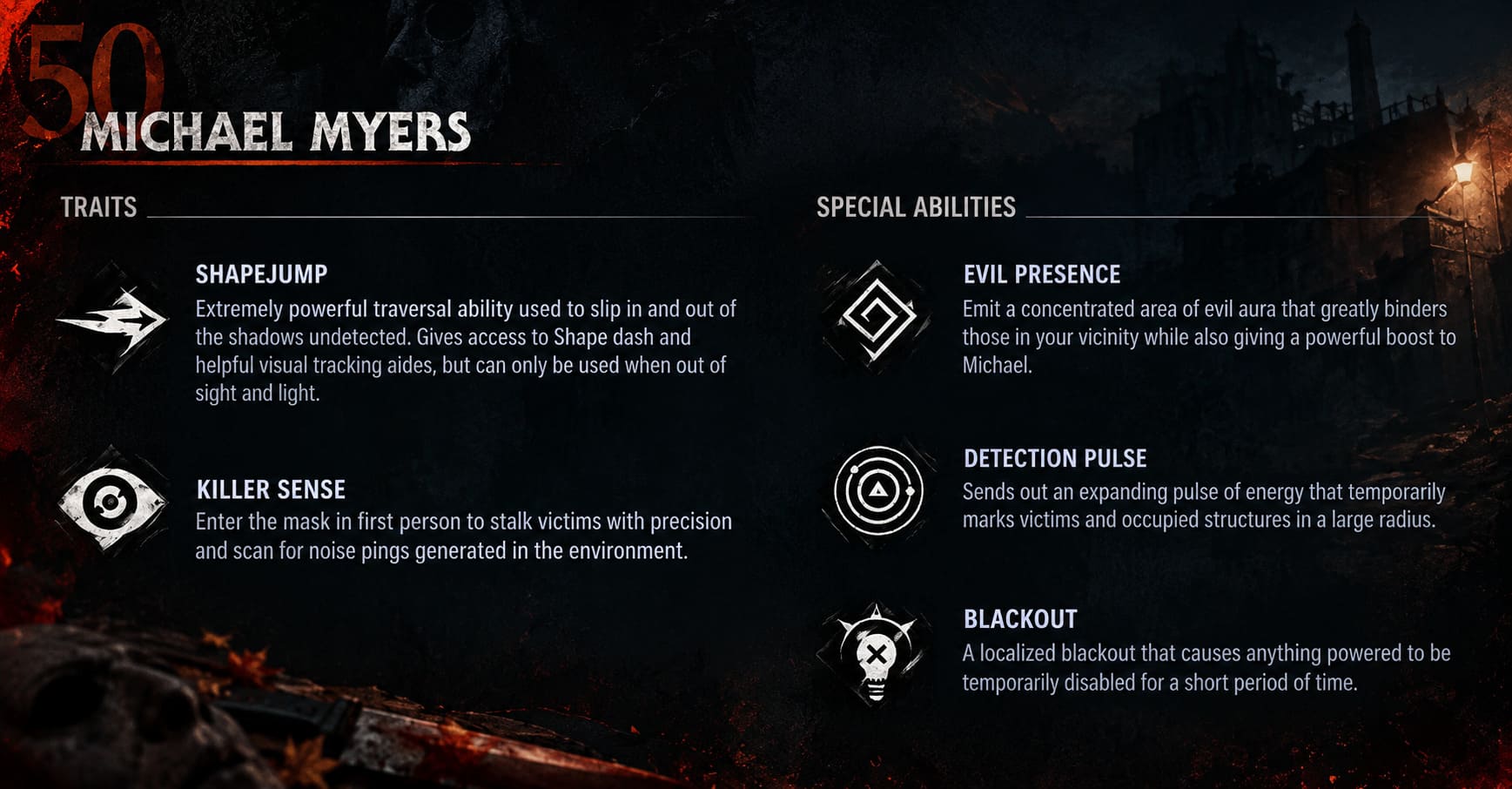
| Ability | Main Purpose | Best Use |
|---|---|---|
| Killer Sense | Detect nearby activity and environmental clues | Finding hidden targets |
| Detection Pulse | Reveals movement and tracking information | Searching buildings and escape routes |
| Stalk | Builds Michael’s power while observing targets | Preparing ambushes |
| Shape Jump | Allows movement through suitable dark entrances | Surprise attacks |
| Shape Dash | Quickly closes distance | Finishing fleeing targets |
| Shape Slip | Fast environmental traversal | Windows, fences, and tight routes |
| Blackout | Removes nearby lighting | Creating stealth zones |
| Bloodthirst | Builds toward stronger combat states | Sustained pressure |
| Reality Tear | Reveals living entities across the map | Endgame tracking |
Killer Sense and Detection Pulse
Killer Sense should become second nature.
Michael isn’t supposed to rely entirely on his eyes. The ability gives you additional information about the environment, including movement-related clues and signs that somebody has been nearby.
Detection Pulse is especially useful when searching houses or areas where a Civilian could be hiding.
If something feels suspicious, stop running around randomly and scan the area.
Listen.
Look for unusual visual indicators.
Check the obvious hiding places.
That extra few seconds can save you from wasting an entire chase.
Stalk Is the Heart of Michael’s Playstyle
If there is one mechanic you need to master, it is Stalk.
Michael becomes significantly more threatening when you build his power before attacking. Instead of immediately rushing a target, use cover and distance to observe them.
The ideal situation is almost cinematic.
A Civilian thinks they are alone.
Michael is standing behind a hedge.
They turn around.
Nothing.
They keep moving.
Michael is still there.
That’s exactly how I like to play him.
Don’t reveal yourself just because you can.
Building Stalk safely gives you more options later. You can move faster, hit harder, and close distance more effectively once your power has developed.
The important part is learning when to stop stalking. Sitting in the same location forever isn’t useful either. Once you’ve reached a meaningful power threshold, transition into the attack.
Shape Jump Makes Darkness Your Best Friend
Shape Jump is one of the mechanics that really sells the fantasy of playing Michael Myers.
Certain darkened entrances and areas allow Michael to bypass obstacles instead of simply smashing his way through them. That means lighting isn’t just cosmetic.
Lighting is part of the map strategy.
A well-lit house can be annoying.
A dark house can become Michael’s playground.
This is why I strongly recommend paying attention to porch lights, garage lights, interior lighting, and other environmental sources. If you can create or exploit darkness, you can create attack routes that the survivors aren’t expecting.
Imagine a player running into a house because they think they’ve escaped.
You don’t follow them through the obvious entrance.
You disappear.
Then you appear inside through a dark entry point.
That is much more effective than running directly behind somebody for thirty seconds.
Shape Dash and Shape Slip: When Stealth Turns Into Violence
Once you have built enough power, Michael becomes much more mobile.
Shape Dash is your gap closer. It is particularly useful against Civilians who have already committed to running in a straight line.
Don’t waste it just because it is available.
I prefer using Shape Dash when the target has limited options. A narrow alley, a doorway, a fence, or a badly chosen escape route can turn the ability into an almost guaranteed hit.
Shape Slip serves a different purpose. It gives Michael better environmental movement, allowing him to navigate windows, fences, and other obstacles more efficiently.
Together, these abilities create an important rhythm:
Watch → stalk → disappear → reposition → strike.
That’s Michael.
Blackout Is More Powerful Than It Looks
Blackout is one of those abilities that becomes much better once you stop thinking about it as a simple darkness button.
Cutting power changes how people move.
AI civilians can panic.
Players lose visibility.
Certain areas become safer for Michael.
And dark entrances become much more useful for Shape Jump.
Whenever possible, I like creating a dark hunting zone before starting a serious attack.
You don’t necessarily need to shut down everything immediately. Think about where the next fight is likely to happen and make that area uncomfortable for the survivors first.
Michael controls the atmosphere when Blackout is used correctly.
Bloodthirst and Reality Tear
Successful attacks, executions, and other interactions contribute toward Michael’s Bloodthirst progression.
Once you’re fully charged, Michael becomes considerably harder to deal with. Survivors can’t simply rely on repeatedly stunning or interrupting him.
The most powerful part of the progression comes when you gain access to Reality Tear.
This ability is extremely valuable when the map becomes chaotic. Instead of guessing where the remaining living characters are, you get a much clearer picture of the battlefield.
I would save this kind of information for moments when the survivors have scattered.
Using a powerful tracking tool when you already know where everybody is doesn’t accomplish much. Using it when three players have disappeared into different parts of Haddonfield?
That’s when it matters.
Early-Game Strategy: Farm the Map Before You Hunt Players
For me, the opening minutes are all about preparation.
Your Special Targets are worth prioritizing because they provide reliable progression and points without forcing you into dangerous player-versus-player situations.
Use Killer Sense to locate them, approach carefully, and start building Stalk before making your move.

Don’t sprint into a house swinging.
Check rooms.
Check closets.
Check under furniture.
Check corners.
The AI civilians can hide when they become frightened, and ignoring those hiding places means leaving easy points on the table.
There is also another benefit.
Every NPC you eliminate reduces the number of resources available to the Heroes of Haddonfield. You’re not simply farming points. You’re gradually making the map less useful to your opponents.
That’s why I consider NPC hunting one of the strongest Michael Myers strategies in Halloween: The Game.
Weapons: Which Michael Myers Loadout Should You Use?
Michael’s weapon choices offer different advantages, so there isn’t necessarily one universal answer.
| Weapon | Strength | Ideal Playstyle |
|---|---|---|
| Kitchen Knife | Fast attacks and recovery | Aggressive close combat |
| Meat Cleaver | Strong heavy attacks | Execution-focused play |
| Hatchet | Ranged pressure | Punishing fleeing targets |
| Pitchfork | Excellent reach | Controlling tight spaces |
The Kitchen Knife is a comfortable starting weapon because its attack speed makes it forgiving.
The Meat Cleaver is more interesting if you enjoy heavier attacks and executions. Landing a well-placed heavy hit can dramatically shorten an encounter.
The Hatchet gives Michael something his basic melee weapons don’t: ranged pressure. A fleeing target who thinks they’re safe in an open street suddenly has another problem to worry about.
Then there’s the Pitchfork.
The reach is the big selling point. In tight areas where survivors normally expect to dodge around Michael, that extra distance can make a huge difference.
Personally, I’d pick based on the map and the type of match you’re expecting rather than blindly using the weapon with the highest theoretical damage.
Don’t Ignore Perks and Graveyard Progression
Michael’s progression system gives you additional ways to specialize your Killer.
If you’re building a stealth-oriented setup, tracking and information perks make a lot of sense.
If you prefer controlling the map, cooldown reduction can be extremely valuable.
My priority would generally look something like this:
- Tracking and detection
- Cooldown reduction
- Blackout-focused utility
- Stalk-related improvements
- Combat bonuses
The exact ideal build can change as the game receives balance patches, so I wouldn’t treat one perk combination as permanently optimal.
The important principle is simple: your perks should support the way you actually play Michael.
If you constantly lose targets because you can’t find them, more damage isn’t going to fix the problem.
Map Strategy: Where Michael Feels Most Dangerous
Haddonfield Suburbs
This is the map that most naturally fits Michael.
There are houses everywhere, fences, backyards, hedges, and plenty of opportunities to disappear from sight.
Use Shape Jump and darkness aggressively here.
Don’t always approach from the street. Sometimes the best attack starts from a backyard or an unlit side entrance.
Haddonfield Town Center
The town center changes the equation.
There are more open spaces and longer sightlines, meaning stealth can be harder to maintain. On the other hand, those sightlines are excellent for building Stalk if you have a safe position.
I like controlling alleys and choke points rather than wandering around the center.
Make the survivors come through areas where you have the advantage.
Orange Grove Estates
This area is much more open and heavily dependent on foliage and darkness.
That makes Blackout especially useful.
Use vegetation as cover, cut the lights when possible, and avoid standing in large open areas without a reason.
The map rewards patience.
Stop the Police Before They Become a Problem
One of the easiest ways for a Michael player to lose control is allowing the survivors to establish reliable communication.
Telephone lines, radios, and related infrastructure can give the Heroes of Haddonfield a route toward calling for help.
And once the police arrive, your quiet little hunting trip becomes much more complicated.
That’s why communication sabotage should be part of your normal rotation.
If you’re hunting one side of the map, check the nearby communication infrastructure. If you hear an obvious phone or communication cue, don’t stubbornly continue a chase just because you’ve already damaged the target.
Break the communication attempt.
Then go back to hunting.
A dead survivor gives you points.
A successful emergency call can potentially create a much bigger problem.
Halloween The Game Multiplayers Guide: 1v4 Survival and Killer Strategies
Five Michael Myers Tips I Actually Recommend
1. Drop Bad Chases
If somebody is looping you around a safe structure for too long, leave.
Seriously.
Go kill an NPC. Build your power. Control another part of the map.
Your ego doesn’t need to win every chase.
2. Make Darkness Work for You
Lights aren’t decoration.
Destroy or disable them where appropriate and create areas where your movement abilities become stronger.
3. Play With Headphones
Audio information matters enormously.
Footsteps, breathing, movement, environmental sounds, and other cues can tell you where somebody is before you actually see them.
4. Spend Progression Points With a Plan
Don’t grab random perks simply because they’re available.
Build toward a role: tracking, stealth, cooldown management, or combat pressure.
5. Don’t Reveal Yourself Too Soon
This is probably my favorite Michael rule.
If the survivors know exactly where you are, you’ve lost one of your biggest advantages.
Sometimes the smartest move is to stand back and watch.
Let them make the mistake first.
Then punish it.
Halloween The Game PC Download Size, Storage & System Requirements Explained (2026)
Final Thoughts: Become The Shape, Not Just Another Killer
Michael Myers is at his best when you stop playing him like a traditional asymmetrical horror killer.
You don’t need to sprint from one target to another.
You don’t need to finish every chase.
And you definitely don’t need to announce your presence at the beginning of every encounter.
The strongest Michael players control the pace of the match.
Farm Special Targets early. Build Stalk. Use Killer Sense intelligently. Create darkness with Blackout. Learn the best Shape Jump routes. Keep communication infrastructure under control. Then, when the survivors finally become vulnerable, strike hard.
That’s what makes playing Michael in Halloween: The Game so satisfying.
There is a huge difference between simply controlling Michael Myers and actually feeling like The Shape.
The first player runs around Haddonfield looking for somebody to hit.
The second player makes Haddonfield feel unsafe.
And that’s the Michael I want to play.