The Blood of Dawnwalker Full Story Plot Explained: Ending and Lore Breakdown
The Blood of Dawnwalker is the kind of RPG that immediately caught my attention because it does something many modern open-world games are afraid to do: it makes time matter.
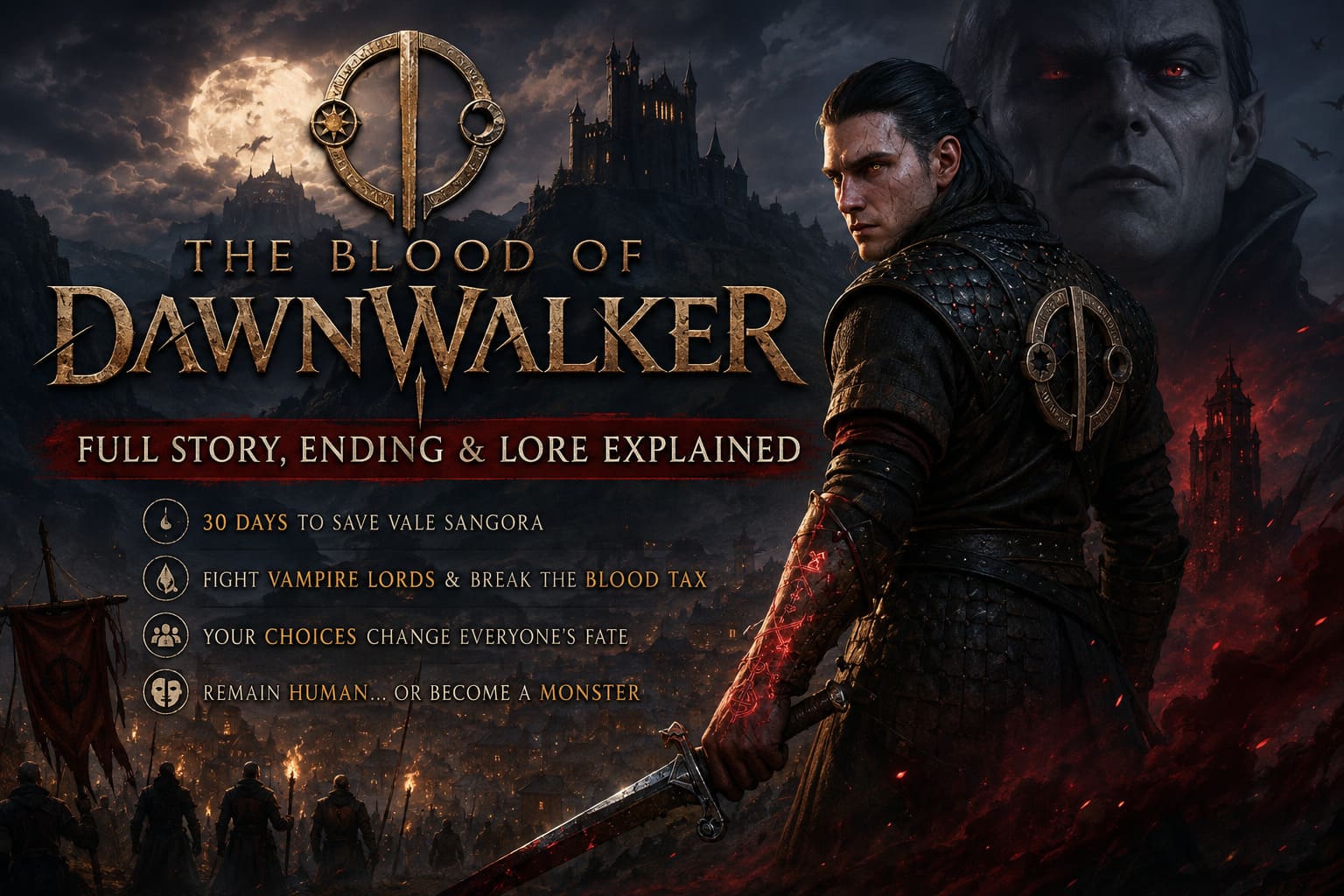
Instead of giving players a gigantic map and essentially telling them to finish everything whenever they feel like it, Rebel Wolves builds the entire story around pressure. You have a limited number of days to save Coen’s family, weaken the vampire regime controlling Vale Sangora, build alliances, and eventually confront Kinyaz Brencis.
And the interesting part is that you simply cannot do everything.
That single idea gives The Blood of Dawnwalker a very different flavor from a traditional fantasy RPG. Your missed quests are not just content you can come back to later. Some opportunities disappear permanently. People can die. Settlements can fall. Relationships can change. Even Coen himself can become a very different person depending on how you play him.
Here is my full breakdown of the Blood of Dawnwalker story, lore, Coen’s transformation, the vampire factions, the 30-day system, and the major ending paths.
Vale Sangora Is Already Broken Before the Vampires Arrive
The story takes place in an alternate version of 14th-century Europe, inside the isolated region of Vale Sangora, hidden among the Carpathian Mountains.
Humanity is already in terrible shape. Wars have devastated the surrounding kingdoms, political authority is collapsing, and the Black Death has ripped through the population.
That detail is important because the vampires don’t conquer a healthy society.
They arrive when civilization is already on its knees.
The vampire ruler Kinyaz Brencis and his Vrakhiri see an opportunity. They crush the remaining human forces, overthrow the local rulers, and establish their own brutal order.
But Brencis doesn’t simply kill everyone.
Instead, he creates a system that is arguably much more disturbing.
The Blood Tax
The surviving humans are essentially turned into livestock.
Adults are required to surrender blood during the full moon, creating the so-called Blood Tax. In return, Brencis provides protection from the plague through his ancient vampiric blood.
That’s where the game’s moral ambiguity becomes interesting.
The vampires are monsters, obviously. But their rule also prevents people from dying from the disease that was already destroying Vale Sangora.
So what happens when an evil regime genuinely provides something its victims desperately need?
That is one of the questions I find most interesting about the setting. The Blood of Dawnwalker isn’t interested in giving Coen a world where every decision has an obvious answer.
The Three Vampires Who Control Vale Sangora
Brencis doesn’t personally manage every part of his empire. He places three powerful vampire officers in charge of different areas.
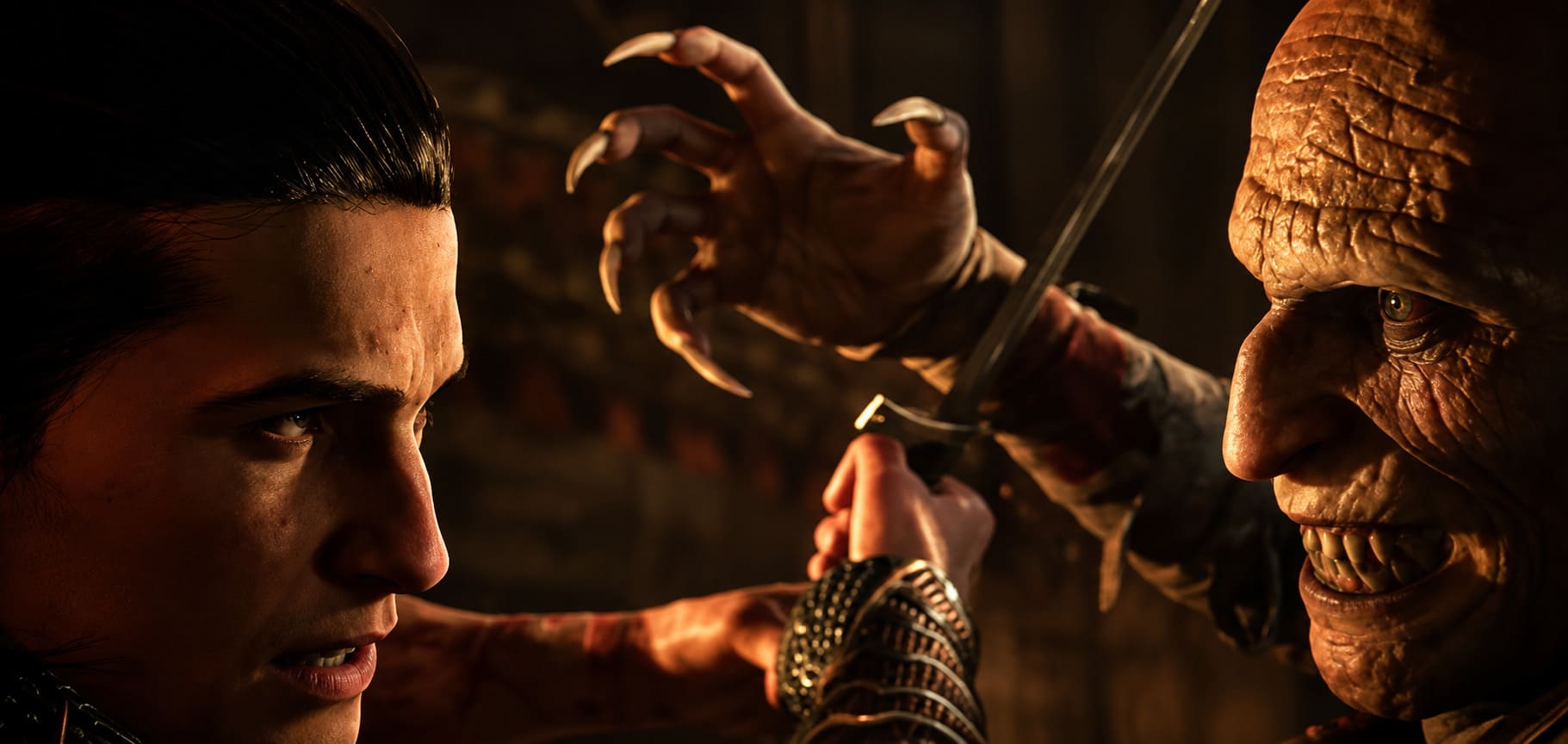
| Vampire | Role | Main Threat |
|---|---|---|
| Umbress | Blood Tax enforcer | Draining dungeons and human prisoners |
| Bakir | Warrior and distillery master | Violence, blood production, vampire decadence |
| Zanthia | Occult researcher and military leader | Blood Guards and dark experimentation |
Umbress is the youngest and reportedly one of the most sadistic members of the ruling structure. Her job is closely connected to enforcing the Blood Tax, including the imprisonment and draining of humans who refuse to cooperate.
Bakir is the physical powerhouse. His role is tied to combat, blood production, and the darker pleasures of the vampire elite. His presence also makes the hierarchy feel less like a collection of supernatural creatures and more like an actual functioning regime.
Then there is Zanthia, who may be the most dangerous from a strategic perspective. Her experiments result in the creation of the Blood Guards, heavily enhanced soldiers designed to crush resistance.
The three officers aren’t simply boss fights waiting at the end of questlines. They represent different pieces of Brencis’ system.
Destroying them is therefore about dismantling the machine that keeps Vale Sangora under control.
Coen’s Story Begins With His Family
The protagonist, Coen, isn’t introduced as some legendary warrior destined to save the world.
He’s a young man from the mining village of Laslea.
Coen grew up working in the silver mines with his father. He dreams about seeing the world beyond the valley, but his responsibilities keep pulling him back toward his family.
That makes the opening conflict much more personal than the usual fantasy RPG setup.
Coen isn’t fighting because an ancient prophecy says he has to.
He’s fighting because his family is in danger.
His little sister Lunka becomes infected with the Black Death, putting the family in an impossible situation. In the brutal world of Vale Sangora, infection can mean execution.
Coen refuses to simply accept that fate.
Things become even worse when rebellion begins to grow around his family. The resistance believes silver could be turned into weapons capable of hurting the vampires, giving the desperate humans at least one possible advantage.
Naturally, Brencis discovers what is happening.
And that’s when Coen’s life completely falls apart.
Brencis Turns Coen Into Something He Never Intended to Be
During the massacre in the mines, Brencis doesn’t kill Coen.
Instead, he infects him with vampire blood.
The intention appears to be simple: turn Coen into another servant.
But something goes wrong.
Coen survives the transformation and becomes a Dawnwalker.
This is the central supernatural idea behind the entire story.
What Makes a Dawnwalker Different?
Coen effectively exists between two worlds.
During the day, he can retain his human form and walk beneath the sunlight. He still has his human emotions and can interact with the world in ways ordinary vampires cannot.
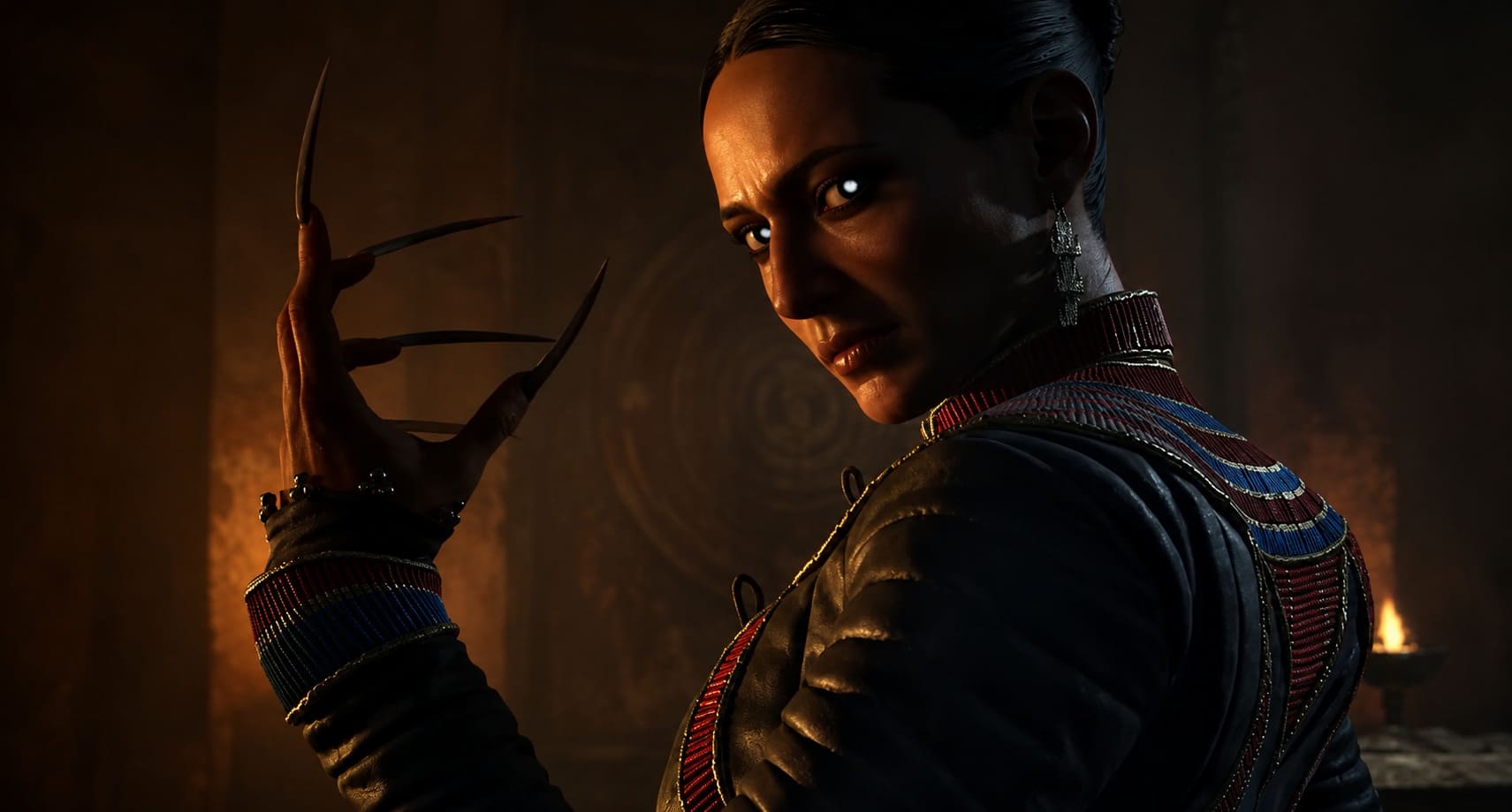
At night, however, his vampire side becomes much stronger.
He gains supernatural abilities, enhanced physical strength, greater mobility, and access to dark powers. The price is his hunger.
And that creates one of the game’s most interesting gameplay and narrative conflicts:
The stronger Coen becomes, the harder it can be to remain human.
After his transformation, Coen eventually confronts Brencis but is hopelessly outmatched. Brencis impales him and leaves him exposed to the coming sunrise, assuming the sunlight will finish the job.
It doesn’t.
Coen survives.
He wakes in the home of Anca, a mysterious herbalist and occult practitioner who understands that Coen is something the vampire court has never seen before.
Anca and the Real Beginning of the Dawnwalker Story
Anca becomes one of the most important figures in Coen’s transformation.
She teaches him about the supernatural forces surrounding Vale Sangora and helps him understand how to use the abilities inside him rather than simply being consumed by them.
But Anca also delivers the worst possible news.
Coen’s village has been destroyed.
His family has been captured.
And Brencis’ forces intend to use them as part of a public execution designed to crush whatever remains of human resistance.
Coen now has a deadline.
Thirty days.
That’s the point where the story of The Blood of Dawnwalker becomes much more than a revenge tale.
The 30-Day System Is the Heart of the Game
This is probably the mechanic that makes the entire premise work.
You have 30 days and 30 nights to prepare for the final confrontation.
The world doesn’t simply run on a normal clock where every minute automatically eats away at your campaign. Instead, major activities consume chunks of your available time.
Investigations, important missions, resting, traveling for specific objectives, and other major actions can all affect your remaining time.
And the game tells you what you’re committing to before you make the decision.
That’s important because there is no perfect playthrough.
You cannot rescue everyone.
You cannot complete every quest.
You cannot build every relationship.
You cannot investigate every corner of Vale Sangora.
And honestly, I think that’s one of the smartest ideas in the game’s design.
Most RPGs teach players that they should eventually collect everything. The Blood of Dawnwalker instead asks you to accept that some things will be lost because you chose something else.
If you spend precious time improving equipment, another settlement might fall.
If you chase one vampire officer, another problem may escalate elsewhere.
If you spend time helping a faction, another faction might become unavailable.
Your lack of action can be just as important as your actions.
Coen’s Blood Hunger Changes More Than Combat
Coen’s vampire curse isn’t just a flashy combat system.
He needs blood to maintain his supernatural abilities, especially at night. That means the player constantly has to decide where that blood comes from.
You can feed on enemies and other creatures, but the temptation to feed on innocent humans can become increasingly difficult to ignore.
And the game ties that choice directly to Coen’s identity.
Give in to the hunger and you become stronger. Resist it and you preserve more of your humanity.
The consequences can extend beyond combat.
Coen’s relationship with ordinary people can change. Some characters may become frightened of him. Merchants and potential allies can react differently. Certain paths can become unavailable depending on how far he falls.
This is where the vampire fantasy becomes genuinely uncomfortable.
The easy solution is often the morally ugly one.
The Factions That Can Shape Coen’s Future
Coen also needs allies if he wants any chance of challenging Brencis.
Three major groups stand out:
- The Human Resistance – desperate survivors trying to restore human rule while struggling to trust a vampire-powered Coen.
- The Heretical Cult – extremists who see the vampires as divine beings and offer forbidden occult knowledge.
- Rogue Vampires – members of the Vrakhiri who oppose Brencis and want their own chance at power.
None of these alliances are completely clean.
The resistance may distrust Coen.
The cult can provide dangerous magical knowledge.
The rogue vampires may help destroy Brencis while having their own ambitions for what comes afterward.
That makes faction decisions feel more meaningful than simply selecting a “good” or “evil” reputation path.
Blood of Dawnwalker Endings Explained
The ending of The Blood of Dawnwalker depends heavily on what Coen accomplished during his limited preparation period.
There isn’t one universal conclusion that every player will see.
Instead, the state of Vale Sangora, Coen’s humanity, his alliances, and the fate of his family can all influence the final outcome.
| Ending Path | Coen’s Direction | Possible Outcome |
|---|---|---|
| Human Savior | High humanity, strong resistance | Brencis falls and human rule can return |
| New Tyrant | High Blood Hunger, vampire alliances | Coen replaces Brencis |
| Desolation | Poor preparation, extreme hunger | Coen loses himself and Vale Sangora collapses |
The Human Savior Path
This is the closest thing to the traditional heroic ending.
Coen prioritizes his family, protects his remaining humanity, builds relationships with the resistance, and works toward destroying Brencis’ regime.
The vampire ruler falls, the Blood Tax can end, and the humans finally have an opportunity to rebuild.
But even this ending isn’t exactly cheerful.
Coen remains a Dawnwalker.
He isn’t magically cured. His existence is still unnatural, and his family has to live with the knowledge that the person who saved them is also something they should fear.
That bittersweet quality fits the tone of the game perfectly.
The New Tyrant Path
This is where Coen stops fighting his nature and starts embracing it.
If you repeatedly give in to Blood Hunger and work with vampire factions, Coen can become less interested in saving the old human world and more interested in controlling it.
Brencis becomes an obstacle rather than the ultimate evil.
Once Coen defeats him, the throne becomes available.
And Coen can take it.
The irony is brutal: he begins the story trying to save his family from a vampire tyrant and can potentially end it by becoming the next one.
The Desolation Path
The bleakest possibility comes from failing to prepare properly.
If Coen doesn’t find enough allies, fails to locate his family, and allows the deadline to arrive without the strength necessary to challenge Brencis, the consequences become catastrophic.
His family can be lost.
His remaining humanity can disappear.
At the extreme end of the Blood Hunger system, Coen becomes less like a person and more like a monster.
Instead of saving Vale Sangora, he can become one of the things that destroys it.
Why the Story of The Blood of Dawnwalker Works for Me
What makes The Blood of Dawnwalker interesting isn’t simply the vampire setting.
We’ve had plenty of vampire games.
It’s the pressure behind every decision.
Coen isn’t deciding between good and evil from the comfort of a save file where everything can eventually be completed. He’s constantly choosing what matters most.
Do you save the village or pursue the vampire officer?
Do you spend time becoming stronger or help someone who may never repay you?
Do you feed on a helpless human because it makes the next fight easier?
Do you trust vampires who claim they want to overthrow Brencis?
Those questions make the story feel personal.
And I particularly like that Coen’s greatest enemy isn’t necessarily Brencis.
It might be the version of himself he becomes while trying to defeat him.
Crimson Moon Best PC Graphics Settings: 2026 Optimization Guide for High FPS
Final Thoughts
The Blood of Dawnwalker has the ingredients for a memorable dark fantasy RPG: a collapsing medieval world, vampires ruling over desperate humans, occult mysteries, a protagonist caught between humanity and monstrosity, and a narrative system where time itself becomes a resource.
But the 30-day structure is what really sells the concept.
Knowing that you cannot save everyone makes every choice heavier. Knowing that Coen’s hunger can make him stronger while slowly destroying his humanity gives the combat a narrative consequence. And knowing that the ending can reflect your priorities makes the journey through Vale Sangora feel like your version of the story, rather than a checklist of predetermined missions.
For me, that’s the biggest appeal.
Coen isn’t a chosen hero walking toward a guaranteed victory.
He’s a desperate young man with a vampire curse, a family waiting to die, and only thirty days to decide how much of himself he’s willing to sacrifice to save them.
And honestly, that’s a much more interesting premise than another fantasy RPG where the hero simply has to kill the big bad at the end.