Lucia in GTA 6: Why This Feels Like a New Era for Rockstar
I’ve been covering Rockstar games for years on stream, and I’ve seen every cycle play out the same way: teaser drops, internet explosion, lore debates, and then endless “this changes everything” videos.
But with the reveal of Lucia in Grand Theft Auto VI, something feels slightly different. Not just hype—actual curiosity about where the franchise is heading.
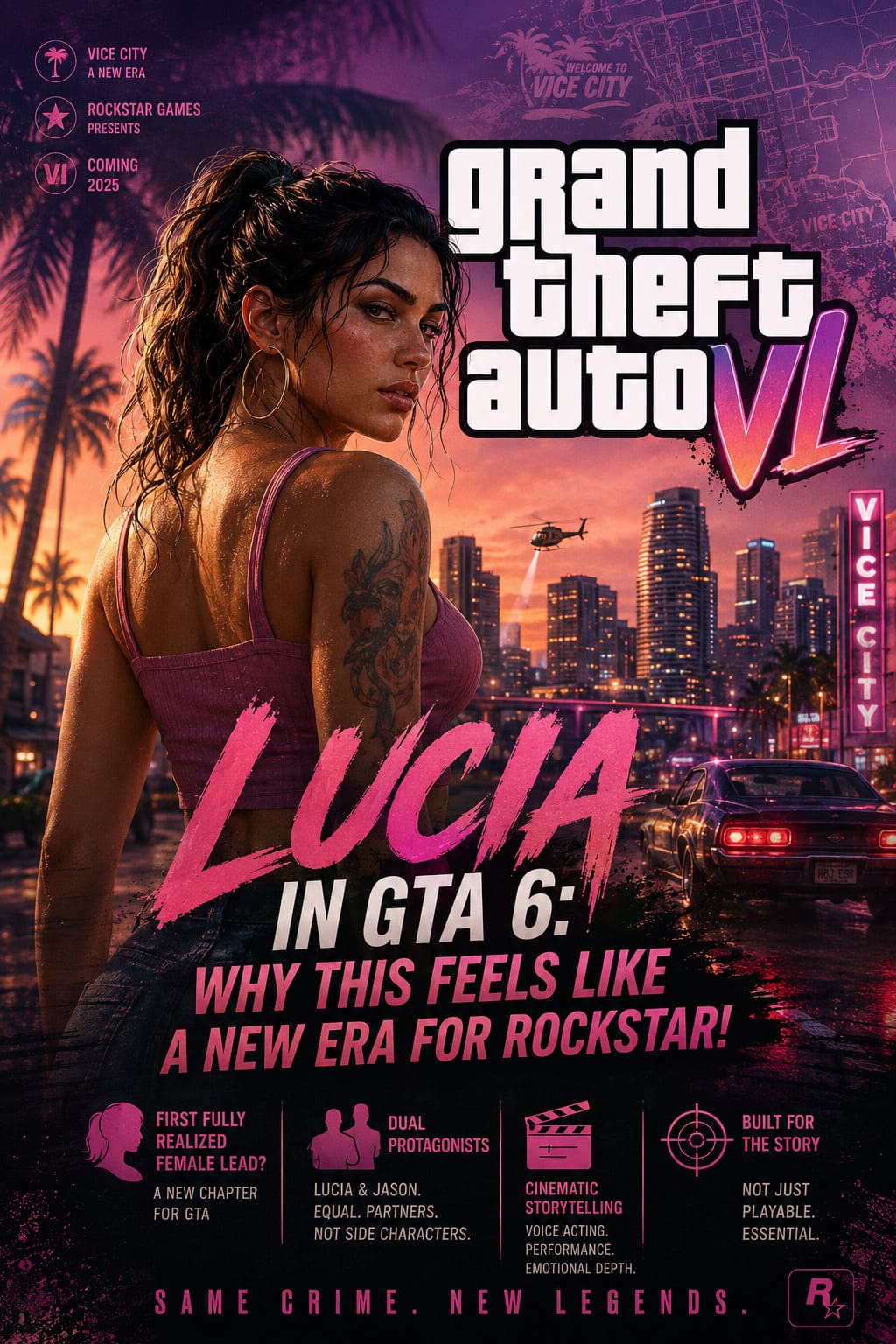
And the same question keeps coming up again and again: is Lucia really the first female protagonist in GTA? The short answer is no. The long answer is way more interesting than people expect.
GTA 6 Story Rumors: A Breakdown of Lucia, Jason, and Crime Romance
My First Reaction as a Streamer
When I first watched the GTA VI trailer live with chat, I expected the usual reaction: memes, chaos, maybe some Vice City nostalgia. But what stood out wasn’t just the world—it was Lucia.
Not as a side note. Not as a marketing checkbox. But as a fully present character clearly designed to exist at the center of the story alongside Jason.
On stream, you can usually feel when something hits differently. Chat didn’t just spam hype—they started digging into lore, arguing definitions, pulling old references from the early days of the franchise. That alone told me this character is going to be discussed for a long time.
The Forgotten Early History of GTA Characters
Before GTA became a cinematic open-world franchise, it looked very different. In the original top-down era, players could choose between multiple criminal avatars, including female ones. But those characters were not written protagonists in the modern sense.
They didn’t have voice acting, personal story arcs, emotional development, or narrative identity. They were essentially selectable gameplay profiles inside a chaotic sandbox system.
Lucia in GTA 6: Why the Internet Thinks It’s Manni L. Perez
This is where most online arguments start. Some players define “first female protagonist” as simply “first playable female character.” Others define it as a fully authored narrative role. Those two definitions completely change the conclusion.
From Sandbox Avatars to Written Characters
The turning point for the franchise came when Rockstar shifted toward cinematic storytelling in Grand Theft Auto III. From that point forward, the series stopped treating characters as selectable templates and started building them as authored personalities.
This shift defined everything that followed: Vice City, San Andreas, GTA IV, and GTA V. Each game had a fixed protagonist or set of protagonists with defined identities, motivations, and arcs.
And for decades, those protagonists were male-only in the mainline story structure.

Why GTA Online Complicates the Debate
Then came GTA Online, which completely changed the equation. In Grand Theft Auto Online, players can create fully customized characters, including female avatars, and build entire criminal empires across a shared online world.
But here’s the key distinction I always bring up on stream: those characters are not authored. They are player-driven identities, not narrative-driven protagonists.
There is no fixed personality, no canonical backstory, and no scripted emotional arc. The character exists as a vessel for gameplay, not storytelling.
Why Lucia Actually Matters
What makes Lucia different is not just that she is playable—it’s how she is framed. Everything shown so far suggests she is part of a dual-protagonist structure with Jason, built around a Bonnie-and-Clyde style dynamic.
And more importantly, she is not framed as secondary. She is not passive. She is not background support. She is directly involved in the action, planning, and emotional core of the narrative.
From a storytelling perspective, that matters more than any technical classification debate.
What Makes Lucia Stand Out
- She appears to have a fully defined backstory and personality
- She is part of a co-lead narrative structure, not a side role
- Her presence is integrated into core story moments, not optional gameplay
- She is designed with cinematic performance capture and voice acting

Simple Comparison of GTA Character Eras
| Era | Character Type | Narrative Depth | Identity Style |
|---|---|---|---|
| Early GTA (2D era) | Selectable avatars | Minimal | Gameplay-based identity |
| GTA Online | Custom character | Player-defined | Sandbox identity |
| Modern GTA | Written protagonists | High | Story-driven identity |
| GTA VI (Lucia era) | Co-lead protagonist | Very high (expected) | Cinematic narrative identity |
Why the Community Can’t Agree
Every time this topic comes up, the community splits into familiar groups. As someone who reads chat reactions in real time, I’ve noticed the same patterns everywhere—from Reddit threads to YouTube comments.
1. Lore-focused players
These players care about technical accuracy and franchise history. They will always bring up early games and argue definitions.
2. Story-focused players
These players only care about modern narrative structure. If a character leads a cinematic story, that’s what matters to them.
3. Casual hype players
This is the largest group. They just want a good game and judge Lucia based on vibes, trailers, and presentation.
My Perspective After Years of Covering Rockstar Games
From a content creator perspective, I don’t think the “first female protagonist” argument is the real point. It’s a labeling debate, not a design discussion.
What actually matters is that Lucia represents a shift in how Rockstar builds characters. Not as optional roles or background elements, but as fully integrated narrative drivers.
If Rockstar executes this well, Lucia won’t be remembered because she was “first.” She’ll be remembered because she felt essential to the story in a way previous entries didn’t attempt with a female lead.
Conclusion: A Shift, Not Just a Label
Lucia is not the first female character ever playable in GTA history. That part is easy to prove. But she may be the first fully realized female lead in a mainline cinematic GTA story, built with equal narrative weight alongside another protagonist.
And in a franchise defined by reinvention, that might be the real evolution—not who came first, but what finally changes in how the story is told.
From where I sit as a streamer watching this unfold in real time, that’s the part worth paying attention to—not the argument, but the direction.