Town to City Research Center Guide: RP Optimization and Progression Strategy
If you’ve spent any meaningful time in Town to City, you probably already noticed a simple truth: money is not the real bottleneck—Research Points (RP) are what actually control your progression speed.
The entire pacing of your city, from early settlement to advanced industrial expansion, is dictated by how efficiently your Research Center operates.
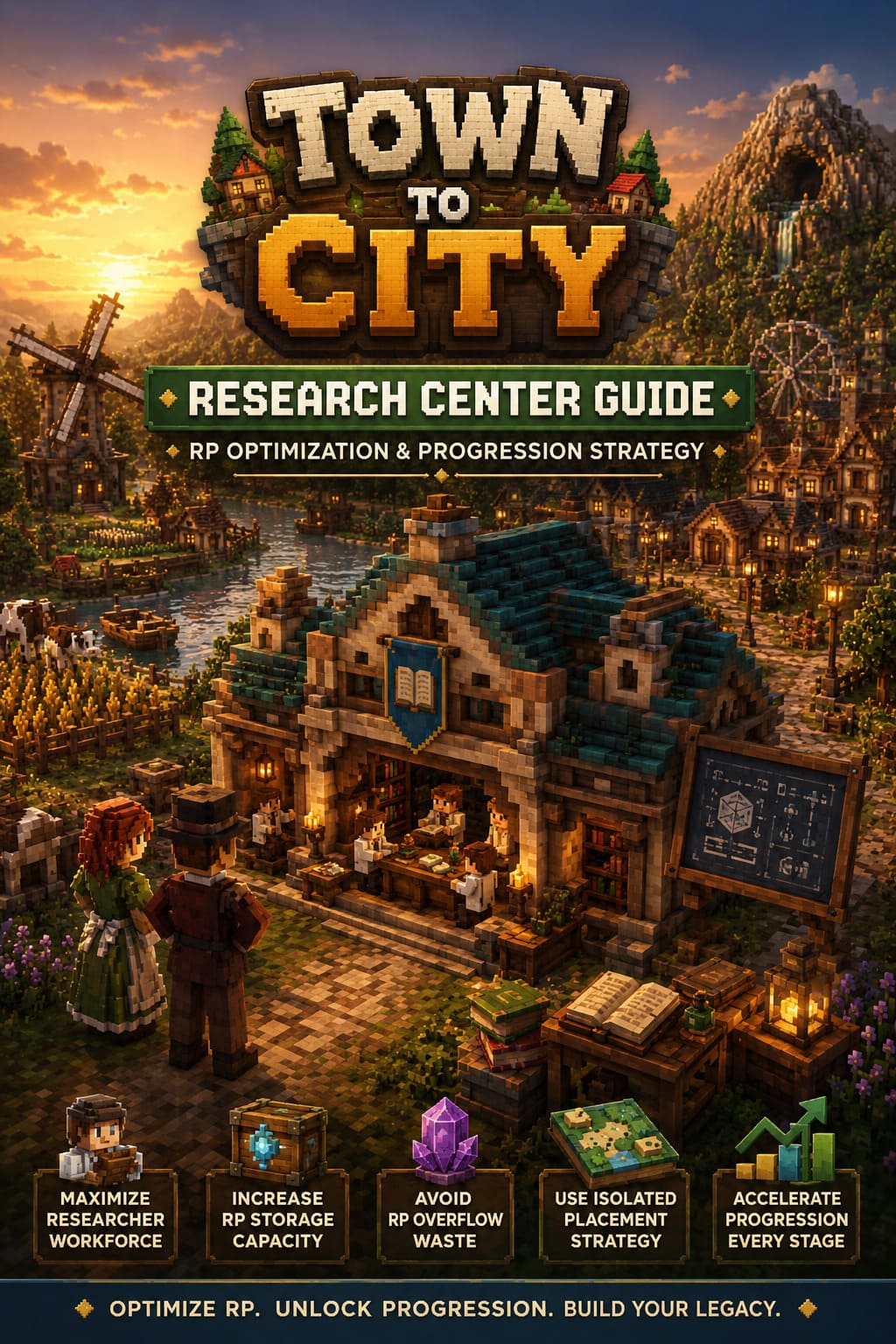
This guide is written from a player perspective, not a system manual. It reflects practical experience with city layouts, progression walls, and RP optimization strategies that actually change how fast your city evolves.
The focus here is simple: how to make the Research Center work at maximum efficiency without wasting space, time, or progression potential.
Town to City Crop Transfer Guide (Global Stockpile Explained)
Why the Research Center Controls Everything
In practice, Town to City is less about building a town and more about managing progression locks. Almost every meaningful upgrade—industries, advanced housing tiers, social class expansion, agricultural systems—is locked behind RP spending.
The Research Center is the only consistent source of RP. If it is inefficient, your entire city slows down regardless of population size or income. That is why optimizing it early is not optional—it is the foundation of smooth progression.
Core Systems Locked Behind RP
The following systems depend directly on Research Points:
- Advanced production buildings and industries
- Higher residential classes such as Artisans and Bourgeoisie
- Infrastructure upgrades and storage improvements
- Late-game decorative and optimization structures
- Cross-map agricultural expansion systems
When RP slows down, everything slows down with it.
Town to City Happiness Guide: How I Keep Citizens Above 60% Mood as a Streamer
Unlocking the Research Center
The Research Center becomes available early, typically around the transition from your initial settlement phase into a Hamlet. Unlike most production buildings, it does not rely on supply chains or consumer goods.
To build it, simply open the Special Structures menu, place the building, and connect it to a road. Once connected, it immediately becomes operational. This simplicity hides its importance—it looks optional but functions as the core engine of progression.
Workforce Stacking: The Most Important Optimization
One of the most common mistakes new players make is underutilizing the Research Center workforce. Running it with minimal staff leads to severe RP bottlenecks that slow down every other system in the game.
The correct approach is straightforward: treat the Research Center like a production factory, not a passive building.
Optimal Staffing Strategy
- Always fill every available researcher slot
- Prioritize researchers over lower-impact jobs in early game phases
- Maintain full staffing even if other buildings are understaffed temporarily
The system scales directly with assigned workers, meaning more staff equals faster RP generation with no hidden penalties.
Understanding and Bypassing RP Storage Limits
Another key mechanic that often surprises players is the RP storage cap. Even if your Research Center continues producing points, excess RP beyond your limit is lost if not spent in time.
This creates a hidden inefficiency where progression appears steady but actual usable RP is wasted.
How to Fix the RP Cap Problem
The most important upgrade to prioritize is the Tier 3 node called New Research Equipment. This upgrade increases your maximum RP storage capacity significantly, allowing you to safely accumulate points for high-cost unlocks later in the game.
Once unlocked, you can strategically “bank” RP instead of constantly spending it, which enables better long-term planning and smoother tech progression.
Isolated Placement Strategy for Maximum Efficiency
One of the most interesting mechanics in Town to City is that the Research Center does not require proximity to citizens, goods, or happiness zones. It functions independently as long as it is connected to a road.
This creates an opportunity for layout optimization that many players overlook.
Remote Placement Method
Instead of placing the Research Center in valuable central land, you can position it in isolated areas of the map such as:
- Remote road extensions
- Unused corners of the map
- Low-value terrain zones away from residential clusters
This frees central space for high-density residential layouts, markets, and decorative structures that directly affect citizen happiness and city aesthetics.
Research Efficiency Comparison
Different approaches to managing the Research Center produce dramatically different results in progression speed and city efficiency.
| Strategy | RP Output | City Efficiency | Difficulty |
|---|---|---|---|
| Minimal Staffing | Low | High waste potential | Easy |
| Balanced Staffing | Medium | Stable layout | Moderate |
| Max Workforce Stack | High | Efficient but requires planning | Advanced |
| Isolated + Max Stack | Very High | Highly optimized city design | Expert |
Dual Progression: Farming and Research Interaction
Later in the game, especially in agricultural maps, progression expands into a second system based on Farm Points. These are generated through crop production and agricultural development.
However, even this system remains tied to Research Points. Most farming infrastructure and processing buildings still require RP unlocks before they become available, meaning your city-based Research Center indirectly controls agricultural expansion.
System Interaction Summary
- Research Points unlock agricultural technologies
- Farm Points generate rural progression
- Both systems depend on coordinated development
Without a strong Research Center, farming progression eventually stalls regardless of crop efficiency.
Final Perspective: Why RP Defines the Entire Game
After extensive gameplay experimentation, one conclusion becomes unavoidable: the Research Center is not just another building—it is the pacing engine of the entire game.
When optimized correctly, the game feels smooth, structured, and rewarding. When ignored, progression becomes artificially slow and inconsistent, regardless of city size or income level.
The difference between a struggling city and a rapidly evolving metropolis almost always comes down to how efficiently Research Points are generated, stored, and spent.
Final Optimization Checklist
- Maximize Research Center workforce early
- Upgrade RP storage as soon as Tier 3 becomes available
- Avoid RP overflow waste
- Use isolated placement for better city space management
- Prioritize RP efficiency over short-term income gains
Once these principles are applied consistently, the entire structure of progression in Town to City becomes significantly smoother and more predictable, turning what feels like a grind into a controlled optimization system.