Fable Reboot and the End of Binary Morality: Why Albion Feels More Alive Than Ever
The upcoming Fable reboot has been one of those rare RPG releases I’ve been cautiously following for years. Not because of hype alone, but because the franchise has always sat in a strange sweet spot between satire, moral choice systems, and genuinely immersive world simulation.
After spending countless hours across different RPG generations—from early morality meters in classics to modern systemic sandboxes—I can confidently say this new direction for Albion feels less like a reboot and more like a philosophical reset.
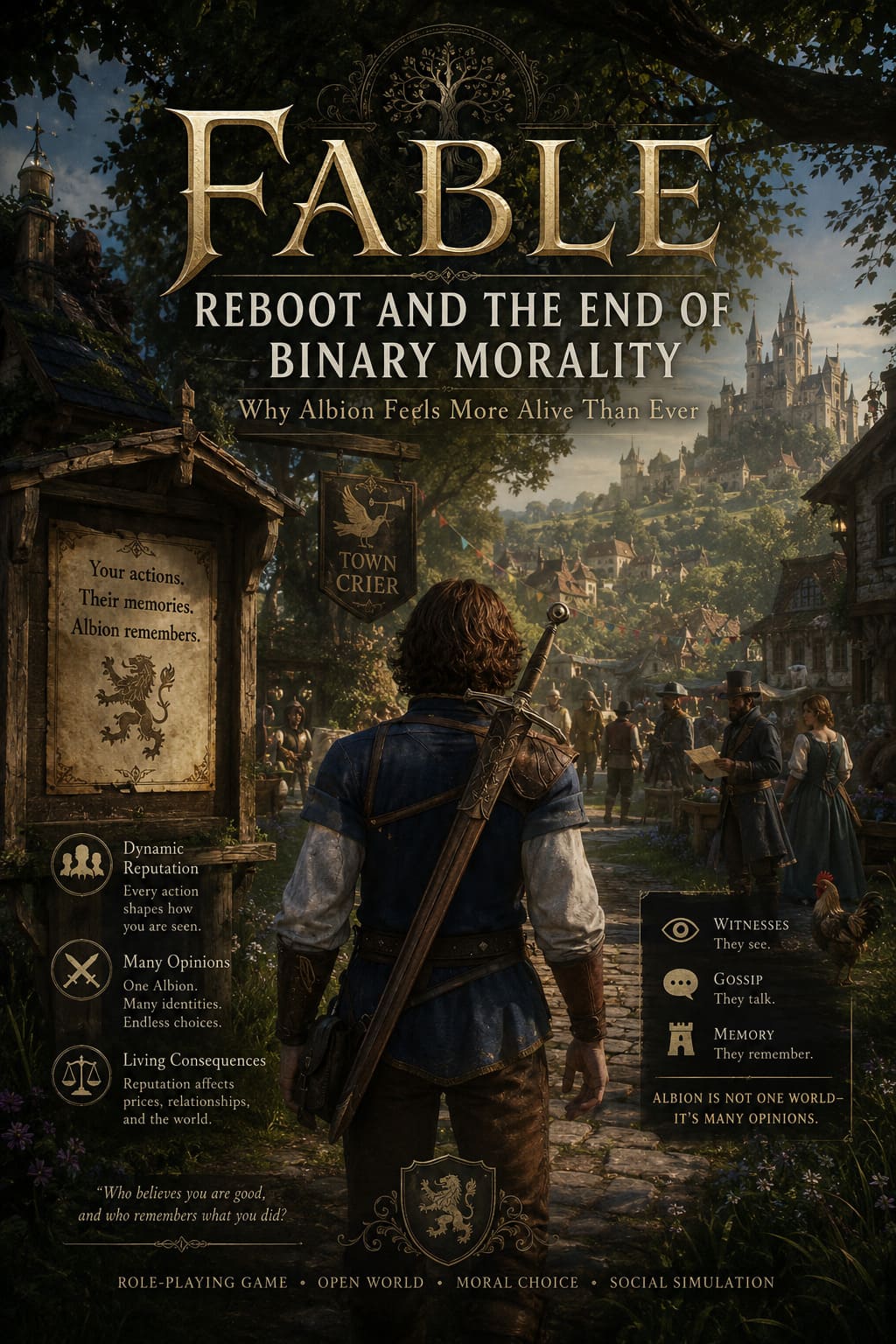
At the center of it all is the Dynamic Reputation System, replacing the old good-vs-evil alignment scale with something far more reactive, fragmented, and closer to how real social perception actually works.
Living the Landlord Fantasy in Fable’s Reboot: My Take on Albion’s Property System
Goodbye Moral Meter, Hello Social Reality
One of the biggest shocks for longtime fans is the removal of the iconic morality transformation system. No more angelic glow for “good deeds,” no more demonic horns for chaotic behavior. At first glance, it feels like something important has been lost.
But after looking deeper, it becomes clear why this change matters. Old Fable morality worked like a universal scoreboard: good actions increased “good,” bad actions increased “evil,” and the entire world reacted uniformly. The reboot breaks that illusion entirely.
Instead, morality is replaced by contextual social memory. People remember what you did—but only if they saw it, heard it, or were told about it.
The Witness System: Reputation Built on Memory, Not Numbers
What makes this system fascinating is that there is no universal morality score hidden in the background. There is no invisible judge tracking your actions.
Instead, reputation is built through three layers: direct witnesses, gossip chains, and local memory zones. Each layer feeds into how NPCs interpret your behavior within their own environment.
Fable’s Styleweaving Combat System Explained From a Player’s Perspective
How Actions Spread Through Albion
For example, stealing in a crowded marketplace isn’t just a numerical penalty. One shopkeeper sees you, that shopkeeper tells another, and within hours the entire district changes its perception of you.
If you act carefully in isolation, however, the world does not magically know. That distinction alone adds tension to even simple actions.

Albion Is Not One World—It’s Many Opinions
The most interesting design decision is regional reputation fragmentation. In most RPGs, your actions follow you across the entire map like a permanent stain. Here, that logic is intentionally broken.
Each region of Albion develops its own interpretation of who you are.
Example Player Identities
One of the most compelling ideas is that players can maintain multiple reputations simultaneously depending on geography and context.
The Hero of the Capital
A player may protect citizens, invest in property, and maintain a respected public image in the capital, gaining trust and economic advantages.
The Northern Predator
The same player can operate as a mercenary in the northern regions, engaging in intimidation tactics, faction conflicts, and morally ambiguous contracts.
These identities can coexist, creating a layered and flexible roleplaying structure rarely seen in mainstream RPG design.
Reputation as a Living Economy
Where things become even more interesting is how reputation influences core systems beyond dialogue and narrative framing. It directly impacts economics, relationships, and even gameplay structure.
Instead of being cosmetic, reputation affects shop prices, NPC cooperation, romantic eligibility, property income, and quest availability.
Reputation Effects Overview
| Reputation Type | NPC Reaction | Economic Effect | Gameplay Impact |
|---|---|---|---|
| Local Hero | Trust and admiration | Discounted prices and better trade | More quests and easier recruitment |
| Neutral Figure | Indifference | Standard pricing | Balanced opportunities |
| Feared Outlaw | Hostility and fear | Inflated prices | Hidden quests and aggressive encounters |
This system ensures that reputation is not just narrative flavor but a mechanical force shaping how the world responds to you.
The 1000-NPC Problem and Systemic Social Behavior
Many games advertise large NPC populations, but most of those characters exist as decorative elements with limited depth. Here, each NPC is designed with individual identity layers including names, routines, personalities, and preferences.
What matters most is not just their presence but how they interact with each other. NPCs communicate through gossip, meaning information spreads organically rather than being statically assigned.
If implemented effectively, this could turn Albion into a genuinely reactive society rather than a scripted environment.
Romance, Morality, and Social Compatibility
Romance systems are also deeply tied to reputation, but not in a universal way. Instead, attraction is based on alignment between personality types and values.
Different social groups respond to different behaviors. Aristocratic characters prefer stability and wealth, while criminal factions value risk, chaos, and independence.
This means there is no single optimal “romance build,” only context-dependent compatibility.
The Town Crier Mechanic: Reputation as a Commodity
One of the most unusual systems is the ability to manipulate public perception through the Town Crier. Instead of grinding repetitive tasks to rebuild reputation, players can directly influence narrative through economic means.
By paying the Town Crier, players can initiate propaganda campaigns that reshape how a settlement perceives them over time.
What This Enables
This mechanic introduces a powerful idea: reputation is not just earned, it can be manufactured. Public opinion becomes a resource that can be bought, altered, and strategically managed.
Personal Take as a Longtime RPG Player
Having played RPGs across multiple generations, I see this direction as both ambitious and risky. It challenges long-standing design conventions while attempting to simulate something closer to real social systems.
On the positive side, it removes simplistic morality structures, encourages experimentation, and creates more meaningful consequences. On the downside, systems like this are notoriously difficult to balance and can easily become inconsistent if not carefully tuned.
Still, I would rather see a game attempt complexity than remain safely predictable.
Final Thoughts: A More Human Albion
If the system works as described, the Fable reboot is not just modernizing mechanics—it is redefining how RPG morality functions entirely.
Instead of asking whether a player is good or evil, the game asks a more interesting question: who believes you are good, and who remembers what you did?
That shift transforms Albion from a morality playground into a reactive social simulation shaped by memory, bias, and consequence.
After years of binary alignment systems, that might be exactly what the genre needed.