Onimusha Way of the Sword Ending Explained: Full Story, Lore Secrets, and Post-Credit Breakdown
There is something strangely satisfying about seeing Onimusha return after so many years. I have played plenty of action games that tried to capture the feeling of a samurai movie, but very few understand that the appeal is not simply about swinging a katana at monsters. It is the atmosphere, the tension before a duel, the feeling that every fight could turn against you. Onimusha: Way of the Sword understands that better than most.
Capcom’s 2026 return to the franchise puts Miyamoto Musashi at the center of a dark supernatural story set in an Edo-era Japan being swallowed by the Genma. The game combines spectacular RE Engine visuals with brutal sword combat, supernatural abilities, and a surprisingly personal story about identity and the price of power. By the time the credits roll, however, the game leaves players with quite a few questions.
What exactly is the voice inside Musashi’s Oni Gauntlet? Why does Musashi survive when he should have died? Does becoming a True Onimusha mean that he has lost his humanity? And perhaps most importantly, what does the post-credit scene mean for the future of Onimusha?
If you finished the game and felt that the final scenes deserved a second look, here is my interpretation of the Onimusha: Way of the Sword ending explained, including the final battle, Musashi’s transformation, the Oni Lady, and the mysterious post-credit tease.
Is Samanosuke Akechi in Onimusha Way of the Sword? Full 2026 Game Breakdown
Musashi Was Never Supposed to Become a Hero
One of the things I liked about Musashi’s story is that he doesn’t feel like a traditional chosen-one protagonist. He isn’t introduced as some noble samurai destined to save Japan. He is a wandering swordsman, an extremely capable fighter who seems much more interested in surviving than becoming a symbol.
That makes his transformation into an Onimusha more interesting.
Early in the game, Musashi is caught in a devastating ambush involving corrupted human forces working with the Genma. Under normal circumstances, this would be the end of his story. Instead, something ancient intervenes. Musashi is resurrected by the Oni Gauntlet, a supernatural weapon that becomes permanently attached to his arm.
The gauntlet gives him abilities that completely change the way he approaches combat. Through Oni Vision, Musashi can detect things hidden from normal human perception, while absorbing Genma souls allows him to increase his supernatural strength and manipulate the battlefield.
At first, it feels like a classic power-up.
The further I got into the game, though, the more obvious it became that the gauntlet is not really a gift. It is a bargain.
Every Genma soul Musashi absorbs makes him more powerful, but it also brings him closer to something he doesn’t fully understand. That conflict becomes one of the most important ideas in the final act.
The Mysterious Voice Inside the Gauntlet
Musashi is not completely alone during his journey.
Throughout the game, he hears the voice of a mysterious woman coming from the Oni Gauntlet. She is eventually referred to as the Oni Lady, and her guidance becomes increasingly important as Musashi approaches the heart of the Genma invasion.
At first, I treated her like the typical supernatural companion who exists mostly to explain game mechanics and push the protagonist toward the next objective. The story gradually makes it clear that she has her own agenda.
She knows far more about the Oni Gauntlet than Musashi does.
She also understands exactly what will happen if he continues absorbing Genma souls.
That is what makes her relationship with Musashi interesting. She isn’t simply helping him save Kyoto. She is also using him as a vessel capable of wielding a weapon that ordinary humans could never control.
The uncomfortable question hanging over the entire story is therefore simple:
Is Musashi using the Oni Gauntlet, or is the Oni Gauntlet using Musashi?
By the ending, the answer becomes much more complicated.
Kyoto Becomes the Real Battlefield
The story eventually leads Musashi toward a corrupted Kyoto, where the boundaries between the human world and the demonic realm are beginning to collapse.
The Genma are taking advantage of the weakening influence of the Oni. Their goal is not merely to invade Japan with monsters. They want to create a permanent connection between the Abyss, allowing the Genma to establish an existence that cannot easily be reversed.
The main figures behind this plan are the Genma siblings Ifuu and Burai.
Their relationship gives the final act more personality than I expected. They aren’t simply interchangeable villains waiting at the end of a level. Their shared ambitions and willingness to sacrifice everything for their objective make the final confrontation feel like the natural conclusion to the game’s escalating conflict.
And then there is Daidara.
The enormous creature is one of those bosses that immediately communicates what kind of game you’re playing. Daidara is obsessed with consuming souls, creating an interesting parallel with Musashi himself. Both characters become increasingly dependent on supernatural power, but Musashi still has something Daidara lacks: restraint.
That distinction becomes critical later.
The Final Battle Against Ifuu and Burai
The final confrontation at the corrupted Kiyomizu-dera is where the game’s combat philosophy really pays off.
This isn’t a slow, defensive battle where you simply wait for an opening. The game expects you to understand its parry and deflection systems, recognize attack patterns, and punish enemies with precise counterattacks.
For me, this is where Way of the Sword feels most like classic Onimusha while still having its own identity.
Musashi eventually confronts Ifuu and Burai as they attempt to use Kyoto’s concentrated Malice to permanently open the path to the Abyss. The fight becomes increasingly chaotic, forcing Musashi to use everything he has learned.
Eventually, Burai is defeated.
But that isn’t the end.
Instead of accepting defeat, Ifuu absorbs her brother’s remaining essence together with the surrounding Malice. The result is something far beyond an ordinary Genma. She becomes a massive manifestation of demonic corruption, essentially turning herself into the final weapon of the Genma uprising.
Musashi is completely outmatched.
And this is when the Oni Lady gives him one final choice.
What Is the True Onimusha?
The Oni Lady tells Musashi that there is only one way to defeat Ifuu in her transformed state.
He must surrender his soul to the Oni Gauntlet.
This is the moment the story has been building toward since Musashi’s resurrection. Becoming a True Onimusha isn’t simply another combat ability. It means allowing the supernatural power inside the gauntlet to completely merge with his body.
There is no guarantee that Musashi will remain himself afterward.
He could lose his memories. He could become a monster. He could become nothing more than another weapon controlled by the Oni.
And yet Musashi accepts.
I actually think this works better because Musashi doesn’t accept the transformation because he suddenly becomes a selfless hero. He accepts it because he understands that somebody has to stop Ifuu, and he is willing to pay the price himself.
That is very Musashi.
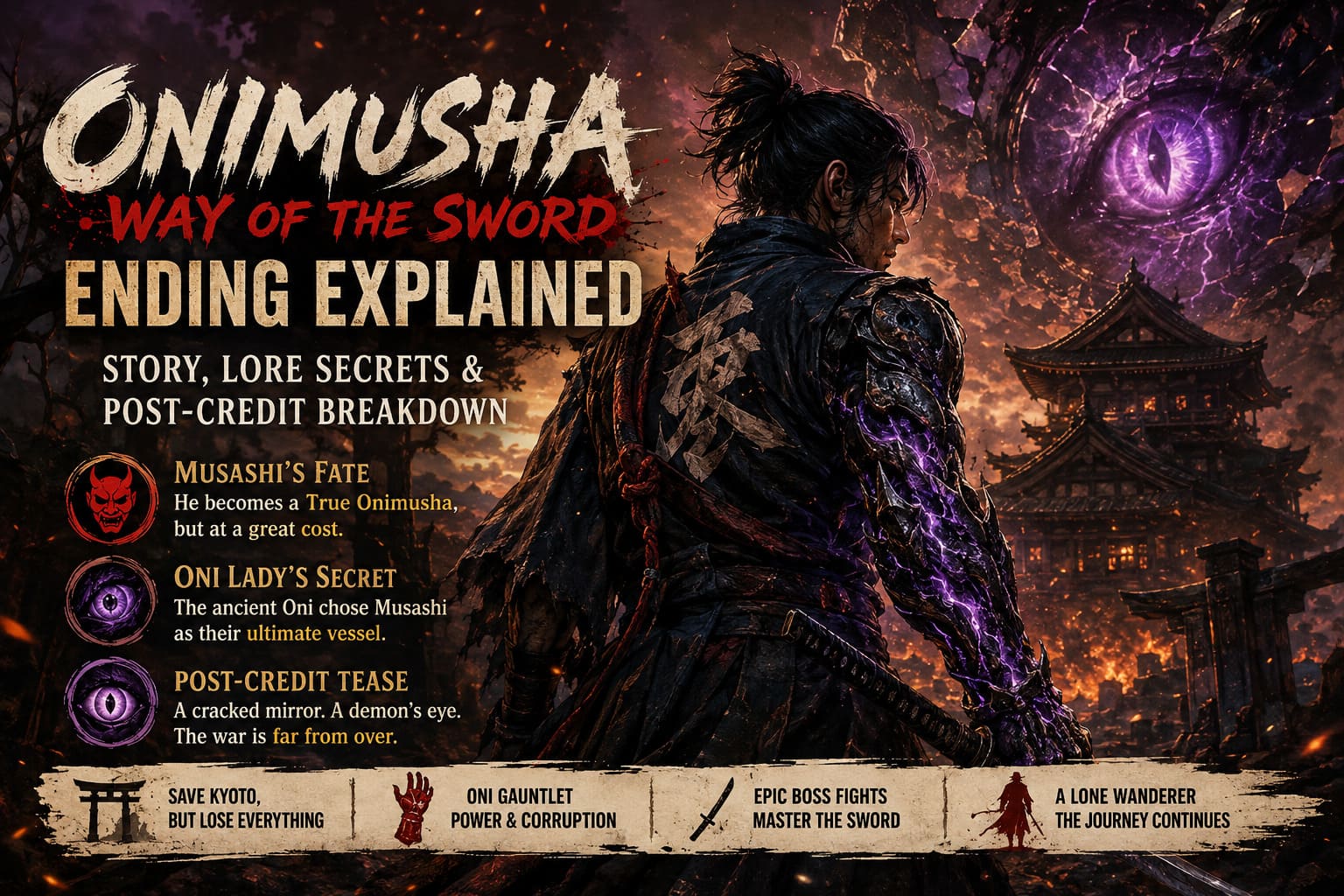
Onimusha: Way of the Sword Ending Explained
The transformation gives Musashi the power needed to destroy Ifuu and seal the dimensional rift.
Kyoto is saved.
The Genma invasion is stopped.
On paper, this sounds like the standard happy ending.
It isn’t.
When the battle ends, Musashi is visibly changed. His body has begun to take on supernatural characteristics, while the Oni Gauntlet’s corruption spreads across his arm, shoulder, and neck. His appearance makes one thing painfully clear:
Musashi survived, but he did not escape unchanged.
The Oni Lady then reveals more about herself and her purpose. She is connected to the ancient Oni order and was searching for a mortal strong enough to become a vessel for their ultimate weapon.
Musashi was never simply rescued.
He was selected.
And perhaps even manipulated.
That revelation gives the entire adventure a darker meaning. The Oni may have saved humanity from the Genma, but they also placed an enormous burden on a single human being without giving him much of a choice.
The Meaning of Musashi’s Final Choice
This is where I think the ending is strongest.
Musashi refuses to define himself by the power inside his arm. He has become something supernatural, but he refuses to accept that supernatural power determines who he is.
The gauntlet may contain Genma souls.
It may cover his body in demonic armor.
It may even threaten his sanity.
But his will still belongs to him.
Instead of surrendering completely to the Oni or Genma influence, Musashi forces the corruption under control. He doesn’t magically become human again. The damage is permanent. What changes is his relationship with that power.
| Story Element | What Happens | Why It Matters |
|---|---|---|
| Oni Gauntlet | Becomes permanently bonded to Musashi | Gives him supernatural power but threatens his humanity |
| Ifuu | Absorbs Burai and the Malice | Creates the final Genma threat |
| True Onimusha | Musashi gives himself to the gauntlet | Allows him to defeat Ifuu |
| Kyoto | The demonic rift is sealed | Prevents the immediate Genma invasion |
| Oni Lady | Reveals her connection to the Oni | Explains why Musashi was chosen |
| Musashi | Controls the corruption instead of surrendering | Establishes his independence and future role |
Why Musashi Leaves Japan Behind
After the battle, Musashi doesn’t return to society as a celebrated hero.
Instead, he chooses isolation.
That decision makes perfect sense when you consider what he has become. Even if he can control the Genma power inside him, there is no guarantee that he will always be able to do so. Remaining around ordinary people would also make him a potential target for surviving Genma forces.
So Musashi walks away.
The snowy landscape surrounding his departure gives the scene a strangely melancholic feeling. After spending the entire game fighting through fire, blood, monsters, and supernatural corruption, the ending becomes almost quiet.
There is no triumphant parade.
No celebration.
Just a swordsman walking into the unknown.
Musashi’s final exchange with the Oni Lady reinforces this idea. He accepts that one day the corruption might win, and he essentially asks her to make sure someone is willing to kill him if he ever becomes a monster.
That line is important because it shows that Musashi’s humanity isn’t defined by being physically pure. It is defined by his ability to choose what he does with the power inside him.
The Post-Credit Scene Changes Everything
If you stopped watching when the credits began rolling, you missed the part that could be the most important clue about the future of the franchise.
The Onimusha: Way of the Sword post-credit scene moves away from Musashi and introduces a completely different location. Deep beneath the surface of feudal Japan, an unknown figure enters a dark chamber containing a damaged stone pedestal.
The figure carries a strange, cracked mirror.
Purple Genma energy pours from it.
Then something inside the mirror opens.
An enormous demonic eye appears, followed by an unmistakable and unsettling laugh.
And then the scene ends.
It is exactly the kind of post-credit sequence designed to make players start theorizing.
What Does the Post-Credit Scene Mean?
The most obvious interpretation is that the Genma were never truly defeated.
Musashi stopped the immediate threat in Kyoto, but the Genma world is much larger than the enemies encountered during the main campaign. There may be older factions, forgotten leaders, and supernatural powers that have been waiting for the right opportunity to return.
The mysterious human figure is arguably even more interesting.
The scene suggests that the conflict isn’t simply humans versus demons. There are people willing to cooperate with the Genma in exchange for power. That opens the door to political conspiracies, corrupted warlords, secret organizations, and potentially a much wider supernatural conflict across Japan.
Personally, I think this is a much better direction than simply bringing back another army of Genma.
The original Onimusha formula has always worked best when Japanese history and supernatural horror collide. If Capcom continues down this path, the next story could explore how much of Japan’s political landscape has already been infiltrated by forces connected to the Abyss.
Will Musashi Return in a Sequel?
The ending deliberately avoids giving us a clear answer.
Musashi is alive, but he is now an exile carrying an unstable supernatural weapon. That makes him difficult to use as a conventional protagonist, but it also gives Capcom plenty of possibilities.
He could return as the main character in a direct sequel.
He could appear later as an older, legendary warrior who guides another Oni Gauntlet bearer.
Or the next game could move to another part of Japan and only reveal Musashi’s influence through rumors and legends.
I would actually prefer the second option if Capcom wants to build a larger Onimusha universe. Musashi’s story has already established his personal conflict. A new protagonist could show us another side of the Oni and Genma war while allowing Musashi to become the mysterious swordsman people only hear about in stories.
That would also let Capcom expand the franchise without throwing away what Way of the Sword established.
Final Thoughts on the Onimusha Ending
After playing through the entire story, I think the ending of Onimusha: Way of the Sword works because it refuses to give Musashi a completely clean victory.
He saves Kyoto, but loses his normal life.
He gains incredible power, but loses part of his humanity.
He defeats the Genma threat, but discovers that the larger war is nowhere near finished.
Most importantly, Musashi doesn’t become a hero because the Oni chose him. He becomes one because he chooses to remain himself despite everything inside him trying to change him.
And that is why the final snowy shot stuck with me more than the giant boss battle. The spectacle is impressive, but the quiet aftermath tells us what the game is really about.
Musashi survived the monster.
Now he has to spend the rest of his life making sure he doesn’t become one.
The post-credit sequence makes it clear that this probably isn’t the end of the story. If Capcom really intends Onimusha: Way of the Sword to be the beginning of a new era for the franchise, then the most exciting part may be what comes next.
The Genma may have lost Kyoto, but the war between the Oni and the darkness is far from over.