Best Multiplayer Campaign Factions in Total War: Warhammer 3 (2026 Co-Op Guide)
Total War: Warhammer 3 is one of those games that can turn a simple evening with a friend into a 40-hour military disaster. You start with a perfectly reasonable plan: build two complementary armies, help each other, conquer a few provinces and eventually destroy the forces of Chaos together.
Twenty turns later, one player is fighting three wars, the other has accidentally occupied the province you needed, and somebody is asking why their ally’s corruption has turned an entire region into a miserable public-order nightmare.
I’ve played enough Total War campaigns to know that picking factions for co-op is almost as important as knowing how to use their armies. A faction can be fantastic in single-player and surprisingly awkward when another human player is trying to expand beside it.
The best multiplayer campaigns aren’t necessarily built around the strongest Legendary Lords. They’re built around factions that have different needs, compatible territories and armies that cover each other’s weaknesses.
And that’s where Warhammer 3 gets really interesting.
What Actually Makes a Good Co-Op Faction?
Before jumping into specific combinations, there are a few things I always look at when starting a multiplayer campaign.
The first is geography.
You want to be close enough that your friend can arrive when something goes horribly wrong, but not so close that both of you are fighting over the same settlements. There’s nothing worse than spending the opening turns politely pretending you don’t want the same province.
Climate matters for the same reason. If one player thrives in mountains while the other wants temperate territory, the campaign map almost divides itself naturally. You conquer what suits your faction and hand the awkward settlements to your partner.
There is also the question of army composition. Two players bringing the same type of army sounds fun until you realize neither of you has the tools to deal with the enemy’s biggest weakness.
And finally, there is diplomacy and unit sharing. Warhammer 3’s co-op system allows players to share troops during battles and even gift units to one another, which can turn an ordinary army into something much more ridiculous.
That is the real secret of multiplayer: don’t build two armies that do the same thing. Build two armies that make each other better.
My Favorite 2-Player Co-Op Faction Combinations
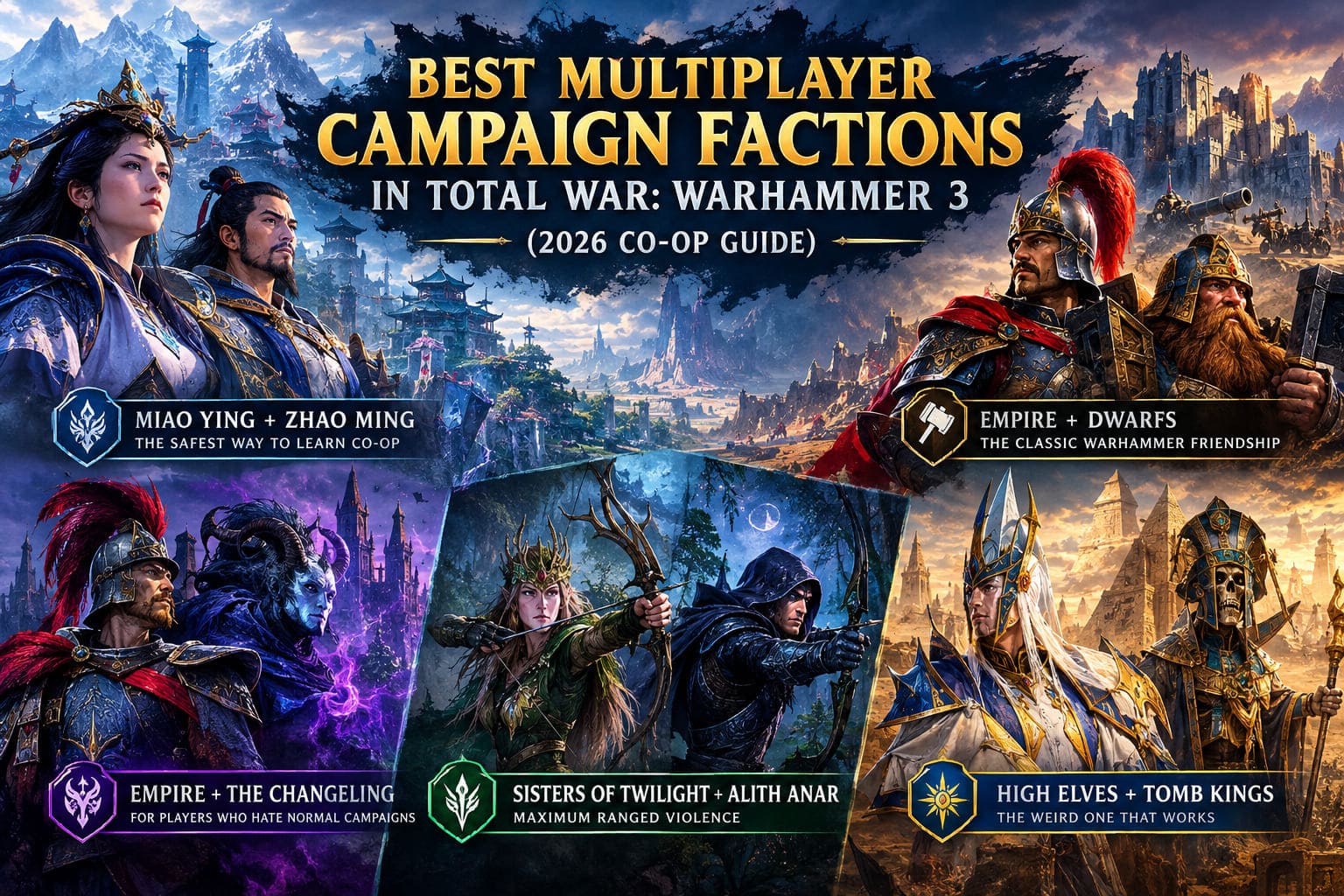
| Combination | Playstyle | Main Strength |
|---|---|---|
| Miao Ying + Zhao Ming | Defensive | Shared Cathay Synergy |
| Empire + Dwarfs | Traditional | Infantry And Artillery |
| Empire + The Changeling | Asymmetric | Territory And Trickery |
| Sisters Of Twilight + Alith Anar | Ranged | Mobility And Ambushes |
| High Elves + Tomb Kings | Experimental | Economy And Numbers |
1. Miao Ying + Zhao Ming — The Safest Way to Learn Co-Op
If you and a friend are playing your first serious Warhammer 3 multiplayer campaign, this is still one of the combinations I’d recommend looking at first.
Miao Ying and Zhao Ming naturally give you something that many co-op pairs lack: a shared cultural identity without requiring identical campaigns.
Miao Ying can concentrate on defending the northern side of Cathay while Zhao Ming has more freedom to operate toward the west and south. You don’t have to constantly negotiate every settlement because your strategic directions can naturally separate.
The other advantage is psychological.
You’re learning the same basic faction ecosystem, so neither player has to spend half the campaign explaining why their economy suddenly works completely differently. At the same time, their armies don’t have to behave identically on the battlefield.
Cathay’s ranged strength is particularly satisfying in multiplayer because one player can establish a defensive firing line while the other controls the engagement with infantry, cavalry and flying units.
The result is less chaotic than some of the combinations below, but honestly, that’s a feature.
Best for: New players, defensive campaigns and friends who don’t want to spend the first 30 turns arguing about who gets which province.
2. Empire + Dwarfs — The Classic Warhammer Friendship
This is probably the combination that most naturally feels like a Total War: Warhammer campaign with a friend.
Put an Empire faction such as Karl Franz or Elspeth alongside a Dwarf faction and you immediately get two armies with very different battlefield identities.
The Dwarfs are slow, heavily armored and extremely comfortable turning a defensive position into a fortress. The Empire has much more flexibility, with cavalry, ranged troops, magic and a variety of mobile options.
That’s exactly what I want from a co-op partner.
If my Dwarf friend is building a ridiculous artillery position, I don’t need to bring another army designed to stand still and shoot things. I can bring cavalry and mobile units to protect the flanks.
Likewise, if my Empire army gets caught in an ugly melee, the Dwarf player can provide the kind of stubborn frontline that refuses to disappear.
The campaign map works nicely too. Dwarfs generally have obvious reasons to prioritize mountainous territory, while Empire players have more incentive to establish themselves in the surrounding human lands. Since unsuitable climates can impose growth and other penalties, dividing territory according to faction needs can save both players a lot of headaches.
And then there is artillery.
Dwarf artillery plus Empire mobility is just fun.
There is something deeply satisfying about watching a Dwarf gunline delete an enemy formation while an Empire cavalry unit charges anything that survives.
3. Empire + The Changeling — For Players Who Hate Normal Campaigns
Now we’re getting weird.
The Changeling is the faction I’d pick when the entire point of the campaign is to do something that doesn’t resemble a normal Total War playthrough.
Instead of simply trying to paint the map your color, The Changeling brings a very different campaign identity based around manipulation, cults and operating behind enemy lines.
That creates an unusual relationship with an Empire player.
The Empire can focus on conventional territorial expansion while The Changeling plays a much more deceptive game around the same general theater. You’re not competing for exactly the same strategic objective, and that is precisely why the pairing can be entertaining.
This isn’t the combination I’d give to someone learning Warhammer 3.
But if both players already understand the campaign mechanics, it can produce some genuinely memorable moments.
The Empire player is effectively playing the recognizable grand-strategy campaign while the Changeling player is running a strange secondary operation underneath it.
It’s less “two armies conquering together” and more “one player is playing Total War while the other is playing political espionage inside Total War.”
That difference makes it one of the most interesting multiplayer setups.
4. Sisters of Twilight + Alith Anar — Maximum Ranged Violence
This pairing is for the people who look at an enemy army and think, why would I ever allow them to reach me?
The Sisters of Twilight bring Wood Elf mobility and devastating ranged pressure, while Alith Anar provides another highly mobile and ranged-focused style of warfare.
The important thing here isn’t simply that both factions can shoot.
It’s that both players can operate around movement and positioning rather than relying on a traditional infantry grind.
That makes battles much more active.
One player can draw an enemy army forward while the other attacks from an unexpected angle. You can force the AI to turn, split its formation and expose vulnerable units before the main engagement even begins.
The downside is obvious: if your plan goes wrong, you don’t have the kind of gigantic armored wall that can simply absorb punishment.
So this is a combination for players who actually enjoy micro-management.
If your idea of fun is positioning 15 units perfectly while your friend is shouting that the enemy cavalry is behind you, you’ll probably have a great time.
5. High Elves + Tomb Kings — The Weird One That Works
I’ll admit this isn’t the first combination I’d have thought of when I started looking at co-op faction synergies.
But that’s exactly why I like it.
High Elves and Tomb Kings approach the campaign economy and military system from very different directions. High Elves can provide powerful elite armies and strong economic infrastructure, while Tomb Kings have an entirely different approach to army recruitment and unit availability.
Instead of trying to imitate one another, the two players can lean into those differences.
The High Elf player can operate as the flexible conventional army, while the Tomb King player builds a wider strategic presence and brings units that don’t require the same traditional upkeep structure.
The battlefield combination can become particularly funny.
High Elf archers and magical units want space and protection. Tomb King armies can provide bodies to occupy the enemy while the Elven units do the expensive work.
It’s not the cleanest pairing in the game.
It’s the pairing I’d choose when both players already know what they’re doing and want something memorable.
Three-Player Co-Op Gets Even Better
Three-player campaigns change the equation considerably.
With three armies operating in the same theater, you don’t necessarily need every faction to be individually perfect. What matters more is whether the three armies create a complete military ecosystem.
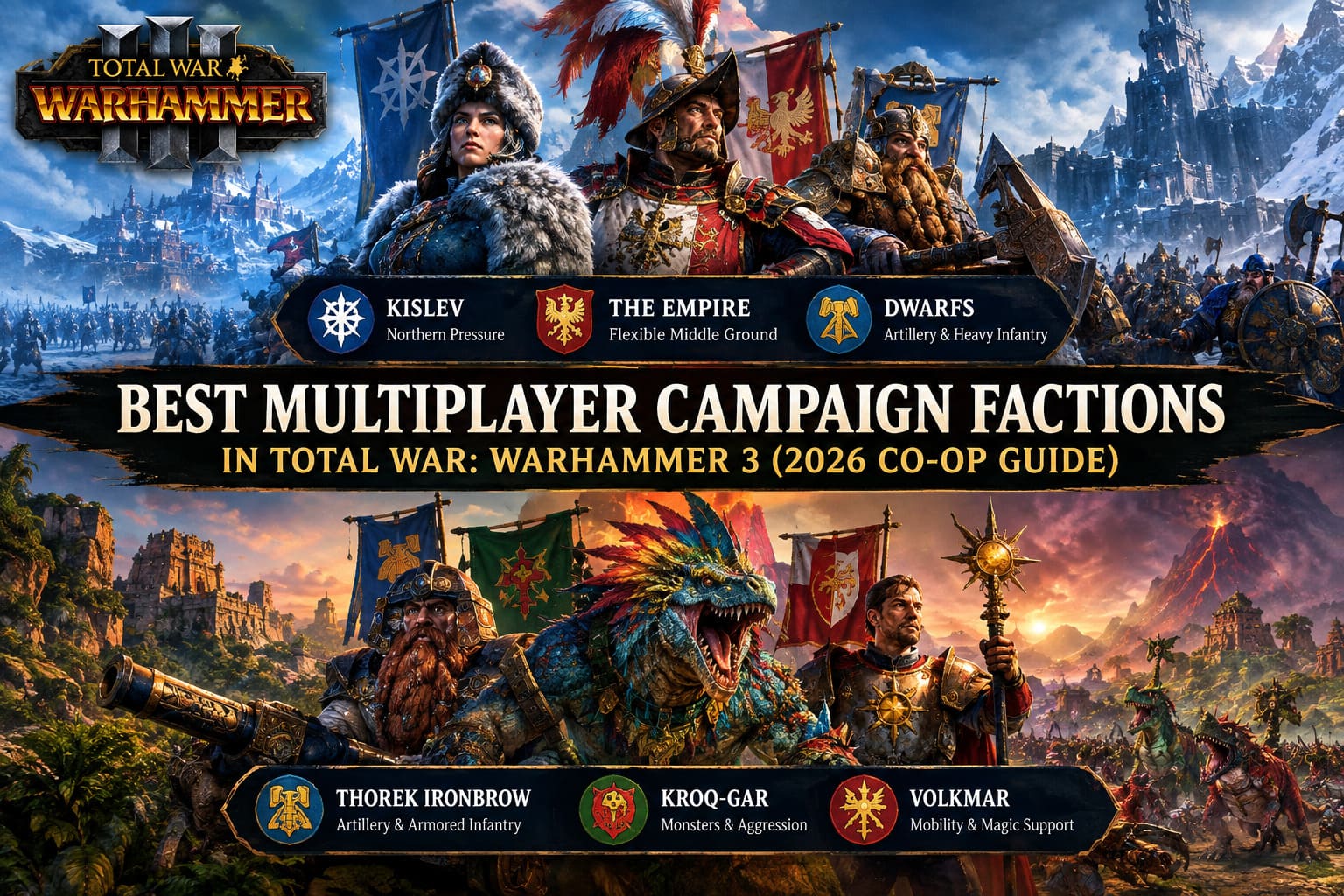
Empire + Kislev + Dwarfs — The Old World Defensive Wall
This might be the most obvious three-player setup, but sometimes the obvious answer is obvious for a reason.
Empire, Kislev and Dwarfs create a satisfying defensive alliance where each faction can occupy a different strategic role.
Kislev deals with northern pressure.
The Empire acts as the flexible middle ground.
The Dwarfs provide heavy infantry and artillery support from mountainous territory.
The biggest advantage is that everyone has a reason to be involved in the same wars.
Nobody needs to spend 50 turns on the other side of the map wondering what their friend is doing.
When one front collapses, the other players can actually respond.
And that’s critical because co-op becomes much less interesting when everyone is effectively playing three separate single-player campaigns beside each other.
Thorek Ironbrow + Kroq-Gar + Volkmar — The Southlands Chaos Machine
If you want the exact opposite experience, try a three-player campaign around the Southlands.
This is where things get messy.
You have Dwarfs bringing artillery and armored infantry, Lizardmen bringing some of the most terrifying monsters in the game, and the Empire adding mobility and magical support.
The battlefield variety is excellent.
A Dwarf player can establish the firing line. Kroq-Gar can send monsters crashing into whatever survives. Volkmar’s army can fill the gaps and pursue whatever tries to escape.
The Southlands also gives you plenty of reasons to keep moving instead of sitting inside your capital for 30 turns.
This is the campaign I’d choose if everyone in the group says, “We don’t want a relaxing game.”
The Most Important Co-Op Rule: Stop Fighting Over the Same Stuff
This sounds obvious, but it is probably the biggest mistake I see in multiplayer Total War campaigns.
Your friend does not need to own every settlement.
If a province is terrible for your faction but excellent for theirs, give it to them.
Likewise, don’t march your legendary lord halfway across the map just because you technically can occupy a settlement that your ally desperately needs.
The best multiplayer campaigns create informal borders.
You might agree that one player controls the mountains while the other controls the plains. That simple decision can prevent dozens of turns of economic inefficiency and diplomatic annoyance.
It also makes the map feel more like a genuine alliance rather than two players racing to paint the same color everywhere.
Use Unit Sharing More Than You Think
One of the most underrated parts of Warhammer 3 multiplayer is the ability to share units during battles.
This opens up some fantastic army combinations.
Imagine an Empire player handing cavalry to a Dwarf player during a battle.
Or a Dwarf player giving control of artillery to an Empire player while concentrating on the frontline.
Or simply giving your friend a few units because their army is about to get surrounded.
These moments are what make multiplayer campaigns memorable.
You’re not just watching your friend’s battle.
You’re participating in it.
My 2026 Co-Op Rules for a Better Campaign
- Pick different battlefield roles. Two artillery-heavy factions aren’t automatically better than one artillery faction and one mobile army.
- Agree on expansion zones early. Don’t wait until turn 30 to discover you’ve both been planning to conquer the same province.
- Build around climate differences. Settlements that are awkward for one faction may be extremely valuable to another.
- Use diplomacy aggressively. Military access, alliances and gifts can make moving armies around the same theater much easier.
- Don’t be afraid to give units away. A gifted unit can sometimes save an entire campaign.
- Choose the Endgame Crisis with your group in mind. A crisis that attacks the same culture your friends are playing can create a very different finale from the one you expected.
Total War Warhammer 3 Patch 9.0 Notes: Full Changelog & Performance Update
So, Which Combination Would I Actually Play?
For a relaxed campaign with someone who is still learning the game, I’d go with Miao Ying and Zhao Ming.
For two experienced players who want classic Warhammer battles, Empire and Dwarfs is incredibly hard to dislike.
For something completely different, I’d pick The Changeling and the Empire. The asymmetric campaign styles make it feel less like two copies of the same strategy game and more like two completely different games happening on the same map.
For three players, Empire, Kislev and Dwarfs gives you the most natural large-scale alliance, while Thorek, Kroq-Gar and Volkmar is the choice I’d make when the group wants constant warfare.
But ultimately, the “best” Warhammer 3 co-op faction isn’t necessarily the one with the strongest army.
It’s the one that gives your friend something useful to do.
That’s the part people sometimes miss when talking about multiplayer tier lists. Co-op is not about creating three unstoppable armies. It’s about creating a campaign where your decisions actually interact.
Give your friend the territory you don’t need. Protect their weak flank. Loan them the cavalry they desperately lack. Let them control your artillery for five minutes while you deal with the enemy reinforcements.
When that starts happening naturally, Warhammer 3 stops feeling like two people playing separate campaigns beside each other.
It starts feeling like a real war.
And honestly, that’s when Total War: Warhammer 3 co-op is at its best.