Nivalis Nights Food Guide: Ultimate Guide to Menus, Dishes, and Ingredients
I’ve played plenty of management and life-sim games where food is basically decoration. You unlock a few recipes, throw ingredients into a machine, sell the finished product, and move on. Nivalis Nights looks much more interesting in this regard. Food sits right in the middle of the business side of the game, and what you decide to serve can affect not only your money but also the customers who keep coming back and the relationships you build around Nivalis.
With the game scheduled to launch on September 29, 2026, the food system is one of the areas I’ll be watching most closely. The basic idea sounds simple: start small with a noodle stand and eventually build something much more ambitious. But once recipes, ingredients, kitchen equipment, customer preferences, sourcing methods, and social progression all start overlapping, running a restaurant becomes a proper management game rather than a side activity.
There is still a lot we don’t know. That matters because the internet is already full of supposed recipe databases and exact numbers that haven’t been officially confirmed. So for this Nivalis Nights food guide, I’m sticking to the dishes, menu categories, ingredient sources, and mechanics that have actually been revealed, while separating confirmed information from things we’ll have to discover after launch.
Nivalis Nights System Requirements: Minimum & Recommended PC Specs
Your Restaurant, Your Menu
The thing I like most about the food system so far is how little it seems to dictate what your restaurant has to be. A lot of restaurant-management games eventually push you toward a specific progression path where you unlock a recipe, use it for a while, then replace it with the next item. Nivalis Nights appears to give players considerably more freedom.
The developers have specifically presented the menu as something the player controls. You could serve something like Subland for dinner and follow it with a Sweet Waffle for dessert if that’s the kind of strange combination you want your restaurant to become known for. That sounds silly on paper, but it also gives the food system some personality. Your restaurant doesn’t have to feel like everyone else’s.
For me, that freedom is particularly important in a game built around relationships. If customers are going to become regulars and those regulars are going to matter socially, then food becomes part of the identity of your business. I’d much rather experiment with a weird menu and slowly figure out which customers respond to it than simply follow a fixed optimal recipe path from the beginning.
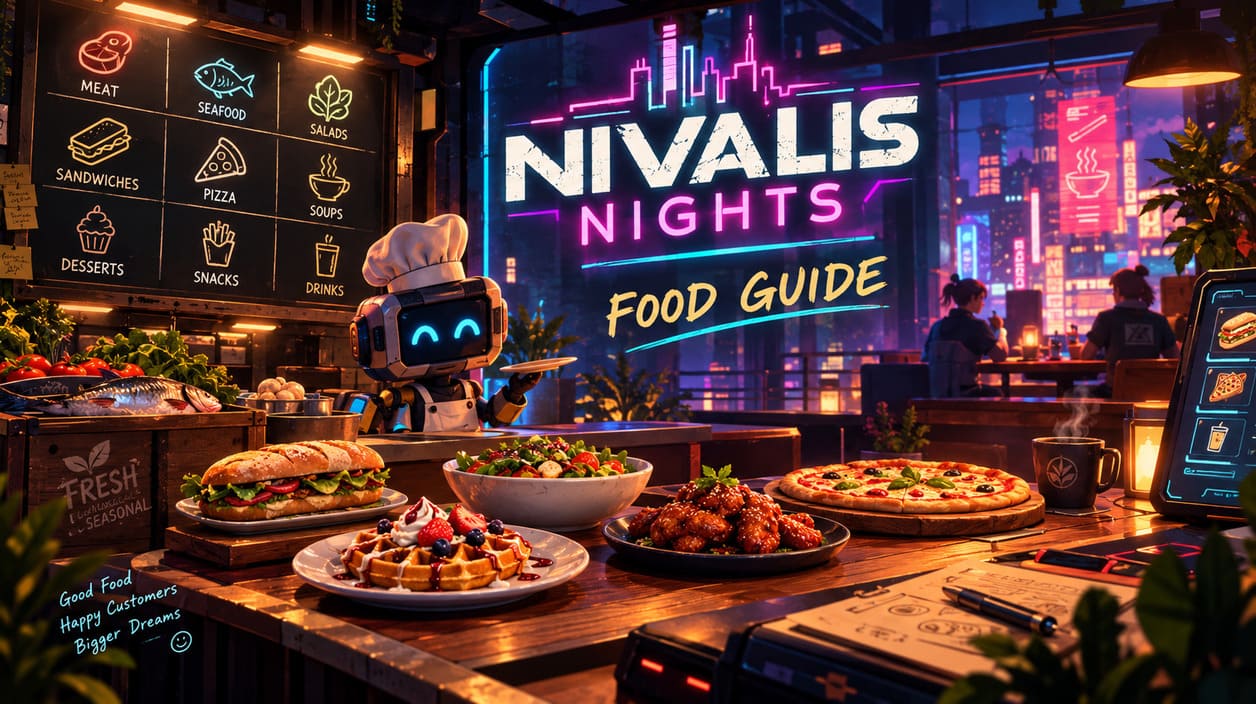
The Nine Nivalis Nights Menu Categories
The currently revealed food system covers nine different menu categories. That is a healthy amount of variety for a restaurant simulation, especially when you consider that players can potentially combine categories instead of specializing in just one.
| Category | What It Represents |
|---|---|
| Meat Dishes | Hearty and protein-focused meals |
| Fish and Seafood | Seafood dishes supported by fishing and other sources |
| Salads | Fresh dishes with possible seasonal considerations |
| Sandwiches | Flexible casual food options |
| Pizza | Shareable meals and social dining |
| Soups | Another broad category for restaurant menus |
| Desserts | Sweet dishes and customizable treats |
| Snacks | Smaller food options |
| Drinks | Beverages that can complement the menu |
Having nine categories doesn’t mean I’d immediately try to run all nine. In management games, spreading yourself too thin is often where the economy starts to fall apart. Every dish needs an appropriate recipe, the necessary ingredients, and suitable kitchen equipment, so a giant menu can create a giant supply problem if your production chain isn’t ready.
Every Officially Revealed Dish So Far
As of September 2026, seven specific food or drink names have been shown in official developer material. That is a much smaller list than some community sites suggest, but honestly, I think that’s a good thing before launch. Discovering recipes yourself is part of the fun, and pretending that every unreleased detail is already known takes some of the mystery out of the game.
Subland
Subland is one of the sandwich options shown in the early food teasers. The official description presents it as a straightforward sandwich using fresh ingredients without going overboard on mayonnaise. It sounds like exactly the sort of reliable menu item I’d expect to use when getting a new restaurant off the ground.
Sweet Waffle
Sweet Waffle is the dessert that immediately caught my attention because of the customization angle. The developers have suggested that you can put practically anything on it, which makes the dish sound less like a rigid recipe and more like a playground for experimentation. If the final implementation is as flexible as the teaser implies, this could become one of those deceptively simple foods that players spend hours optimizing.
Stinky Tofu
Stinky Tofu has also appeared in official material, although it has not been assigned to one of the nine categories in the same explicit way as some of the newer dishes. What matters more is the role it represents: food can help establish the reputation of a venue. Serving something unusual like this could be a deliberate choice rather than simply another item to sell.
Cola Chicken
Cola Chicken was highlighted in the August 14, 2026 Steam menu post and falls under meat dishes. The developers describe it as a crispy and savory option, even giving it a personal recommendation for a movie night. I’m always a fan of games that aren’t afraid to put slightly ridiculous real-world food ideas into their systems, and Cola Chicken definitely qualifies.
Summer Salad
Summer Salad is where the food system starts getting more interesting from a management perspective. It is presented as a seasonal dish and is explicitly described as being banned outside summer. If that restriction works as a real gameplay rule rather than just flavor text, players will need to think about their menus throughout the year instead of relying on one successful combination forever.
Meridian Pizza
Meridian Pizza is the currently revealed pizza option. Its official presentation leans heavily into the social side of food, describing it as something suited to sharing with friends. That fits Nivalis Nights surprisingly well because restaurants aren’t isolated production buildings here; they are places where characters meet, socialize, and potentially become part of your wider network.
VegCoffee
Finally, there is VegCoffee, one of the revealed drink options. The developers presented it as the kind of beverage you might want on a rainy afternoon, which gives it a bit more personality than simply calling it another drink. Whether it becomes a major money-maker or just a useful addition to certain menus remains something I want to test after launch.
The Ingredient Triangle: Buy, Grow, or Catch
This is probably the part of the Nivalis Nights food system that interests me the most from a pure management perspective. Ingredients can come through three different sourcing routes: Buy, Grow, and Catch. Instead of treating ingredients as an abstract inventory number, the game gives you different ways to build the supply chain behind your kitchen.
Buy
Buying ingredients is obviously the easiest option. You spend money and get the resources you need, which means less time spent producing them yourself. The downside is equally obvious: if every plate starts with ingredients purchased at full cost, your potential profit margin can suffer.
Still, I wouldn’t dismiss buying as a bad strategy. Early in a management game, time can be just as valuable as money. If buying ingredients lets you keep your restaurant running while you invest in better equipment or build relationships with customers, it could make sense even if the raw numbers aren’t as attractive.
Grow
Growing your own ingredients gives you more control over the supply chain. Instead of constantly paying for everything your kitchen consumes, you can produce ingredients yourself and feed them directly into your recipes.
This is the sort of system where planning should eventually matter more than simply grinding. A well-organized production setup could reduce costs considerably, but it also requires investment, space, and time. I expect players who enjoy optimizing farms and production chains will get a lot out of this side of the game.
Catch
Then there is fishing, which adds a completely different option. Players can head out on their own boat and catch fish and seafood themselves. The basic economic appeal is obvious: if you catch an ingredient rather than purchasing it, your main investment becomes your time instead of your cash.
That could make seafood particularly interesting for players who are willing to spend time away from the restaurant. Personally, I like when management games force you to think about opportunity cost. Going fishing means you aren’t doing something else, so the real question isn’t simply whether catching fish is free. It’s whether your time is better spent on the water or behind the counter.
Seasonal Food Could Change Your Entire Menu
The Summer Salad is currently the clearest example of seasonal food restrictions. The official description says it is not allowed outside summer, which suggests that the calendar may have a real influence on restaurant management.
If more dishes follow this pattern, seasonal menu planning could become a major part of the game. Instead of finding one perfect menu and sticking with it indefinitely, you may have to rotate dishes as the year changes. That would also give players another reason to experiment with different recipes rather than building their entire business around a single profitable item.
I’m deliberately cautious here, though. Until launch, we don’t know whether every seasonal restriction is enforced through gameplay or whether some of the language is simply part of the game’s presentation. The Summer Salad is confirmed as seasonal in the official material, but the full scope of seasonal mechanics remains something players will have to verify.
Be Careful With Pre-Launch Recipe Guides
This is worth mentioning because pre-release games always attract websites claiming to know everything before anyone has actually played the finished version. Nivalis Nights is no exception. There are already community pages discussing supposed recipe counts, ingredient combinations, prices, unlock requirements, and other details.
The problem is that exact numbers have not been officially published for the full recipe system. Until the game releases, I would treat any supposedly complete database with a healthy amount of skepticism. Official developer posts are currently the safer source for confirmed information.
There’s also a practical reason not to obsess over an exact recipe list before launch. If the game is designed around experimentation, discovering how recipes, customers, ingredients, and equipment interact may be much more valuable than copying someone else’s spreadsheet on day one.
How I’d Approach the First Restaurant
If I were starting Nivalis Nights on launch day, I wouldn’t immediately attempt to create a giant restaurant serving everything. I’d start with a manageable menu and learn how the economy actually behaves. The most useful early objective would be finding a balance between food variety, ingredient costs, equipment requirements, and the amount of time I’m willing to spend producing resources myself.
- Start small: build a menu that your current kitchen can comfortably support.
- Experiment with sourcing: compare buying ingredients with growing or catching them yourself.
- Watch your customers: regulars and relationships may be just as valuable as immediate sales.
- Respect seasonal restrictions: keep an eye on dishes that may not be available throughout the year.
- Expand carefully: premium dishes sound appealing, but expensive recipes are not automatically better for an underdeveloped business.
The fishing system is especially tempting because of its potential effect on seafood margins. If catching ingredients yourself genuinely saves substantial money, I’d probably spend some early time learning the boat mechanics rather than blindly buying everything from suppliers. At the same time, I wouldn’t assume that the mathematically cheapest ingredient is always the best choice. In a game where time and social progression matter, convenience has its own value.
Why the Food System Could Be One of Nivalis Nights’ Best Features
After playing a lot of simulation and management games, I’ve become much more interested in systems that connect to each other instead of existing in separate little boxes. That’s what makes the food design in Nivalis Nights promising. Recipes connect to ingredients, ingredients connect to buying, farming, and fishing, restaurants connect to customers, and customers connect to the social side of the city.
That interconnected design is what could make a simple dish feel meaningful. A Summer Salad isn’t just another icon on a menu if it forces you to think about the season. A fish dish isn’t just another recipe if you have to decide whether to buy the ingredients or take your boat out. A strange food choice isn’t just cosmetic if it helps shape which customers become regulars.
Of course, the real test comes on September 29. We still need to see the complete recipe pool, actual prices, equipment progression, customer behavior, and how much freedom the final game gives us in practice. But based on the officially revealed information, Nivalis Nights is treating food as a genuine business system rather than a decorative restaurant feature, and that is exactly the direction I want from this kind of game.
For now, the smartest approach is to learn the confirmed basics without pretending we already know everything. Understand the nine menu categories, keep the Buy-Grow-Catch triangle in mind, watch seasonal dishes, and resist the temptation to build an enormous menu before your restaurant can support it. Once the game launches, the fun will be finding out which recipes actually work for your particular business and turning that knowledge into a restaurant that feels like your own.
Nivalis Nights has the ingredients for a surprisingly deep food economy. Whether it becomes one of the game’s standout systems will depend on how well all these mechanics interact once players have the complete version in their hands. For me, that discovery is half the appeal.