Total War Warhammer 3 Beginner Guide: Best Factions and Essential Campaign Tips (2026)
There is a moment in Total War: Warhammer 3 when the map suddenly stops feeling like a strategy game and starts looking like a second job.
You have settlements to upgrade, armies to move, diplomacy to manage, technology to research, heroes wandering around, enemy factions declaring war from three directions, and somewhere in the middle of all that you are supposed to actually fight battles.
I remember how easy it was to look at Immortal Empires and think, Where am I even supposed to start?
The good news is that you don’t need to understand every faction mechanic, every legendary lord, or every obscure campaign trick before starting your first game. In fact, trying to learn everything at once is probably the fastest way to make Warhammer 3 feel exhausting.
After spending time with different campaigns, the biggest lesson I’ve learned is surprisingly simple: your first goal isn’t to conquer the world. It’s to build an empire that doesn’t fall apart.
Here are the Total War Warhammer 3 beginner tips I wish I had followed from the beginning.
Don’t Be Afraid to Restart
This is probably the most important advice I can give a new player.
Your first campaign may be terrible.
You might lose your legendary lord, accidentally start three wars, bankrupt your economy, discover that your borders are completely undefended and then watch an enemy army march straight toward your capital.
That’s fine.
Restarting isn’t failure in Total War. It’s part of learning the game.
Warhammer 3 has so many factions with completely different campaign mechanics that the first few attempts can feel like experiments. You might spend 20 turns discovering how a faction actually works before realizing that its playstyle isn’t for you.
Don’t force yourself to continue a campaign that has already become miserable. Restarting after 15 or 20 turns can teach you more than stubbornly dragging a doomed empire toward turn 100.
What Do You Actually Need to Play Immortal Empires?
The store situation can be confusing when you’re new.
The important thing to understand is that you don’t need to immediately purchase every Total War: Warhammer game and every DLC just to experience the huge Immortal Empires sandbox.
Start with the base game and learn what you enjoy.
DLC factions and Legendary Lords can appear in your campaign world even when you don’t own their content. Buying the corresponding DLC generally determines whether you can actually play that content yourself.
That means there’s very little reason to spend a fortune before you’ve even discovered what kind of campaign you like.
| What You’re Buying | What It Means |
|---|---|
| Base Warhammer 3 | Access to the core game and Immortal Empires |
| Race/Lord DLC | Unlocks additional playable content |
| Older Warhammer content | Expands the number of factions and legendary lords you can play |
| Multiple DLCs | Best purchased after you know which playstyles you enjoy |
One other thing is easy to overlook: keep your DLC purchases on the same storefront whenever possible. Ownership generally doesn’t transfer between Steam, Epic Games Store and Microsoft Store versions.
The Best Beginner Factions in Total War Warhammer 3
Not every faction is equally friendly to a new player.
Some legendary lords throw you into complicated diplomacy, hostile starting positions and unusual mechanics almost immediately. That’s part of what makes them fun later, but I wouldn’t necessarily recommend them for your very first campaign.
For learning the fundamentals, I would look toward factions that let you concentrate on economy, army composition and basic battlefield positioning.
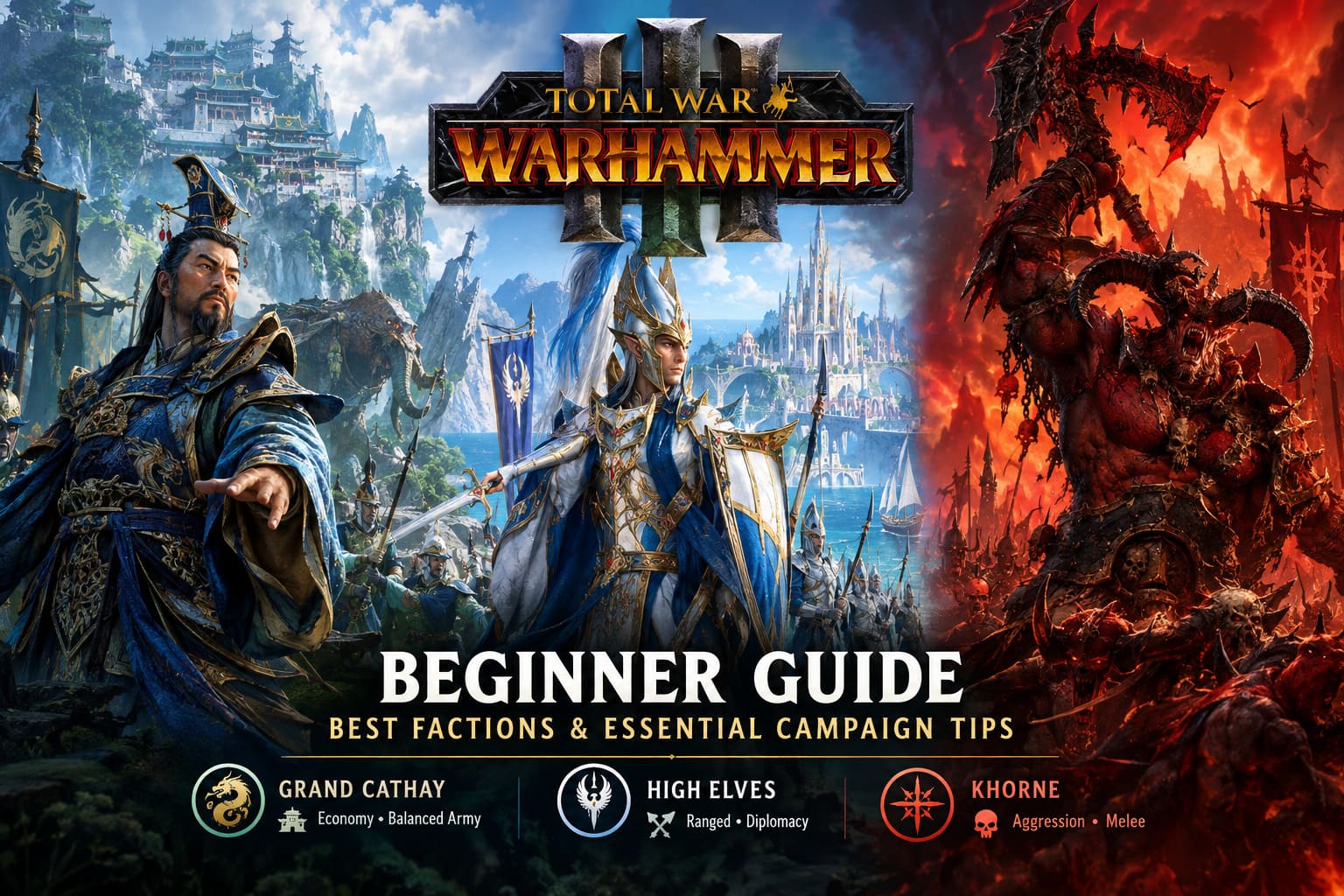
1. Grand Cathay — Zhao Ming
If you want a relatively controlled introduction to Immortal Empires, Zhao Ming and Grand Cathay are excellent choices.
Cathay gives you a nice combination of ranged firepower, durable infantry and monsters without making every battle feel like a puzzle.
The army formation is particularly beginner-friendly. You can establish a solid frontline, put ranged units behind it and let your heavier units react to whatever the enemy is doing.
The Harmony system also encourages you to think about unit placement rather than simply throwing everything into one enormous blob.
And then there’s the campaign side.
Cathay gives you a strong economy and the Caravan system, which adds another layer of income and strategic decision-making without completely overwhelming the campaign map.
For a first campaign, that’s exactly the kind of complexity I like.
You get interesting mechanics, but you can still understand what your army is supposed to do.
2. High Elves — Tyrion
Tyrion remains one of those Legendary Lords I would recommend to anyone who wants to learn the fundamentals of Total War.
Ulthuan gives you a comparatively understandable geographical situation, while the High Elf roster is wonderfully straightforward.
You have:
- Strong archers
- Reliable spearmen
- Powerful elite infantry
- Useful cavalry
- Excellent characters
That makes learning army composition much easier.
You can put spearmen in front, position archers behind them and learn the fundamentals of protecting your ranged damage.
The High Elves also provide a useful introduction to diplomacy and trade. You’re not forced into constant warfare just to keep your campaign alive.
If your goal is to understand how a conventional Total War army works, Tyrion is a very natural starting point.
3. Khorne — Skarbrand
Now, this is my recommendation for the player who looks at diplomacy screens and immediately thinks, Can I just hit everybody instead?
Yes.
You can.
Skarbrand is basically the opposite of a traditional beginner campaign.
Khorne encourages aggression. You aren’t building a sophisticated ranged army or trying to maintain a web of friendly trade agreements. You’re taking heavily armed monsters and warriors and throwing them into the enemy.
The lack of conventional ranged units makes the battles easier to understand in one sense, although the faction has its own learning curve.
The campaign rewards constant warfare, and that makes Skarbrand particularly appealing if you simply want to learn the combat system while keeping the campaign moving.
Just remember that “simple” doesn’t necessarily mean “easy.”
Your First 20 Turns Should Be Boring
I mean that as a compliment.
One of the biggest mistakes I see new players make is trying to expand as quickly as possible.
You don’t need six provinces.
You need one province that actually works.
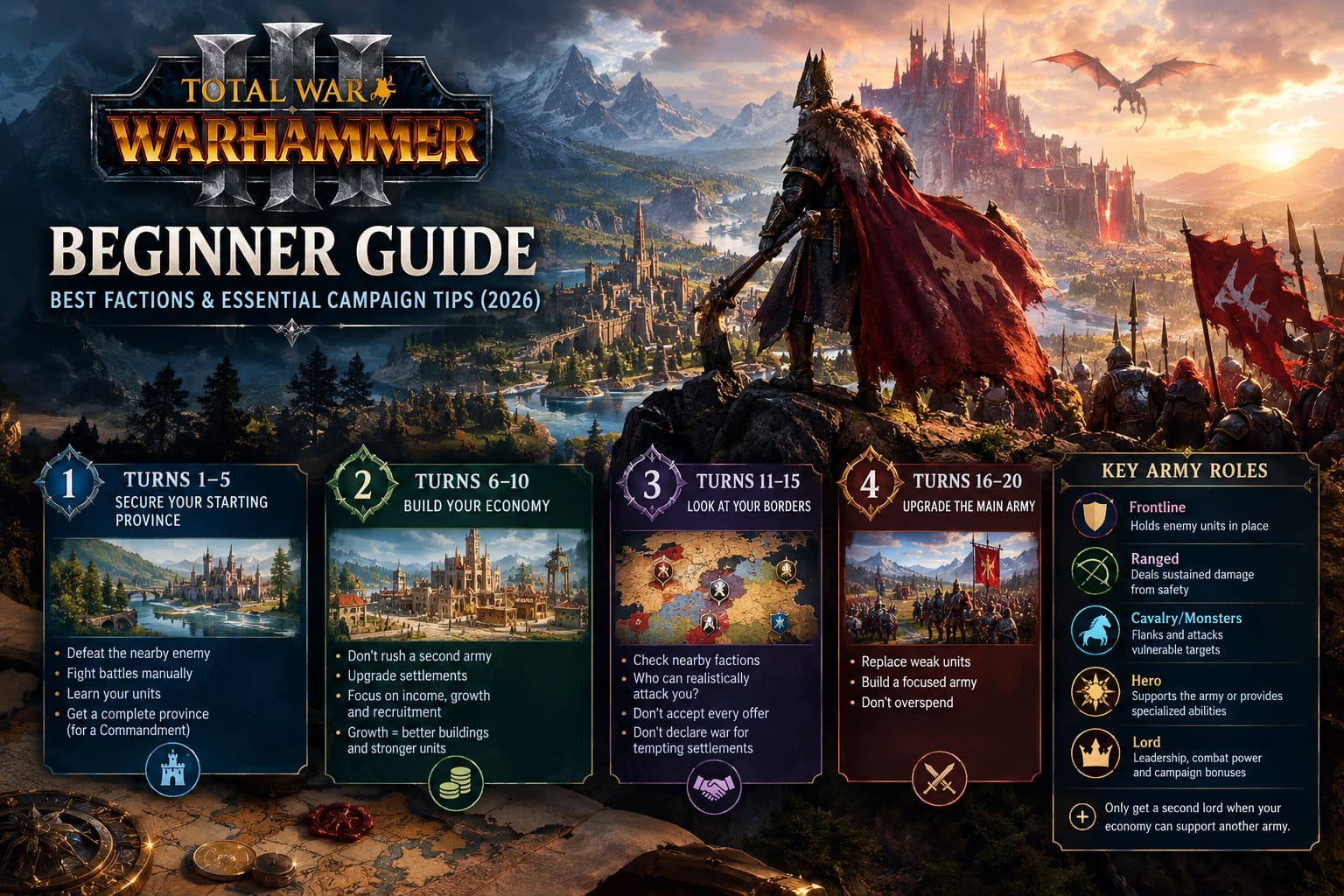
Turns 1–5: Secure Your Starting Province
Deal with the enemy directly threatening your starting position.
Whenever possible, manually fight your early battles.
Yes, I know the temptation to press Autoresolve is enormous.
But those early fights are basically free tutorials. Use them to learn how your infantry responds to charges, how ranged units behave and how quickly your cavalry can get around an enemy flank.
Then start consolidating your starting province.
A complete province gives you access to a Commandment and, more importantly, gives you a stable base from which to expand.
Turns 6–10: Build Your Economy
This is where I would slow down.
Don’t immediately create a second army just because you can.
Armies cost money, and a second army that you can’t properly maintain is worse than having one strong army.
Upgrade your settlements and prioritize the buildings that improve income, growth or recruitment.
Growth deserves particular attention because settlement tiers unlock better buildings and stronger units.
If your economy is weak, your shiny new army won’t save you. It’ll just become an expensive collection of units standing around waiting for your treasury to hit zero.
Turns 11–15: Look at Your Borders
Now open diplomacy and actually study the factions around you.
Ask yourself:
Who can realistically attack me?
That’s a much better question than asking which faction you can conquer next.
Don’t accept every diplomatic offer simply because the game gives you a button to press. An alliance can drag you into wars on the opposite side of the map.
Likewise, don’t declare war just because an enemy settlement looks tempting.
A territory you cannot defend is often more trouble than it’s worth.
Turns 16–20: Upgrade the Main Army
By this point, your first province should be becoming much more developed.
Start replacing some of your weakest units as better recruitment options become available.
You don’t necessarily need the most expensive army possible. You need an army that has a clear purpose.
| Role | Purpose |
|---|---|
| Frontline | Holds enemy units in place |
| Ranged | Deals sustained damage from safety |
| Cavalry/Monsters | Flanks and attacks vulnerable targets |
| Hero | Supports the army or provides specialized abilities |
| Lord | Leadership, combat power and campaign bonuses |
Only consider a second lord when your economy can comfortably support another army.
Stop Treating Autoresolve Like a Magic Button
Autoresolve is convenient.
It is also one of the easiest ways for a new player to learn bad habits.
There are battles that look terrible in the preview but become easy once you manually control your army. There are also battles where Autoresolve can produce casualties that you could have avoided yourself.
I’m not saying you should manually fight every battle for the next 200 turns.
Absolutely not.
Once you’re comfortable, Autoresolve becomes one of the best quality-of-life features in the game.
But during your first campaign, manually fight the battles that teach you something.
That’s especially true for battles involving cavalry, monsters, ranged units or difficult terrain.
Learn the Basic Army Formation
You don’t need a complicated spreadsheet to build a functional army.
Think in roles.
Your frontline holds. Your ranged units damage. Your fast units exploit weaknesses.
That’s the basic idea.
Put your infantry in a reasonably organized line rather than creating one giant blob.
Keep ranged units behind them with enough room to fire.
If you’re using gunpowder units, pay special attention to line of sight. A perfectly positioned gun unit is useless if your own infantry is standing directly in front of its weapons.
And please don’t charge cavalry straight into spearmen.
I know it looks cool.
I also know how quickly that cavalry unit disappears.
Instead, wait until the enemy infantry is engaged. Move around the side and hit them from the flank or rear.
Then pull out and charge again.
Cycle charging is one of those mechanics that feels unnecessary until you realize how much damage it can create.
Characters Can Completely Change a Battle
Legendary Lords and Heroes aren’t just expensive decorations.
They can dramatically change the outcome of battles.
When leveling characters, don’t randomly click skills just because something looks powerful.
Campaign movement bonuses and replenishment can be incredibly valuable because they improve your ability to actually operate your army across the map.
Spellcasters are another story.
A powerful area-of-effect spell used against a tightly packed enemy formation can turn a difficult battle into a massacre in seconds.
The exact spell you want depends heavily on the faction, but the principle is universal:
Look for abilities that solve the problems your army keeps encountering.
Best Multiplayer Campaign Factions in Total War: Warhammer 3 (2026 Co-Op Guide)
A Few Interface Tricks That Saved Me Time
Warhammer 3 throws an absurd amount of information at you, so learning a few interface shortcuts makes the entire game less frustrating.
The Spacebar overlay during battles is particularly useful for checking movement paths, firing information and other battlefield details.
On the campaign map, don’t ignore corruption overlays. Chaos, Vampiric and Skaven corruption can tell you a lot about what is happening around your territory.
Later in the campaign, when you have armies scattered across half the world, keeping track of which characters still have movement points becomes increasingly important.
I can’t count how many times I’ve ended a turn and immediately thought:
“Wait. I forgot that army.”
It happens.
Total War Warhammer 3 Patch 9.0 Notes: Full Changelog & Performance Update
My Biggest Beginner Tip: Don’t Play Warhammer 3 Like a Race
This is the part I would put at the top of the guide if I could.
You don’t win Immortal Empires by expanding as quickly as possible.
You win by building a position that can survive what comes next.
A slightly smaller empire with a healthy treasury, strong armies and defensible borders is often much easier to manage than a giant empire that is fighting six wars and losing money every turn.
For your first campaign, concentrate on three things:
- Secure your starting province.
- Build an economy that can support your armies.
- Fight enough battles manually to understand what your units actually do.
Once those three things become second nature, Warhammer 3 starts changing.
The enormous map stops looking like an impossible wall of information. You start recognizing faction mechanics, understanding threats and planning several turns ahead.
And that’s when Immortal Empires becomes really addictive.
Your first campaign doesn’t have to be legendary.
It just has to teach you enough that your second campaign is better than your first.
That’s honestly one of the best parts of Total War: Warhammer 3. There is always another faction, another starting position and another ridiculous campaign waiting for you.