Best Beginner Factions in Total War: Warhammer 3 Immortal Empires (2026 Guide)
Total War: Warhammer 3 has a funny way of making you feel like a genius one minute and completely lost the next.
You win a huge battle, capture a province, build a shiny new army, and start thinking you’ve finally figured out Immortal Empires. Then three enemy factions declare war on you, your economy collapses, and an army you forgot about gets wiped out somewhere on the other side of the map.
I’ve been there. More than once.
That’s why picking the right faction for your first Immortal Empires campaign matters so much. The game gives you an absurd number of legendary lords to choose from, but not all of them are equally friendly to someone still learning how provinces, diplomacy, army compositions, and battle mechanics fit together.
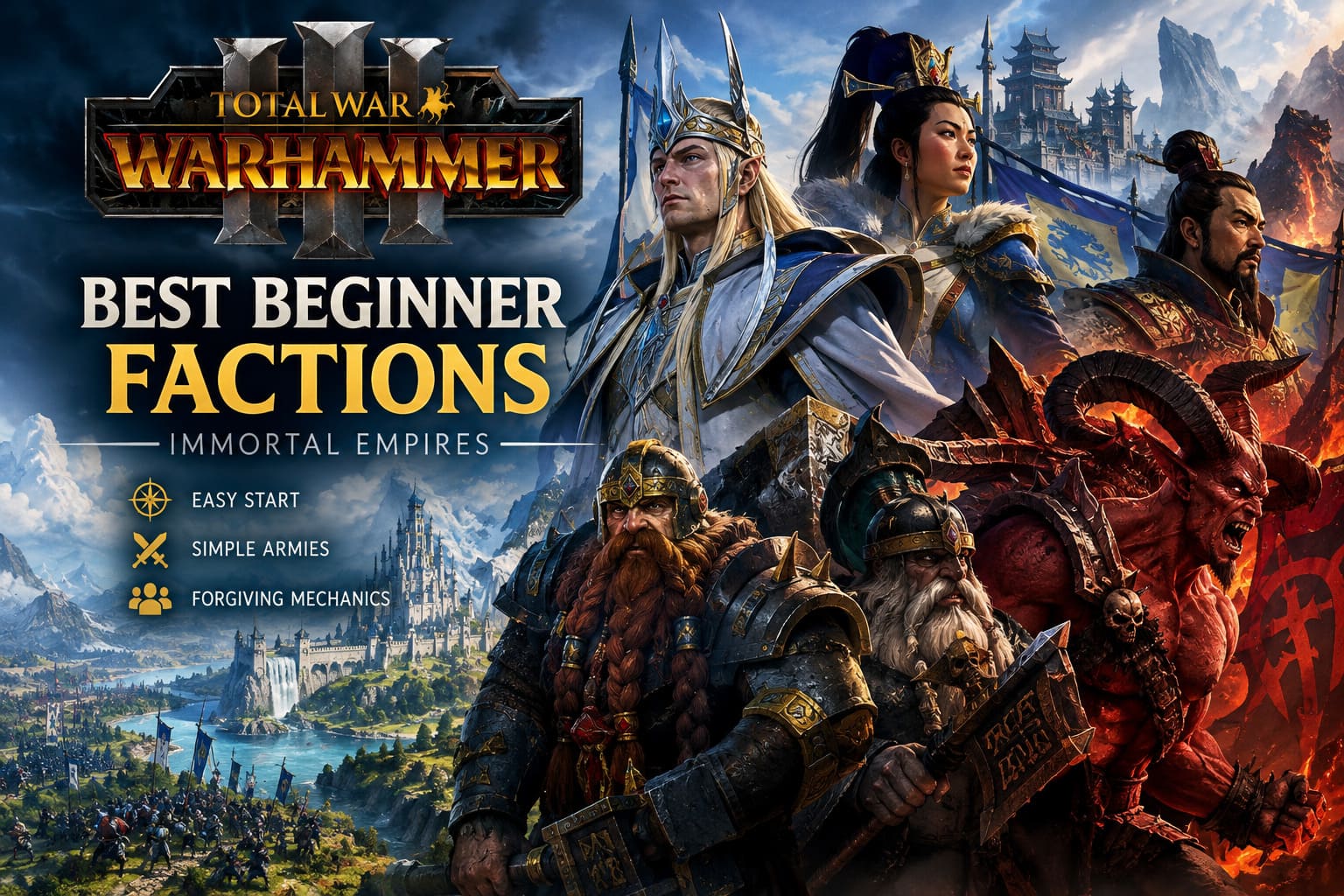
For a beginner, I generally look for three things: a forgiving starting position, an easy-to-understand army, and campaign mechanics that don’t punish you for learning slowly.
With that in mind, these are the factions and legendary lords I’d put at the top of a new player’s list in 2026.
The Best Beginner Factions at a Glance
| Faction / Lord | Why It Works for Beginners | Main Difficulty |
|---|---|---|
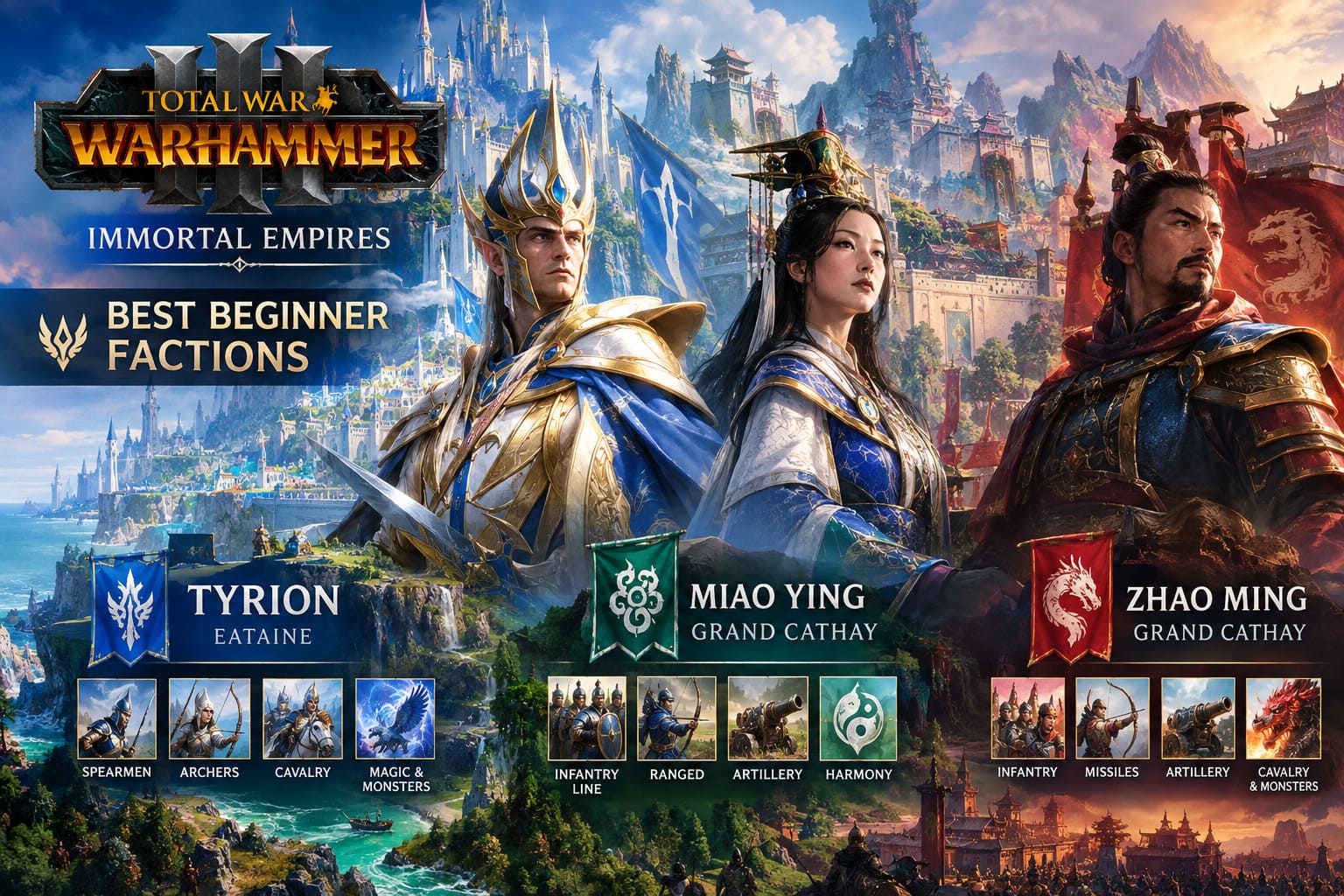
| Tyrion – Eataine | Balanced armies, wealthy territory, strong diplomacy | Low |
| Miao Ying – Grand Cathay | Defensive position, strong ranged units, simple formations | Low-Medium |
| Zhao Ming – Grand Cathay | Secure territory and flexible roster | Low-Medium |
| Thorgrim Grudgebearer – Dwarfs | Tough infantry, powerful artillery, easy battle lines | Medium |
| Thorek Ironbrow – Dwarfs | Defensive armies and relatively straightforward battles | Medium |
| Skarbrand – Khorne | Extremely direct campaign and brutal melee armies | Medium, but unconventional |
1. Tyrion – Eataine
If someone asked me to pick one faction to learn Total War: Warhammer 3, Tyrion would still be near the top of my list.
The reason isn’t simply that Tyrion is powerful. It’s that an Eataine campaign naturally teaches you many of the systems you’ll eventually need to understand anyway.
You get a relatively comfortable position on Ulthuan, access to wealthy settlements, a strong roster, diplomacy opportunities, and a faction that can transition from basic infantry-and-archer armies into something much more spectacular.
And honestly, that progression is one of the things I like most about the High Elves.
Why Tyrion Is So Good for Learning
Your early armies can be incredibly simple:
- Spearmen form the frontline.
- Archers provide reliable ranged damage.
- Cavalry gives you some mobility later.
- Magic and monsters gradually add more tactical options.
You don’t need some elaborate army composition just to survive your first battles. You can look at your army, understand what most units are supposed to do, and start experimenting from there.
Tyrion himself is also a fantastic safety net. He’s a powerful legendary lord who can make difficult battles considerably more manageable, particularly when you’re still learning how to deal with enemy characters.
The campaign side is similarly forgiving. Influence gives the High Elves interesting diplomatic tools, while Ulthuan provides plenty of opportunities to establish friendly relationships and develop your economy.
The biggest beginner lesson here is diplomacy. You quickly learn that not every faction on the map needs to become your enemy.
And that’s a lesson worth learning early.
2. Miao Ying – Grand Cathay
If you’re playing Warhammer 3 without relying on older games or additional content, Grand Cathay is one of the first factions I’d consider.
Miao Ying is particularly interesting because her campaign naturally encourages defensive thinking.
The Great Bastion gives you a very obvious strategic problem: protect the northern entrance into Cathay.
That clarity is valuable when you’re new.
Instead of staring at the entire Immortal Empires map wondering where the next disaster is coming from, you have a fairly obvious area that needs your attention. Once you’ve stabilized the situation, you can start expanding your empire and learning the wider campaign systems.
Cathay Is Basically a Giant Strategy Lesson
Grand Cathay’s battlefield identity is built around Harmony.
That makes intuitive sense when you’re looking at the army.
Your melee troops hold the line while ranged units and artillery work behind them. Jade Warriors and similar frontline units can protect missile troops, while artillery gives you another way to punish enemies before they reach your formation.
This is exactly the kind of setup I like recommending to new players because it teaches one of the most important concepts in Total War:
Don’t throw every unit into the same fight.
Keep your frontline together. Protect your ranged units. Watch the flanks. Let the enemy come to you when the situation favors it.
Once you’ve mastered that, more complicated factions become much easier to understand.
Cathay also has its trade caravan system, which can provide substantial economic rewards while exposing you to a different side of the campaign map.
3. Zhao Ming – Grand Cathay
Zhao Ming deserves his own mention because his campaign can feel noticeably different from Miao Ying’s despite sharing the same faction.
His position gives you room to develop while learning the fundamentals of Cathay’s economy, armies, and diplomacy.
For a player who wants to experiment without immediately being thrown into the most chaotic corner of the map, that’s a useful advantage.
The other thing I like about Zhao Ming is flexibility.
You aren’t forced into one single battle strategy. You can lean into infantry, missiles, artillery, cavalry, monstrous units, or combinations of them as your campaign develops.
That makes Zhao Ming a good second beginner campaign if you’ve already learned the basics with another faction and want to start experimenting.
4. Thorgrim Grudgebearer – The Dwarf Learning Campaign
There’s something wonderfully uncomplicated about a Dwarf battle line.
You put your heavily armored infantry in front, artillery behind them, missile troops somewhere safe, and then wait for the enemy to discover why charging directly into Dwarfs isn’t a great life decision.
Thorgrim Grudgebearer is a particularly good choice if you don’t enjoy managing cavalry or extremely fast units.
Dwarf armies are slow. Very slow.
But that can actually be an advantage while learning.
You’re not constantly trying to reposition six different cavalry units while simultaneously managing magic, monsters, flying units, and a fragile frontline.
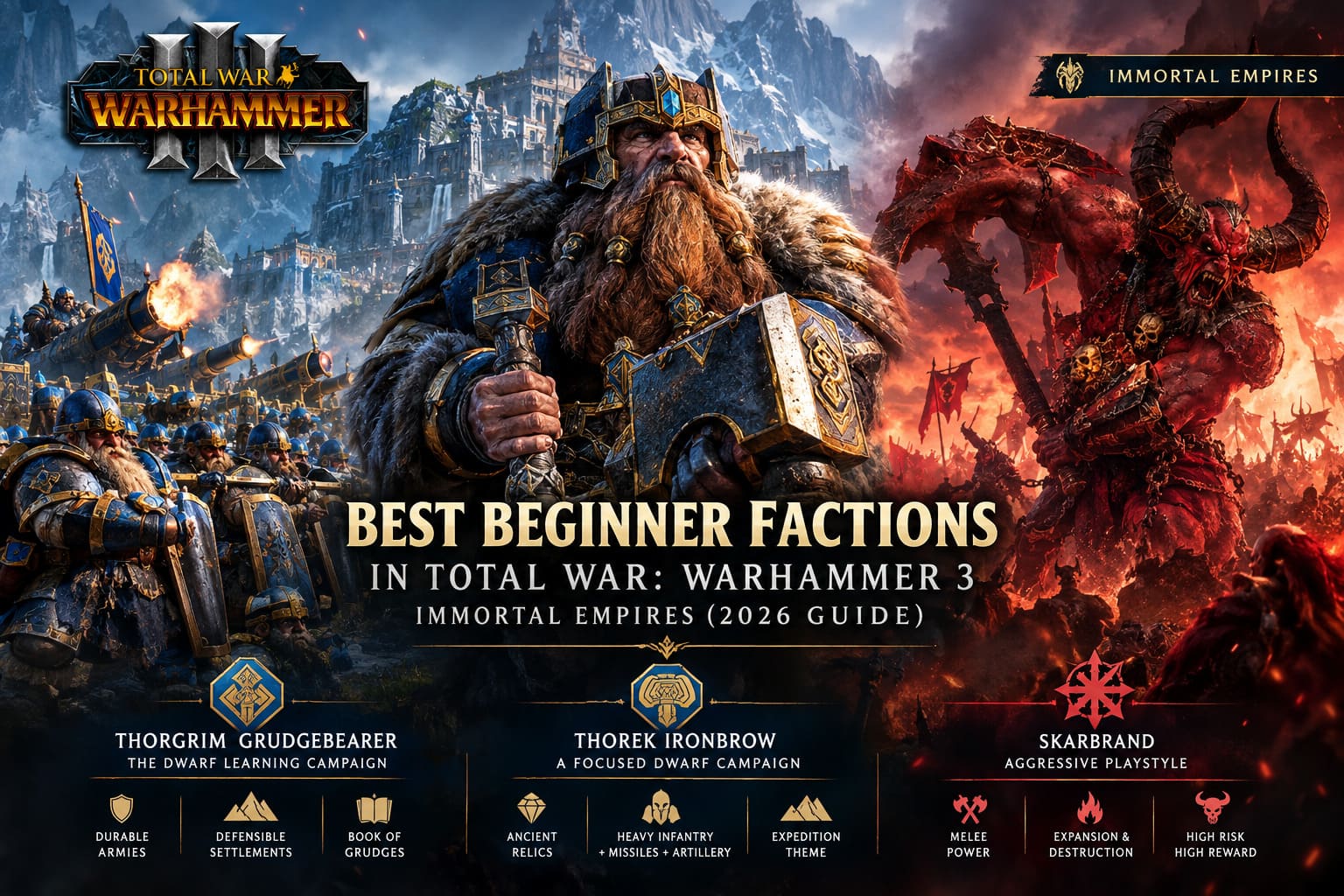
Instead, you can concentrate on the fundamentals:
- Where is my frontline?
- Where is my artillery firing?
- Are my missile troops protected?
- Is the enemy trying to flank me?
- Which units need support?
That’s a much more manageable checklist.
Dwarfs Also Forgive Mistakes
Dwarf infantry is heavily armored and generally dependable in prolonged combat. Their artillery can punish approaching enemies, while units such as Quarrelers and Thunderers provide additional ranged pressure.
The Book of Grudges adds another layer to the campaign, but it is relatively easy to understand: enemies wrong you, the grudge gets recorded, and dealing with those enemies can provide rewards.
Their settlements and mountain territories can also create defensible positions that make it easier to establish a secure base before expanding.
If your biggest concern is “I don’t want my army to collapse because I clicked the wrong thing for three seconds,” Dwarfs are worth considering.
5. Thorek Ironbrow – A More Focused Dwarf Campaign
Thorek gives you another way to experience the Dwarfs without simply copying Thorgrim’s campaign.
His expedition has a strong thematic focus around reclaiming ancient Dwarf relics, and the campaign can be especially appealing if you enjoy the idea of gradually assembling a collection of powerful artifacts.
The battlefield fundamentals remain familiar.
Heavy infantry + missiles + artillery is still the name of the game.
That consistency makes Thorek useful for players who want to understand Dwarf mechanics before moving on to more demanding factions.
The major difference is that you shouldn’t mistake “easy to understand” for “completely effortless.” Dwarf armies are durable, but their lack of speed means positioning mistakes can still hurt badly.
Once you’ve committed your army to the wrong location, getting it somewhere else takes time.
A lot of time.
6. Skarbrand – For Players Who Don’t Want a Defensive Campaign
Now we get to the weird recommendation.
Skarbrand is absolutely not the traditional beginner faction, but I think he deserves a place on this list for one reason:
Some players simply don’t enjoy defensive Total War.
If your idea of fun is building a neat formation and waiting for the enemy to attack, you’ll probably have a miserable time with Khorne.
If your reaction is instead, “Can I just attack everyone?”, Skarbrand makes considerably more sense.
Khorne Has One Very Clear Philosophy
Fight.
Then fight again.
Then find someone else to fight.
Khorne largely removes the traditional reliance on ranged troops and spellcasters and replaces it with terrifying melee power. Skarbrand himself is an absolute monster on the battlefield, and his campaign mechanics reward aggressive expansion and destruction.
That simplicity can actually be refreshing.
You don’t have to spend hours worrying about the perfect missile formation because your army’s answer to most problems is generally some variation of put a very angry daemon in the enemy’s face.
The catch is that Khorne teaches a different lesson from Tyrion or Cathay.
You’re learning aggression, momentum, army movement, and how to maintain pressure rather than defensive positioning and diplomacy.
So I’d recommend Skarbrand to a particular type of beginner, not every beginner.
Factions I’d Be Careful With on a First Campaign
Some legendary lords may look beginner-friendly because the game presents them as recommended choices. That doesn’t necessarily mean their Immortal Empires campaigns are going to feel comfortable to someone who has never played Total War before.
Karl Franz – The Empire
Karl Franz looks like the obvious starting point.
He’s iconic, the Empire is central to Warhammer’s setting, and the faction appears to represent the classic Total War formula.
The problem is the strategic pressure.
The Empire can become involved with multiple threats and diplomatic problems, while the player has to manage provinces, political relationships, and a campaign position that can turn complicated quickly.
For an experienced Total War player, that complexity can be exactly what makes the campaign enjoyable.
For someone who is still learning what a settlement building does, it can feel like being handed six homework assignments at once.
I’d save Karl Franz for a second or third campaign.
Katarin – Kislev
Kislev is another faction I would approach carefully.
The campaign fantasy is fantastic: you’re essentially standing between the civilized world and some extremely unpleasant neighbors.
But that’s also the problem.
You’re expected to deal with significant external pressure while simultaneously learning the game’s economic and military systems.
It’s possible to start with Kislev, of course. But if your first campaign already feels like a desperate defensive war from turn one, don’t assume you’re simply bad at the game.
Sometimes you’ve just picked a faction with a demanding strategic position.
Beginner Rules That Will Save Your Campaign
Regardless of which faction you choose, a few habits will make your first Immortal Empires campaign considerably less painful.
1. Build One Strong Army First
Don’t immediately create several half-filled armies.
A strong 20-unit army led by your legendary lord can accomplish far more than three weak forces wandering around the map.
Concentrate your power before spreading it out.
2. Develop Provinces Before Conquering Everything
Expansion feels great. Your map gets bigger, your borders look impressive, and suddenly you own half a region.
Then you realize you can’t defend any of it.
Take a moment to stabilize newly captured territory before moving on. Growth, income, public order/control, and settlement upgrades all matter.
3. Learn to Read the Battlefield
Don’t rely exclusively on auto-resolve.
If the game gives you a result that looks ugly, fight the battle manually. Even losing a battle can teach you something about unit positioning, morale, armor, ranged fire, or enemy abilities.
The first few manual battles may be messy.
That’s completely normal.
4. Don’t Start Every War
One of the biggest beginner mistakes is assuming every nearby faction eventually needs to be conquered.
It doesn’t.
Sometimes a diplomatic agreement is more valuable than another province.
A peaceful neighbor is a lot cheaper than an army sitting on your border waiting for trouble.
Total War Warhammer 3 Beginner Guide: Best Factions and Essential Campaign Tips (2026)
My Beginner Faction Cheat Sheet
| If You Want… | Consider… |
|---|---|
| A classic all-rounder | Tyrion |
| Defensive formations and ranged support | Miao Ying |
| A flexible Cathay campaign | Zhao Ming |
| Tough infantry and artillery | Thorgrim |
| A slower, methodical campaign | Thorek |
| Constant melee aggression | Skarbrand |
| A challenging political campaign | Karl Franz |
| A campaign under heavy external pressure | Katarin |
Best Multiplayer Campaign Factions in Total War: Warhammer 3 (2026 Co-Op Guide)
Final Thoughts
The best beginner faction in Total War: Warhammer 3 Immortal Empires isn’t necessarily the faction with the strongest units. It’s the one that lets you make mistakes without immediately ending your campaign.
That’s why I keep coming back to Tyrion, Grand Cathay, and the Dwarfs when talking about learning the game. They give you room to understand the basics while still having enough depth to remain interesting after the first few dozen turns.
Tyrion is probably the closest thing to a traditional Total War classroom: infantry, archers, cavalry, monsters, diplomacy, economy, and a relatively understandable starting position.
Cathay teaches defensive formations and battlefield balance.
The Dwarfs teach patience, positioning, artillery, and the value of letting heavily armored troops do their job.
And then there’s Skarbrand.
He’s the option for the player who looked at this entire guide and thought, “All right, but what if I just kill everybody?”
Honestly, that’s a perfectly legitimate way to learn too.
The important thing is not to judge your first campaign by how quickly you conquer the map. Immortal Empires is a sandbox, and the early campaigns are as much about learning the systems as they are about winning.
Once you understand how to build an economy, protect your provinces, create a balanced army, and avoid unnecessary wars, the enormous faction selection stops looking intimidating.
That’s when Warhammer 3 really opens up.