The Witcher 3 Next-Gen: Most Broken Mutations Tier List (2026 Meta Guide)
There is a very specific moment in The Witcher 3: Wild Hunt when Geralt stops feeling like a monster hunter and starts feeling like the monster.
You walk into a camp packed with enemies, activate a few buffs, throw out a Sign, swing your sword a couple of times — and suddenly half the battlefield is either frozen, burning, bleeding, poisoned, or simply dead. That ridiculous power spike is exactly why I still love the mutation system.
The mutations added with Blood and Wine were already capable of pushing Geralt’s builds into absurd territory. The Next-Gen version changed the surrounding balance, though, and some old favorites don’t feel quite as dominant as they once did. At the same time, a few mutations became much more interesting because they interact so well with modern hybrid builds.
So, after looking at what actually works in high-level play rather than blindly following old pre-Next-Gen tier lists, here is my Witcher 3 mutations tier list for 2026.
And yes, Euphoria is still ridiculous. But it isn’t the only mutation worth talking about anymore.
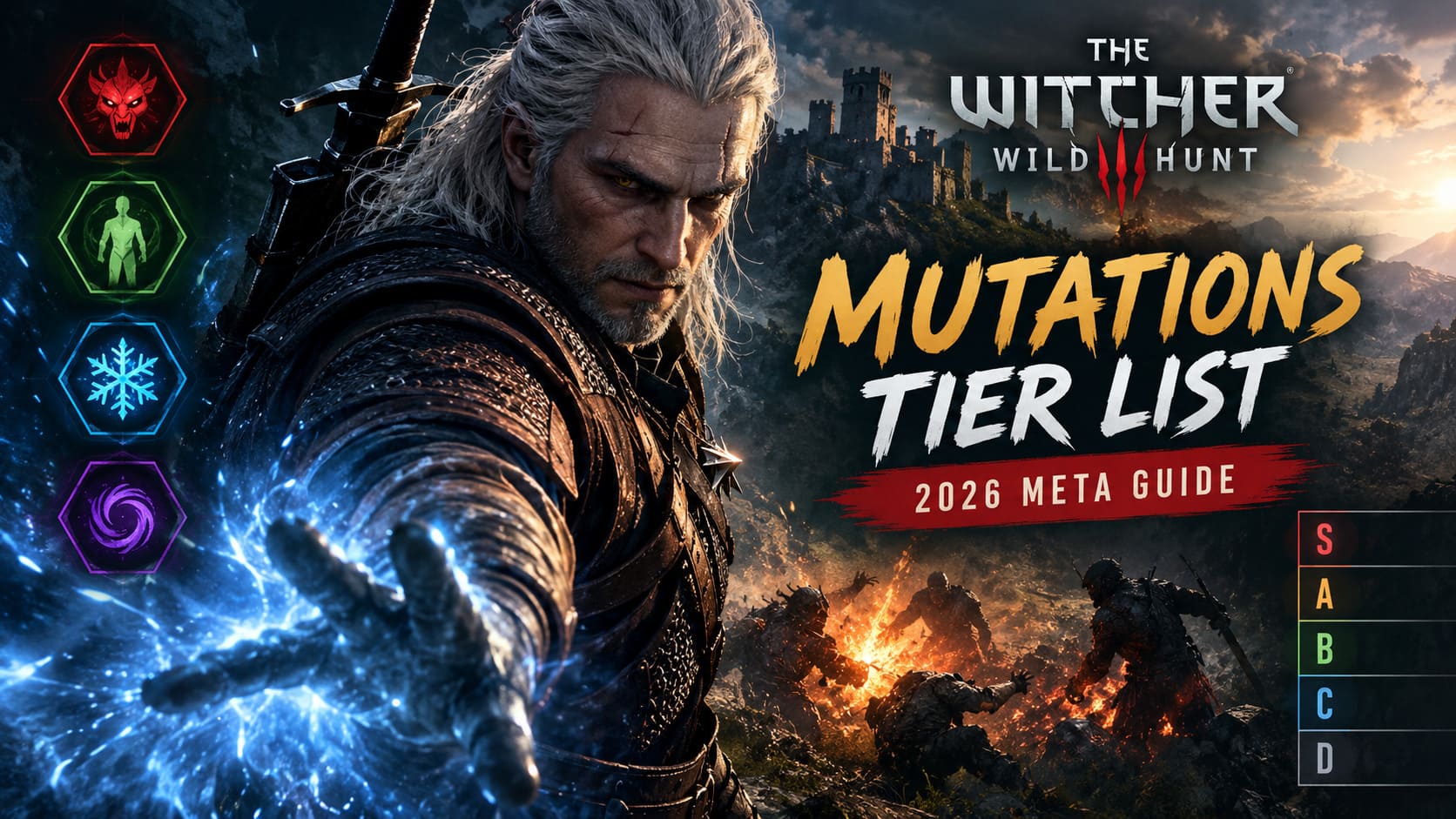
Witcher 3 Mutations Tier List: Quick Overview
| Tier | Mutations | What They Excel At |
|---|---|---|
| S-Tier | Metamorphosis, Euphoria, Piercing Cold | Endgame damage, versatility, crowd control |
| A-Tier | Conductor of Magic, Bloodbath, Deadly Counter | Specialized high-damage builds |
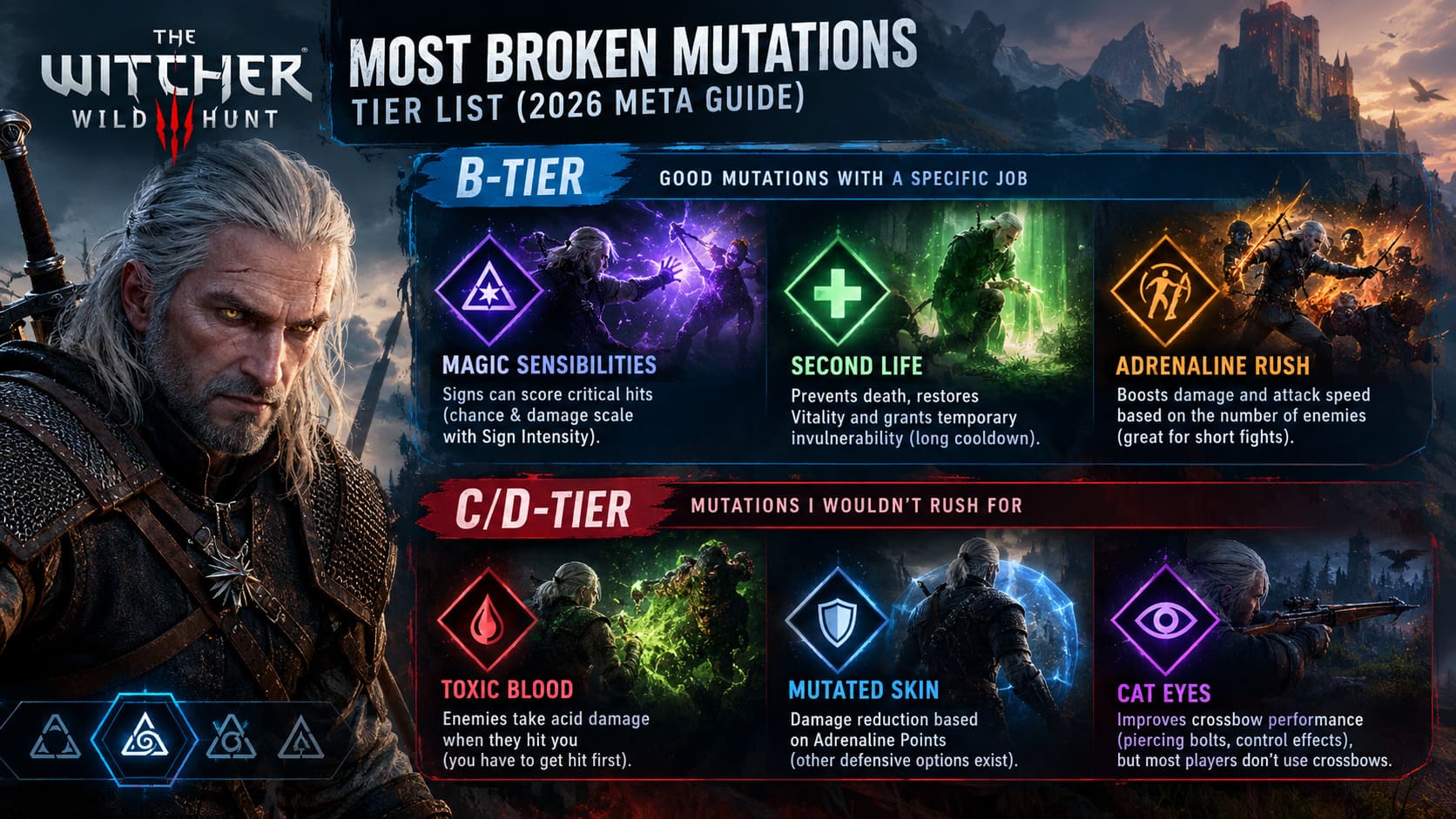
| B-Tier | Magic Sensibilities, Second Life, Adrenaline Rush | Niche and situational builds |
| C/D-Tier | Toxic Blood, Mutated Skin, Cat Eyes | Limited or highly specialized utility |
The interesting thing here is that there isn’t one mutation that makes every possible build obsolete. Your combat style matters. A sign-heavy Geralt has completely different priorities from a Whirl-focused Death March build.
Still, three mutations sit above the rest for me.
S-Tier: The Mutations That Can Break Geralt
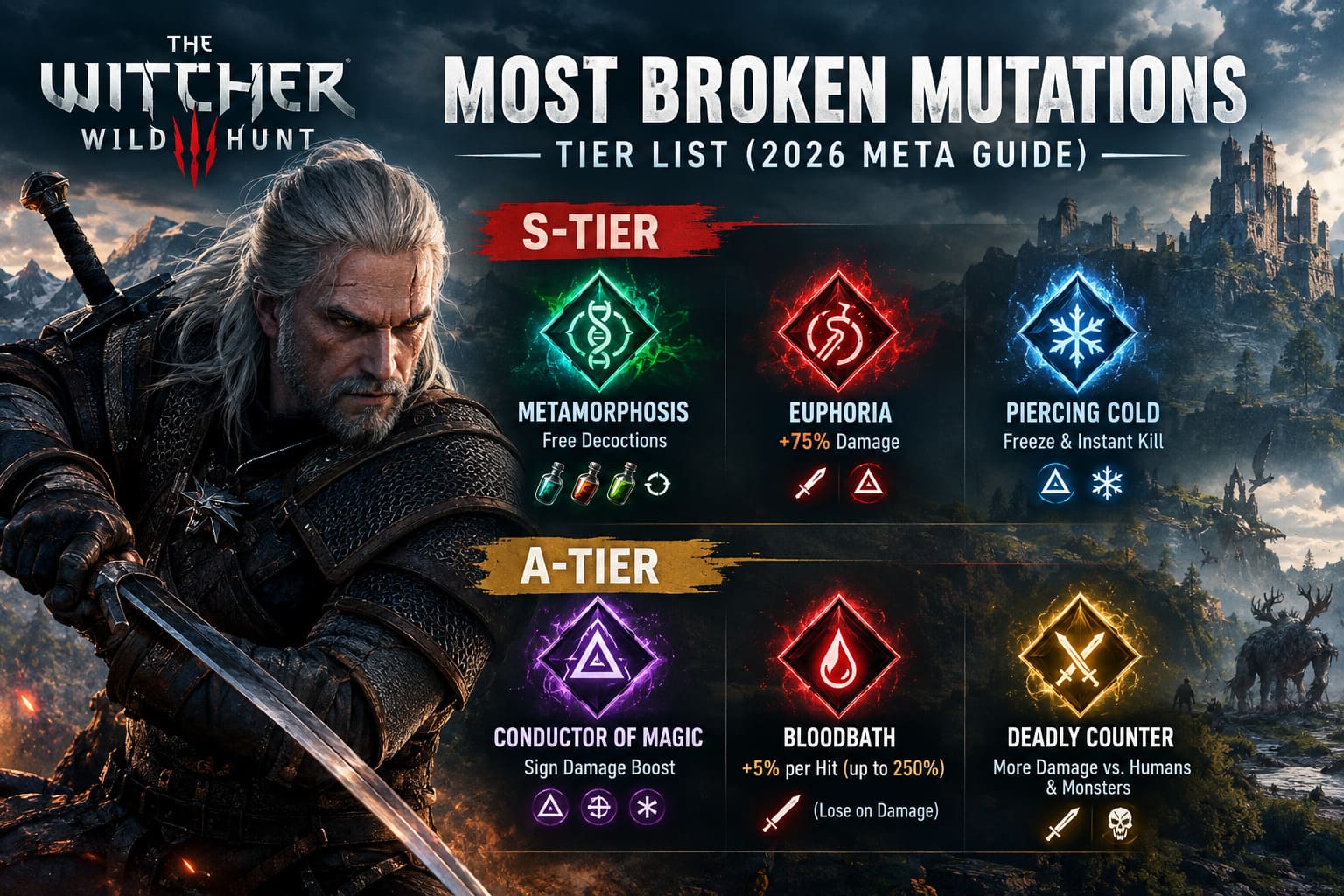
1. Metamorphosis — The 2026 Endgame Monster
If I had to pick the mutation that best represents the completely ridiculous side of the Witcher 3’s endgame, it’s Metamorphosis.
The basic idea is simple. Apply critical effects to enemies and the mutation can activate random decoctions for 120 seconds without consuming Toxicity, with up to three decoctions active through the mutation at once.
That sounds good.
In practice, it can get stupid.
The real strength of Metamorphosis is that it attacks one of the biggest limitations of powerful alchemy builds: resource management. Normally, stacking several strong decoctions means paying for them through your Toxicity pool. Metamorphosis effectively says, what if we just didn’t care?
That makes critical-effect builds particularly nasty.
A few successful attacks can start the chain, and suddenly Geralt has several powerful decoction effects running while still having room for conventional potions.
Why I rate it so highly:
- Free decoction activation
- Excellent synergy with critical-effect builds
- Works with Combat, Signs, and Alchemy setups
- Extremely strong in long encounters
- Doesn’t force you into a single weapon type
This is one of those mutations that gets stronger the more creative you become with the rest of the build.
And that’s exactly what I want from an endgame mutation.
2. Euphoria — Still the Classic Damage Monster
Yes, Euphoria is still here.
Anyone who played the old toxicity-focused builds knows why this mutation became infamous. Its current version isn’t the same monster it was before the major balance changes, but that doesn’t make it weak.
Euphoria increases sword damage and Sign Intensity based on Toxicity, reaching a 75% maximum bonus.
That is still a gigantic passive boost.
The important difference is that Euphoria is incredibly straightforward. You don’t need to maintain a complicated rotation or wait for a special trigger. Get your Toxicity where you want it, and the mutation does its job.
For hybrid Combat/Alchemy builds, that reliability is hard to beat.
The Manticore armor set is especially relevant because of its Toxicity-related bonuses. Put the right alchemy skills around Euphoria and Geralt can walk into a fight already carrying an enormous damage multiplier.
Metamorphosis gives you more flexibility.
Euphoria gives you consistency.
And sometimes consistency is exactly what you want when you’re fighting something that can kill you in two hits.
3. Piercing Cold — Aard Goes Completely Off the Rails
I didn’t appreciate Piercing Cold enough during my first few builds.
Then I tried actually building around it.
Big mistake.
For anyone on the receiving end.
Piercing Cold gives Aard a chance to freeze enemies, and enemies that are simultaneously knocked down and frozen can be killed instantly. Even when the instant-kill effect isn’t relevant, the additional damage and crowd control make Aard dramatically more threatening.
The mutation turns groups of enemies into targets rather than threats.
Bandit camps become especially funny. Instead of carefully isolating targets, you can throw Aard into a crowd and let the mutation do the dirty work.
A dedicated Sign build makes this even nastier, particularly when combined with equipment and abilities that increase Aard’s effectiveness.
Piercing Cold isn’t the most universal mutation in the game.
But if your build is designed around Signs, it can feel absolutely unfair.
A-Tier: Ridiculously Strong, But More Specialized
4. Conductor of Magic
Conductor of Magic is where things get interesting for pure Sign builds.
When you’re using a Witcher sword, Magic sword, Unique sword, or Relic sword, the mutation increases Sign damage based on the equipped sword’s base damage.
That creates a surprisingly strong connection between your weapon choice and your Sign damage.
And this is where something like Aerondight becomes especially interesting.
If you’re stacking Sign Intensity and using a powerful sword, the resulting Sign damage can get ridiculous. Igni becomes a genuine damage tool rather than something you casually throw out to interrupt enemies.
For a dedicated mage-style Geralt, I can absolutely understand choosing this over Euphoria.
5. Bloodbath
Bloodbath is the mutation for players who believe the best defensive strategy is simply killing everything before it can hit you.
Every successful sword strike increases your attack power by 5%, stacking up to 250%.
There is one enormous catch: take damage and the entire bonus disappears.
That’s brutal.
But it also makes the mutation incredibly satisfying.
With good dodging, Quen, Fleet Footed and fast attacks, you can build stacks surprisingly quickly. Once Bloodbath starts rolling, ordinary enemies disappear and bosses can lose health at an alarming rate.
The problem isn’t the damage ceiling.
The problem is keeping it.
6. Deadly Counter
Deadly Counter is less flashy than Bloodbath, but I really like it for straightforward sword builds.
It provides a significant damage increase against human enemies that cannot be countered and against monsters. Against other targets, low-health enemies become vulnerable to an execution through a successful counterattack.
There isn’t much complexity here.
You hit things.
You counter things.
Things die.
For players who don’t want their build to revolve around Toxicity management or Sign rotations, Deadly Counter remains a very comfortable choice.
B-Tier: Good Mutations With a Specific Job
7. Magic Sensibilities
Magic Sensibilities allows Signs to score critical hits, with the critical chance and damage scaling from Sign Intensity.
Sounds amazing, right?
It is.
The problem is that the competition is brutal.
A mutation based around Sign criticals can produce spectacular damage numbers, but Conductor of Magic provides a more dependable damage increase for many dedicated Sign builds.
Magic Sensibilities is therefore more attractive if you enjoy building specifically around critical Sign damage rather than simply wanting the biggest reliable numbers possible.
8. Second Life
Second Life is basically Geralt’s insurance policy.
When your health reaches zero, the mutation prevents death, restores your Vitality and temporarily makes you invulnerable. It has a lengthy cooldown, but when it activates, you get another chance to recover.
For a first Death March run, this can be incredibly valuable.
For an optimized endgame build?
I’d rather spend that mutation slot making enemies die faster.
That’s the whole problem with Second Life. It is fantastic when you need it, but a strong Geralt build can often prevent the situation from happening in the first place.
9. Adrenaline Rush
Adrenaline Rush is one of those mutations that looks insane for the first few seconds and considerably less impressive afterward.
Its bonuses scale with the number of enemies you’re fighting, making it potentially excellent when you immediately engage a large group.
That’s great for camps and fast encounters.
The problem appears when a fight becomes a marathon.
If the enemy refuses to die quickly, the mutation’s temporary advantage starts disappearing and can turn into a liability.
For speed-focused players, though, that opening burst can be extremely useful.
C/D-Tier: Mutations I Wouldn’t Rush For
10. Toxic Blood
The concept behind Toxic Blood is fun.
The execution is less impressive.
When enemies hit Geralt, they take acid damage based on his Toxicity. The problem is obvious: you have to get hit first.
On lower difficulties, that can be amusing.
On Death March, deliberately allowing enemies to hit you is generally not the sort of strategy I want my build to encourage.
Toxic Blood can work as a novelty setup, but there are simply too many mutations that provide value without requiring Geralt to take damage.
11. Mutated Skin
Mutated Skin provides damage reduction based on Adrenaline Points, reaching a substantial defensive bonus at maximum stacks.
On paper, that sounds fantastic.
The problem is that Geralt already has a ridiculous collection of defensive options.
Quen exists.
Armor exists.
Dodging exists.
Potions and decoctions exist.
At high levels, spending your mutation slot purely to become harder to kill can feel like overkill when another mutation could simply delete the enemy first.
12. Cat Eyes
I genuinely want to love Cat Eyes.
I just can’t.
It improves crossbow performance dramatically, giving the weapon much more offensive potential and allowing bolts to pierce enemies or produce strong control effects.
For a dedicated crossbow build, that’s obviously useful.
But let’s be realistic.
Most Witcher 3 players aren’t building Geralt around his crossbow.
It’s primarily a utility weapon for underwater enemies, flying creatures and specific situations. Turning it into your main damage source requires committing heavily to a gimmick that other builds can outperform.
Fun?
Absolutely.
Meta?
Not really.
The Witcher 3 Next-Gen Death March Skills Tier List (2026 Guide)
My Favorite 2026 Metamorphosis Build
If I were starting a serious Death March playthrough and wanted to experiment with the strongest mutation mechanics, Metamorphosis would be my starting point.
The basic setup would look something like this:
- Mutation: Metamorphosis
- Armor: Grandmaster Manticore or Grandmaster Wolven
- Silver Sword: Aerondight
- Steel Sword: Belhaven Blade
- Combat Core: Whirl and Rend
- Alchemy Core: Acquired Tolerance and Heightened Tolerance
- Utility: Delayed Recovery and Fixative
- Status Setup: Crippling Strikes
The important part isn’t simply copying the equipment list.
The build works because the pieces feed into each other.
You start combat with your oils and potions prepared. Then you begin generating critical effects through attacks and abilities. Metamorphosis starts activating decoctions, while your alchemy investment keeps the rest of your setup functioning.
And suddenly you’re not playing a basic sword build anymore.
You’re playing a walking collection of buffs.
That is the fun part.
The Witcher 3 Next-Gen Console Commands List: PC Cheat Guide (2026 Update)
Final Thoughts
The best thing about the Witcher 3 Next-Gen mutations system is that the game doesn’t really have one universal answer.
Metamorphosis is my favorite choice for an absurd hybrid build because it turns Toxicity management into a completely different problem. Euphoria remains an incredibly reliable damage engine, while Piercing Cold is the mutation I’d pick if my goal was to turn Aard into a weapon of mass destruction.
Then you have Bloodbath for players who trust their reflexes, Conductor of Magic for Sign specialists, and Deadly Counter for people who just want to hit monsters very, very hard.
The lower tiers aren’t necessarily worthless, either. They simply require more commitment to a specific playstyle to justify their mutation slot.
And honestly, that’s what keeps me coming back to The Witcher 3.
You can spend dozens of hours building Geralt one way, decide that you’ve figured everything out, then change three skills, swap one mutation and suddenly the entire game feels different.
That’s when the build system is doing its job.