Solarpunk Game Review: Cozy Skybound Survival Sandbox Guide
For years, survival games have followed the same formula. Wake up in a hostile world, punch a tree, desperately search for food, and spend half your time trying not to die from monsters, weather, or some random disaster. It’s a formula that works, but after hundreds of hours across countless survival titles, I started feeling burned out.
Then Solarpunk arrived.
At first glance, it looks like another cozy indie crafting game. Bright colors, floating islands, peaceful landscapes, and a promise of zero combat. Honestly, I expected something charming but shallow.
After spending dozens of hours building my sky settlement, automating farms, and cruising through the clouds in a custom airship, I can confidently say that Solarpunk became one of the biggest surprises of 2026.
It doesn’t try to compete with hardcore survival games.
Instead, it asks a simple question:
What if survival could actually feel relaxing?
A World That Feels Worth Living In
The first thing that struck me was the atmosphere.

Most survival games drop players into worlds that are already ruined. Solarpunk does the exact opposite. Instead of exploring post-apocalyptic wastelands, you’re welcomed into a beautiful network of floating islands suspended above the clouds.
Every island feels handcrafted rather than randomly generated. That’s a huge advantage.
Too many procedural worlds eventually start feeling repetitive. Here, exploration feels intentional. New islands often reveal unique resources, fresh farming opportunities, hidden technology, or simply breathtaking scenery worth stopping to admire.
There were multiple moments when I completely forgot about progression because I was too busy watching waterfalls disappear into endless clouds below.
That’s not something I can say about many survival games.
Building Without Stress Is Surprisingly Addictive
The building system quickly became my favorite part of the experience.
I’ve always enjoyed construction mechanics, but many survival games punish creativity. You’re constantly interrupted by raids, enemies, or resource shortages.
Solarpunk removes those distractions.
There are no zombie attacks.
No monster invasions.
No base destruction.
No pressure.
That freedom completely changes the experience.
Instead of building walls for defense, I found myself focusing on aesthetics. My first shelter evolved from a simple wooden cabin into a multi-level sky house with gardens, terraces, and a massive glass greenhouse overlooking the horizon.
The amount of decoration available is impressive for an indie title.
Players can create:
- Cozy cabins
- Futuristic eco-homes
- Large farming compounds
- Airship docks
- Botanical gardens
- Fully automated industrial districts
The best part is that every structure feels like a genuine home rather than a temporary survival bunker.
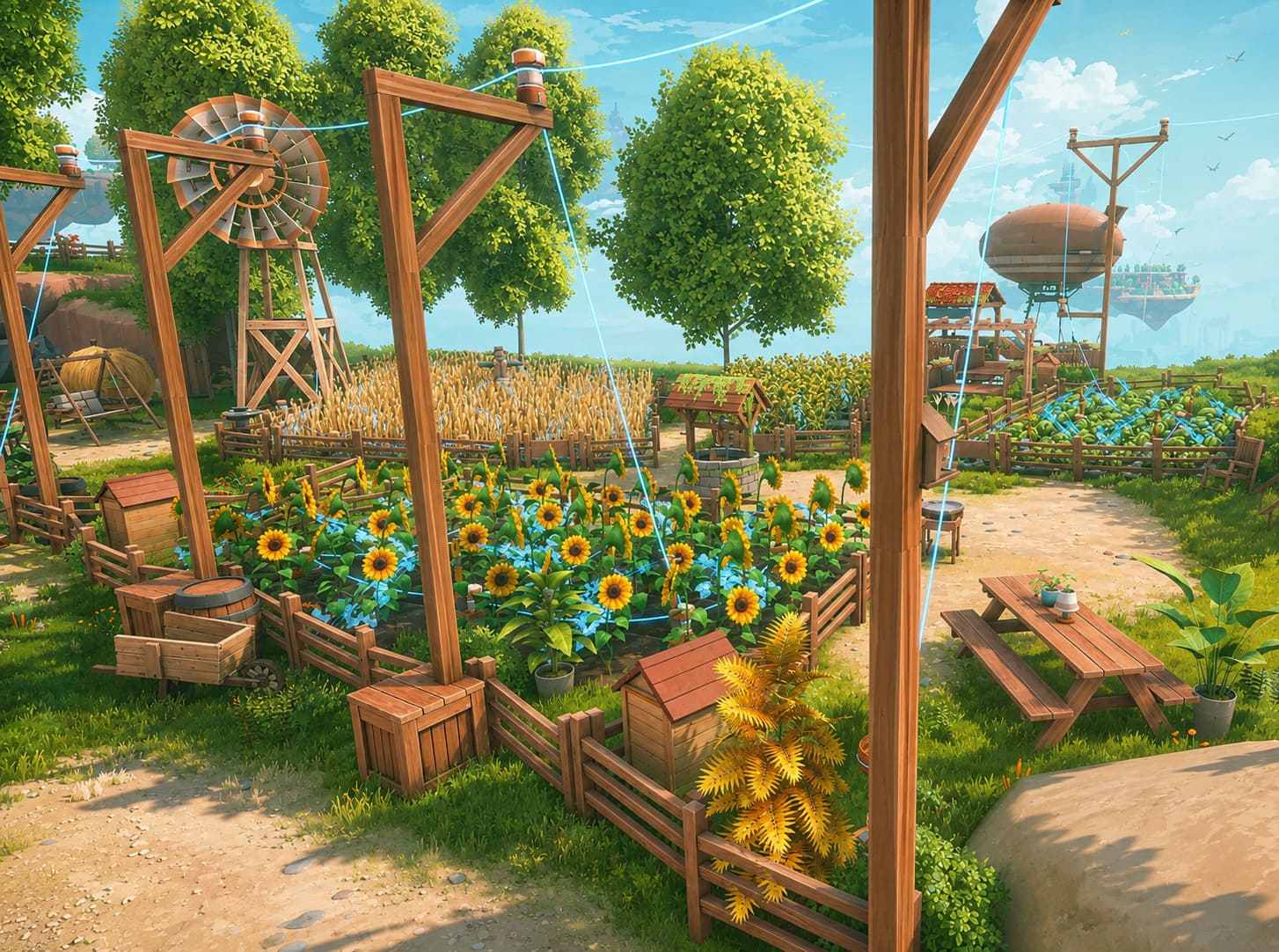
Farming Actually Feels Rewarding
I’ll admit it.
I’m usually the player who ignores farming systems whenever possible.
Solarpunk changed that.
Growing crops isn’t just about filling a hunger meter. The game encourages players to create sustainable ecosystems.
As your settlement expands, farming becomes increasingly sophisticated. Soil quality, environmental conditions, and resource management start playing a meaningful role without becoming overwhelming.
The game also takes a refreshing approach to animals.
Unlike many farming games where creatures are simply production machines, Solarpunk focuses on coexistence. Animals contribute naturally to your settlement when cared for properly.
This design choice perfectly supports the game’s optimistic theme and helps the world feel more alive.
It’s a small detail, but one that left a surprisingly strong impression on me.
The Hidden Star of Solarpunk: Automation
Many people will probably buy Solarpunk because of the cozy visuals.
They’ll stay because of the automation.
Beneath its peaceful exterior lies a surprisingly deep management system.
Players generate electricity using renewable energy sources such as:
- Solar panels
- Wind turbines
- Water wheels
- Battery storage systems
Weather directly impacts efficiency.
Cloudy days reduce solar production.
Strong winds boost turbine output.
Storms can dramatically change your energy balance.
Because of this, building an efficient power grid becomes an engaging puzzle rather than a simple progression step.
What impressed me most was the wireless infrastructure system.
Unlike factory games that eventually become tangled nightmares of cables and conveyors, Solarpunk keeps everything clean and elegant.
Once I unlocked drones and advanced automation tools, my settlement practically ran itself.
Crops harvested automatically.
Resources sorted themselves.
Materials moved between storage facilities without manual intervention.
The result is a rare survival experience where technology reduces busywork instead of creating more complexity.
Flying Airships Never Gets Old

If there’s one feature that perfectly defines Solarpunk, it’s the airships.
Unlocking my first flying vessel felt like a major milestone.
Suddenly, the world opened up.
Exploration transformed from short island trips into full-scale sky expeditions.
The airships aren’t just transportation either.
They’re customizable mobile bases.
I spent an embarrassing amount of time redesigning mine, adding storage compartments, crafting stations, and decorative elements.
There is something incredibly satisfying about loading a ship with supplies, setting a distant destination, and slowly sailing across an ocean of clouds.
It captures a sense of adventure that many larger open-world games struggle to achieve.
Every journey feels meaningful.
Every new island feels like a discovery.
Multiplayer Done Right
Co-op survival games often create problems between players.
Shared inventories become chaotic.
Resources disappear.
Progression gets messy.
Solarpunk avoids most of those issues.
Up to four players can share a world while maintaining personal inventories and individual progression.
This allows groups to collaborate without stepping on each other’s toes.
Friends can:
- Build a shared floating city
- Create specialized settlements
- Trade resources
- Connect energy networks
- Explore together using airships
The cooperative design feels thoughtful rather than simply added as an extra feature.
Whether you’re playing solo or with friends, the experience remains equally enjoyable.
Performance and Accessibility
One area where Solarpunk deserves additional praise is accessibility.
The controls are intuitive.
The user interface is clean.
The progression system introduces mechanics gradually instead of overwhelming players with information.
Even players who normally avoid survival games should have little trouble getting started.
Performance has also been surprisingly solid considering the complexity of the building and automation systems.
Across long sessions filled with large structures and active drone networks, the game remained stable and responsive.
For a project created by a tiny indie team, that’s genuinely impressive.
Solarpunk at a Glance
| Category | Rating |
|---|---|
| Visual Design | 9.5/10 |
| Building System | 9/10 |
| Farming | 8.5/10 |
| Automation | 9.5/10 |
| Exploration | 9/10 |
| Multiplayer | 8.5/10 |
| Overall | 9.2/10 |
Solarpunk Lore: The Tragic History and Uplifting Secrets of the Floating Islands
What I Loved Most
Highlights:
- Beautiful floating-island world
- Relaxing zero-combat gameplay
- Excellent building tools
- Deep automation systems
- Customizable airships
- Strong co-op support
- Positive and uplifting atmosphere
Minor Drawbacks:
- Players seeking combat may lose interest
- Main progression can be completed relatively quickly
- More late-game content would be welcome
Solarpunk Release Date & Xbox Game Pass Guide: Everything You Must Know
Final Verdict
Solarpunk succeeds because it understands something many survival games forget.
Not every challenge needs to involve danger.
Not every adventure needs violence.
Sometimes the most satisfying experience comes from building something beautiful, watching it grow, and exploring a world that genuinely wants you to enjoy your time there.
Cyberwave has created a survival sandbox that feels refreshingly optimistic in an industry often obsessed with destruction and conflict.
Whether you’re a fan of base-building games, automation systems, farming simulators, or simply looking for a relaxing escape after a long day, Solarpunk is absolutely worth your attention.
In a year packed with major releases, this charming indie project managed to do something unexpected:
It made survival feel peaceful again.