Pragmata 2026 Review: Gameplay, Story, and Capcom’s New Sci-Fi Hit
Capcom’s Pragmata has been one of those rare modern AAA projects that lived for years as a mystery rather than a real, playable experience. First shown back in 2020 with a cryptic sci-fi trailer, it quickly became a symbol of ambition mixed with uncertainty.
After multiple delays and an extended period of silence, many players assumed it might never fully materialize. In 2026, however, the game finally arrived — and it didn’t just return quietly, it landed as one of the most talked-about sci-fi releases of the year.

What makes its launch especially interesting is not only that it survived development hell, but that it actually feels like a cohesive, carefully designed experience rather than a compromised project. It is ambitious, unusual, and occasionally rough around the edges, but it carries a creative identity that stands out in today’s crowded action-shooter market.
10 Best Games to Play After Destiny 2 Ends Development (Top MMO & Looter Shooters)
The Long Road From Mystery to Release
For years, Pragmata was almost a meme within gaming communities. After its initial reveal, updates became scarce, and the project slowly slipped into uncertainty. The situation escalated when it was delayed indefinitely, which led many to believe it had been quietly canceled or restarted internally.
What makes the 2026 release notable is that it doesn’t feel like a rushed recovery. Instead, it feels like a project that needed time to evolve. Rather than cutting features or simplifying its core identity, Capcom appears to have refined the original vision until it finally worked as intended.
Story Setup: A Broken Moon and Two Connected Survivors
At its core, Pragmata is a sci-fi survival story set on a collapsing lunar facility. Players control Hugh Williams, an armored astronaut trapped after a catastrophic lunar event. Alongside him is Diana, an advanced android child capable of interacting directly with digital systems.
The relationship between Hugh and Diana is not just narrative-driven but mechanically essential. Their bond defines how the entire game plays, blending emotional storytelling with tactical gameplay systems. Rather than separating story and mechanics, Pragmata fuses them into a single experience.
Best JDM Street Racing Builds in Forza Horizon 6 (Ultimate Tuning Guide)
Main Themes
The story leans heavily into isolation, artificial intelligence, and survival under extreme conditions. It avoids overly complex exposition and instead builds tension through environmental storytelling and character interaction.
Gameplay: A Dual-System Combat Experiment
The most distinctive feature of Pragmata is its dual-character gameplay system. Unlike traditional shooters where companions act as background support, Diana is an active and constant presence in combat.
Players must manage both Hugh’s physical combat abilities and Diana’s hacking skills simultaneously. This creates a layered gameplay loop where survival depends on coordination rather than pure reflexes.
Core Roles
Hugh Williams: Handles movement, shooting, defensive positioning, and environmental traversal using thrusters and heavy armor systems.
Diana: Executes real-time hacking sequences that disable enemy defenses and create damage windows.
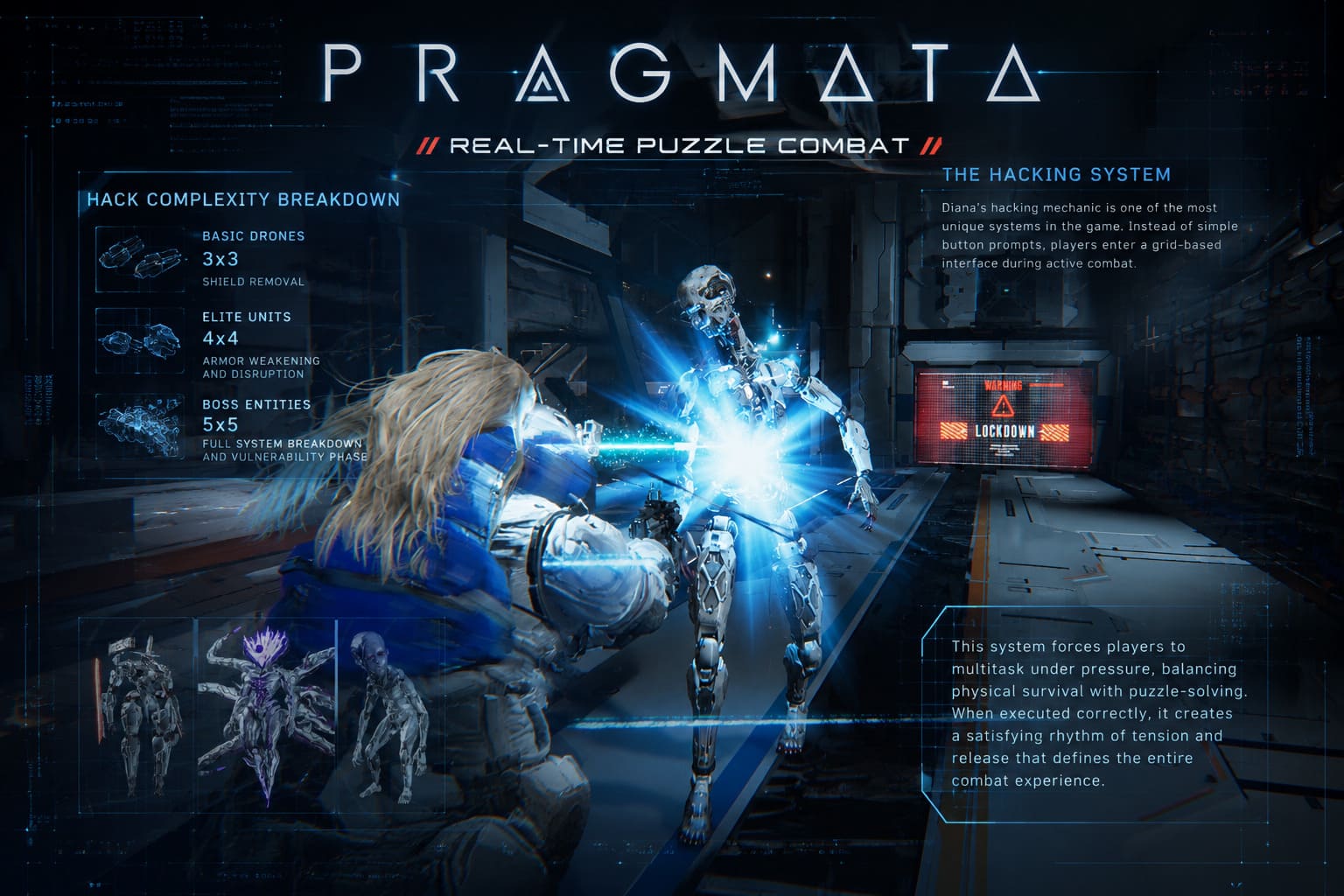
The Hacking System: Real-Time Puzzle Combat
Diana’s hacking mechanic is one of the most unique systems in the game. Instead of simple button prompts, players enter a grid-based interface during active combat.
Hack Complexity Breakdown
| Enemy Type | Grid Size | Result |
|---|---|---|
| Basic Drones | 3×3 | Shield removal |
| Elite Units | 4×4 | Armor weakening and disruption |
| Boss Entities | 5×5 | Full system breakdown and vulnerability phase |
This system forces players to multitask under pressure, balancing physical survival with puzzle-solving. When executed correctly, it creates a satisfying rhythm of tension and release that defines the entire combat experience.
Combat Flow and Player Experience
Combat in Pragmata is structured around vulnerability windows. Enemies are not easily damaged through brute force alone. Instead, players must first break their systems using Diana’s hacking abilities before unleashing Hugh’s full offensive potential.
This creates a loop where fights alternate between high-pressure survival moments and explosive damage phases. The pacing can feel intense, especially in later encounters, but it rewards players who fully engage with both systems rather than relying on one playstyle.
Strengths and Weak Points
What Works Well
- – The dual-character system feels innovative and meaningful
- – Strong sci-fi atmosphere and visual identity
- – Rewarding combat once mechanics are mastered
- – Emotional connection between main characters
Where It Struggles
- – Early gameplay learning curve can feel overwhelming
- – Hacking system may not appeal to all action-shooter fans
- – Occasional pacing issues during narrative transitions
Post-Launch Direction and Content Approach
Unlike live-service games, Pragmata is not built around constant seasonal updates. Instead, Capcom has opted for a lighter post-launch structure focused on expansion rather than repetition.
Planned Additions
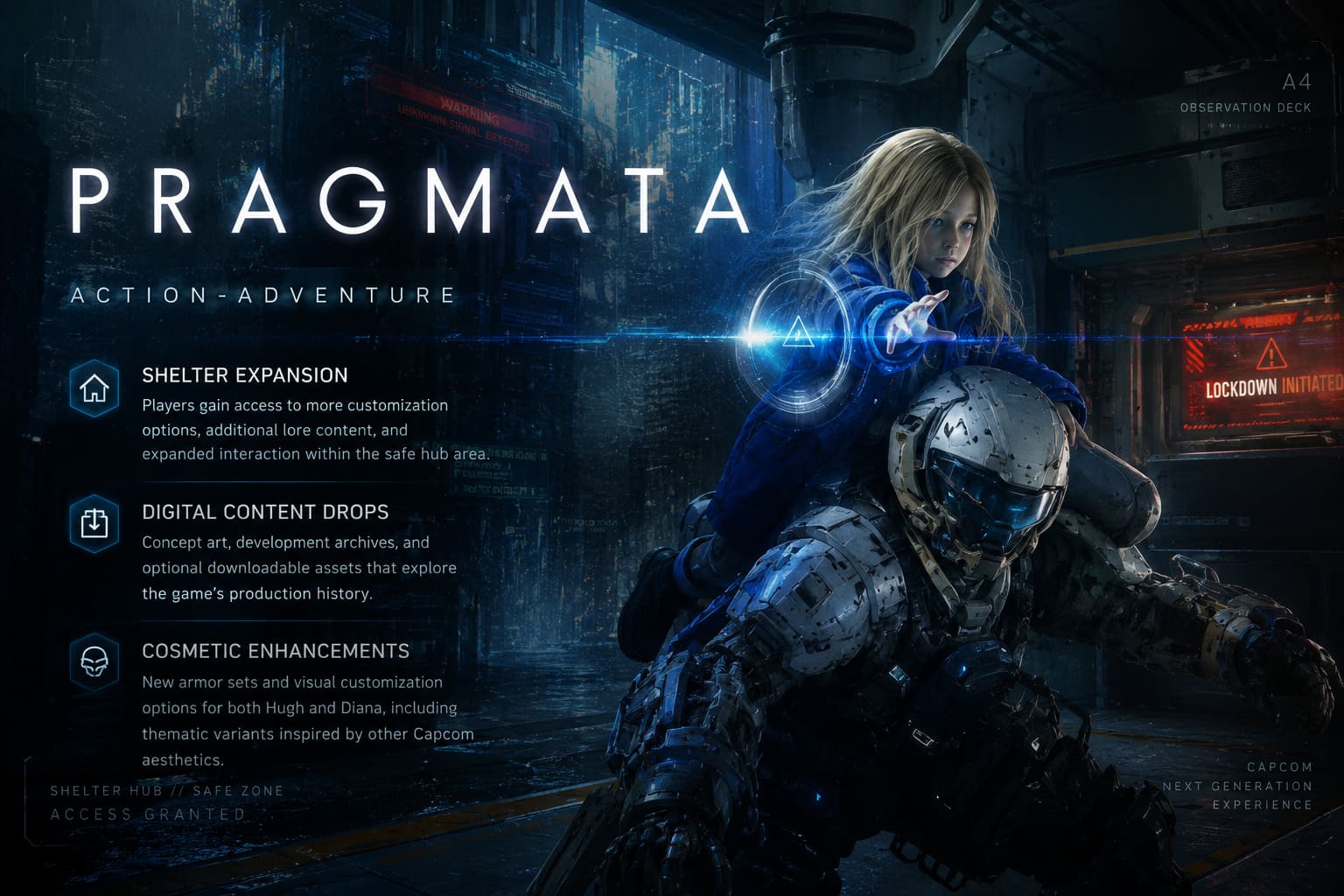
Shelter Expansion: Players gain access to more customization options, additional lore content, and expanded interaction within the safe hub area.
Digital Content Drops: Concept art, development archives, and optional downloadable assets that explore the game’s production history.
Cosmetic Enhancements: New armor sets and visual customization options for both Hugh and Diana, including thematic variants inspired by other Capcom aesthetics.
Future of the Franchise
Given the strong commercial performance at launch, discussions around a sequel are already active. The developers have expressed interest in continuing the story, while Capcom leadership appears open to expanding Pragmata into a long-term intellectual property.
Whether this leads to a direct sequel or broader universe expansion remains unclear, but the foundation is now strong enough to support either direction. What was once a risky experimental project has quickly become a viable franchise candidate.
Final Thoughts
Pragmata is not a flawless game, but it is a memorable one. It succeeds because it takes risks in a market that often avoids them. The combination of real-time combat and hacking puzzles creates a system that feels fresh, even when it occasionally overwhelms the player.
For fans of sci-fi settings, experimental gameplay systems, and narrative-driven action games, Pragmata is one of the more interesting releases of 2026. It is a reminder that long development cycles do not always signal failure — sometimes they signal ambition that simply needed more time to become playable reality.