Odette vs. Odile: Build Comparison and Strategy for Dark Light: Survivor
I’ve played a lot of roguelite shooters over the years — from the ultra-simple “just one more run” survivors-like games to more complex hybrid shooters — but Dark Light Survivor honestly surprised me more than I expected.
It’s not just another swarm-survival clone. It feels like someone mixed a cyberpunk nightmare, a train ride through dimensions, and a build-crafting sandbox where your decisions actually matter mid-fight.
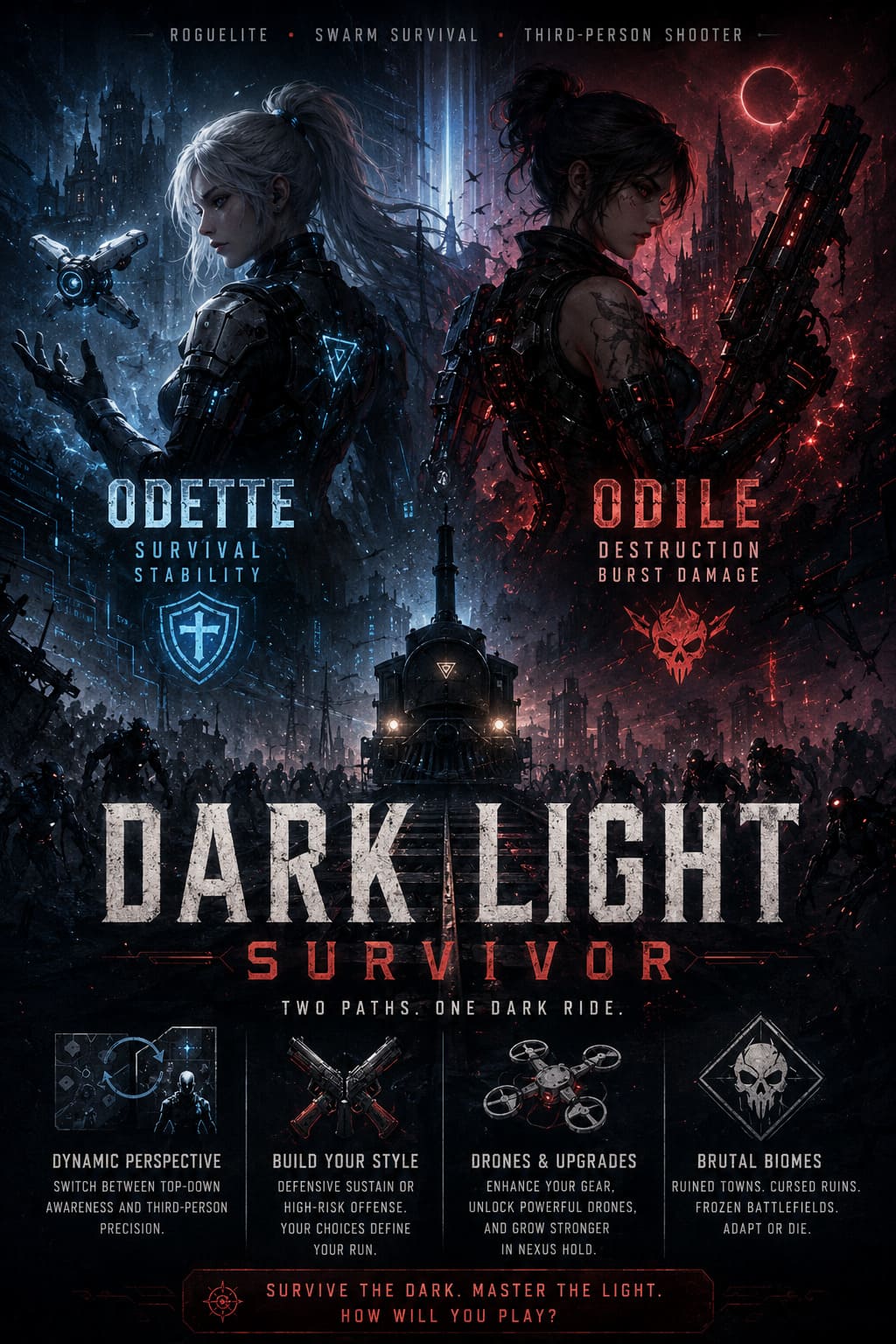
What really stuck with me wasn’t just the gameplay loop — it was how differently the game feels depending on how you build your character. Especially when you get into the community-discussed archetypes: Odette and Odile.
They’re not official class names in a strict sense, but players use them constantly to describe two opposite play philosophies: survival vs destruction.
This guide is less “perfect meta breakdown” and more like a player talking to another player who’s trying not to get deleted in the first five minutes of a run.
The Core Identity of Dark Light Survivor
At its core, the game is a hybrid of survivors-like swarm combat, third-person shooter precision gameplay, roguelite progression, and tactical perspective switching mid-fight.
Two Core Combat Views
The entire gameplay loop revolves around switching perspectives at the right time.
Top-down survival mode is used for reading enemy swarms, avoiding being surrounded, and managing chaotic wave density. It gives you awareness of everything happening around your character, which becomes essential when the screen fills with enemies.
Third-person combat mode is where precision matters. This view is essential for boss fights, weak point targeting, and burst damage optimization. It transforms the game from survival chaos into a more traditional action shooter for short, high-impact moments.
The combination of these two systems is what makes the game feel less like passive survival and more like controlled panic.
Odette vs Odile: Two Ways to Play the Same Game
The community often separates builds into two conceptual archetypes: Odette and Odile. These are not official classes but rather playstyle identities that emerge from skill and equipment choices.

Build Comparison Overview
| Style | Identity | Strength | Weakness | Best Use Case |
|---|---|---|---|---|
| Odette | Defensive sustain | High survivability and stability | Lower burst damage | Long survival runs |
| Odile | High-risk offense | Extreme damage output | Very fragile | Boss melting and fast clears |
Odette Build Philosophy — Stability Over Chaos
Odette-style gameplay is about endurance. Instead of trying to eliminate threats instantly, you focus on surviving long enough for threats to become manageable.
Windrose Israel Hands Boss Guide 2026: Best Strategy, Loadout, and Mechanics
Core Gameplay Identity
The goal is simple: reduce incoming damage, control space, and outlast enemy waves through defensive mechanics and consistent output.
Key strengths
Odette builds are forgiving, meaning mistakes are not immediately fatal. They allow players to learn enemy patterns, survive chaotic encounters, and maintain steady progression through biomes.
Typical play approach
Players using this style rely heavily on shields, crowd control abilities, and mid-range weapons. Melee can also be effective for space control when surrounded.
Limitations
The biggest downside is speed. Boss fights and elite encounters take longer, and the gameplay may feel less explosive compared to offensive builds.
Odile Build Philosophy — Maximum Damage, Maximum Risk
Odile represents the opposite approach. Instead of surviving through defense, you eliminate threats so quickly that survival becomes a byproduct of aggression.
Core Gameplay Identity
This style focuses on converting risk into power. Health, positioning, and timing are traded for extremely high burst damage potential.
Key strengths
Odile builds can delete bosses in seconds when optimized correctly. They also provide extremely fast clearing speed for regular enemies, making runs feel intense and efficient.
Typical play approach
Players often rely on shotguns, dual pistols, and teleport-based mobility tools. Positioning is everything, and staying still even for a moment can be fatal.
Limitations
The main issue is fragility. One mistake can end a run instantly, and inconsistent item drops can significantly affect performance.

Biome Progression and What Actually Matters
The game’s difficulty curve is heavily tied to biome progression, and each area forces different adjustments in strategy.
Ruined Town — Early Survival Test
This biome introduces swarm pressure and ranged enemies. Movement is critical here, and staying in one place is usually a mistake.
The most effective strategy is constant repositioning and learning enemy spawn behavior. Top-down view usage is especially important for awareness.
Cursed Castle Ruins — Environmental Pressure
This biome introduces environmental hazards that deal consistent damage over time. It is less about raw enemy density and more about managing space and buffs.
Defensive builds perform particularly well here due to their ability to absorb environmental chip damage.
Frozen Battlefield — Endgame Skill Check
This is where builds are truly tested. Enemies have significantly higher health pools, and boss encounters require precise targeting.
Switching to third-person view becomes essential here for weak point targeting and maximizing damage output.
Progression System: Nexus Hold
Between runs, progression is handled through a central hub system that allows permanent upgrades and build customization.
Recommended upgrade priorities
Players should focus on survivability upgrades first, followed by weapon mastery improvements and drone enhancements.
Why drones matter
Drones often provide passive damage and crowd control, making them one of the most efficient upgrades for long-term progression.
Practical Player Advice
After multiple runs, some patterns become very clear regardless of build choice.
Key survival tips
Movement speed is often more important than raw damage. Positioning mistakes cause more deaths than lack of DPS.
Learning enemy spawn behavior in early biomes significantly improves consistency in later runs.
Perspective switching should be intentional rather than reactive, especially in boss fights.
Final Thoughts
Dark Light Survivor is not a casual experience. It demands attention, adaptation, and a willingness to experiment with different builds. What makes it stand out is not just its hybrid gameplay, but how it forces players to constantly rethink their approach mid-run.
Odette and Odile are not just builds — they are philosophies. One is about endurance, the other about domination. Neither is strictly better, and both offer completely different experiences depending on how you want to engage with the game.
If you enjoy roguelite shooters that reward both mechanical skill and strategic thinking, this game delivers a surprisingly deep system hidden under its chaotic surface.