Iron Nest Steam Next Fest Demo Updates: How This Indie Heavy Turret Simulator Dominated June 2026
June 2026’s Steam Next Fest was, from the perspective of someone who practically lives inside simulation and strategy games, an overwhelming showcase of quantity over clarity. With thousands of demos competing for attention, most projects blurred together after a short time, creating a sense of fatigue among players trying to discover something genuinely distinctive. Against this noisy backdrop, Iron Nest: Heavy Turret Simulator unexpectedly broke through and established itself as one of the most talked-about indie releases of the event.
Developed by a two-person team, Nick Nieuwoudt and Dominik Latos, the game immediately stood out for its uncompromising design philosophy. Instead of simplifying systems to appeal to a broader audience, it commits fully to mechanical realism and procedural complexity. The result is a simulation that demands attention, patience, and a willingness to learn systems that feel closer to operating machinery than playing a traditional video game.
The impact was immediate and measurable. The title rapidly climbed Steam’s “New and Trending” and “Top Demos” rankings during the festival, ultimately achieving one of the highest engagement spikes among indie projects. Combined with an overwhelmingly positive community reception of around 99%, the game became one of the standout success stories of the entire event.
A Simulator Built Around Mechanical Responsibility
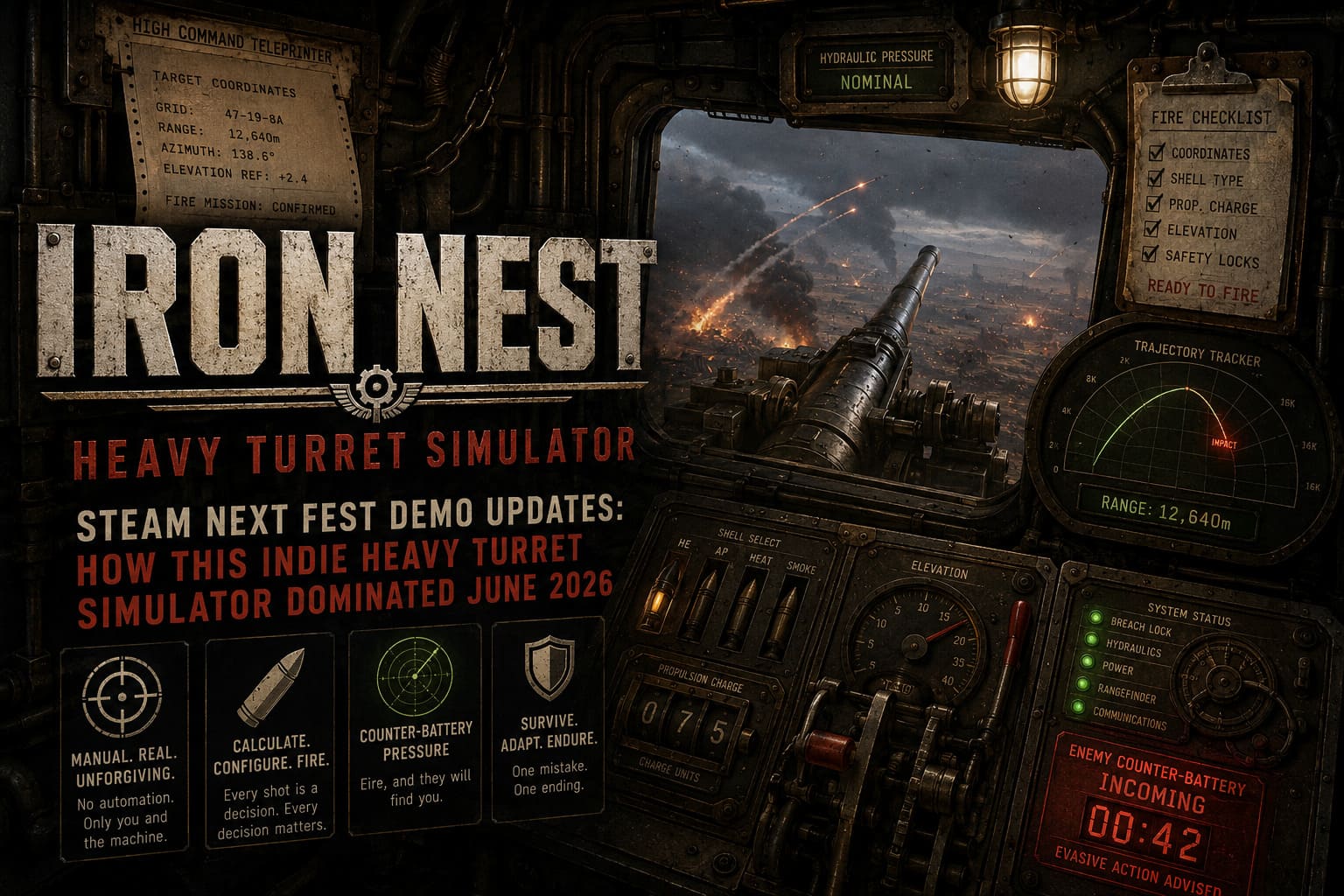
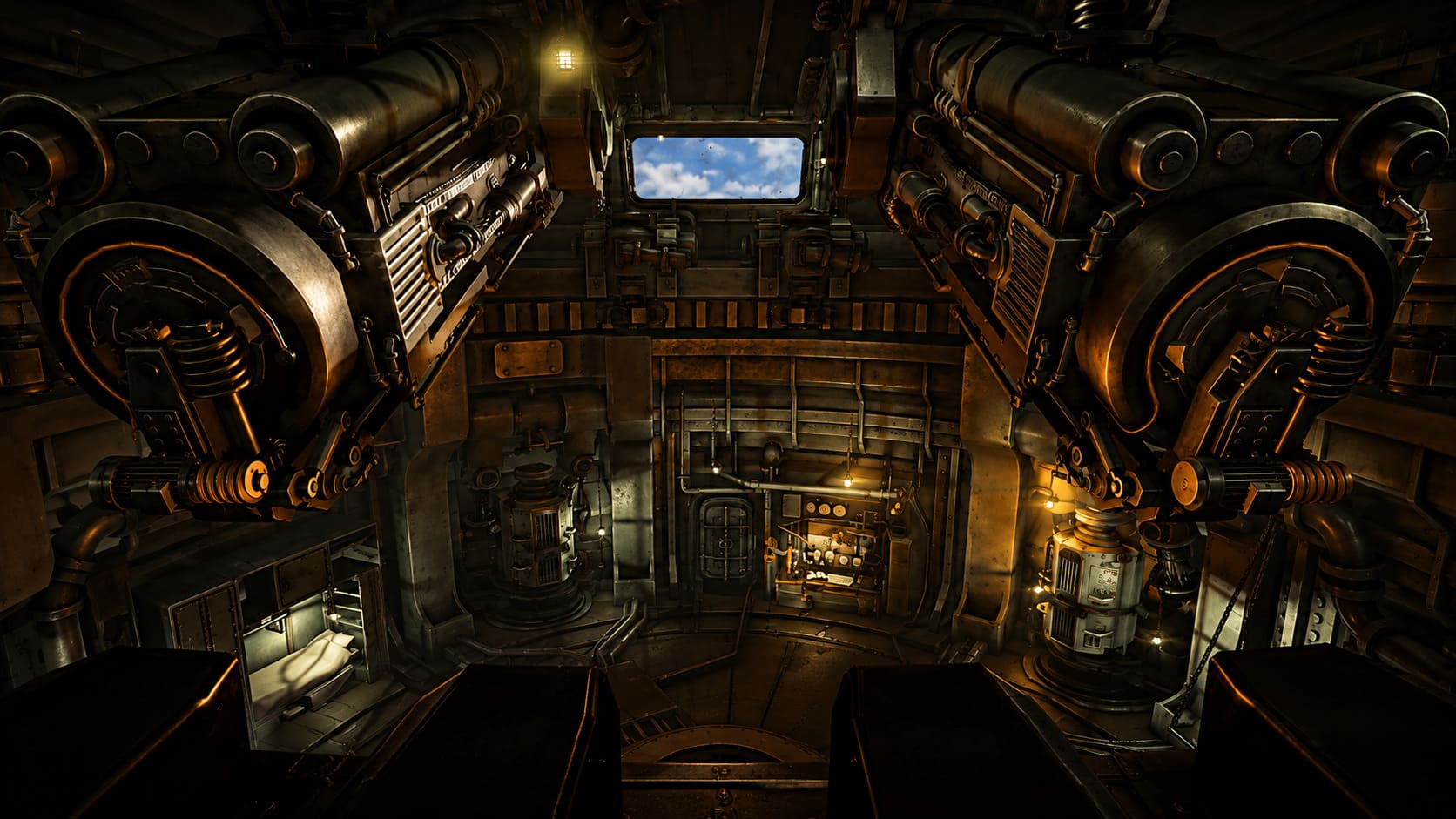
Unlike most modern military shooters or streamlined strategy titles, Iron Nest removes almost all forms of automation from its core gameplay loop. Instead of relying on aim assists or simplified targeting systems, players are placed directly into the role of a turret operator inside a heavily armored dieselpunk war machine. Every action must be executed manually, and every mistake has immediate consequences.
The gameplay structure revolves around interpreting battlefield reports, managing hydraulic systems, and physically operating heavy artillery controls. High Command provides coordinates through mechanical teleprinters, but execution is entirely dependent on the player’s understanding of the system. This creates a unique sense of responsibility where success is not just about reaction time, but about comprehension of mechanical processes.
What makes the experience compelling is the gradual learning curve. The game does not simplify itself for the player; instead, the player adapts to the machine. Over time, what initially feels overwhelming begins to form a structured and satisfying operational rhythm.
The Demo Update That Changed Player Experience
The June demo update introduced several mechanical refinements that significantly improved clarity without reducing difficulty. One of the most impactful additions was the inclusion of localized projectile trajectory tracking systems inside the turret cockpit. These analog-style instruments provide immediate visual feedback on shell impact zones, allowing players to adjust calculations with greater precision.
This change addressed one of the most common early frustrations in the original demo, where players relied heavily on trial and error. While the system remains intentionally challenging, the added feedback loop transforms the experience into a more readable and skill-based process rather than a purely experimental one.
Additional refinements to shell calibration and propulsion configuration further improved gameplay clarity. Instead of simplifying mechanics, the update enhances interpretability, allowing players to better understand how physical variables affect projectile behavior in real time.
Shell Loading and Tactical Depth
At the core of the experience lies the shell loading and charge configuration system, which functions as both a tactical mechanic and a puzzle structure. Every shot requires deliberate preparation, including selecting projectile types and configuring propulsion charges based on distance and target positioning.
Different ammunition types interact with propulsion systems in unique ways, meaning that incorrect configurations lead to predictable but punishing outcomes. A miscalculated shot may fall short, overshoot, or fail entirely, resulting in wasted resources and increased vulnerability to enemy retaliation.
Core gameplay systems overview
| System | Player Action | Outcome |
|---|---|---|
| Shell Selection | Choose projectile type | Determines damage and effect profile |
| Propellant Configuration | Set charge units manually | Affects range and velocity |
| Elevation Control | Adjust turret mechanics | Defines trajectory arc |
| Coordinate Input | Interpret teleprinter data | Determines targeting accuracy |
This layered system ensures that every firing decision feels meaningful. Rather than rewarding speed, the game rewards precision, planning, and understanding of mechanical cause and effect.

Counter-Battery Pressure and Survival Tension
One of the most defining aspects of Iron Nest is its counter-battery system, which transforms each offensive action into a potential survival risk. Once a shell is fired, enemy forces begin calculating the turret’s location and preparing retaliatory strikes.
This creates a persistent tension loop where the player must balance offensive output with defensive survival. As incoming fire is triangulated, environmental cues and system alerts escalate pressure, forcing rapid decision-making under uncertainty.
The gameplay becomes a layered multitasking challenge. Players must simultaneously manage firing solutions, interpret incoming coordinates, and execute countermeasures before the enemy’s countdown completes. Failure is immediate and decisive, reinforcing the importance of accuracy over aggression.
Community Response and Viral Growth
The community reaction to the demo was unusually strong for a niche simulation title. Discussions across gaming forums highlighted the game’s rare combination of complexity and clarity, noting that it manages to feel demanding without becoming inaccessible.
During the festival period, engagement metrics reportedly surged in a way that surprised even the developers. Wishlist growth accelerated from steady early adoption into massive daily spikes as word-of-mouth spread across platforms like YouTube and Reddit. At its peak, the game accumulated tens of thousands of wishlists within single-day windows, marking it as one of the fastest-growing indie demos of the event.
What stands out most in community feedback is not hype alone, but respect for the design discipline. Players consistently emphasize how rare it is to see a game commit so fully to mechanical depth without diluting its identity for mass appeal.
Roadmap and Future Development
The planned full release in August 2026 is positioned as a premium experience without microtransactions, battle passes, or additional monetization layers. This decision aligns with the game’s overall philosophy of structural purity and mechanical focus.
Beyond the PC release, the developers are actively exploring console adaptations, as well as a potential VR version. VR in particular presents an interesting extension of the game’s philosophy, as physically interacting with turret controls could significantly enhance immersion.
In VR, mechanical systems such as hydraulic wheels, elevation controls, and loading mechanisms could be translated into physical gestures, potentially creating one of the most tactile simulation experiences in the genre if executed correctly.
Final Perspective
Iron Nest: Heavy Turret Simulator is not designed as a casual or instantly accessible experience. It is structured around learning, adaptation, and mastery of complex systems that prioritize realism over convenience. For players willing to engage with its depth, it offers a uniquely grounded simulation experience that stands apart from most contemporary releases.
At a time when many games streamline complexity to increase accessibility, this title takes the opposite approach and builds its identity around controlled difficulty and mechanical authenticity. The result is a simulation that feels less like entertainment in the traditional sense and more like a structured system waiting to be understood.