DORF RTS Logistics Guide: Master Supply Lines and Base Layouts
I’ve played a lot of real-time strategy games over the years, from the old-school classics where losing a single harvester could ruin an entire match to newer RTS titles that practically automate the economy for you. That’s why D.O.R.F. Real-Time Strategic Conflict immediately caught my attention. It looks like the kind of game that remembers what made 90s RTS games so addictive: ugly industrial machinery, huge armies, messy battlefields, and an economy that can collapse spectacularly if you stop paying attention.
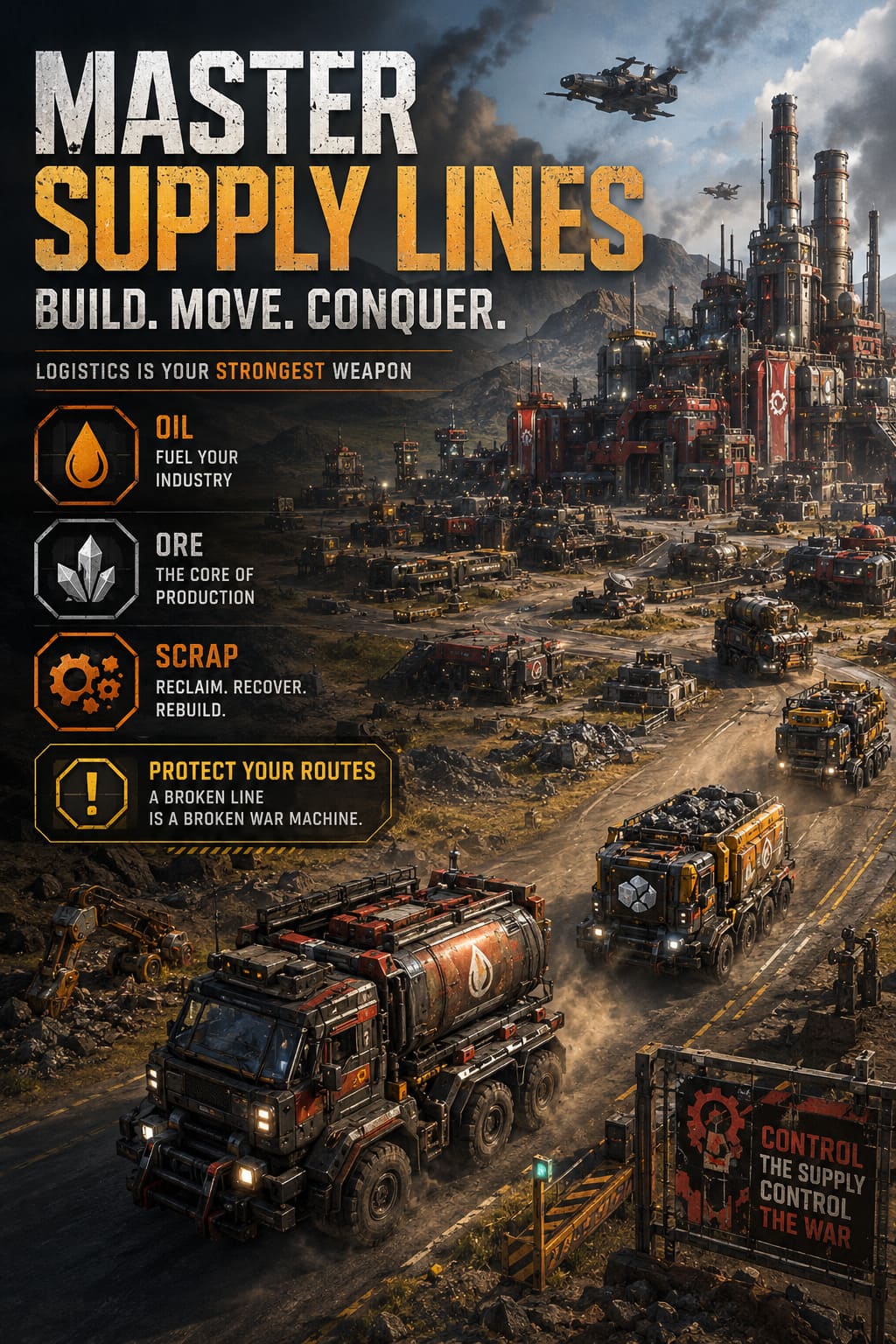
But there is one part of D.O.R.F. that I find especially interesting. Resources aren’t simply numbers sitting in a global bank account. The game treats logistics as something physical. Oil has to move, ore has to be processed, scrap has to be recovered, and the finished materials have to reach the places where your factories actually need them. That sounds like a small difference on paper, but in practice it completely changes how you should think about building a base.
If you’ve spent years playing RTS games where a refinery is basically a button that magically transfers resources into your economy, D.O.R.F.’s supply system will probably punish you at first. Your army can be enormous and your resource income can look fantastic, yet a badly designed base can still bring production to a grinding halt. After spending enough time thinking about how these systems interact, I’ve come to the conclusion that logistics isn’t a side mechanic in D.O.R.F. It is one of the main weapons in your arsenal.
D.O.R.F. RTS Resource Management Guide: Master Logistics and Economy
How the D.O.R.F. Resource System Actually Works
D.O.R.F. revolves around a physical economy built around three important materials: Oil, Ore, and Battlefield Scrap. Each one enters your economy differently, and that distinction matters when you’re planning your territory. Oil comes from localized deposits that need pumping and transportation, while ore is extracted through mining operations. Scrap is much more interesting because it comes from the battlefield itself, meaning yesterday’s battle can literally become tomorrow’s production budget.
Once you’ve collected those raw materials, they don’t simply become instantly available everywhere. They have to reach processing infrastructure and eventually make their way toward production facilities. That creates an actual logistics network across your base, complete with transport vehicles, delivery points, roads, and potential traffic problems.
This is where D.O.R.F. starts feeling very different from a conventional RTS. Your factory can have resources available somewhere in your territory and still be unable to produce anything. If the physical route between the refinery and factory is blocked, inefficient, or vulnerable to enemy attacks, your production chain suffers. It reminds me less of managing a spreadsheet and more of running a dangerous military-industrial complex.
| Resource | Primary Role | Logistics Concern |
|---|---|---|
| Oil | Industrial economy and processing | Protect pumps and transport routes |
| Ore | Core manufacturing material | Keep mining and refinery connections clear |
| Battlefield Scrap | Reclaimed resources from destroyed units | Secure dangerous frontline collection areas |
1. Build Your Base Around Traffic, Not Appearance
This is probably the biggest adjustment I would recommend to anyone coming from Command & Conquer-style RTS games. Don’t build your base because a particular arrangement looks neat. Build it because your trucks and other logistics units can actually move through it efficiently.
D.O.R.F. allows structures to be rotated during placement, and you should treat that ability as a serious strategic tool. The orientation of a refinery, factory, barracks, or other industrial building can determine whether your transport vehicles have a clean route or spend half their time awkwardly navigating around other structures.
I would start thinking of your base as an industrial district. Put your major production structures where they can be reached easily, leave wider transport corridors than you initially think you need, and avoid creating tiny gaps between buildings just because you technically can fit another structure there. A beautiful base that jams its own logistics is still a terrible base.
My basic layout rule
- Keep refineries relatively close to major production centers.
- Rotate buildings so loading and delivery points face useful routes.
- Leave enough space for logistics traffic to pass without constant congestion.
- Avoid creating dead-end paths around important industrial structures.
- Separate military traffic from your most important economic routes whenever possible.
This might sound overly cautious, but RTS players know how quickly a tiny inefficiency can become a huge problem. A few seconds lost by one truck doesn’t matter. A hundred transport trips being inefficient over the course of a long match absolutely does.
2. Your Supply Trucks Are Targets
One of my favorite things about this system is that it gives raiding a much bigger purpose. In many RTS games, harassment means killing workers, destroying a resource structure, or forcing an opponent to retreat. In D.O.R.F., an enemy doesn’t necessarily need to attack your main base at all. They can hit the infrastructure keeping that base alive.
Imagine you’ve built a powerful economy behind your frontline. Your factories are producing tanks, artillery, and infantry at a comfortable pace. Then a small enemy raiding force slips around the side of your defenses and starts destroying your transport vehicles. Suddenly your factories aren’t receiving enough materials, your production queues slow down, and your frontline begins losing momentum.
That’s a much more interesting form of economic warfare than simply clicking on a worker. The road itself becomes a strategic objective.
For that reason, don’t think of your logistics routes as harmless civilian infrastructure. Guard them. Towers, walls, defensive infantry positions, patrols, and sensible route placement can make the difference between a stable economy and an industrial disaster. You don’t necessarily need to turn every road into a fortress, but the most important corridors should never be completely exposed.
3. Don’t Ignore Battlefield Scrap
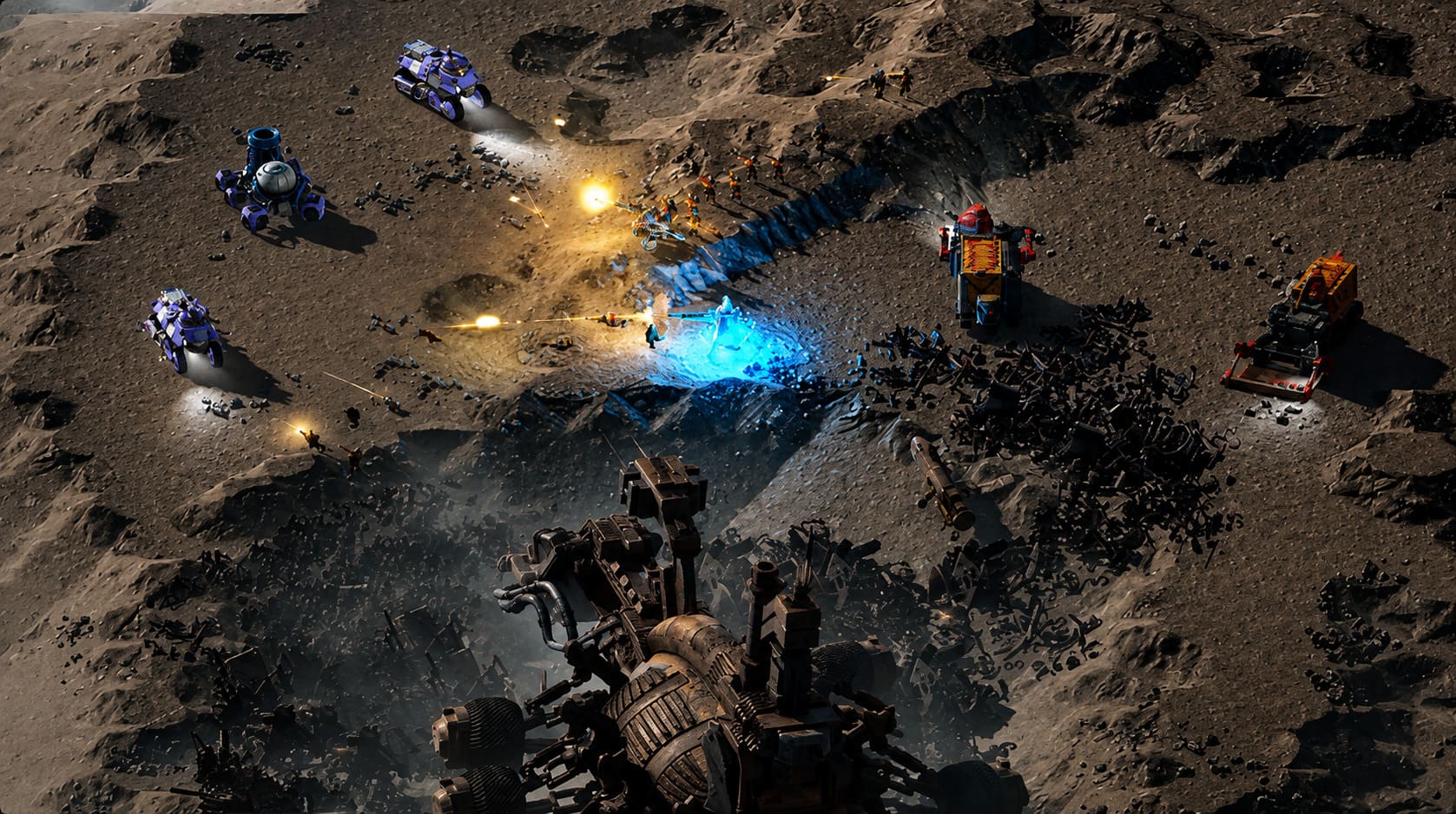
Scrap deserves special attention because it creates a fascinating relationship between combat and economy. In most RTS games, the battlefield is where you spend resources. Once the battle is finished, the wreckage is usually just decoration. D.O.R.F. gives that wreckage an economic value.
That means a major battle can leave behind a temporary resource opportunity. If you control the area and can safely send reclamation units into the wreckage, the remains of destroyed armies can help finance your next wave. Suddenly winning a fight isn’t only about removing enemy units. Where the fight happens can matter almost as much as who wins it.
There is an obvious risk, though. Scrap collection near an active frontline is dangerous. Sending expensive or vulnerable reclamation units into an area that the enemy still controls is basically asking for trouble. If you’re going to exploit battlefield scrap, make sure you’ve created enough local security to keep those collectors alive.
4. Learn What Makes Your Faction Economically Different
D.O.R.F.’s three factions aren’t simply visual variations of the same RTS economy. The Empire, Warbands, and N.W.O. approach technology and infrastructure differently, and that should influence how you build your bases.
The Empire feels like the faction for players who enjoy organized, heavy industrial warfare. Their infrastructure is large and powerful, but that strength comes with the responsibility of planning. If you’re going to build a massive production network, you need to think ahead rather than constantly rearranging your base after the match has already become chaotic.
The Warbands are much more appealing if you enjoy improvisation. Their relationship with scavenged technology and battlefield scrap gives them a more opportunistic identity. A fight that looks like a costly exchange can potentially become an economic opportunity if you’re positioned to reclaim what was left behind.
Then there’s the N.W.O., which leans toward sophisticated technology and efficiency. Their approach appears better suited to players who enjoy optimizing infrastructure rather than simply throwing more machinery onto the map. The trade-off is that sophisticated systems often demand more investment before they start paying off.
| Faction | General Logistics Style | Best For |
|---|---|---|
| Empire | Heavy and structured | Players who like planned industrial bases |
| Warbands | Flexible and scavenger-focused | Aggressive, opportunistic players |
| N.W.O. | Advanced and efficiency-focused | Players who enjoy optimization |
5. Move Your Production Closer to the War
There is a point in every long RTS match where your main base stops being a convenient place to manufacture everything. Your army is fighting halfway across the map, while your factories are sitting safely at home. You can keep sending reinforcements from the rear, but eventually the travel time starts becoming a serious problem.
This is where forward logistical positions become extremely useful. Establishing secondary production hubs closer to the active battlefield can dramatically reduce reinforcement times. Of course, those facilities are more exposed, so you can’t treat them like another copy of your main base.
Instead, I prefer thinking of a forward base as a temporary industrial extension. Give it enough resources and protection to keep units flowing, connect it to safer rear infrastructure where possible, and don’t invest more than you can realistically defend. The goal isn’t to recreate your entire home base at the frontline. The goal is to shorten the distance between production and combat.
6. Think About Logistics Before the Battle Starts
One mistake I expect many players to make is treating logistics as something they fix after their economy starts struggling. By that point, you’ve already lost valuable time. The better approach is to think about supply routes while you’re expanding, scouting, and choosing where to fight.
If you know a particular oil deposit is going to become important later, consider how you’re going to connect it before the enemy arrives. If a narrow section of the map is the only practical route to your forward factories, understand that it could become one of the most important strategic locations on the entire map.
This also makes scouting more valuable. You’re not just looking for the enemy army. You’re looking for the infrastructure that keeps that army moving. If you can identify a vulnerable logistics corridor and attack it at the right moment, you may achieve more than you would by charging directly into a heavily defended base.
Why D.O.R.F.’s Logistics Could Become Its Secret Weapon
I’ve played enough RTS games to know that complexity by itself doesn’t make a system good. A complicated economy can just become tedious if the player has to constantly fight the interface instead of making meaningful decisions. What makes D.O.R.F.’s approach interesting is that logistics can directly connect base building, combat, map control, scouting, and faction design.
Your base layout affects transport efficiency. Transport routes affect your economy. Your economy determines production. Production determines how much pressure you can maintain on the battlefield. Meanwhile, the location of battles can create scrap opportunities, and enemy raids can attack the physical network connecting all of those systems.
That’s the kind of interconnected RTS design I personally enjoy. You’re not simply collecting resources so you can buy an army; you’re building the machine that allows the army to exist. If D.O.R.F. manages to make those logistics systems as satisfying during actual matches as they look on paper, it could offer something that modern RTS games don’t often attempt.
Final Thoughts
The biggest lesson I’d take into a D.O.R.F. match is simple: don’t look at your economy as a number. Look at it as a network. Every refinery, factory, road, transport vehicle, mining operation, oil pump, and scrap collection point is part of the same machine, and your opponent will eventually try to find the weakest component.
Build with traffic in mind, protect important routes, use forward production intelligently, and learn exactly how your faction handles resources. Most importantly, don’t become so obsessed with the army at the frontline that you forget what’s happening behind it. In D.O.R.F., the player who controls the supply chain may ultimately control the battle.
And honestly, that’s exactly the kind of RTS headache I enjoy. Give me a huge industrial base, a map full of dangerous chokepoints, a convoy that desperately needs to reach a factory, and an opponent trying to blow the whole thing apart, and I’m interested. D.O.R.F. looks like it could turn logistics from background bookkeeping into one of the most entertaining parts of the war.