D.O.R.F. RTS Resource Management Guide: Master Logistics and Economy
I’ve played a lot of real-time strategy games where the economy is basically a number sitting in the corner of the screen. You send a harvester out, it comes back, the credits go up, and that’s more or less the end of the story. D.O.R.F. Real-Time Strategic Conflict takes a much more old-school, physical approach to resource management, and honestly, it took me a while to stop thinking about its economy like I would in a conventional RTS.
What makes D.O.R.F. interesting is that resources don’t magically teleport from a mining operation into some invisible bank account. They have to be extracted, processed, moved and delivered to the places where they’re actually needed. That sounds like a small distinction on paper, but in a real match it changes the way you design your base, protect your infrastructure and even decide where your next factory should go.
Why D.O.R.F.’s Economy Is Different
The first thing I’d tell anyone coming from Command & Conquer-style RTS games is to forget the idea that income alone determines how fast your production runs. In D.O.R.F., logistics are part of the economy. You can have plenty of raw materials available and still watch a factory sit there doing nothing because the finished resources aren’t reaching its entrance efficiently.
That creates a really unusual kind of strategic pressure. Your base isn’t simply a collection of buildings surrounded by walls. It’s an industrial network, and every refinery, factory and transport route has a practical relationship with the others. Once you start looking at your base this way, D.O.R.F.’s economy becomes one of the most interesting parts of the game rather than something you manage in the background.
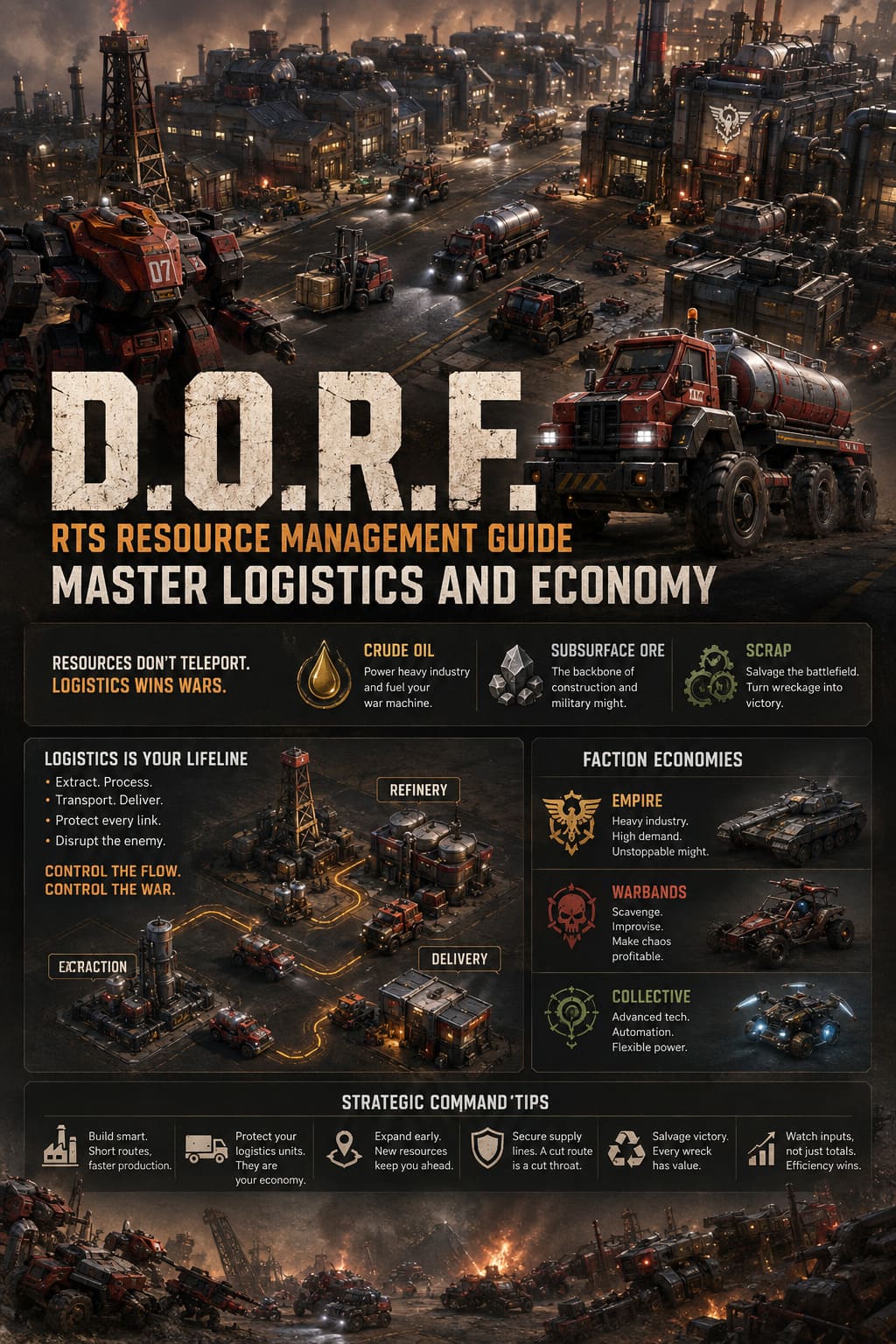
The Three Resources You Need to Understand
D.O.R.F. gives its economy several distinct resource streams, and each one creates a different problem. Learning what they do is easy; learning how to keep them flowing under battlefield pressure is where things get interesting.
Crude Oil
Oil is essential for the heavy industrial side of your economy. You need to locate oil deposits and establish extraction infrastructure before you can reliably support the more demanding parts of your military production. Getting an oil field early can make a huge difference, particularly when you’re planning to move into heavier vehicles and machinery.
What I like here is that oil isn’t simply a button you click for passive income. The infrastructure around it matters. Trucks, pipelines and refineries become part of the supply chain, which means a poorly protected oil operation can become a very obvious target for an opponent who understands your economy.
Subsurface Ore
Ore is the backbone of the game’s heavier construction and military production. Harvesters work mineral fields and transport the material back to processing facilities, but those deposits aren’t an infinite ATM. Once a mineral field starts running dry, you need to think about expansion before your production queue begins starving.
This is one of those classic RTS lessons that D.O.R.F. makes much more physical: resource expansion isn’t optional if you want to maintain momentum. Waiting until your starting deposit is almost empty before searching for another one can put you several steps behind an opponent who expanded early.
Scrap and Battlefield Salvage
Scrap is probably my favorite idea in the entire resource system. Destroyed units and structures leave behind wreckage, and that wreckage can become part of your economy. Suddenly, winning a tank battle isn’t only about removing enemy armor from the map. The battlefield itself becomes a potential resource site.
That creates a fantastic feedback loop. You survive a major attack, salvage the remains, turn those materials back into production and use the new units to push forward. The enemy’s failed assault can literally help finance your counterattack. It’s a clever system, especially for players who enjoy aggressive RTS play rather than sitting behind a perfect defensive wall.
Physical Logistics Can Make or Break Your Base
This is the part of D.O.R.F. that I think players need to understand as early as possible. After raw resources are extracted and processed, materials still have to physically reach the buildings that consume them. Forklifts, utility vehicles and other logistical units move supplies around your industrial complex, so the distance between structures suddenly matters in a way that most RTS players aren’t used to thinking about.
Put a factory on the opposite side of your base from the refinery and you’ve effectively created a commute for every delivery. That might not sound disastrous when you’re looking at the buildings individually, but multiply those trips across an entire production cycle and the inefficiency becomes painfully obvious.
And there is another problem: logistics units are vulnerable. An enemy doesn’t necessarily need to destroy your refinery or factory. Sometimes disrupting the transport network between them is enough to cripple your production. A few raiders slipping through your defenses can cause far more economic damage than their unit cost suggests.
How I Would Design a D.O.R.F. Base
Base building in D.O.R.F. deserves considerably more thought than simply finding an empty patch of ground and filling it with structures. Since buildings can be rotated and positioned deliberately, you should treat the layout almost like an industrial floor plan.
- Keep major production buildings close to processing facilities. Shorter delivery routes mean fewer wasted logistics trips and faster access to materials.
- Leave room for transport vehicles. A beautiful wall of tightly packed buildings is useless if forklifts and utility trucks constantly struggle to find a route.
- Protect important supply corridors. Defensive structures shouldn’t only guard the perimeter. They should also make it difficult for enemy units to reach your logistics network.
- Consider forward industrial bases. When your territory expands, producing everything from your original headquarters may become inefficient. A local refinery and factory can dramatically shorten reinforcement routes.
The last point is particularly important. I’ve seen plenty of RTS players build one enormous central base because it feels safer. D.O.R.F. gives you a reason to break that habit. A smaller industrial pocket near a newly secured resource field can be much more useful than dragging every shipment halfway across the map.
Faction Economies Don’t Play Exactly the Same
| Faction | Economic Identity | What to Watch |
|---|---|---|
| Empire | Heavy industrial production | High oil and ore demand |
| Warbands | Scrap and improvised technology | Maximize battlefield salvage |
| Collective | Advanced technology and automation | Resource flow and power management |
The Empire feels like the faction for players who enjoy building a brutal industrial machine and letting heavy equipment do the talking. Their expensive military hardware puts serious pressure on the economy, but their tougher transport infrastructure helps them operate across larger territories.
The Warbands take almost the opposite approach. Their strength comes from making something useful out of absolute chaos. Cheap units and aggressive battlefield activity naturally create more wreckage, which means skilled players can turn salvage into an important part of their production cycle. If you enjoy fighting over the battlefield rather than simply mining safely behind your base, this economic identity is especially appealing.
Then there’s the Collective, which leans much harder into advanced technology and automated infrastructure. Their economy is less about crude industrial mass and more about maintaining sophisticated systems, including mobile refinery and logistics capabilities. That flexibility can make them particularly difficult to shut down if the player keeps moving the economic center of their operation.
Don’t Treat Logistics Vehicles Like Disposable Background Units
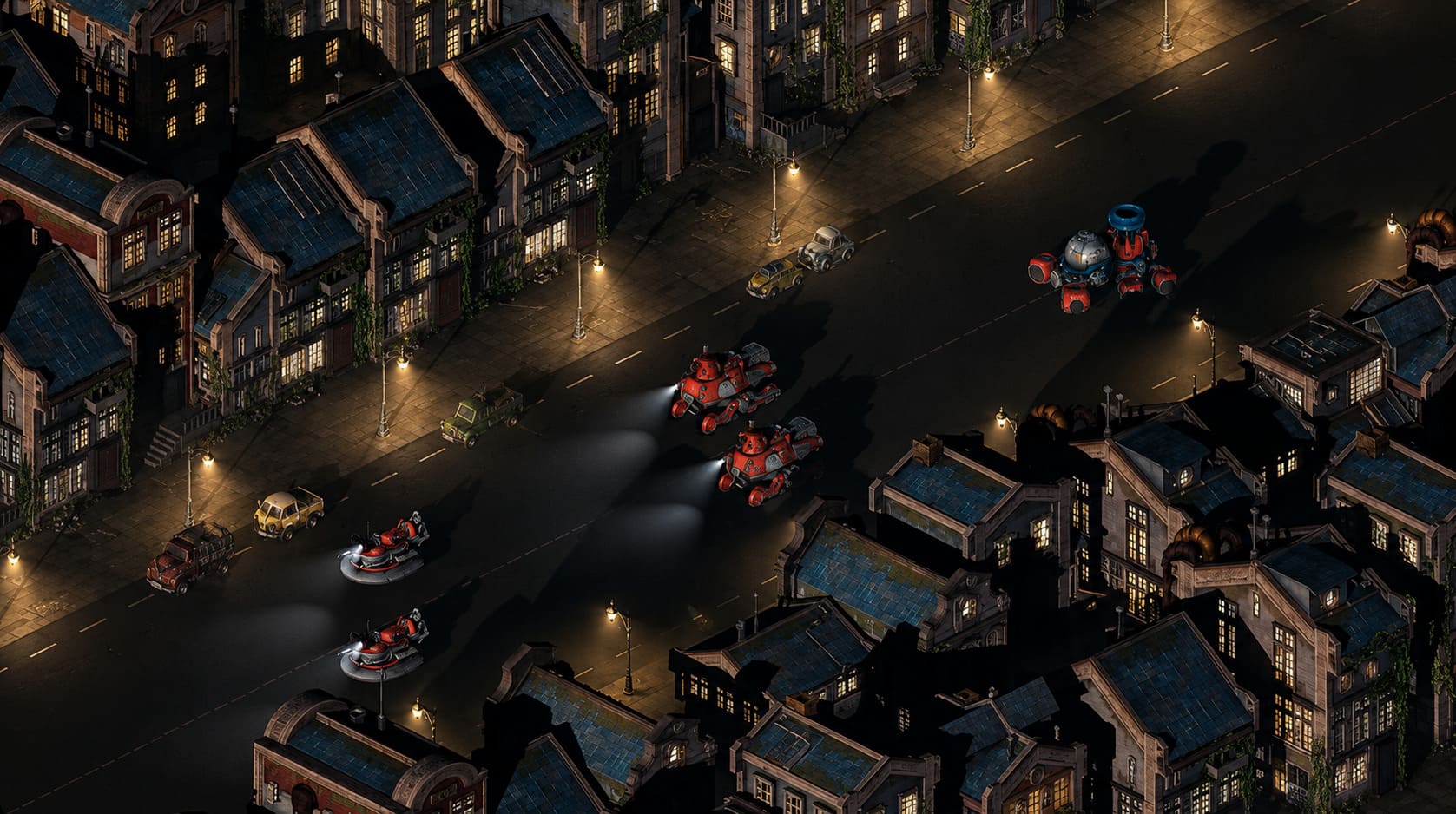
One mistake I’d expect many players to make is ignoring their transport vehicles once the base starts getting busy. It’s easy to watch a forklift drive past and think of it as background animation, but those little vehicles are effectively carrying your production queue on their backs. If something goes wrong with that network, your expensive factories become very expensive decorations.
For that reason, I would protect internal logistics almost as seriously as the resource deposits themselves. Walls, defensive positions and sensible building placement can prevent a small enemy raid from turning into an economic disaster. Your opponent doesn’t always need to destroy the factory if they can interrupt what feeds it.
Battlefield Salvage Changes How You Think About Winning
The scrap system also creates an interesting reason to fight over territory after the shooting stops. Normally, an RTS battle ends when one side retreats and both players immediately start rebuilding. In D.O.R.F., the wreckage left behind can still have strategic value.
That means a victorious player may want to secure the battlefield rather than immediately retreating home. If you can safely recover the debris from a major engagement, you’re effectively extending the economic reward of winning that fight. In my view, this is one of the mechanics that gives D.O.R.F. its own personality instead of making it feel like another nostalgia-driven 90s RTS clone.
My Biggest D.O.R.F. Economy Tips
- Plan your base around delivery routes, not just building placement.
- Expand toward new ore and oil deposits before your existing ones are exhausted.
- Keep logistics vehicles protected from raids and harassment.
- Use battlefield salvage whenever it is safe to do so.
- Build forward industrial networks when your territory becomes too large.
- Watch factory inputs, not just your resource totals.
That final point is probably the most important. A big number in your resource counter doesn’t necessarily mean your economy is healthy. I would much rather have a slightly smaller income with an efficient, reliable delivery network than a massive stockpile that can’t reach my production buildings quickly enough.
Final Thoughts on D.O.R.F. Resource Management
After playing enough RTS games to know how predictable resource systems can become, I genuinely appreciate what D.O.R.F. is attempting here. Its economy isn’t just about collecting more stuff than the other player. It’s about building a functioning military supply chain and then trying to keep that chain alive while someone is actively trying to break it.
That makes D.O.R.F. resource management feel surprisingly close to commanding an actual industrial war machine. Your refineries, factories, harvesters and logistics vehicles all have jobs, and the further you expand, the harder it becomes to keep everything connected. When the system works, watching resources move through your base and turn into fresh units feels incredibly satisfying.
For me, that’s the real appeal of D.O.R.F. The game doesn’t simply ask whether you have enough resources. It asks whether you can actually deliver those resources where they matter before the enemy destroys the system that moves them. If you’re the kind of RTS player who enjoys optimizing layouts, protecting supply lines and finding clever economic advantages in the middle of a messy battlefield, this is a system worth paying close attention to.