Cyberpunk 2077 Phantom Liberty Best Ending: The Definitive Choice Guide (2026 Edition)
Few expansions have managed to split an entire community the way Phantom Liberty did. Even in 2026, players continue debating which ending deserves to be called the “best.” After replaying every route more than once and reading countless discussions from longtime Cyberpunk fans, I don’t think the answer is as simple as choosing the ending that gives V the highest chance of survival.
That’s because Phantom Liberty isn’t really about winning. It’s about deciding what kind of person V becomes when every option carries a painful price.
Unlike many RPGs, there isn’t a hidden perfect outcome waiting for players who complete every side quest or pick every correct dialogue option. Every ending asks you to sacrifice something important—trust, loyalty, freedom, identity, or your own future.
If you’re trying to decide which path deserves your first playthrough or wondering whether it’s worth replaying the expansion, here’s my complete breakdown of every ending, what each one means, and why one choice still stands above the others.
The Decision That Changes Everything
Everything eventually comes down to one mission: Firestarter.
During the operation inside Kurt Hansen’s heavily fortified stadium, V must decide whether to believe Songbird or remain loyal to Solomon Reed and the FIA.
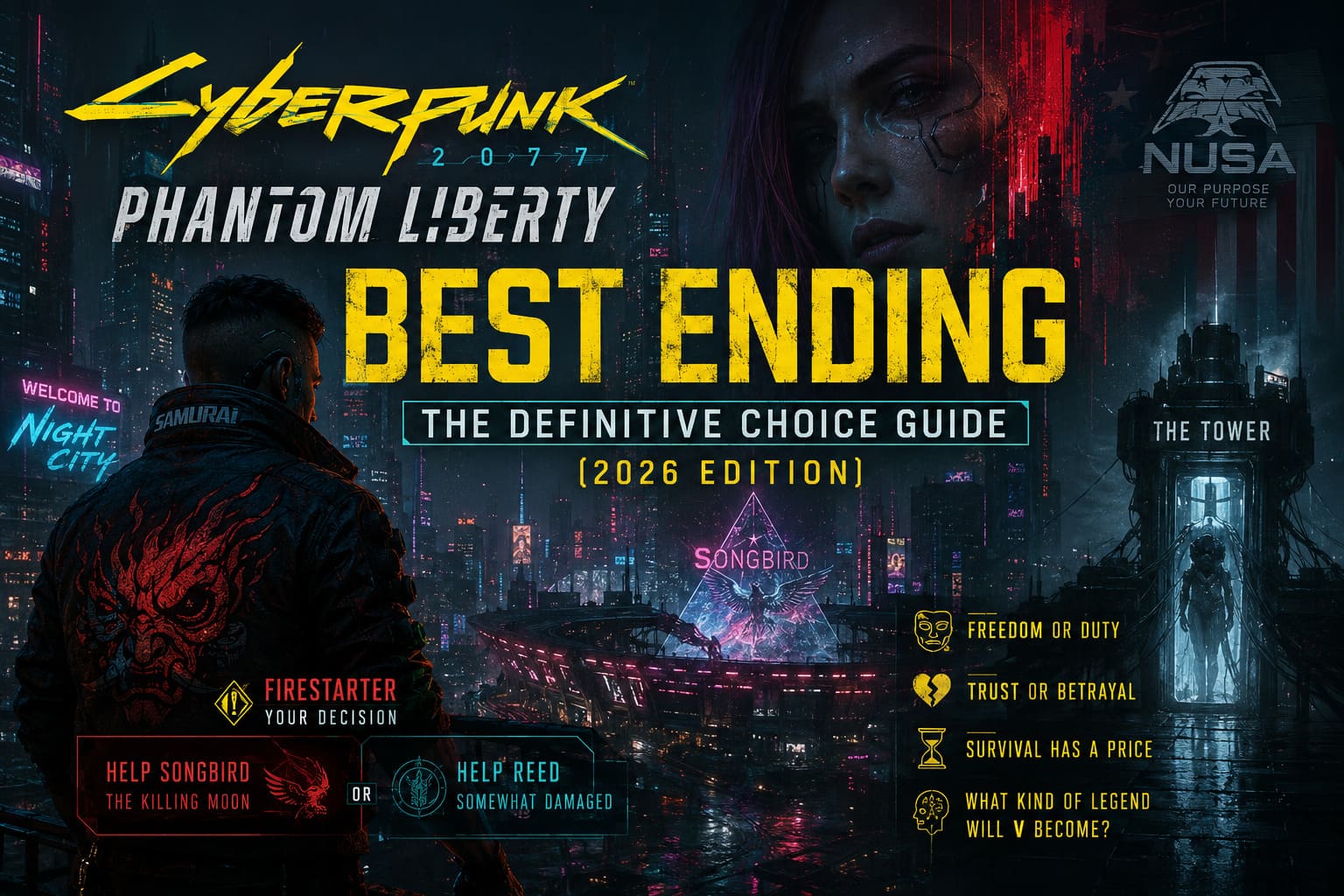
From that moment forward, the expansion splits into two entirely different stories.
| Your Decision | Final Mission | Overall Theme |
|---|---|---|
| Help Songbird | The Killing Moon | Freedom, betrayal, survival |
| Help Reed | Somewhat Damaged | Duty, regret, consequences |
Neither route is objectively better from a gameplay perspective. They simply tell two very different stories.
Ending One: King of Wands — The Most Human Choice
If someone asked me which ending best captures everything Cyberpunk has always been about, this would be my answer.
After siding with Songbird, you eventually discover the painful truth.
She lied.
The Neural Matrix can only save one person.
That revelation completely changes your understanding of everything that happened throughout the expansion. At that moment, most games would expect players to seek revenge.
Instead, Phantom Liberty asks something far more uncomfortable:
Can you forgive someone whose desperation mirrors your own?
If you continue helping Songbird and ultimately shoot Reed to let her escape to the Moon, V gives up their last realistic chance at survival.
From a practical standpoint, it’s a terrible decision.
From a narrative standpoint?
It’s brilliant.
Songbird isn’t innocent. She manipulates nearly everyone she meets. But she’s also been used as a government weapon for years, treated more like military hardware than an actual person.
Helping her finally break free feels like the only genuine act of compassion anyone offers her.

Why Players Still Love This Ending
- Songbird finally escapes Myers.
- Reed is released from years of blind loyalty.
- Johnny Silverhand strongly approves.
- V stays true to their own principles.
This ending hurts, but it hurts for the right reasons.
Ending Two: King of Swords — Choosing Yourself
This ending begins almost identically.
You trust Songbird.
You fight for her.
You risk everything.
Then she admits she deceived you from the very beginning.
Here, players can decide they’ve had enough.
Instead of helping her board the shuttle, V hands her over to Reed and the NUSA in exchange for the promised Relic treatment.
It’s difficult to call this decision evil.
It’s understandable.
After all, V has been dying since the beginning of the base game. Most people would probably make exactly the same choice if faced with certain death.
Still, there’s something emotionally devastating about carrying Songbird back into the hands of the people she spent years trying to escape.
You survive.
She loses everything.
Ending Three: King of Cups — Mercy Above Everything
This route surprised me more than any other.
Choosing Reed eventually leads players into the eerie Cynosure research facility, one of the best-designed locations in the expansion.
Instead of another firefight, the atmosphere shifts toward survival horror.
When you finally reach Songbird, she’s barely recognizable.
Connected to the Blackwall and overwhelmed by its influence, she begs V to end her suffering.
No tricks.
No manipulation.
Just one final request.
Pulling the plug is heartbreaking, but it’s also the only moment where Songbird regains complete control over her own fate.
Nobody owns her anymore.
Not Myers.
Not Reed.
Not the FIA.
Not even the Blackwall.
For me, this is the expansion’s most emotionally mature ending.
Ending Four: King of Pentacles — Nobody Wins
This ending is probably the hardest one to recommend.
You refuse Songbird’s final request.
Reed takes her back.
Myers gets exactly what she wanted.
V earns access to the government’s promised cure.
Technically, everyone who matters to the government succeeds.
Emotionally, everyone loses.
Songbird becomes a permanent government asset.
Reed receives promotions but remains emotionally shattered.
V survives at someone else’s expense.
It’s difficult to walk away from this ending feeling satisfied.
Comparing Every Phantom Liberty Ending

| Ending | Songbird | Reed | V | Overall Feeling |
|---|---|---|---|---|
| King of Wands | Escapes | Dies | No cure | Hope mixed with tragedy |
| King of Swords | Captured | Lives | Cure promised | Survival through betrayal |
| King of Cups | Dies peacefully | Lives | No cure | Bittersweet mercy |
| King of Pentacles | Captured | Lives | Cure promised | Emotional defeat |
Is The Tower Really Worth It?
Unlocking either government-ending eventually opens The Tower, arguably the most controversial conclusion in Cyberpunk 2077.
On paper, it sounds perfect.
The Relic is removed.
V survives.
Mission accomplished.
Except that’s only half the story.
The operation leaves V in a two-year coma.
When they finally wake up, Night City has moved on.
Friends have disappeared.
Relationships have ended.
The people who once depended on V built completely different lives.
Perhaps the cruelest consequence isn’t losing cyberware.
It’s realizing that the city no longer remembers who you were.
Cyberpunk has always asked one uncomfortable question:
What makes someone legendary?
The Tower offers an answer many players simply don’t accept.
Living isn’t always the same as truly surviving.
My Personal Ranking
After multiple playthroughs, here’s how I’d rank every ending.
| Rank | Ending | Why |
|---|---|---|
| 1 | King of Wands | The strongest emotional payoff and the ending that best represents Cyberpunk’s themes. |
| 2 | King of Cups | Painful but deeply compassionate, with excellent Blackwall lore. |
| 3 | King of Swords | Understandable choice for players who value V’s survival above everything else. |
| 4 | King of Pentacles | Effective storytelling, but emotionally exhausting with almost no satisfying resolution. |
Which Ending Fits Johnny Silverhand?
Johnny isn’t exactly subtle about his opinions.
Throughout both the base game and Phantom Liberty, he repeatedly criticizes corporations, governments, and anyone willing to surrender freedom for security.
Because of that, it’s no surprise that he clearly favors helping Songbird escape.
Watching V reject Myers’ control feels completely in line with Johnny’s philosophy.
Even if it means dying sooner.
Don’t Ignore the Gameplay Differences
Story isn’t the only factor worth considering.
The Reed route also includes one major advantage.
Players who explore Cynosure gain access to exclusive Blackwall technology and some of the expansion’s rarest equipment.
Depending on your choices, you can eventually unlock powerful endgame rewards tied to the mysterious AI research hidden beneath Dogtown.
Meanwhile, Songbird’s path delivers fewer exclusive combat rewards but offers what many players consider the stronger narrative experience.
Neither option is wrong.
It simply depends on whether you’re replaying for story or collecting everything the expansion has to offer.
Cyberpunk 2077 Best Graphics Settings for RTX 5090 (2026 Definitive Guide)
Final Thoughts
After spending dozens of hours inside Dogtown, I still don’t believe Phantom Liberty has a truly happy ending.
That’s exactly why it works.
Every important decision forces you to question your own values instead of simply chasing the “correct” outcome.
Do you save yourself?
Do you save someone who betrayed you?
Do you grant mercy?
Or do you convince yourself survival justifies every compromise?
Personally, King of Wands remains the ending that stays with me long after the credits roll. It isn’t because everyone wins—they absolutely don’t. It’s because, for one brief moment in Night City, someone finally escapes the system that spent years turning people into disposable tools. In a universe built on exploitation, that tiny victory feels surprisingly meaningful.
Cyberpunk 2077 Path Tracing FPS Drop Fix: Guide for RTX 40-Series
Frequently Asked Questions
Can Both Songbird and Reed Survive?
No. The story is intentionally designed so that you cannot save both. One way or another, your decision permanently changes their fate.
Does Phantom Liberty Replace the Original Endings?
Not automatically. Finishing the expansion simply unlocks additional possibilities. You can still return to the main game’s original finale unless you specifically choose to pursue the government treatment that leads to The Tower.
Which Ending Is Best for First-Time Players?
For players experiencing Phantom Liberty for the first time, I’d recommend King of Wands. It delivers the strongest emotional impact, stays true to Cyberpunk’s core themes of freedom and rebellion, and leaves the biggest impression once the credits begin to roll.