Graveyard Keeper 2 Farming Guide: How to Make Gold with Wine & Crops
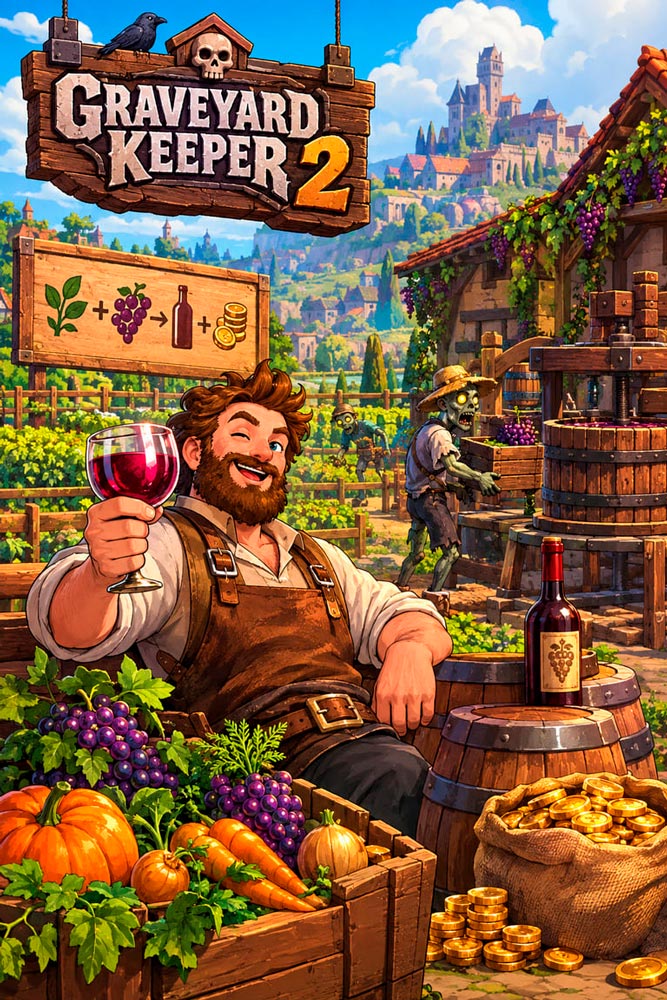
If there is one thing I learned very quickly while playing management-heavy games, it is that the moment a game gives you farming, crafting, and an economy, you should probably stop thinking like a survivor and start thinking like a factory owner. Graveyard Keeper 2 takes that idea and pushes it much further than the original. You are not simply growing a few vegetables to keep yourself supplied anymore. You can build a serious agricultural operation, produce high-quality wine, automate much of the work with zombies, and turn all of that production into a reliable source of Gold.
The funny part is that all the dramatic stuff around you can make farming seem secondary. There are undead armies, town restoration, defenses, combat systems, and plenty of grim medieval nonsense happening at the same time. Yet money still solves an absurd number of problems. If you want better infrastructure, expensive materials, upgrades, and access to later-game projects, having a reliable economy makes everything else considerably easier.
After spending time with farming systems in games ranging from survival sandboxes to full-blown management sims, I tend to look for one thing: a production loop that eventually feeds itself. Graveyard Keeper 2 absolutely has one. The trick is understanding its technology tree, crop quality, fertilizer system, grape production, winemaking, and eventually zombie automation.
Graveyard Keeper 2 Building Guide How to Craft and Upgrade Workstations
Why Farming Becomes So Important in Graveyard Keeper 2
The early economy can be surprisingly forgiving. You can make money from simple materials, basic crops, burial-related activities, and whatever other small opportunities you find around town. That is perfectly fine when you are still learning the game, but these methods start feeling painfully slow once your ambitions become bigger.
The real transition happens when you stop farming simply to survive and start farming for profit. Bronze crops are useful, Silver crops are better, but Gold-quality crops are where the production chain starts becoming genuinely interesting. Once you combine Gold crops with wine production and automated workers, your farm can become something that keeps producing while you concentrate on exploration, construction, quests, and combat.
There is also a satisfying progression here. You begin with basic garden beds and gradually unlock better fertilizers, specialized farming technologies, vineyards, and zombie workers. It feels less like unlocking random recipes and more like building an actual medieval agricultural industry.
Graveyard Keeper 2 Farming Technology Progression
Before worrying about making thousands of coins, you need to understand how the farming technology tree is structured. The Farming and Nature branch contains a large number of technologies, recipes, production stations, and useful items, so rushing randomly through it can leave you with expensive upgrades but no coherent production system.
The basic starting points include Garden Beds and Gathering, each requiring 5 Green Tech Points. From there, you move toward Gardening, fertilizers, Transplanting, Grape Farming, and eventually the technologies that make the serious money possible.
Key Farming Technologies
| Technology | Main Cost | Why It Matters |
|---|---|---|
| Garden Beds | 5 Green | Opens basic crop production |
| Grape Farming | 5 Red, 20 Green, 10 Blue | Gives access to vineyard production |
| Simple Fertilizers | 75 Green, 20 Blue | Unlocks early quality improvements |
| Complex Fertilizers | 150 Green, 35 Blue | Gives access to advanced fertilizer |
| Winemaking | 50 Red, 20 Green, 30 Blue | Opens the wine production chain |
| Zombie Gardening | 20 Green, 5 Blue | Automates crop production |
| Zombie Vineyard | 25 Red, 125 Green, 25 Blue | Automates grape production |
The exact costs are only part of the equation. Several of these technologies also require earlier nodes, so you cannot simply save up the required points and immediately buy everything you want.
For the long-term money-making route, I would personally prioritize the technologies that move you toward quality crops, grapes, winemaking, and automation rather than spending heavily on every farming-related option the moment it becomes available.
Mastery Matters More Than It First Appears
One of the easiest farming mechanics to overlook is Mastery. If you simply throw seeds into a garden bed without checking their requirements, you may wonder why your production feels inconsistent.
Seeds have their own Mastery requirements. Some of the better crops require significantly higher levels, and when your farming Mastery is too low, the interface warns you about the reduced chance of getting the best possible outcome.
That matters because farming isn’t just about harvesting vegetables. You also care about getting seeds back and improving their quality over multiple cycles. If your character lacks the required Mastery, you can lose additional yield and fail to recover enough seeds to efficiently continue your production loop.
Early on, this means manual farming requires some attention. Later, zombie automation changes the equation considerably, which is another reason I would not treat the manual farming stage as the final version of your operation.
The Fertilizer Trick for Producing Gold Crops
This is where the farming system starts becoming much more interesting.
If you want serious money, you eventually need to move away from basic Bronze-quality production. Quality Fertilizer is the key because it influences crop quality rather than simply making plants grow faster.
The game separates fertilizer into two useful categories:
- Boost Fertilizer reduces crop growing time.
- Quality Fertilizer improves the chance of producing higher-quality crops and seeds.
That distinction is extremely important. If you are trying to build an economy, faster Bronze crops aren’t necessarily what you want. You are trying to create a production chain that eventually produces Gold-quality crops and Gold seeds.
Simple Fertilizers unlocks the first tier of these systems, while Complex Fertilizers eventually gives you access to the stronger versions. Quality Fertilizer II is particularly important for a serious high-end farming setup.
How to Build a Gold Seed Loop
The basic quality loop looks like this:
- Prepare the garden bed with Peat.
- Add your best available Quality Fertilizer.
- Plant Silver-quality seeds.
- Harvest the crops.
- Keep the Gold seeds you obtain.
- Replant those Gold seeds.
- Continue using strong Quality Fertilizer.
- Gradually build a much larger supply of Gold seeds.
This is the part where patience pays off. You should not look at the first harvest and decide that the system isn’t working because you only received a small number of upgraded seeds. The point is to compound the quality over multiple cycles.
Once you have enough Gold seeds, your farm stops feeling like a resource sink and starts looking like a production engine.
Peat Is More Important Than It Looks
The Compost Heap deserves some attention because it is easy to ignore while focusing on glamorous things like Gold Wine.
Organic waste can be converted into useful materials such as Peat and Maggots, and Peat becomes a valuable part of your agricultural production. It is not the most exciting item in your inventory, but management games are full of these seemingly boring resources that quietly determine whether your bigger system runs smoothly.
I recommend treating Peat as part of your regular production pipeline rather than something you remember only when you suddenly run out. If you are planning to maintain a large farm, a healthy stockpile of basic agricultural materials saves you from constantly interrupting your other activities.
Building a Vineyard for Serious Money
Once Grape Farming and Winemaking are unlocked, the economy changes considerably.
Grapes take longer to mature than many basic crops, but their value comes from what happens after harvesting. Instead of simply selling the grapes, you can process them into juice and then turn that juice into wine.
The process is straightforward:
Grapes → Grape Juice → Red Wine
First, take harvested grapes to the Juice Press. The quality of the resulting grape juice reflects the quality of the grapes you put into the process. You then take matching-quality juice to the Wine Making Barrel for fermentation.
This is why your earlier investment in Gold-quality farming matters. Producing low-quality grapes and then expecting the winery to magically turn them into premium wine is not how the system works. Your input quality determines the quality of what comes out.
Gold Wine Is the Real Endgame Farming Product
Silver Wine has plenty of uses, particularly when quests and NPC requests enter the picture. But if the goal is purely to build wealth, Gold-quality Red Wine is the product you should be watching.
A high-volume winery can turn your agricultural output into something dramatically more valuable than the raw crops. This is one of those production chains that feels satisfying because every stage has a purpose.
There is another reason not to automatically sell every bottle, though. Wine is also a useful consumable. High-quality Red Wine can restore a significant amount of energy, making it useful during long crafting sessions or demanding dungeon runs.
Personally, I would keep a reserve rather than treating every bottle as currency. Selling enough to maintain your Gold reserves while keeping some high-quality wine for your own activities is much more practical than constantly buying back consumables later.
Zombie Farms Change Everything
Manual farming works, but eventually you will reach the point where walking around planting, harvesting, fertilizing, and moving materials starts feeling like unpaid labor.
That is where the undead workforce becomes one of the best systems in Graveyard Keeper 2.
Zombie Gardening unlocks automated agricultural production, while Zombie Vineyard lets you automate grape production. Once these technologies are available, you can start shifting repetitive work away from your character and toward your undead workforce.
This is exactly the kind of automation I like in management games. You are not simply making a task faster. You are removing the task from your personal workload altogether.
How Zombie Farms Work
Automated farms behave differently from manually operated beds.
One particularly useful feature is that fertilizer does not need to be repeatedly applied in the same way you would handle every manual planting cycle. Once a zombie farm has been properly established and upgraded with strong quality fertilizer, the plot can maintain its production setup.
That means the real job becomes building the system correctly in the first place.
I would think about your zombie farm as infrastructure rather than a normal field. You are investing resources upfront so that the farm can keep generating crops without constantly demanding your attention.
There is, however, one important issue: seed sustainability.
Zombie farming can experience occasional seed losses, meaning you should never operate your automated farms with exactly the number of seeds they need. A production line with zero reserve is asking for trouble.
Keep a Seed Buffer
If your automated farm requires 24 seeds, don’t throw exactly 24 into the system and forget about it.
Keep additional seeds nearby as a buffer. Having an extra stack available means a few unlucky harvests won’t immediately stop production.
The same principle applies to the rest of your economy. I have played enough management games to know that the most annoying failure is rarely something dramatic. It is usually one tiny missing component that brings an entire production chain to a halt.
A practical setup is to maintain:
- A dedicated seed reserve.
- Extra Peat and fertilizer materials.
- A stockpile of grapes or crops waiting for processing.
- Backup wine production materials.
- Enough storage space for finished products.
The more automated your operation becomes, the more important these buffers are.
Zombie Efficiency and Better Workers
Zombie quality also matters. More efficient workers can improve the overall performance of your automated operation and help reduce the impact of production inefficiencies.
This becomes increasingly relevant when you have several farms running simultaneously. You don’t want your best production buildings being operated by workers that barely get anything done.
The whole point of automation is scale. Once you start producing Gold crops and large quantities of grapes, small differences in efficiency become much more noticeable because they are multiplied across many production cycles.
Don’t Forget Zombie Porters
Producing thousands of crops is only useful if those crops actually reach the stations where they need to be processed.
This is where Zombie Porters become extremely useful.
Instead of personally carrying every batch from your farms to storage, presses, barrels, or other processing locations, you can assign undead workers to handle transportation. That allows you to create something much closer to an actual automated production line.
The ideal long-term setup is basically:
Zombie Farm → Storage/Transport → Processing → Winery → Storage → Sales
Once that chain works smoothly, you can spend your time doing almost anything else.
How to Sell Wine Without Destroying Your Profits
There is one final part of the economy that many players overlook: market saturation.
Dumping enormous quantities of the same product into one market can reduce the selling price. So even if you have a warehouse full of Gold Wine, selling everything at once is not necessarily the smartest way to manage your income.
I prefer treating the Merchant like part of the production schedule rather than an emergency buyer.
Sell controlled quantities, monitor the market, and avoid flooding it with your entire stockpile in one transaction. You want your production rate and sales rate to work together.
This becomes especially important once automation starts producing far more goods than you can personally consume.
Crop Crates Are Another Great Money Sink
Wine isn’t the only high-value agricultural product worth considering.
Gold-quality vegetables such as Pumpkins, Onions, and Carrots can be turned into Crop Crates once you progress through the appropriate merchant and business systems. These crates provide another way to convert agricultural production into a larger, more predictable payout.
This is particularly useful because it gives you another destination for crops that would otherwise overwhelm your storage.
Instead of thinking:
‘I have too many vegetables.’
you can start thinking:
‘I have another production chain that needs vegetables.’
That mental shift is basically the entire farming philosophy of Graveyard Keeper 2.
My Recommended Farming Progression
If I were starting a fresh save and wanted to build a serious agricultural economy, I would approach it in roughly this order:
- Unlock basic Garden Beds and Gathering.
- Build a stable supply of Peat and basic farming materials.
- Unlock Gardening and the fertilizer technologies.
- Start improving Silver crops into Gold crops.
- Research Grape Farming.
- Unlock Winemaking as soon as the required technology path allows it.
- Build the Juice Press and Wine Making Barrel production chain.
- Establish a reserve of Gold seeds.
- Unlock Zombie Gardening.
- Move your best crop production into automated farms.
- Unlock Zombie Vineyard.
- Add zombie transport and storage infrastructure.
- Keep reserve seeds and fertilizer materials.
- Sell Gold Wine and high-quality crop products in controlled quantities.
The key is not trying to automate everything immediately. Build the production chain manually first, understand how much it consumes, then automate the repetitive sections. Otherwise, you can end up with a complicated network that you don’t fully understand and can’t easily troubleshoot.
Final Thoughts
The farming system in Graveyard Keeper 2 is much more than a side activity. Once you understand crop quality, fertilizer, grape production, winemaking, and zombie automation, agriculture becomes one of the strongest economic foundations you can build.
The biggest mistake is thinking about individual crops instead of thinking about production chains. A Gold seed isn’t valuable simply because it is Gold. It is valuable because it can become a Gold crop, that crop can become premium ingredients, those ingredients can become Gold Wine or valuable crates, and your zombie workforce can eventually handle much of the repetitive work.
That is when the whole thing clicks.
You start with a few miserable garden beds and a character doing everything by hand. Eventually, you have zombies tending vineyards, porters moving resources, barrels producing premium wine, and storage rooms filling up faster than you can empty them. That is the point where Graveyard Keeper 2’s farming stops feeling like farming and starts feeling like running a bizarre undead corporation.
And honestly, that is exactly the kind of ridiculous progression I want from this series.