Aliens Fireteam Elite 2 Crossplay Guide: PC, PS5, Xbox Series X, and Launch Details
If you have ever played the original Aliens: Fireteam Elite with a headset on, three friends screaming in comms, and a wall of Xenomorphs pouring through a doorway, you already know why the sequel has my attention. The Alien universe is practically built for co-op shooters: cramped corridors, terrible visibility, ammunition that suddenly feels way too scarce, and the constant suspicion that something with far too many teeth is about to drop from the ceiling.
Now, Aliens: Fireteam Elite 2 is finally here. Cold Iron Studios and Daybreak Game Company are preparing to launch the sequel on August 25, 2026, and this time the studio is going much bigger with its multiplayer systems.
The obvious question is not just whether the game looks better or has nastier Xenomorphs. For anyone playing with friends, the real question is much simpler:
Can PC, PlayStation 5, and Xbox players actually play together?
Yes. Aliens: Fireteam Elite 2 launches with full crossplay.
And honestly, that is exactly what a modern co-op shooter like this needs.
Aliens: Fireteam Elite 2 Has Full Crossplay at Launch
The biggest multiplayer news is refreshingly straightforward. PC players on Steam and the Epic Games Store, PS5 players, and Xbox Series X/S players share the same matchmaking ecosystem from day one.
That means you can build a squad without worrying about which plastic box or gaming platform your friends happen to own.
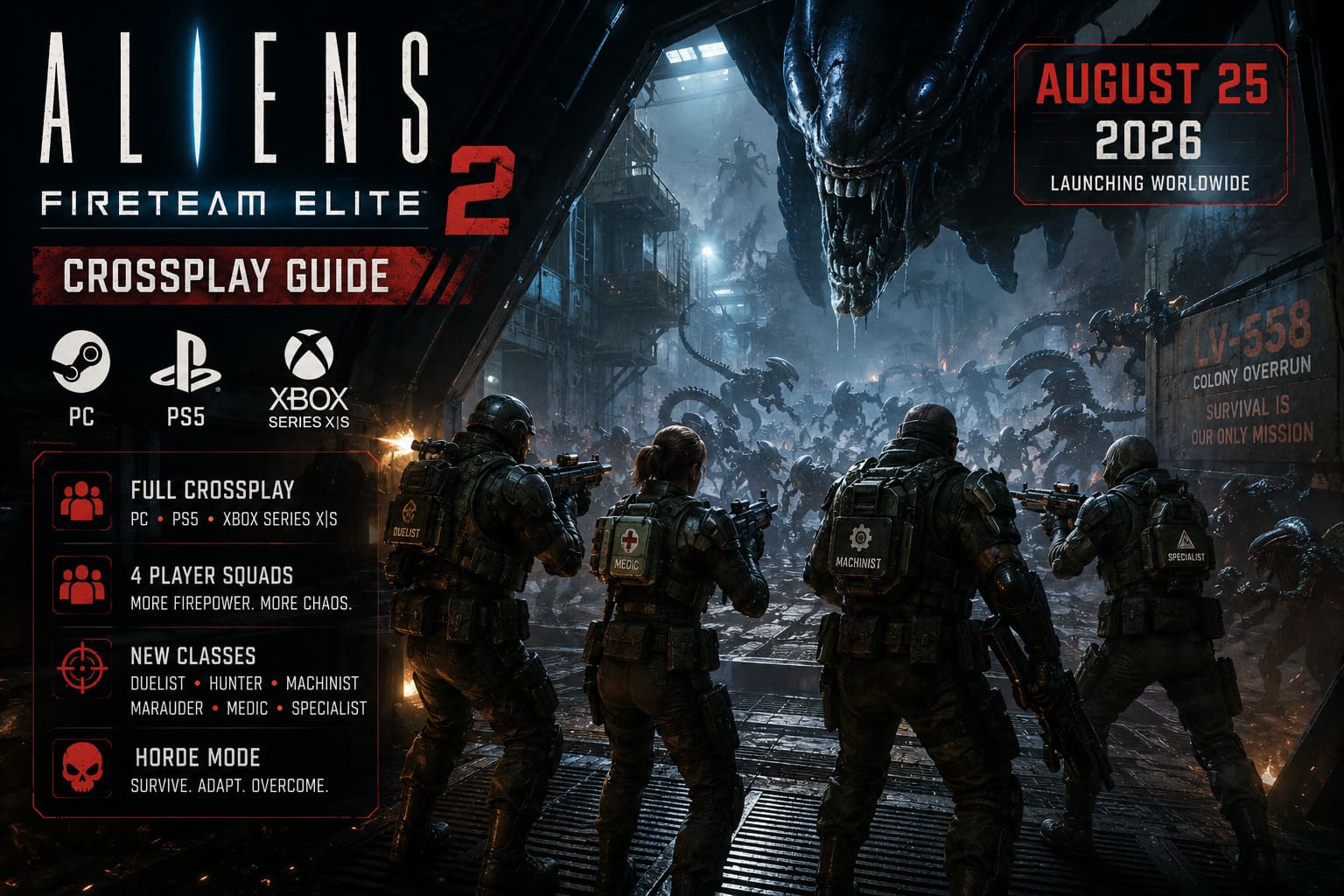
A typical fireteam could include:
- One PC player
- One PlayStation 5 player
- Two Xbox Series X/S players
Everyone can jump into the same missions, use matchmaking together, and communicate through the game’s integrated voice chat.
This is especially important because the original Fireteam Elite did not launch with the kind of universal cross-platform experience many players expected. Crossplay arrived later through post-launch support. For the sequel, Cold Iron Studios has apparently treated crossplay as a fundamental part of the game rather than something to bolt on after release.
That is the right decision.
Co-op games live or die by their player population. Splitting the community between platforms is one of the fastest ways to make matchmaking feel dead, especially months after launch. A unified player pool gives Fireteam Elite 2 a much better chance of keeping missions populated when the initial launch hype disappears.
PC, PS5, Xbox, and Switch 2: Where Can You Play?
At launch, the game is focused on current-generation hardware and PC. The initial release date is August 25, 2026 for PC, PlayStation 5, and Xbox Series X/S.
Nintendo players have a little longer to wait.
A Switch 2 version is reportedly planned for Fall 2026, with an expected window around October or November. The important part for Nintendo fans is that the version is intended to join the same global crossplay ecosystem once it arrives.
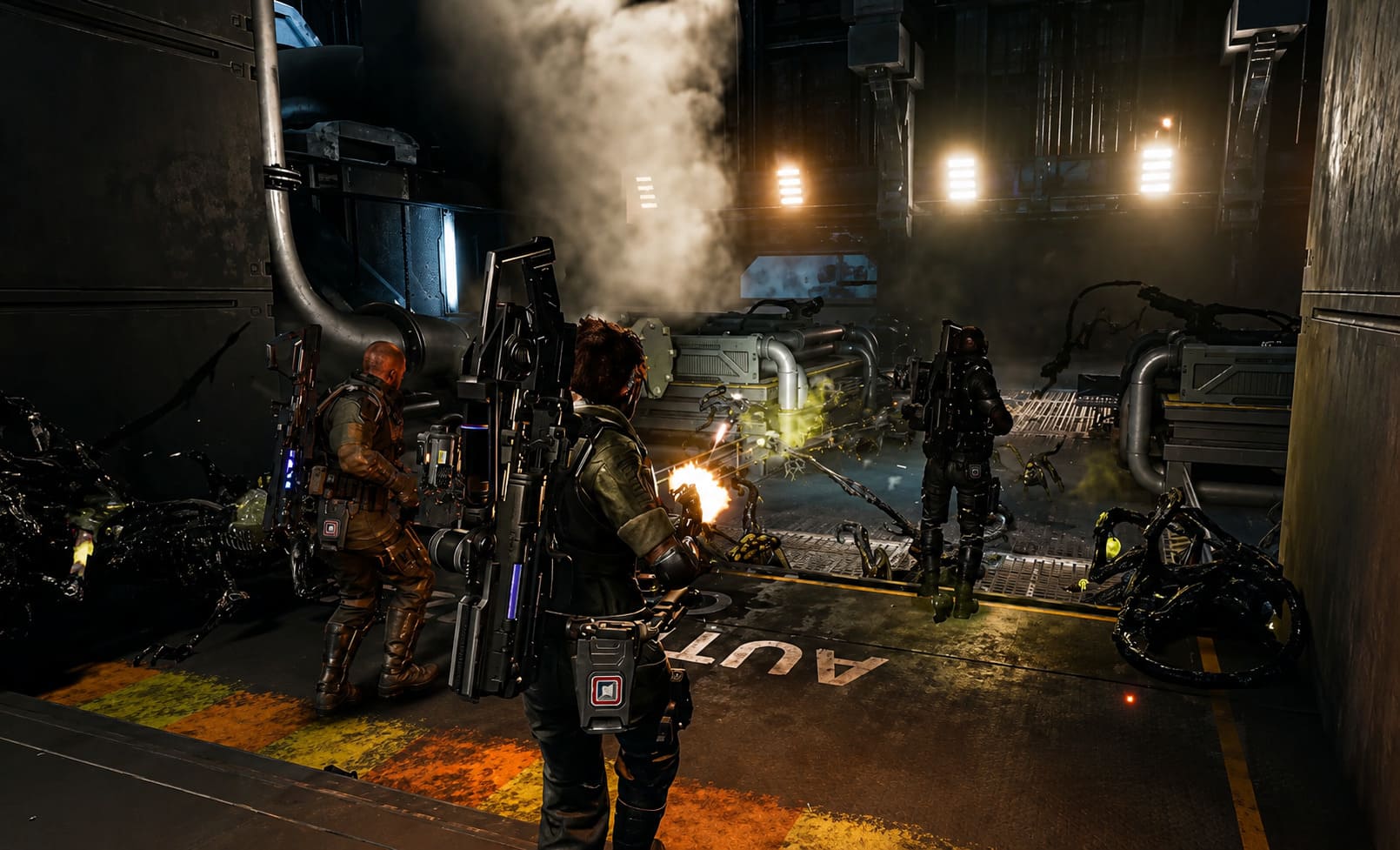
| Platform | Release Window | Crossplay |
|---|---|---|
| PC — Steam | August 25, 2026 | Yes |
| PC — Epic Games Store | August 25, 2026 | Yes |
| PlayStation 5 | August 25, 2026 | Yes |
| Xbox Series X/S | August 25, 2026 | Yes |
| Nintendo Switch 2 | Fall 2026 | Planned |
For PC players, Steam and Epic users aren’t being placed into separate multiplayer bubbles either. That matters more than it sounds. Nobody wants to discover that their friend bought the game from another storefront and suddenly can’t join the squad.
Four Marines Are Better Than Three
Here’s another change that could have a surprisingly big impact on how Fireteam Elite 2 feels: the maximum squad size has increased from three players to four.
As someone who enjoys co-op shooters, I like this change a lot.
Three-player teams can work brilliantly, but they also create awkward situations. Somebody has to play the support role, someone needs to bring damage, and the third player often ends up filling whatever gap the team has. With four players, there is considerably more room for specialization.
It also makes crossplay parties more flexible.
Imagine your regular gaming group has four people:
PC + PS5 + Xbox + Xbox.
Nobody has to sit out. Nobody has to create a separate party. Nobody has to argue about who gets kicked because the squad is full.
If you don’t have four humans available, the game can fill the empty slot with an AI-controlled marine or use crossplay matchmaking to find another player.
That sounds like a small quality-of-life feature, but for a game built around replaying missions, it can make a huge difference.
The Class System Is Getting a Serious Overhaul
The sequel isn’t simply taking the original class structure, changing some weapons, and calling it a day.
The launch roster introduces several distinct roles:
- Duelist
- Hunter
- Machinist
- Marauder
- Medic
The interesting addition is the Specialist.
This is where things get considerably more flexible.
Rather than being locked into a traditional class archetype, the Specialist can combine abilities, perks, and passive effects from other classes. In theory, this should allow players to build highly specific hybrid characters around the needs of their squad.
And this could become one of the best parts of the sequel if Cold Iron gets the balance right.
A four-player squad already has more tactical possibilities than the three-player structure of the original. Add a customizable Specialist into the mix and suddenly team composition becomes something worth discussing before a mission instead of simply picking whichever class has the coolest-looking weapon.
Of course, this also creates the classic co-op problem: someone is going to create an absolutely ridiculous meta build within a week of launch.
That’s basically inevitable.
A Darker Story Set Five Years Later
The sequel takes place in 2207, five years after the events of the original Aliens: Fireteam Elite.
Players once again step into the boots of Colonial Marines, this time serving with Dagger Company aboard the UAS Endeavor.
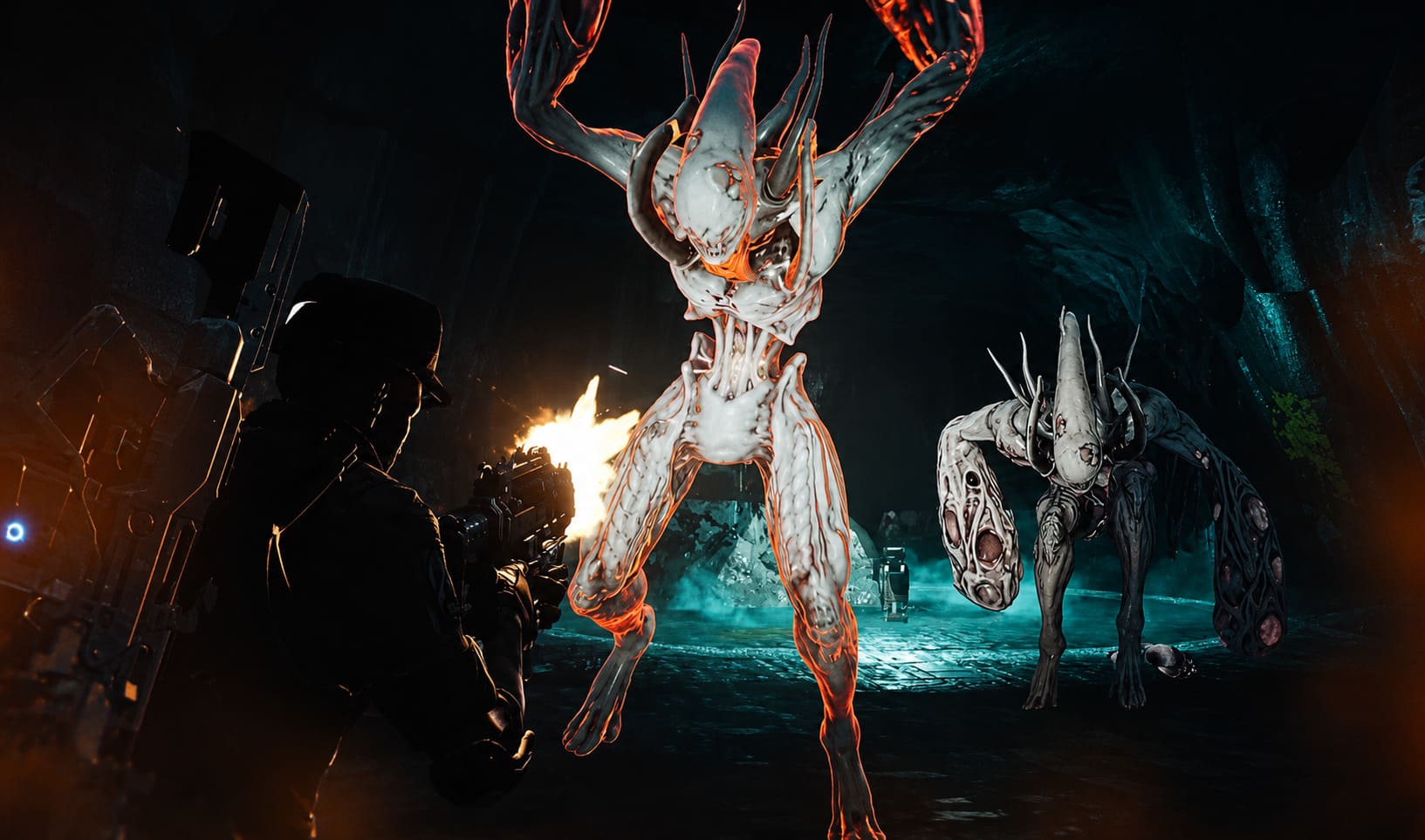
The main operation takes the squad to LV-558, where the situation has already gone completely sideways.
And I mean completely.
The colony is overrun, the Xenomorph threat is aggressive, and survival rather than heroic rescue operations is the central theme.
That tonal shift is something I’m particularly interested in.
The first game often pushed players through familiar Alien-style environments while juggling objectives such as rescuing personnel, investigating facilities, and dealing with Weyland-Yutani installations. The sequel appears more interested in throwing players directly into the meat grinder.
The campaign consists of five campaigns and approximately 15 main missions at launch.
Expect dark corridors, damaged infrastructure, ambushes, and enemy encounters designed to make you question whether moving forward is actually a good idea.
And the Xenomorphs aren’t supposed to behave like simple running targets anymore.
The new enemy AI is designed around ventilation systems, vertical surfaces, and ambush tactics, which is exactly what I want from an Alien game.
If the Xenomorphs can genuinely attack from multiple angles rather than simply sprinting directly toward the nearest marine, four-player squads are going to have to pay attention to their surroundings.
Because getting jumped from behind is one thing.
Getting jumped from above while everyone is watching the corridor in front of them?
That’s the good stuff.
Weyland-Yutani Synthetics Join the Fight
Xenomorphs aren’t the only threat waiting on LV-558.
Players will also face armed Weyland-Yutani synthetics, adding another type of enemy encounter to the campaign.
That’s important because fighting the same enemy type for fifteen missions can get repetitive, no matter how much you love blowing Xenomorphs apart.
Having hostile synthetics introduces a different combat rhythm. Xenomorph encounters can focus on positioning, swarm control, choke points, and reaction speed, while synthetic enemies can create more conventional firefights.
The combination should give the campaign some much-needed variety.
Horde Mode Is Available on Day One
This is another decision I strongly approve of.
Horde Mode launches on Day 1.
There is no waiting several months for the game’s “real” replayable endgame to arrive.
The mode is built around dedicated defensive maps where squads face increasingly difficult waves of Xenomorphs. As the waves progress, enemies become more dangerous and players have to manage ammunition, abilities, positioning, and defensive choke points.
This is basically the kind of mode that can turn a four-player co-op shooter into a nightly addiction.
You finish the campaign mission.
Someone says, “One Horde run?”
Twenty minutes later you’re on wave 17 wondering why everyone is still alive.
That’s the authentic Aliens experience.
The reward structure also gives players a reason to push further. Surviving deeper waves can provide rare weapon attachments, cosmetics, perk modifiers, and other progression rewards.
That makes Horde Mode more than a disposable arcade mode. It becomes another reason to keep your Marine progressing after you’ve worked through the story.
Cross-Platform Voice Chat Makes the Whole System Better
Crossplay is great.
Crossplay with no communication is considerably less useful.
Thankfully, Fireteam Elite 2 includes cross-platform voice chat, meaning players on PC, PS5, and Xbox can communicate directly through the game.
That is particularly important for a game where positioning and timing matter.
When a Xenomorph swarm starts pouring through multiple entrances, typing messages is obviously not an option. You need to be able to shout:
- “LEFT SIDE!”
- “Reloading!”
- “Get the Medic up!”
- “WHY IS THERE ONE BEHIND US?”
And then immediately discover that the entire squad has been eaten.
That’s the authentic Aliens experience.
Integrated voice chat also means players aren’t forced to coordinate through Discord or another third-party service simply because they’re playing on different hardware.
What About Cross-Progression?
This is where things get less exciting.
Crossplay and cross-progression are not the same thing.
While players can fight together regardless of platform, character progression is tied to individual platform accounts at launch.
So if you level your Marine, unlock weapons, and build your perks on Steam, you shouldn’t assume that switching to PS5 will magically bring all that progress with you.
The relevant ecosystems remain tied to their respective accounts, including Steam, Xbox Network, and PlayStation Network.
It’s a little disappointing.
If you’re building a game around a unified multiplayer ecosystem, true cross-progression would be the obvious next step. Nobody enjoys unlocking the same gear twice simply because they moved from one platform to another.
Still, at least the distinction is clear: crossplay is fully supported, while cross-progression is not fully shared between platforms at launch.
Anti-Cheat Matters More When Consoles and PC Share a Lobby
There’s another technical consideration that is easy to overlook.
When PC and console players share the same matchmaking pool, cheating becomes a much bigger concern. A modified PC client can potentially ruin the experience for everyone else in the lobby, including players who have absolutely nothing to do with PC gaming.
Cold Iron Studios is therefore implementing modern PC anti-cheat measures designed to protect public matchmaking.
For a PvE game, some people might shrug and say cheating doesn’t matter because you’re fighting AI.
It absolutely can matter.
If progression, loot, leaderboards, rewards, or matchmaking are involved, one player abusing a modified client can still damage the experience for an entire squad. The more interconnected the multiplayer ecosystem becomes, the more important basic security is.
This Is the Sequel I Wanted
The biggest strength of Aliens: Fireteam Elite 2 isn’t any single weapon, class, or graphical upgrade.
It’s the fact that the sequel appears to understand what makes a co-op shooter worth coming back to.
You’ve got four-player squads instead of three. You’ve got full crossplay between PC, PS5, and Xbox Series X/S from launch. You’ve got cross-platform voice chat, a more flexible class system, a customizable Specialist, a roughly 15-mission campaign, and Horde Mode available immediately.
That is a much stronger multiplayer package than simply releasing another set of Xenomorph corridors.
The one obvious omission is cross-progression. If you’re someone who regularly switches between PC and console, that limitation is going to sting. The lack of a completely shared progression system feels old-fashioned in a game that otherwise embraces cross-platform play.
But if your main concern is “Can I play this with my friends?”, the answer is refreshingly simple.
Yes.
PC, PS5, and Xbox Series X/S players can squad up from day one. The four-player structure gives teams more breathing room, the Specialist class should create some wild build possibilities, and Horde Mode gives everyone something to do once the campaign is finished.
And let’s be honest: the real test will come when four strangers from four different platforms are standing in a dark corridor, hearing something crawl through the ventilation above them.
At that point, the platform doesn’t matter.
You just better hope somebody brought the Medic.
Aliens: Fireteam Elite 2 — Quick Facts
| Feature | Details |
|---|---|
| Developer | Cold Iron Studios |
| Publisher | Daybreak Game Company / Enad Global 7 |
| Release Date | August 25, 2026 |
| Launch Platforms | PC, PS5, Xbox Series X/S |
| Nintendo Switch 2 | Fall 2026 |
| Co-op | Up to 4 players |
| Crossplay | Yes, across active platforms |
| Voice Chat | Cross-platform |
| Campaign | 5 campaigns, approximately 15 missions |
| Horde Mode | Available at launch |
| Cross-Progression | Platform-specific at launch |