Pax Autocratica Colony Management Guide: Resource Optimization Strategy
Pax Autocratica is the kind of game that can punish you for making one small economic mistake twenty minutes earlier. On paper, it looks like a colony builder mixed with a first-person roguelite shooter. In practice, the two systems are constantly fighting for your attention.
You need materials to expand. You need power to keep production running. You need workers to operate your colony. Then you need soldiers to leave the planet and bring back the rare stuff your factories desperately want.
And yes, there is also the small matter of keeping your population from deciding that your glorious authoritarian paradise isn’t quite as glorious as you promised.
After spending time looking at how the different systems interact, I think resource management is the real core of Pax Autocratica. Combat is exciting, but a great expedition doesn’t mean much if your colony is falling apart while you’re away.
This guide covers the colony management strategy I’d recommend, including automation, population control, power management, construction placement, and the connection between your economy and frontier expeditions.
The Resources You Actually Need to Watch
The easiest mistake is treating every resource as if it has the same importance. They don’t.
Early on, wood and stone are your foundation. You’ll burn through them while establishing basic housing, storage, production buildings, and command infrastructure. Once your colony starts developing, steel and refined materials become much more important.
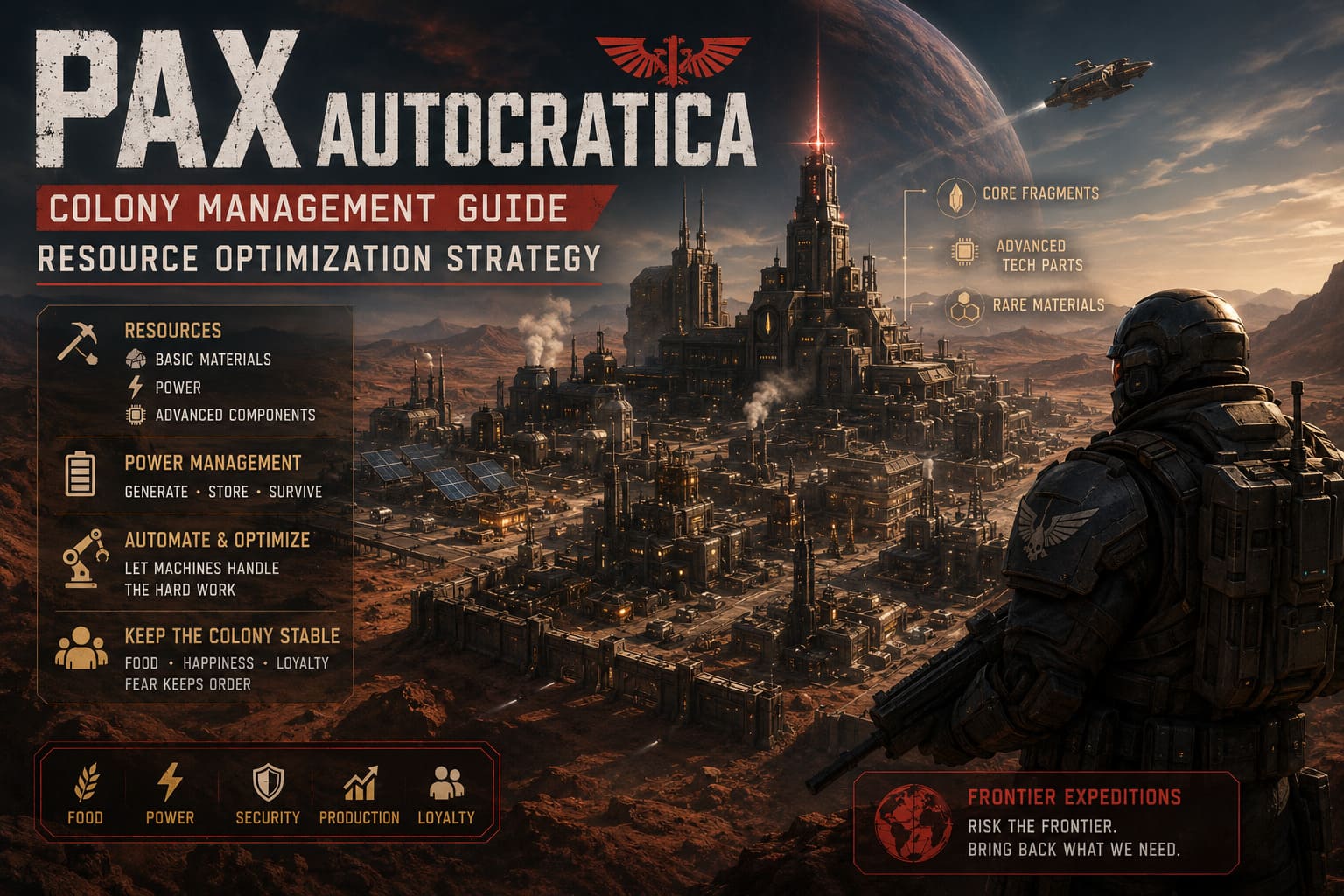
Later, rare components such as Core Fragments and advanced technology parts start determining how quickly you can move into stronger military and research options.
I like to think about the economy in three broad categories:
| Resource Category | Main Purpose | Priority |
|---|---|---|
| Basic Materials | Construction and early production | High |
| Power | Factories, defenses, automation | Very High |
| Advanced Materials | Research and military upgrades | Critical |
The important part is that your economy has to move from basic extraction toward processing and automation. If you’re still relying heavily on manual labor when your industrial infrastructure is expanding, you’re probably making life harder than it needs to be.
Power Is More Important Than It Looks
Power was one of the systems I’d keep an eye on constantly.
Solar generation sounds great until nighttime arrives.
If your colony depends almost entirely on daytime solar production and you haven’t built enough storage, your factories can effectively hit a wall every evening. Production stops, automated systems shut down, and suddenly you’re staring at a colony that looked perfectly healthy a few minutes earlier.
Battery storage should be treated as part of your production infrastructure, not as an optional luxury.
Build enough capacity to absorb excess daytime generation and carry your essential systems through the night. A reliable power reserve also gives you some breathing room when you expand faster than expected.
I would rather have slightly too much stored energy than watch an entire manufacturing chain sit idle because the sun disappeared.
And once you’re running several production lines at the same time, that difference becomes huge.
Stop Making Humans Do Robot Jobs
This is probably my biggest recommendation for new players:
Automate basic resource gathering as early as you reasonably can.

Human workers come with baggage. They need food, they get tired, their morale matters, and poor working conditions can eventually create social problems.
Machines don’t care.
Worker mechs can handle repetitive industrial jobs without consuming your food reserves or suffering from the same social pressures as colonists. That makes them incredibly valuable for mining, gathering, and transportation.
I’d prioritize using robotic labor for jobs such as:
- Wood gathering
- Stone and raw ore extraction
- Heavy industrial transport
- Repetitive factory-related tasks
Meanwhile, humans can be assigned to roles where having an actual person matters more, including research, administration, security, and combat.
This creates a much healthier economy. Your machines keep the industrial side moving while your population handles the jobs that benefit from human labor.
It also reduces the number of situations where exhausted workers become an economic problem.
Don’t Waste Your Best Building Space
One thing I think players can overlook is how valuable the colony’s internal space actually is.
Not every building needs to occupy the most efficient part of your main supply area.
Residential habitats, research facilities, landing pads, and certain special structures can often be placed outside the core industrial area. That gives you more room inside your important supply zones for things that actually need to interact with your production network.
I prefer keeping the central area focused on:
Extraction → Processing → Refining → Storage
The shorter those routes are, the less time your logistics systems spend moving materials around.
It may not look like a huge improvement when you place one building, but once you have several production chains running, inefficient layouts start becoming obvious.
Don’t Be Afraid to Rebuild
One of the most useful mechanics in the system is the 100% refund when demolishing structures.
That completely changes how I approach colony design.
In many city builders, you hesitate before moving a building because you know you’ll lose part of the investment. Here, you have far more freedom to experiment.
Build something.
Test the layout.
Realize you made a terrible decision.
Tear it down.
Build it somewhere better.
That’s especially useful when moving from a basic colony into a more advanced industrial setup. You don’t have to protect every early-game building forever.
Population: The 60-Citizen Problem
Population growth isn’t automatically good.
That’s a lesson I’d recommend learning before your colony gets too large.
The 60-citizen threshold is particularly important because crossing it pushes the colony into a more demanding population tier. You gain access to more advanced possibilities, but your citizens also expect more resources and infrastructure.
If your economy is already struggling, adding more people can make the problem much worse.
That’s why I’d avoid expanding population simply because you have the ability to do so.

Instead, ask yourself:
Can my current production network comfortably support the next tier?
If the answer is no, stabilize the economy first.
A smaller colony with healthy food reserves, reliable power, and automated extraction is much easier to manage than a large colony where every production line is running at maximum capacity just to keep people alive.
Sometimes reducing your population below the threshold can even be useful as a temporary economic reset. It isn’t glamorous, but in a survival-focused colony game, keeping the entire system alive matters more than chasing growth numbers.
Fear, Happiness, Hunger and Loyalty
This is where Pax Autocratica gets especially interesting.
Your citizens aren’t just another workforce statistic. Their social condition directly affects the stability of the colony.
Hunger is particularly dangerous.
When food supplies start dropping, you don’t just have a nutrition problem. You also create a productivity and stability problem.
That’s why I would keep an emergency food reserve whenever possible rather than operating permanently at the edge of your production capacity.
The other side of the equation is social control.
Surveillance structures, police infrastructure, propaganda, curfews, and other authoritarian policies give you tools to manage unrest. You don’t necessarily need everyone to be happy all the time. You need the colony to remain functional.
That distinction matters.
A heavily controlled colony can survive periods of poor happiness if the other systems are strong enough. But if hunger, low morale, weak security, and failing production all happen simultaneously, things can spiral very quickly.
My rule is simple:
Never allow multiple negative systems to collapse at the same time.
If food production is temporarily weak, make sure power and security are solid. If you’re pushing aggressive industrial policies, compensate with stronger social control.
It’s all about keeping the problems separated instead of allowing them to stack.
Why Frontier Expeditions Matter So Much
This is the part that makes Pax Autocratica more than another colony management game.
Your planetary economy isn’t completely self-sufficient.
Once local resource deposits are exhausted, you need another solution. That’s where your wider military operations become important.
Eventually, you’ll want stronger agricultural infrastructure, including Greenhouses and Farms, while specialized Excavators can help with longer-term extraction.
But rare technology and high-value components require something more dangerous.
You have to leave the colony.
The FPS missions aren’t just side content. They feed directly back into your economic progression.
Treat Expeditions Like Economic Missions
When I look at a frontier expedition, I don’t see it purely as a combat mission.
I see it as a resource run where somebody happens to be shooting at me.
The goal is to return with materials your colony can’t easily produce at home.
Hostile Urslan positions and corporate facilities can contain valuable resources, including refined steel, advanced components, Core Fragments, and other useful rewards.
That creates an interesting risk-reward loop.
The colony needs rare materials to become stronger.
Those materials require dangerous missions.
Those missions require good equipment.
That equipment requires a healthy industrial economy.
And the industrial economy needs the rewards from successful missions.
It’s a loop.
If one side becomes too weak, the whole system suffers.
Don’t Throw Away Your Best Soldiers
Because expeditions are tied to the economy, losing experienced troops isn’t just a military setback.
It’s an economic one.
You spent resources building their equipment. You spent time preparing them. Their deaths can also reduce your ability to complete the next expedition successfully.
Before sending a squad into a difficult area, make sure your colony can actually afford the risk.
I’d rather return with a smaller amount of valuable loot than lose an entire elite squad chasing one extra objective.
Survival is part of the economy.
Pax Autocratica Console Commands List (2026): All Cheat Codes & How to Enable
My Recommended Pax Autocratica Progression
If I were starting another colony, I’d approach the early and mid-game roughly like this:
- Establish wood, stone, food, and basic power production.
- Move repetitive extraction jobs to mechs as soon as possible.
- Build sufficient battery storage before relying heavily on solar power.
- Keep the population below major thresholds until the economy is ready.
- Design the colony around short industrial logistics routes.
- Use the demolition refund to rebuild inefficient layouts instead of tolerating them.
- Expand food production before population growth creates a new demand spike.
- Send well-equipped expedition teams after the colony can support the risk.
- Use rare expedition rewards to accelerate technology and military development.
The biggest mistake I’d avoid is trying to do everything simultaneously.
You don’t need the biggest population.
You don’t need every building immediately.
And you definitely don’t need to send soldiers into every dangerous location just because the game lets you.
Build a stable economy first. Then expand.
Pax Autocratica Steam Deck Best Settings: How to Get Stable 60 FPS
Final Thoughts
Pax Autocratica’s colony management becomes much easier once you stop thinking of each system separately.
Power affects factories. Factories affect resources. Resources affect food and population growth. Population affects stability. Stability affects productivity. Expeditions bring back the materials needed to improve almost everything.
That’s what makes the management side so satisfying.
Personally, I think the strongest approach is a relatively compact, heavily automated colony supported by a controlled population and a reliable energy reserve. Let mechs handle the boring industrial work. Keep humans in valuable specialist roles. Don’t rush population tiers. And when the colony needs something it can’t produce, send a properly equipped expedition rather than blindly burning through soldiers.
The goal isn’t simply to build a huge colony.
The goal is to build one that keeps working when everything starts going wrong.
And in Pax Autocratica, something is almost always going wrong.