Big Walk Game 2026 PC System Requirements: Can Your Rig Handle House House’s Next Co-op Hit?
When House House announced Big Walk, I immediately knew this wouldn’t be another ordinary co-op game. After spending years playing everything from hardcore survival sandboxes to chaotic party games and massive open-world adventures, I’ve learned that the best multiplayer experiences are not always about combat, progression systems, or endless grinding. Sometimes the most memorable gaming moments come from getting completely lost with friends, arguing about a puzzle solution, or accidentally walking in the wrong direction while everyone laughs.
That’s exactly the feeling Big Walk appears to be chasing. Instead of focusing on weapons, competitive mechanics, or complicated character builds, the game is built around exploration, communication, and teamwork. It looks simple at first glance, but behind its charming art style is a surprisingly advanced technical foundation. Before jumping into this unusual multiplayer adventure, PC players should know whether their hardware is ready.
Is Big Walk Coming to PS5? Release Date, PS Plus, and Crossplay Details Explained
Official Big Walk PC System Requirements
The good news is that Big Walk does not demand an expensive high-end gaming PC. However, players should not underestimate the requirements just because the game has a colorful and relaxed visual style. The large seamless island, multiplayer synchronization, physics interactions, and advanced proximity voice chat system require more power than many traditional indie games.
House House seems to have found a reasonable middle ground. The game is not designed only for enthusiasts with premium hardware, but it also does not pretend that older budget systems can handle every modern feature without compromises.
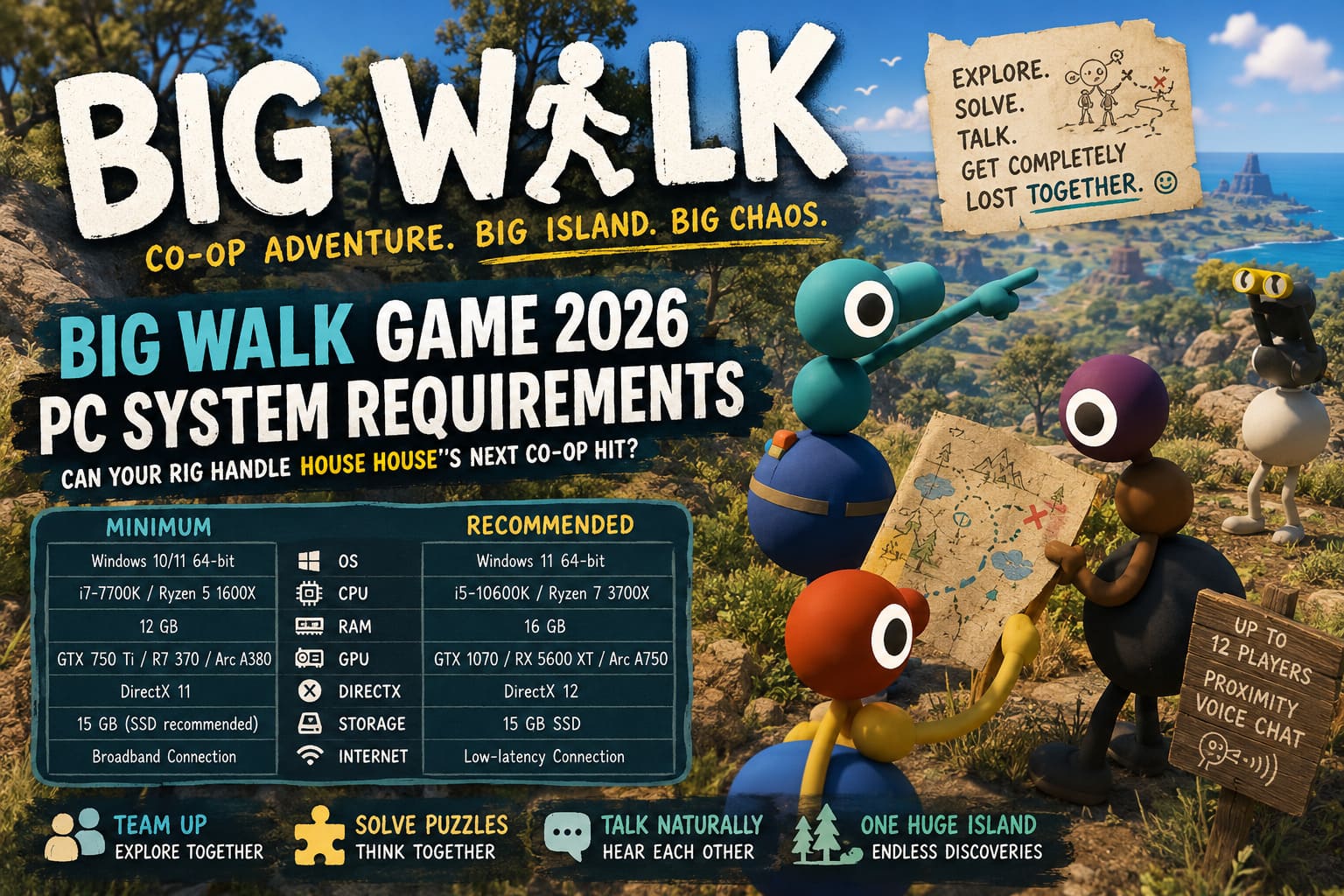
| Component | Minimum | Recommended |
|---|---|---|
| Operating System | Windows 10/11 64-bit | Windows 11 64-bit |
| Processor | Intel Core i7-7700K / AMD Ryzen 5 1600X | Intel Core i5-10600K / AMD Ryzen 7 3700X |
| RAM | 12 GB | 16 GB |
| Graphics Card | GTX 750 Ti / Radeon R7 370 / Intel Arc A380 | GTX 1070 / RX 5600 XT / Intel Arc A750 |
| DirectX | Version 11 | Version 12 |
| Storage | 15 GB (SSD recommended) | 15 GB SSD |
| Internet | Broadband connection | Low-latency broadband connection |
Don’t Judge Big Walk by Its Visual Style
One of the biggest mistakes PC gamers make is assuming that a stylized indie game automatically means low hardware requirements. After playing hundreds of different titles, I have seen this happen many times. A game with simple visuals can still push your CPU, memory, and storage much harder than a realistic-looking project.
Big Walk is a perfect example. The game does not focus on realistic textures or cinematic graphics, but it constantly manages a huge outdoor environment, multiple players, interactive objects, puzzle states, and dynamic audio systems. The engine is doing a lot of work behind the scenes even when the screen looks calm and peaceful.
The art direction helps accessibility, but the technology powering the experience still requires a modern enough system.
Why Big Walk Needs 12 GB to 16 GB of RAM
A few years ago, 8 GB of RAM was enough for most indie games. Today, that amount is becoming increasingly difficult to recommend, especially for multiplayer experiences that constantly load and synchronize new information.
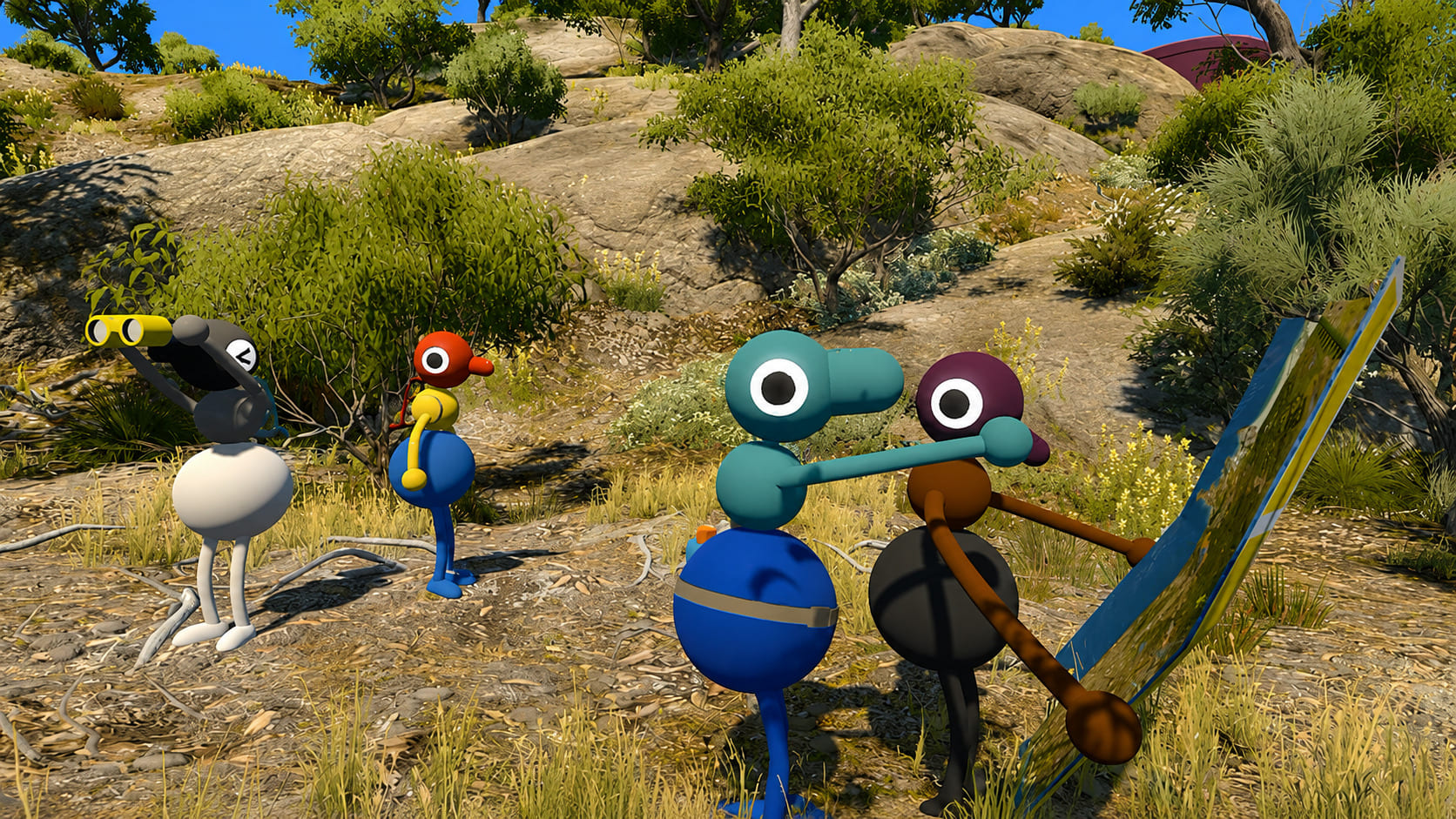
Big Walk allows up to twelve players to explore the same world together. Every player position, animation, puzzle interaction, environmental object, and audio effect needs to stay synchronized. The game also needs enough memory to smoothly stream new areas as the group moves across the island.
If your PC has exactly 12 GB of RAM, the game should technically work. However, from my experience, 16 GB is the much safer choice, especially if you like keeping Discord, browsers, or other applications open while playing.
CPU Performance Is More Important Than Many Players Expect
The processor requirements are actually one of the most interesting parts of the specification list. Seeing CPUs like the Intel Core i7-7700K in the minimum category tells us that Big Walk depends heavily on processing power, not just graphics performance.
The reason is the game’s proximity voice chat system. Instead of simply sending everyone’s voice at the same volume, the game tries to simulate realistic communication. Voices become quieter with distance, sounds change inside different environments, walls affect audio, and special devices can modify communication quality.
This creates a much more immersive multiplayer experience, but it also means your CPU has another complex system to process constantly. An older processor may cause voice delays, audio problems, or performance drops during larger group activities.
Graphics Cards: You Don’t Need an Expensive GPU
This is probably the most comfortable part of the requirements. Unlike many modern AAA games, Big Walk is not asking players to buy the latest graphics card just to enjoy basic gameplay.
Older GPUs like the GTX 750 Ti can handle the game at lower settings, but players who want better visuals and smoother performance should look closer to the recommended hardware. A GTX 1070 or RX 5600 XT provides much more breathing room, especially when exploring large areas with long-distance views.
In my opinion, stable performance matters more than maximum graphics quality in exploration-focused games. I would always choose a consistent 60 FPS experience over unstable ultra settings with constant drops.
Why Installing Big Walk on an SSD Is Important
Some PC recommendations are optional. This one is much harder to ignore. Even though Big Walk only requires around 15 GB of storage space, using an SSD can significantly improve the overall experience.
The game relies on continuous world streaming instead of constantly stopping the player with loading screens. An old mechanical hard drive may struggle to load new areas quickly enough, leading to texture pop-in, small freezes, and longer waiting times when joining multiplayer sessions.
For a smooth adventure with friends, installing the game on an SSD should be considered a basic requirement rather than a luxury.
Big Walk PC Performance Optimization Tips
If your computer is close to the minimum requirements, you can still improve performance with a few simple adjustments. In many games, smart settings changes make a bigger difference than simply lowering everything to the lowest possible option.
- Reduce View Distance: Large environments can heavily affect performance. Lowering this setting slightly can improve FPS without damaging the experience.
- Close Background Applications: Browsers, streaming software, and other memory-heavy programs can reduce available RAM.
- Update Graphics Drivers: Install the latest NVIDIA, AMD, or Intel drivers before launch.
- Use an SSD: Faster storage helps prevent streaming issues and loading problems.
- Keep Free Storage Space: A nearly full drive can negatively affect overall system performance.
Can Gaming Laptops Run Big Walk?
Most gaming laptops released during the last several years should have no serious problems with Big Walk. Systems equipped with GPUs like the GTX 1660 Ti, RTX 2060, RTX 3060, or newer models should comfortably handle the game at 1080p.
Older laptops with graphics cards like the GTX 1050 or GTX 960M may still launch the game, but players will probably need to lower settings and accept reduced performance. Cooling is also important because long multiplayer sessions can push laptop hardware closer to its thermal limits.
Is Big Walk Actually Demanding?
After comparing its requirements with many recent releases, I would describe Big Walk as moderately demanding rather than graphically demanding. The hardware requirements are not caused by realistic visuals or extreme graphical effects. Instead, they come from the combination of multiplayer networking, world streaming, physics, and real-time audio processing.
Honestly, that approach is refreshing. Many modern games focus heavily on visual realism while forgetting about performance. House House appears to be using technical resources where they matter most: creating a cooperative experience where players can naturally interact and create their own stories.
If your PC has a modern six-core processor, 16 GB of RAM, an SSD, and a graphics card from the last several years, you should be ready for a comfortable experience. Big Walk has the potential to become one of those rare multiplayer games remembered not because of graphics benchmarks, but because of the ridiculous and unforgettable moments created with friends.
After playing countless co-op titles, those are usually the games that stay installed the longest.