Path of Exile 2: Return of the Ancients Divination Cards Farming Guide & Drop Locations
After spending dozens of hours exploring the massive endgame overhaul introduced in Path of Exile 2: Return of the Ancients, one thing became clear almost immediately: Divination Cards are no longer just another item cluttering your loot filter.
For years, Path of Exile veterans became accustomed to traditional card farming. You ran a specific map, hoped for favorable RNG, collected enough copies, and eventually traded them for a reward. It was effective, but it often felt repetitive and disconnected from actual gameplay progression.
Patch 0.5 completely changes that philosophy.
Instead of simply dropping from monsters and accumulating in stash tabs, Divination Cards have become active objectives that directly influence how you build your character, choose your Atlas progression, and approach endgame content. Whether you love the new system or miss the old one, there is no denying that it has transformed farming into something much more strategic.
For players looking to generate currency, chase powerful uniques, or optimize endgame efficiency before the road to Version 1.0, understanding these systems is absolutely essential.
The New Divination Card System Explained
The biggest surprise for many players is how cards now function as active contracts rather than passive collectibles.
When you obtain a Divination Card, it must be placed into dedicated Card Slots on your character. These slots are limited, which immediately creates meaningful decisions.
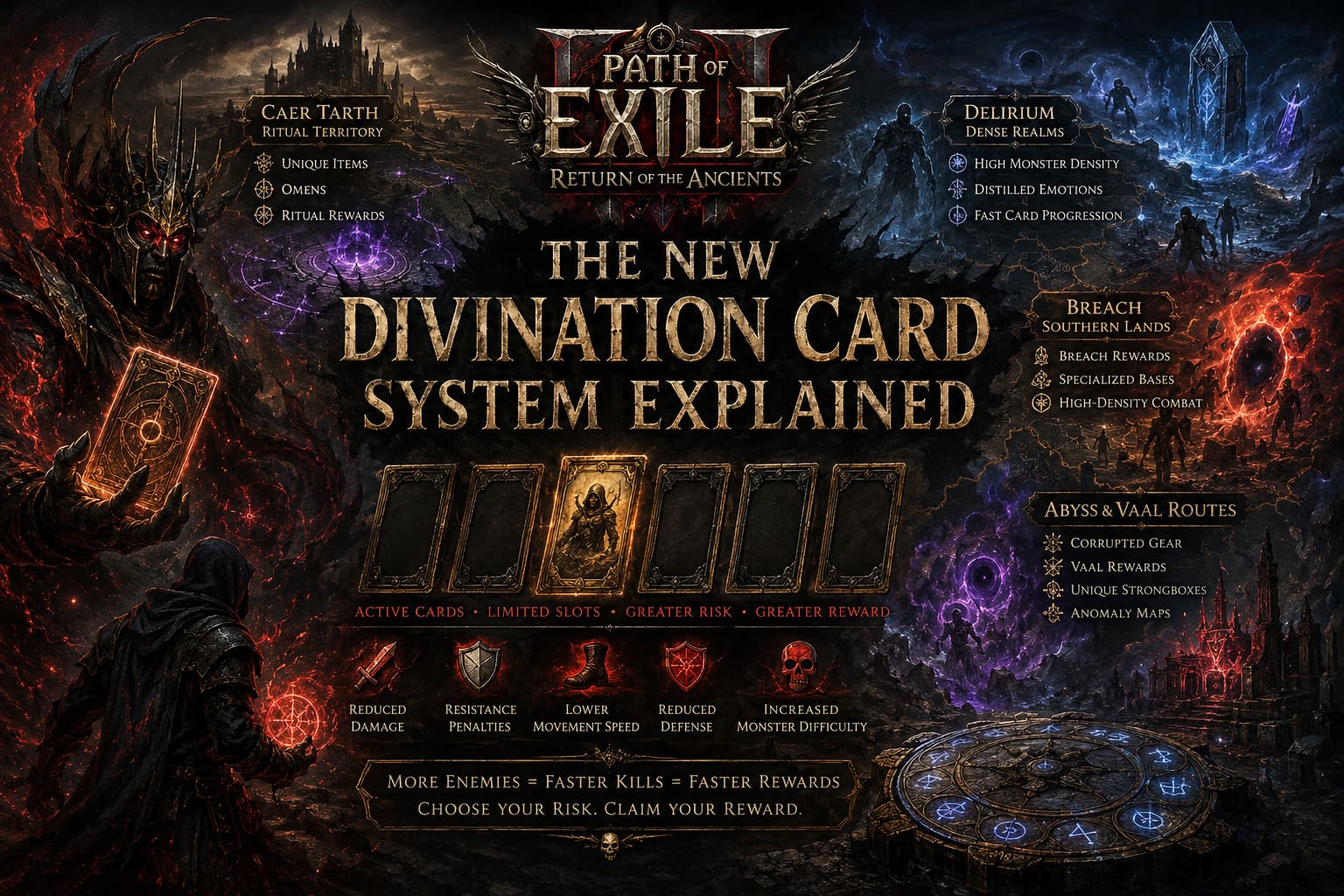
What makes things interesting is that every active card comes with a drawback.
The better the reward, the harsher the penalty.
While farming high-value rewards, you may find yourself dealing with:
- Massive reductions to overall damage
- Severe resistance penalties
- Lower movement speed
- Reduced defensive stats
- Additional monster difficulty modifiers
At first, I was skeptical about this system. However, after spending time with it, I realized it creates a genuine risk-versus-reward dynamic that was often missing from traditional farming methods.
Instead of mindlessly grinding, every farming session becomes a challenge you actively choose to take on.
Kill Requirements Are the Real Endgame Grind
Once a card is activated, progress is tracked through monster kills.
The reward doesn’t appear randomly.
You earn it by completing the required objective.
For lower-tier cards, the requirements are manageable. But the most valuable rewards can demand enormous kill counts in high-level content.
Some elite contracts require:
| Card Tier | Typical Requirement | Slot Usage |
|---|---|---|
| Common | Low monster kills | 1 Slot |
| Rare | Moderate monster kills | 2-4 Slots |
| Elite | Extremely high kill counts | 4-8 Slots |
| Chase Unique | Massive endgame grind | All Slots |
This means your farming efficiency is no longer measured solely by drop luck.
Clear speed, monster density, and survival become the most important factors in determining how quickly rewards are completed.
Personally, I find this far more engaging than relying entirely on random drops.
Atlas Regions Now Matter More Than Ever
One of my favorite changes introduced in Return of the Ancients is the new regional Atlas design.
Rather than scattering mechanics randomly across the Atlas, content now exists within dedicated sectors. This makes farming routes significantly more predictable.
Each region has its own identity and reward focus.
Western Atlas – Ritual Territory
Players moving west will eventually encounter the heavily Ritual-focused region surrounding Caer Tarth.
This area is excellent for:
- Unique item farming
- Omen acquisition
- Ritual progression
- Jewelry-focused rewards
The redesigned Ritual system feels much more rewarding than previous versions, particularly when pushing toward the King and Queen encounters.
For players targeting powerful unique accessories, this is often the first destination worth specializing in.
Southwest Atlas – Delirium Farming Paradise
If monster density is your priority, the southwestern region quickly becomes one of the strongest farming locations available.
Delirium content now offers access to Distilled Emotions, one of the most interesting progression systems introduced in the patch.
Benefits include:
- High monster counts
- Excellent card progression speed
- Valuable crafting materials
- Strong jewel rewards
- Consistent mapping returns
For completing active Divination Cards quickly, I consistently found Delirium zones among the most efficient options available.
Southern Atlas – Breach and Keepers of the Flame
The southern sector focuses heavily on the updated Breach ecosystem.
Players interested in:
- Breach-exclusive rewards
- Specialized crafting bases
- Breach encounters
- High-density combat
will naturally spend significant time here.
While not my personal favorite region, it remains one of the strongest choices for players seeking specific unique rewards tied to Breach content.
Northern and Eastern Atlas Routes
The eastern side of the Atlas is dedicated to Abyss content, while the northern regions revolve around Vaal-themed progression systems.
These areas offer access to:
- Corrupted gear opportunities
- Vaal-focused rewards
- Unique Strongboxes
- Anomaly Maps
- Rare foil item drops
The northern route particularly stands out because of its strongbox synergy and unique reward potential.
For players chasing corrupted equipment and endgame gambling opportunities, this section of the Atlas feels incredibly rewarding.
Why Runes of Aldur Is Perfect for Card Farming
The current challenge league may actually be the best companion system Divination Cards have ever had.
Runes of Aldur revolves around Ezomyte Remnants that allow players to customize encounters using runic combinations.
The beauty of the mechanic lies in its scalability.
You choose your rewards.
You choose your risk.
You create the monster density.
Every additional rune slot dramatically increases encounter difficulty while simultaneously generating more enemies.
For Divination Card progression, this is exactly what you want.
The formula is simple:
More enemies = Faster kill completion = Faster card rewards
Because active cards depend on monster kills rather than random drops, these encounters become some of the most valuable farming opportunities available in the entire game.
My Preferred Farming Strategy
After extensive testing, I found several principles consistently outperform everything else.

Focus on Monster Density
Many players still obsess over quantity modifiers.
While quantity remains useful, kill-based progression shifts the balance significantly toward density.
I would rather run a map with thousands of monsters than a map with slightly better drop modifiers but fewer enemies.
Favor Compact Layouts
Indoor maps continue to dominate efficiency rankings.
Smaller layouts allow:
- Faster clears
- Better league mechanic overlap
- Less travel time
- Higher kills per minute
Efficiency in Path of Exile has always been about reducing downtime, and that remains true in Return of the Ancients.
Push Difficult Rune Combinations
If your build can handle it, higher-tier Runeshaping combinations are incredibly rewarding.
The increased danger is noticeable, but so are the gains.
The jump from moderate encounters to fully stacked rune setups can dramatically improve card completion speed.
Build Around the Card Penalties
This may be the most overlooked tip.
Many players focus entirely on rewards while ignoring card downsides.
Instead, build your character specifically to compensate for those penalties.
If a card reduces resistances, overcap them.
If it lowers damage, improve offensive scaling elsewhere.
Treat the downside as another map modifier that needs solving.
Path of Exile 2 Fractured Item Crafting Guide: From Beginner to Pro (2026 Endgame)
Final Thoughts
Return of the Ancients has fundamentally changed how Path of Exile 2 handles targeted farming.
Divination Cards are no longer passive rewards waiting to drop. They have become an active progression system that directly impacts character strength, Atlas planning, and endgame strategy.
What I appreciate most is that success now feels earned.
Path of Exile 2: Runes of Aldur Tier 4 Essence Upgrade Recipes & Crafting Guide (2026)
The combination of regional Atlas specialization, card contracts, kill-based progression, and Runes of Aldur encounters creates a gameplay loop that rewards preparation and efficient execution rather than pure luck.
For players willing to optimize monster density, specialize their Atlas pathing, and embrace the challenge of active card penalties, Divination Cards may become one of the most profitable and satisfying systems Path of Exile 2 has ever introduced.
And honestly, after spending time with the new endgame, I don’t think I could go back to the old system. The new approach feels more engaging, more rewarding, and far more connected to the actual gameplay experience that makes Path of Exile so addictive in the first place.