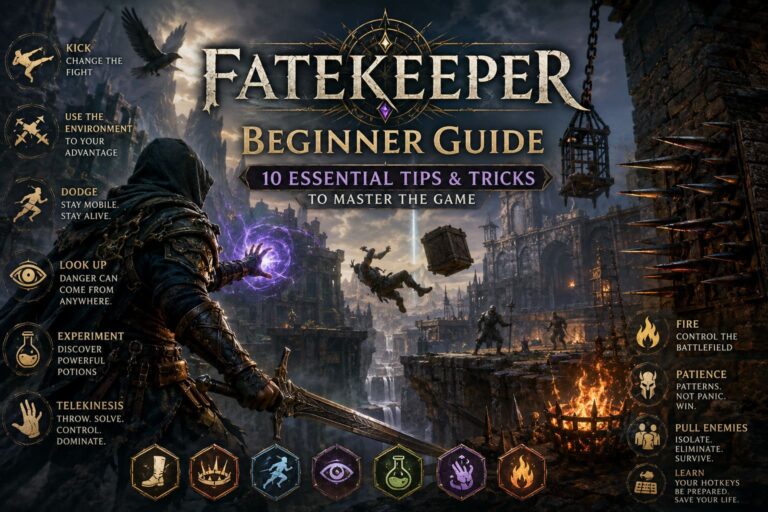
1666 Amsterdam Witch Abilities Guide: Noa Brooklyn Combat, Spells, and Cat Familiar Mechanics
There’s something wonderfully strange about 1666: Amsterdam. On paper, it sounds like a historical action game mixed with witchcraft, detective work, stealth, and a talking-cat-sized problem from the future. In practice, that combination is exactly what makes it stand out.
Developed by Panache Digital Games under Patrice Désilets, the game drops you into a grimy, atmospheric version of 17th-century Amsterdam and puts you in control of Noa Brooklyn, a witch whose job is essentially to investigate supernatural monsters during the day and hunt them under the full moon.
After spending time looking at how its systems fit together, I think the most interesting part of 1666: Amsterdam isn’t any individual spell. It’s the way the game asks you to think about magic, investigation, stealth, resources, and your cat companion as one connected system.
Noa isn’t simply another fantasy protagonist who throws fireballs until everything stops moving. Her abilities are designed around the city itself, and understanding that distinction is the key to getting the most out of the game.
Amsterdam Is Basically Two Games in One
The first thing players need to understand about 1666: Amsterdam gameplay is that the day/night cycle isn’t just an atmospheric feature.
It completely changes what you’re supposed to be doing.
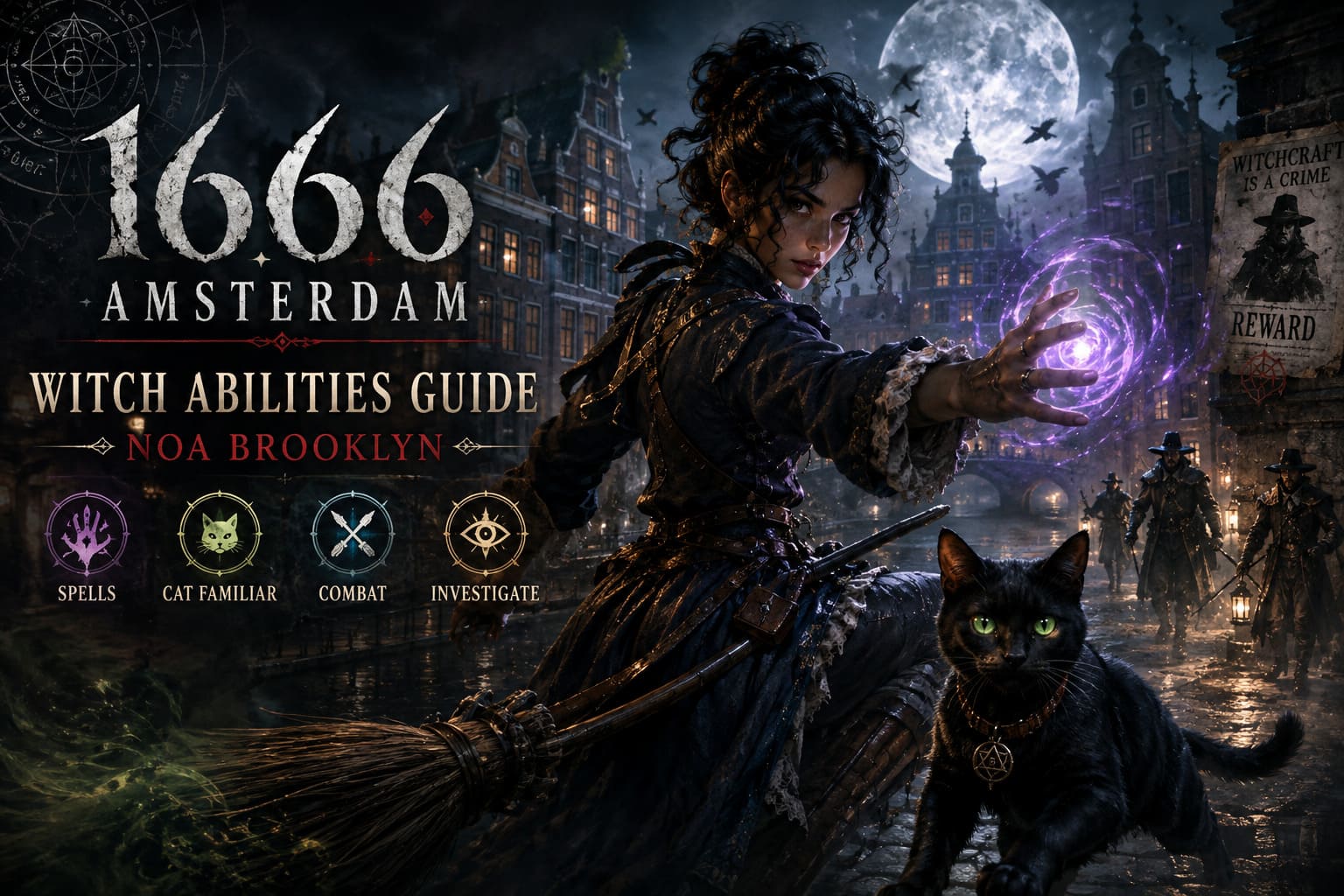
During the day, Amsterdam feels much closer to an open-world investigation game. The streets are full of civilians, merchants, guards, and potential clues. Noa can move through buildings, investigate locations, examine strange objects, and use her supernatural senses to piece together information.
Your goal isn’t necessarily to start a fight.
Instead, you’re trying to answer three important questions:
- Who is the Original hiding in human society?
- Where can you find them?
- What evidence connects them to their supernatural pact?
This setup is one of my favorite ideas in the game because it gives exploration an actual purpose. You’re not just collecting random objects because an icon appeared on the map. You’re building a case against something that you eventually have to hunt.
Then night arrives.
And everything gets considerably nastier.
The Esbat Turns Investigation Into Survival
Once the full moon appears, the Esbat begins. This is where 1666: Amsterdam stops feeling like a historical mystery and starts behaving more like a supernatural action game.
The Original you spent the entire day tracking is finally vulnerable.
This is where Noa’s combat abilities become essential, but there’s a catch that completely changes how you approach these encounters: the night hunts have roguelite mechanics.
If Noa dies during the hunt, you don’t simply reload from a convenient checkpoint with every temporary upgrade intact. The progress and abilities gained during that particular run can disappear.
Personally, I think this is a smart way to make the nighttime sections feel dangerous. It also means you shouldn’t treat every fight as an excuse to demonstrate your entire spellbook.
Sometimes the best move is simply to survive.
Lux and Nux: The Two Resources You Need to Understand
If there is one system I would recommend learning early, it’s the relationship between Lux and Nux.
They aren’t interchangeable mana bars. They serve very different purposes.
| Resource | Main Purpose | Availability | Typical Use |
|---|---|---|---|
| Lux | Exploration and utility | Common | Environmental magic, senses, movement |
| Nux | Combat and powerful abilities | Rare | Offensive spells and defensive techniques |
Lux is the resource you’re going to see much more often. Corpses throughout the world can provide it, which makes exploration and combat naturally feed into your magical toolkit.
Nux is the valuable stuff.
It’s much harder to maintain, and because it powers some of Noa’s most important combat abilities, wasting it can leave you in serious trouble.
That creates an interesting rhythm: explore and collect Lux, conserve Nux, and let Aaron help bridge the gap between the two.
Once you understand that loop, Noa starts feeling much more versatile.
Noa Brooklyn’s Best Witch Abilities
Noa’s magic isn’t built around standing in one spot and launching projectiles. Her abilities work best when they’re combined with movement and melee attacks.
Her broomstick might sound like a joke weapon at first, but in combat it becomes surprisingly effective.
Levitation Is More Than a Crowd-Control Trick
Levitation is probably one of the most useful abilities in Noa’s arsenal.
You can suspend enemies in the air and effectively remove them from the fight for a short period. That’s useful on its own, but the real fun starts when you combine levitation with Noa’s physical attacks.
An enemy floating helplessly above the battlefield is basically an invitation to start juggling them with the broomstick.
Against stronger opponents, this can create breathing room while you decide which target deserves your attention first.
Outside combat, levitation also has obvious exploration value. Reaching elevated areas, crossing awkward terrain, and accessing locations that would normally require a longer route all become easier.
That’s exactly the kind of spell design I like: one ability, multiple reasons to use it.
Petrification Gives You Time to Think
Petrification is the ability I would prioritize when facing groups.
Turning an enemy into stone temporarily removes a threat from the fight, giving Noa the opportunity to concentrate on somebody else.
That matters because many encounters can quickly become chaotic. When several enemies are attacking simultaneously, raw damage isn’t always the solution.
Sometimes you need to make the fight smaller.
Petrification effectively lets you do that.
Once the most dangerous enemies have been neutralized or separated, you can return to the petrified targets and finish them off.
Warp Makes Noa Extremely Difficult to Pin Down
The Warp ability is where Noa’s mobility really starts to shine.
Short-range teleportation is useful for escaping attacks, closing gaps, repositioning against ranged enemies, and generally refusing to stand where your opponent expects you to stand.
For players who prefer aggressive combat, Warp should become part of your basic movement rather than something you save for emergencies.
The best Noa players won’t simply dodge after an attack comes toward them. They’ll use Warp to change the entire geometry of the encounter.
And then there is Amsterdam’s water.
Water Gliding Is Exactly as Cool as It Sounds
Amsterdam without canals would be weird enough, but giving Noa a magical way to glide rapidly across the water makes the city feel much more connected.
Instead of treating canals as boundaries separating neighborhoods, you can use them as another movement route.
It also becomes particularly useful when authorities are chasing you.
If your suspicion level is climbing and witch hunters are closing in, being able to disappear across the water can be the difference between reaching safety and turning a small problem into a full-scale disaster.
Don’t Underestimate Disguise and Intimidation
One thing I appreciate about Noa’s toolkit is that not every ability exists to kill something.
Intimidation can make weaker enemies panic and flee. That’s incredibly useful when you’re trying to avoid turning a small encounter into an extended brawl.
Then there’s disguise.
Noa can alter her appearance to blend into the civilian population, which gives her another way to escape attention.
This is where the game starts rewarding players for thinking like an actual witch living in a suspicious historical city rather than a superhero.
If people are watching you cast spells in the street, you’re going to attract attention.
If you can avoid being seen in the first place, you don’t have to spend resources solving the problem afterward.
The Suspicion Meter Changes How You Play
Magic comes with consequences.
The Suspicion Meter is one of those mechanics that looks simple until you realize how much it affects your behavior.
Using supernatural abilities in front of civilians can increase suspicion. Once that suspicion gets high enough, witch hunters begin appearing.
And these guys aren’t interested in having a polite conversation.
The mistake is thinking of the meter as something you only need to worry about after you’ve already been detected.
Instead, I would treat suspicion as a second resource.
Sometimes using a powerful ability is worth the risk. Sometimes it isn’t.
If things start getting out of control, head toward a Safehouse. These locations allow Noa to recover, lower her suspicion, and prepare for whatever comes next.
The smartest players won’t wait until the city is completely hostile before retreating.
Coven Coffers and the Risk of Temporary Power
Exploration also feeds directly into progression through Coven Coffers.
Opening one gives you a choice between random abilities or passive upgrades. These bonuses are represented by magical jewelry appearing on Noa, which is a nice visual touch because your character actually looks different as she becomes more powerful.
But there is an important catch.
Temporary upgrades collected during an Esbat can be lost if Noa dies.
That means every night hunt becomes a gamble.
Do you keep pushing because you’ve already built a fantastic combination of abilities, or do you play conservatively because losing everything would hurt?
For me, that’s where the roguelite mechanics become interesting rather than frustrating.
The game is constantly asking:
How much are you willing to risk for more power?
Aaron the Cat Is Absolutely Not a Gimmick
Then there’s Aaron.
Yes, he’s a cat.
No, he’s not just there to make screenshots adorable.
Aaron is actually a man from 1999 who was transported through time and trapped inside the body of a black cat. That sentence alone tells you what kind of wonderfully bizarre game 1666: Amsterdam is.
More importantly, Aaron has his own gameplay role.
Noa is powerful.
Aaron is useful.
And that distinction matters.
Why Aaron Is So Important
Aaron can reach places Noa simply can’t.
He can squeeze through small openings, crawl through restricted spaces, climb structures, investigate hidden areas, and manipulate things from positions that would be inaccessible to a human character.
He can also track scents, follow clues, and interact with NPCs in ways that would be impossible for Noa.
The ability to switch between Noa and Aaron means the game isn’t forcing you to solve every problem with magic.
Sometimes the correct answer is:
Send the cat.
Honestly, that’s one of the game’s strongest ideas.
Aaron’s Cat Archetypes Add Another Layer
Aaron can also be configured through different feline archetypes, which essentially act as specialized classes.
The available options include:
- The Dreamer
- The Hermit
- The Spirit
- The Knight
- The Page
- The Child
- The Alchemist
- The Guardian
- The Wildling
These aren’t simply cosmetic labels. Each archetype changes the way Aaron contributes to exploration, supernatural interactions, and support.
That means your preferred playstyle can influence which version of Aaron makes the most sense.
If you rely heavily on scouting, you’ll naturally want to think differently than someone who wants maximum combat support.
Aaron Solves Noa’s Biggest Problem: Nux
This is where the witch-and-familiar relationship becomes genuinely clever.
Remember how Lux is plentiful while Nux is scarce?
Aaron can collect the abundant Lux and transmute it into Nux, effectively helping Noa maintain her combat resources.
That’s a brilliant connection between the two characters because it means Aaron isn’t just an optional sidekick.
He is part of the resource economy.
During intense encounters, players can also trigger quick-time events involving Aaron. Successfully executing these actions can restore Nux charges directly to Noa.
So your combat loop becomes something like:
Attack → reposition → manage Nux → use Aaron → recover resources → return to offense.
It’s a much more involved system than simply waiting for a mana bar to refill.
My Biggest Tip for Playing Noa
If I had to give new players one piece of advice, it would be this:
Stop thinking of Noa’s spells as separate abilities. Think of them as pieces of a combo system.
Levitation creates an opening.
Warp changes your position.
Petrification removes a threat.
The broomstick converts those openings into damage.
Aaron keeps your Nux supply alive.
And the disguise system gives you a way to reset the situation when things get too hot.
That’s when the combat starts feeling less like button-mashing and more like controlled chaos.
How to Fix 1666: Amsterdam Not Loading, Crashing on Startup, and Black Screen Issues on PC
Final Thoughts: This Witch Has More Depth Than She First Appears
1666: Amsterdam has a strange premise, but after looking closely at its systems, I think the weirdness is actually its biggest strength.
Noa Brooklyn isn’t interesting simply because she’s a witch. She’s interesting because the game makes her magic interact with almost everything around her.
The city is your investigation board during the day. The canals become escape routes. Corpses become magical resources. Suspicion determines how safely you can operate. Coffers create temporary builds. The Esbat turns everything into a high-stakes gamble.
And then there’s Aaron, a time-displaced man trapped inside a cat who somehow becomes one of the most important parts of your combat economy.
That’s a lot of moving parts, but they fit together surprisingly well.
If you’re starting 1666: Amsterdam, don’t rush straight toward the biggest spells. Learn the day/night rhythm, experiment with Lux and Nux, use your familiar constantly, and keep an eye on suspicion before the witch hunters become a problem.
Once those systems click, Noa stops feeling like a character with a list of magical powers and starts feeling like what she should be: a witch who has learned how to turn an entire city into her weapon.