Star Wars Zero Company Trick Clone Trooper Guide: Best Builds, Talents, and Tactical Strategies
There are always a few characters in a tactical game who seem to click with you almost immediately. In Star Wars Zero Company, Trick is that character for me.
CT-3301 isn’t flashy in the traditional sense. He doesn’t have the mysterious personality of a secret Jedi or the effortless cool of a legendary hero. He’s a battered clone trooper veteran who has already seen more than enough of the Clone Wars, and that history gives him a completely different kind of appeal. Trick feels practical. He gets the job done, carries an absurd amount of firepower, and somehow manages to survive situations where I probably shouldn’t have put him in the first place.
That last part is especially important.
Trick’s unique self-revive mechanic makes him one of the most interesting companions to build around in Star Wars Zero Company. When you combine that passive with heavy explosives, cover destruction, and a more aggressive frontline specialization, he can become an absolute problem for enemy formations.
If you’re looking for the best Trick build in Star Wars Zero Company, this is the setup I’d personally recommend after focusing on what makes him different from the rest of the roster.
Why Trick Is Such a Valuable Companion
Trick isn’t simply another soldier you can swap into the squad whenever you need a little extra damage. He’s a story companion with his own predefined identity, equipment, and signature talent.
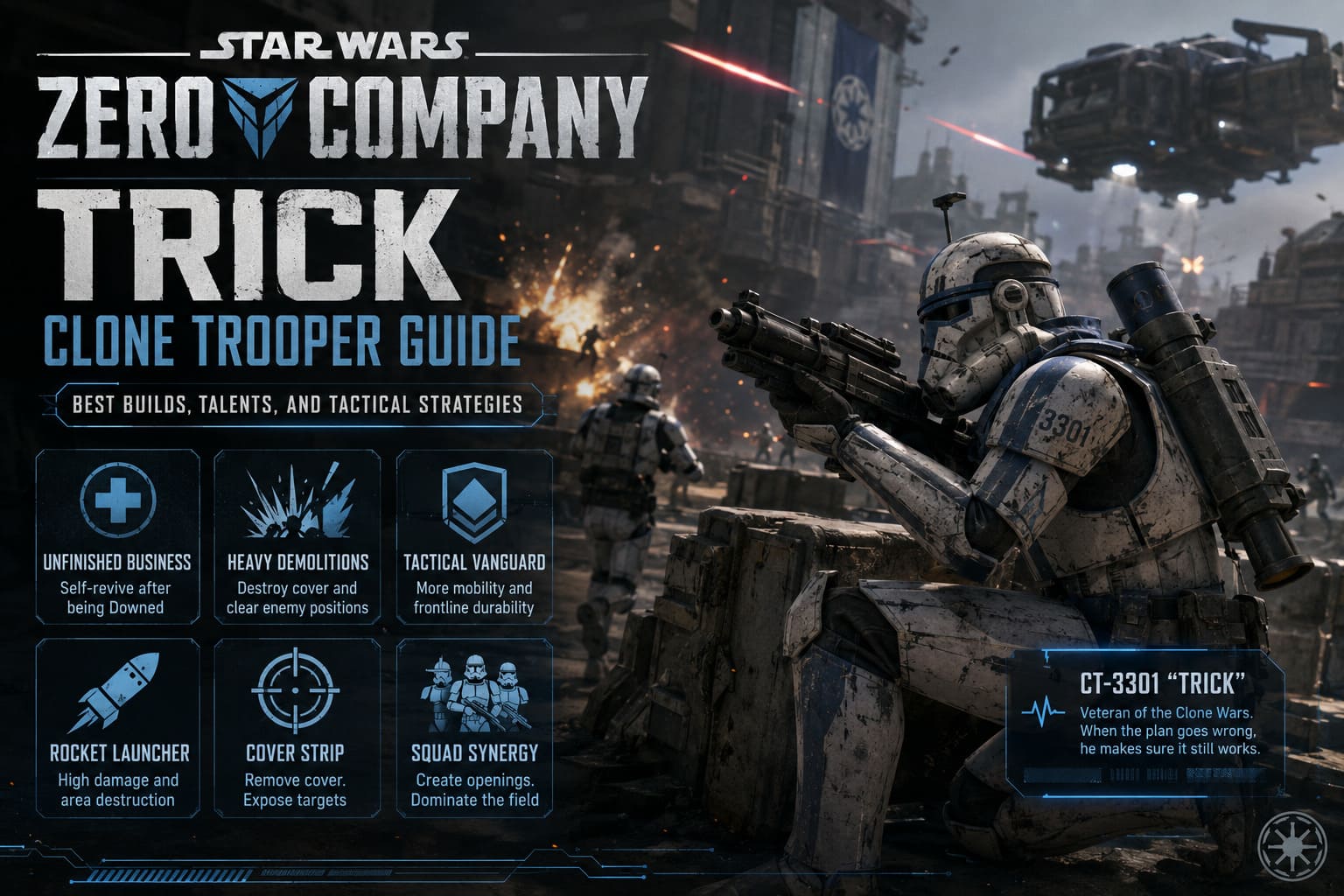
His background is also one of the reasons I like using him. After suffering serious injuries during a Separatist disaster on Antine, CT-3301 was declared unfit for continued military service. Instead of disappearing completely, however, he eventually became part of Captain Hawks’ Zero Company.
And honestly, that fits his gameplay perfectly.
Trick isn’t the clone you use because everything is going according to plan. He’s the clone you use when the plan has already gone sideways.
His standard equipment gives him a blaster carbine and an integrated rocket launcher, immediately establishing his role as a heavy combat specialist. The rocket launcher is particularly useful when enemy units are hiding behind strong defensive positions.
That’s where Trick starts feeling less like a standard clone trooper and more like a portable tactical demolition team.
Trick’s Core Combat Identity
| Feature | What It Means In Combat |
|---|---|
| Blaster Carbine | Reliable weapon for standard engagements |
| Rocket Launcher | Heavy damage and cover destruction |
| Unfinished Business | Allows Trick to revive after being Downed |
| Heavy Specialization | Improves his demolition-focused role |
| Vanguard Cross-Training | Adds durability and frontline utility |
| Best Role | Aggressive heavy support / frontline demolition |
The Trick Passive You Should Build Around
The most important part of Trick’s kit is his unique baseline talent, Unfinished Business.
This passive gives Trick something very few tactical characters can replicate: a built-in second chance.
When Trick enters the Downed state, the ability allows him to automatically revive on the following tactical turn. Upgrading the talent improves the amount of health restored and provides additional protection against injuries immediately after getting back on his feet.
This completely changes how I think about positioning him.
With most characters, ending a turn in an exposed position can be disastrous. With Trick, there’s a little more room for calculated aggression. You still don’t want to throw him into a firing squad for no reason, but you can afford to take risks that would be unacceptable for another squad member.
That’s the important distinction.
The revive shouldn’t be treated as permission to play recklessly. It’s a safety net that lets you play aggressively when the tactical payoff is worth it.
I would prioritize upgrading this passive rather than treating it as a minor bonus. The stronger Trick’s revival becomes, the more comfortable he is operating close to enemy formations.
Best Trick Build: Heavy Demolitions
For my preferred setup, Heavy Demolitions is the obvious starting point.
It plays directly into what Trick already does well instead of trying to turn him into something he isn’t.
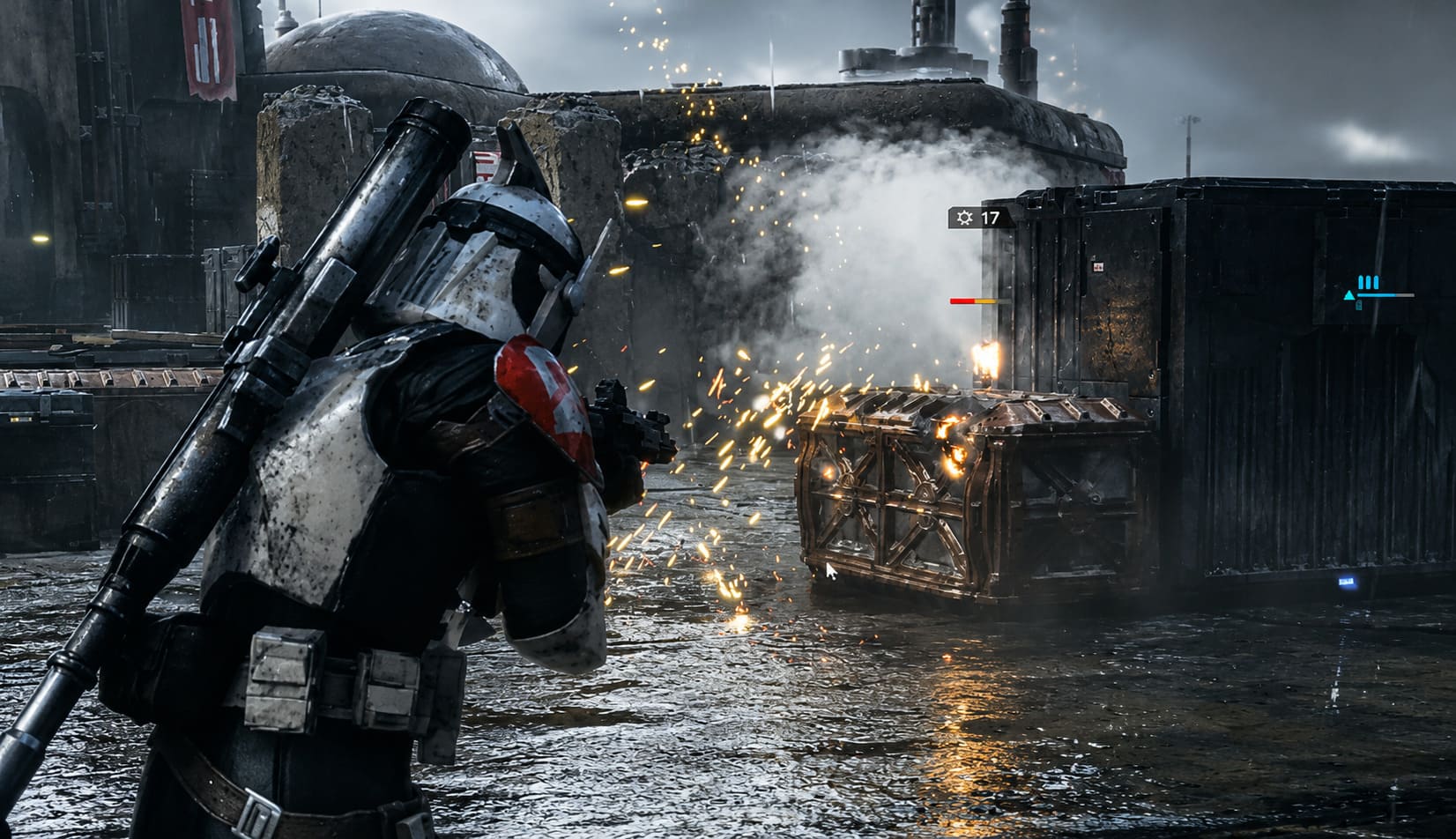
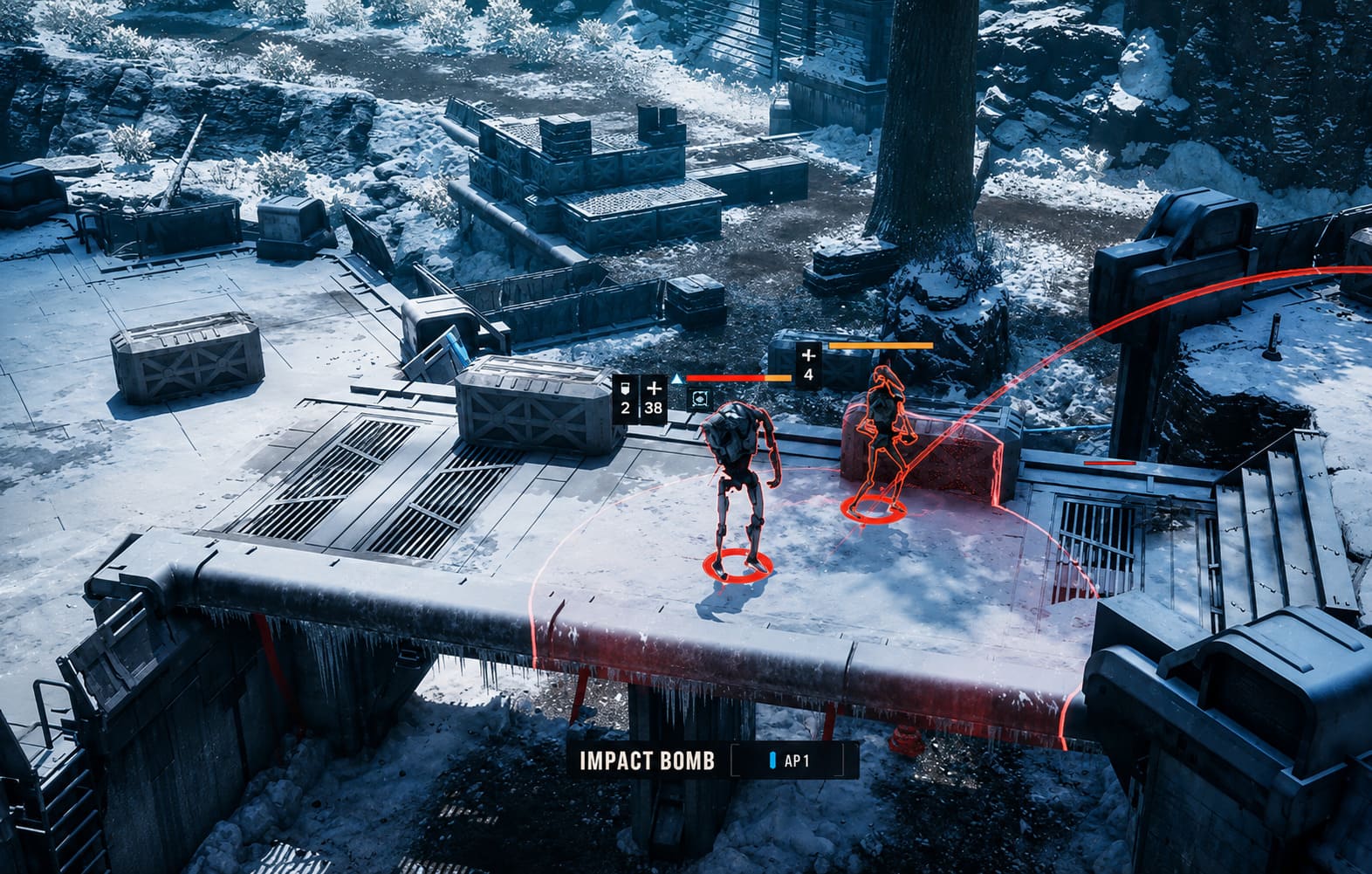
The rocket launcher is the centerpiece of his offensive identity, so abilities that improve his ability to destroy cover and punish grouped enemies are incredibly valuable.
Sabotage
Sabotage is particularly useful on maps with explosive environmental objects.
Rather than simply firing at the closest enemy, you can look for opportunities to manipulate the battlefield itself. A well-placed explosion can damage several enemies at once, force opponents out of favorable positions, and create openings for the rest of your squad.
This is one of those abilities that becomes much better when you stop thinking about it as a basic damage tool.
You’re not just blowing something up.
You’re changing the shape of the encounter.
Cover Strip
Cover Strip is arguably even more important for Trick’s role.
Enemies hiding behind full cover can become frustrating targets, especially when you’ve got a high-damage character ready to punish them but can’t get a clean shot.
Trick solves that problem by bringing the destruction directly to them.
Destroying full cover exposes targets to the rest of the squad, allowing characters with stronger precision attacks to immediately capitalize on the opening.
This is why I wouldn’t judge Trick’s damage purely by how many enemies he personally kills. Sometimes his biggest contribution is the enemy he allows somebody else to kill.
Secondary Specialization: Tactical Vanguard
Once the secondary specialization becomes available, I like the idea of adding Tactical Vanguard to Trick’s build.
This creates a much more balanced version of the character.
Heavy Demolitions gives him the destructive tools, while Vanguard helps compensate for the obvious weakness of playing aggressively: eventually, something is going to shoot back.
The Vanguard path can improve Trick’s mobility and provide additional defensive benefits when he completes movement inside half-cover.
That combination makes sense.
You aren’t abandoning the demolition role. You’re making your demolition specialist harder to punish.
And that’s exactly what Trick needs.
Recommended Build Philosophy
If I were spending progression points on Trick, my priority would look something like this:
- Strengthen Unfinished Business so his self-revive becomes more valuable.
- Invest in Heavy Demolitions abilities that improve cover destruction and area damage.
- Add Vanguard upgrades once the secondary specialization becomes available.
- Focus on abilities that support aggressive positioning and survivability.
- Avoid turning Trick into a generic damage dealer when his utility is what makes him special.
How I Use Trick During Missions
The biggest mistake you can make with Trick is treating him like a stationary heavy weapons platform.
He’s much more useful when you move him around the battlefield.
1. Use Height Whenever Possible
Elevated positions can improve the effectiveness of Trick’s attacks, so don’t automatically leave him standing on the same piece of cover where the mission starts.
If there is a ladder, platform, scaffold, or elevated defensive position nearby, consider spending an action to move Trick there before launching his heavier attack.
The extra positioning can make the difference between an ordinary turn and one that completely changes the encounter.
Of course, don’t climb upward simply because you can. Tactical games love punishing players who sacrifice safety for a tiny accuracy advantage.
Look at the entire battlefield first.
2. Destroy Cover Before Calling in the Damage
This is probably my favorite way to use Trick.
Instead of asking, “Who can Trick kill this turn?” ask:
“Which enemy becomes vulnerable if Trick acts first?”
That small change in thinking makes him much more valuable.
If an important enemy is hiding behind full cover, destroy that cover. Then let another squad member finish the job.
Trick essentially becomes the guy who opens the door so everybody else can kick it down.
Trick and the Self-Revive Gambit
Here’s where things get particularly fun.
Because Unfinished Business activates after Trick is Downed, you can occasionally use him as a deliberate distraction when the tactical reward is high enough.
Imagine an enemy position protected by dangerous overwatch.
Instead of sending a weaker unit forward and hoping they survive, Trick can potentially take that risk. If the enemy’s reaction fire drops him, his passive gives him a route back into the fight.
Meanwhile, the rest of your squad can use the enemy’s exposed position to eliminate the threat.
I wouldn’t recommend doing this every mission. That’s how you turn a clever tactic into a terrible habit.
But when you need to break a defensive line, Trick is one of the few characters I’d trust to take that calculated gamble.
And given his personality, it feels completely appropriate.
Best Squadmates for Trick
Trick becomes even better when the rest of your squad is designed to exploit the openings he creates.
Jae Mordant
Jae is a natural partner for Trick because her close-range abilities can help compress enemy groups into more manageable positions.
Get enemies close together, then let Trick introduce them to several tons of explosives.
It’s a simple concept, but tactical games are often about making simple ideas happen at exactly the right moment.
Luco Bronc
This is probably the cleanest synergy.
Trick destroys the cover. Luco punishes the exposed target.
If Luco is positioned for a powerful sniper shot or overwatch opportunity, Trick can effectively prepare the target for him.
That means Trick’s contribution isn’t necessarily measured by his own damage numbers. His ability to create firing lanes is just as important.
Astromech Support
An astromech equipped for area denial can complement Trick’s explosives extremely well.
When you combine rockets, environmental destruction, fire, and other damaging zones, you can make certain areas of the battlefield extremely unpleasant for enemy units.
This is especially useful when you want to control where enemies can move rather than simply trying to eliminate them immediately.
Star Wars Zero Company Best PC Graphics Settings: Guide to Max Quality at 60FPS
Building an Entire Clone Trooper Squad
One of the more interesting customization features surrounding Star Wars Zero Company is the ability to expand beyond Trick and eventually recruit additional standard Clone Trooper operators.
That opens up some fun possibilities for players who, like me, can never resist making themed squads.
Eventually, you can build a team consisting entirely of clone troopers, giving you the opportunity to create your own little Republic strike team rather than relying exclusively on the named companions.
The customization options also go further than simply changing colors.
Equipping an operator with a Phase II Clone Trooper helmet can apply a clone-style voice modulation effect to their combat dialogue and callouts. It’s a small feature, but it does a lot to sell the fantasy of commanding a squad of Republic veterans.
There are also numerous armor colors, markings, helmet patterns, and legion-inspired cosmetic options to experiment with.
Some legacy-style equipment, including the classic Phase I ARC Trooper armor configuration, is tied to the Grand Army of the Republic cosmetic pack included with the Deluxe Edition rather than standard campaign progression.
How to Fix STAR WARS Zero Company Crashing on Startup on PC (Windows 10 & 11)
My Final Take on Trick
Trick might not look like the most complicated character on paper, but I think that’s exactly why he works so well.
His kit has a very clear identity.
He blows things up. He breaks cover. He takes dangerous positions. And when things go horribly wrong, he gets back up.
That combination makes him one of the most entertaining companions to use in Star Wars Zero Company.
My preferred setup is Heavy Demolitions as the primary specialization with Tactical Vanguard as the secondary direction, while prioritizing upgrades to Unfinished Business and abilities that improve his battlefield control.
The key is not to confuse survivability with immortality. Trick can survive mistakes, but he shouldn’t be used as a disposable clone trooper.
Instead, use his revive mechanic to support calculated aggression.
Destroy the cover protecting a dangerous enemy. Take the high ground when the map gives you a safe opportunity. Force enemies out of defensive positions. Then let the rest of Zero Company capitalize on the chaos.
That’s where Trick really shines.
For me, he’s at his best when he’s standing one step closer to danger than everyone else, rocket launcher ready, while the rest of the squad waits for the opening he just created.
And honestly? That’s exactly where a clone trooper named Trick belongs.