Star Wars Zero Company Base Building Guide: How to Upgrade The Den Headquarters
If there is one thing I love about a good tactical game, it is when the base between missions actually matters. Too many strategy games turn headquarters into a glorified menu where you click through upgrades, buy some gear, and immediately jump back into combat.
Star Wars Zero Company does something much more interesting with The Den.
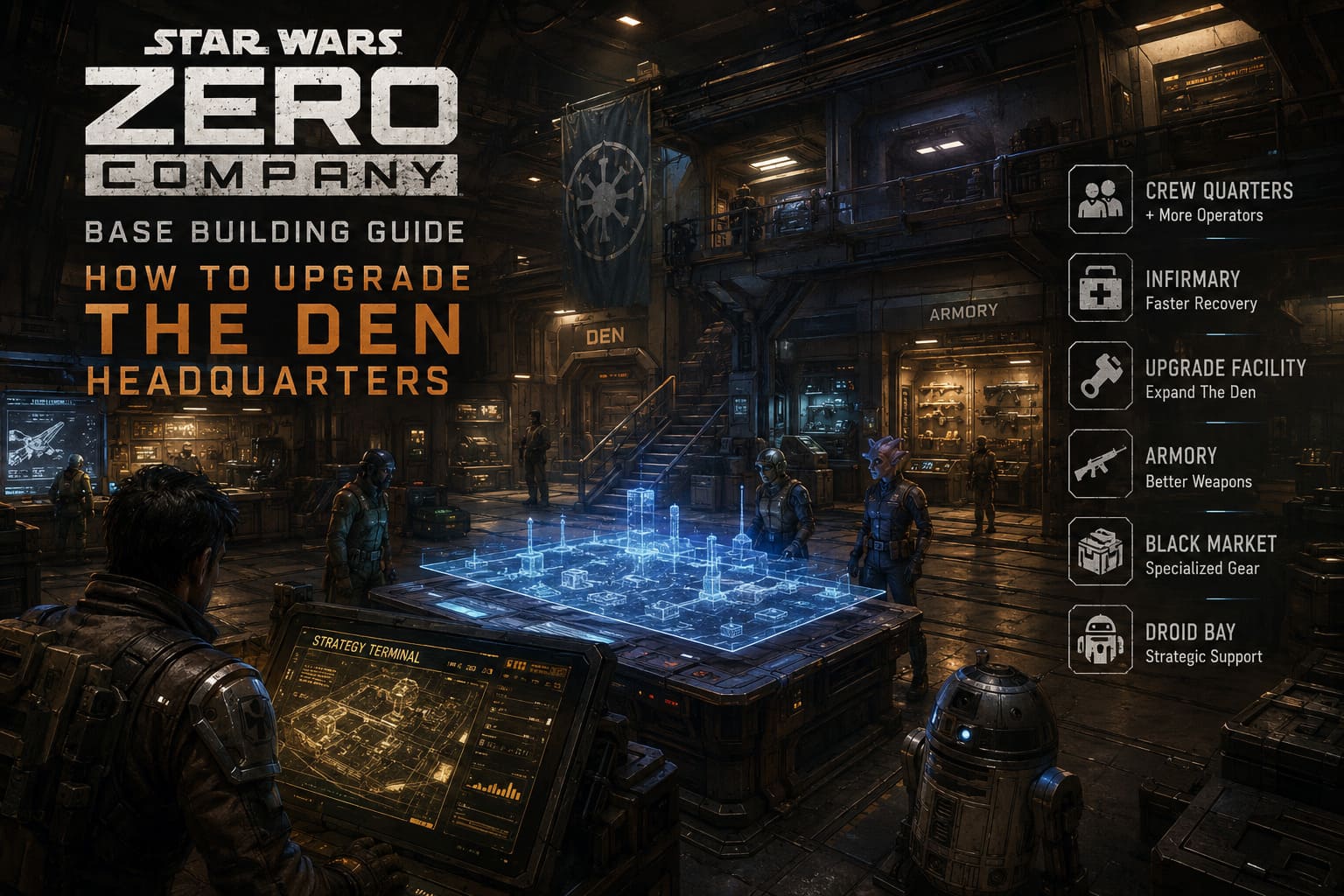
Your headquarters on the Ring of Kafrene feels like an actual place. You walk through it, talk to your crew, check the strategy terminal, visit the armory, and gradually turn a rough mining-station hideout into something that can support a serious fighting force. And after spending time thinking about how the upgrade economy works, I honestly think the biggest mistake is treating every room as equally important.
They aren’t.
Some upgrades will save your campaign. Others are nice luxuries that can wait.
So, if you’re looking for a Star Wars Zero Company base building guide, this is how I would approach The Den without wasting resources or finding myself stuck with half a roster recovering while the galaxy burns.
The Den Is More Important Than It Looks
The Den is your operational home, but it is also one of the game’s biggest progression systems. Your decisions here affect roster capacity, healing, equipment, customization, and long-term squad effectiveness.
That makes the base economy surprisingly important.
| Resource | What I Use It For | Why It Matters |
|---|---|---|
| Credits | Rooms, recruits, weapons | Your basic spending currency |
| Materials | Facility expansion | Essential for higher-tier construction |
| Intel | Special operations | Opens access to unique opportunities |
| Cycle Time | Strategic progression | Determines when new options become available |
The important thing is not simply collecting everything you can. It’s collecting the right resource at the right time.
I’ve always preferred tactical games where resource management forces you to make uncomfortable choices. Zero Company seems to lean into that idea. If you spend every credit on weapons, your infrastructure falls behind. If you obsess over future upgrades, your current squad can end up under-equipped.
That balance is where The Den becomes interesting.
Crew Quarters Should Be One of Your First Priorities
The starting roster limit of seven operators sounds reasonable until a few missions go badly.
And they will.
Turn-based tactical games have a funny habit of making your favorite soldier the one who gets critically injured right before the mission you really wanted them for.
That’s why I would prioritize Crew Quarters upgrades early.

Expanding your roster gives you room for more recruits and allows you to rotate damaged operators instead of constantly waiting for the same handful of characters to recover.
The bigger roster also becomes useful for relationships. Operators left at The Den can continue developing rapport, which can eventually translate into stronger squad combinations.
For me, this is one of those upgrades that doesn’t look spectacular on paper. You don’t get a giant damage number or a shiny new weapon.
But having additional soldiers available when things go wrong?
That’s extremely valuable.
And eventually, the roster can grow toward a maximum of 20 operators, giving you a much healthier pool of characters to rotate through.
The Infirmary Is Your Insurance Policy
The second upgrade path I’d seriously consider is the Infirmary.
Combat injuries are one of those mechanics that can quietly destroy a campaign’s momentum. You finish a difficult operation, win the fight, and then discover that half your best characters are sitting around recovering.
Suddenly, your next mission isn’t about which squad composition is strongest.
It’s about which soldiers are actually available.
Upgrading the Medbay gives you more treatment capacity and eventually access to faster recovery options such as rejuvenator tanks. That means less downtime and a much better operational rhythm.
I would especially prioritize the Infirmary if you’re playing aggressively.
If you’re constantly taking difficult missions, your medical infrastructure becomes increasingly valuable. A player who takes fewer risks might get away with delaying it, but I wouldn’t push the delay too far.
A powerful squad that spends multiple cycles recovering isn’t actually a powerful squad.
Don’t Ignore the Upgrade Facility
The Upgrade Facility is where The Den starts becoming much more than a simple headquarters.
This is the infrastructure engine.

Investing in it allows you to expand the available space and unlock additional sections of the base. That’s important because some of the more specialized systems don’t simply appear because you’ve accumulated enough credits.
You need the physical infrastructure to support them.
This creates an interesting progression loop:
Missions → Resources → Infrastructure → New Facilities → Better Equipment → Stronger Missions
Once I understood that loop, the upgrade system made much more sense.
If your progression suddenly feels blocked, don’t immediately assume you need more credits. Check whether you are missing materials or an infrastructure upgrade.
That distinction can save you a lot of wasted time.
The Armory Is Where Your Investment Starts Showing Up in Combat
Eventually, you need to make your soldiers hit harder and shoot more reliably.
That’s where the Armory and Black Market become essential.
The Armory handles the broader weapon progression, while the Black Market gives you access to more specialized equipment and modifications.
This is where things like:
- Scopes
- Stabilizers
- Barrels
- Weapon cells
- Other specialized modifications
start becoming important.
And personally, I would rather have a smaller number of meaningful upgrades than waste resources buying every piece of equipment the moment it becomes available.
Think about what your squad actually struggles with.
If enemies are consistently surviving because your attacks aren’t accurate enough, accuracy-focused modifications make more sense than blindly chasing damage. If cover is causing problems, prioritize equipment that helps counteract that defensive advantage.
Build around the problems your squad actually has.
That’s a much better approach than simply buying whatever has the highest number attached to it.
The Droid Bay Is a Mid-Game Goal
The Droid Bay is one of the upgrades I’d treat as a major mid-game milestone.
It isn’t something I’d rush immediately, especially if your basic infrastructure is still struggling. But once your roster and medical support are stable, unlocking this area becomes much more attractive.
The Droid Bay opens up additional customization possibilities involving Astromech support units and utility programs.
That means your strategic options expand beyond simply making organic operators stronger.
This is exactly the kind of upgrade I enjoy because it changes how you think about squad composition. You’re not just asking, “Which soldier has the biggest gun?”
You’re asking:
What combination of operators, equipment, and support systems gives me the best tactical answer to this mission?
That’s where Zero Company can become really addictive.
My Preferred Upgrade Order
If I were starting a fresh campaign today, I wouldn’t blindly follow the order in which rooms become available. I’d use a priority system.
| Priority | Facility | Main Reason |
|---|---|---|
| 1 | Crew Quarters | More operators and better rotation |
| 2 | Infirmary | Faster recovery and less downtime |
| 3 | Upgrade Facility | Unlocks broader base progression |
| 4 | Armory | Improves combat effectiveness |
| 5 | Black Market | Better specialized modifications |
| 6 | Droid Bay | Expands late tactical options |
This isn’t an absolute rule.
That’s important.
If your squad is already comfortably surviving missions, pushing the Armory earlier makes sense. If your operators are constantly injured, the Infirmary suddenly becomes much more important.
Your campaign should determine your priorities.
Early Game: Don’t Try to Build Everything
During the first several Cycles, I’d keep things simple.
Your main objectives should be increasing your available roster and preventing injuries from completely shutting down your campaign.
That means Crew Quarters first, followed by basic medical infrastructure.
I would also avoid spending every resource on cosmetic or secondary improvements just because they are available. Early-game resources have a much higher strategic value when they improve your ability to keep deploying a healthy squad.
The Smugglers’ Manifest operation in Cycle 5 is also worth paying attention to because it ties into the M-3VO systems and associated bonus content.
The early game isn’t about creating the perfect Den.
It’s about creating a Den that keeps you moving.
Mid Game: Start Thinking About Efficiency
Once you have a decent roster and your core facilities are functioning, the priorities change.
This is when I’d start pushing the Upgrade Facility harder and working toward the Droid Bay.
At this point, you’re no longer simply trying to survive.
You’re trying to become efficient.
Your squad should have enough operators to rotate injured characters, your medical facilities should reduce downtime, and your equipment should begin giving you noticeable advantages over tougher enemies.
This is also the stage where the Black Market becomes increasingly attractive.
If you’ve been saving materials and credits, this is where some of that preparation finally pays off.
Late Game: Maximize Operational Uptime
By the later Cycles, enemies become much less forgiving.
This is where I would stop thinking about individual missions and start thinking about the campaign as a whole.
A devastating battle can leave several operators injured. If your Medbay is underdeveloped, that one mission can effectively disrupt your entire schedule.
That’s why I would push medical upgrades hard during the late game.
After that, I’d finish expanding the Crew Quarters toward the 20-operator maximum and invest remaining resources into high-tier weapon modifications and specialized equipment.
At this point, every improvement matters because the difference between a clean tactical victory and a mission that nearly wipes your squad can be enormous.
The Biggest Base-Building Mistakes I’d Avoid
There are a few traps I’d personally try to avoid.
Hoarding Everything
Saving every credit because you might need it later sounds smart.
It usually isn’t.
If a relatively cheap upgrade can make your current squad more effective across several missions, spending the resources now can generate more value than keeping them locked away.
Ignoring Materials
Credits are easy to think about because they’re the obvious currency.
Materials can be easier to overlook.
Don’t.
If you’re planning to expand The Den, deliberately take missions that provide the materials you need instead of constantly chasing the biggest credit reward.
Treating The Den Like a Menu
This might be the easiest mistake to make.
Walk around.
Talk to your crew.
Check the rooms.
Pay attention to the dialogue.
The Den is designed as an actual 3D hub, and the conversations and character interactions help reinforce the relationship systems that sit behind the tactical combat.
If you only treat it as an upgrade screen, you’re missing part of what makes the headquarters interesting.
Star Wars Zero Company Trick Clone Trooper Guide: Best Builds, Talents, and Tactical Strategies
How I’d Spend Resources Between Missions
Before starting the next operation, I would ask myself three questions:
Who is injured?
If several important operators are recovering, prioritize medical infrastructure or choose missions that won’t require your strongest roster.
What is currently limiting my progression?
If you have plenty of credits but can’t construct the next facility, you probably need materials or another infrastructure prerequisite.
What is actually killing me in combat?
If your squad is missing too many shots, improve accuracy. If enemies are surviving too long, improve damage. If your team is constantly getting exposed, reconsider equipment and tactical utility.
That last question is especially important.
Don’t upgrade because the game tells you something is available.
Upgrade because you know why you need it.
Star Wars Zero Company Best PC Graphics Settings: Guide to Max Quality at 60FPS
Final Thoughts: Build The Den Around Your Playstyle
The best thing about Star Wars Zero Company base building is that The Den isn’t just decoration between missions. Your decisions there directly affect how your campaign feels.
A larger roster gives you flexibility. Better medical facilities keep your best operators in circulation. The Upgrade Facility opens new possibilities, while the Armory and Black Market turn those possibilities into actual battlefield advantages.
My preferred path is pretty straightforward: Crew Quarters → Infirmary → Upgrade Facility → Armory/Black Market → Droid Bay, then finish the infrastructure that supports your preferred squad.
But don’t treat that as a rigid formula.
If you’re playing carefully, you may be able to delay medical upgrades. If you’re getting destroyed by enemy defenses, weapons may deserve an earlier investment. If you love experimenting with squad compositions, expanding the roster becomes even more valuable.
That’s what makes the system work.
The Den isn’t about finding one perfect build.
It’s about creating a headquarters that solves the problems your version of the campaign keeps throwing at you.
And honestly, that’s exactly how I want a tactical Star Wars base to feel.