Weapon Upgrade & Crafting Guide for Stranger Than Heaven
After spending way too many hours across different action RPGs and brawler-style games, I’ve learned one thing: most upgrade systems either feel too shallow or unnecessarily complicated.
Stranger Than Heaven sits somewhere in the middle—but to its credit, it actually makes you think about your loadout in a way most games in the genre don’t.
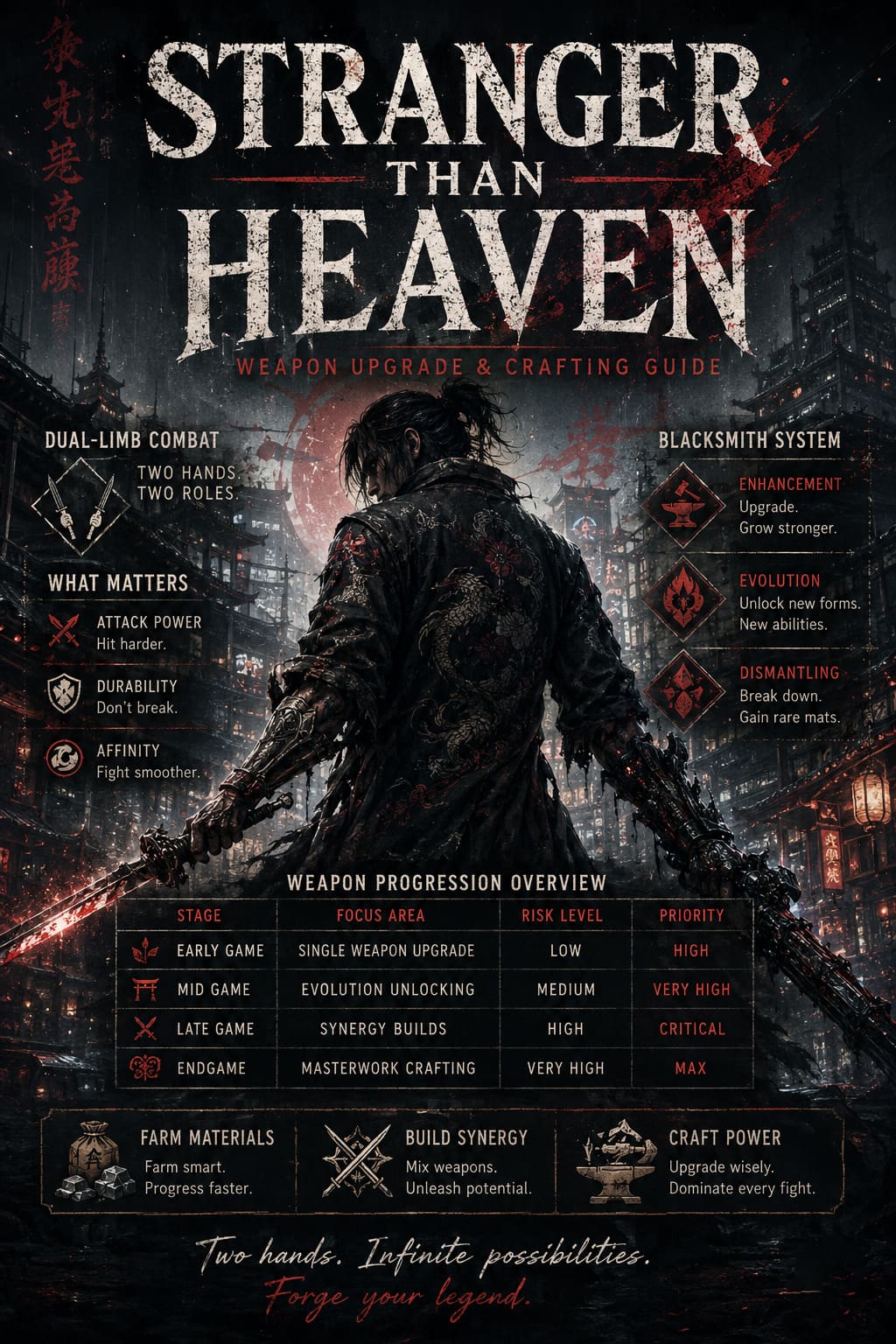
This isn’t your typical “find better sword, hit harder” loop. The weapon system is tied directly to the game’s dual-limb combat mechanics, and that alone changes everything. If you ignore that synergy, you’ll hit a difficulty wall fast—no matter how good your reflexes are.
Stranger Than Heaven Recruitment Guide: How to Build Your Band Empire
The Core Idea: Two Hands, Two Roles
What immediately stood out is how independent limb combat changes weapon identity. You’re not just equipping a weapon—you’re building two parallel combat tools.
One side can be aggressive, the other defensive—or both can be offensive if you’re confident.
Key Weapon Stats You Should Actually Care About
Instead of treating stats like background noise, you really need to understand their practical impact:
- Attack Power – obvious, but not everything. High damage often comes with slower recovery.
- Durability – more important than it sounds. A broken weapon mid-fight can ruin encounters.
- Affinity – affects stamina usage and overall weapon feel in combat.
Affinity often ends up being the stat that separates smooth combat from frustrating encounters.
Blacksmith System: Where Builds Actually Happen
You don’t upgrade weapons in the field. Every major city has a blacksmith, and they function as your main progression hub.
1. Enhancement (Basic Upgrades)
This is the standard upgrade loop. You invest materials to increase weapon stats. Simple on paper, but extremely important for long-term scaling.
2. Evolution (The Real Power Spike)
Once a weapon hits its cap, it can evolve into a new form. This doesn’t just improve stats—it can change mechanics or add elemental effects.
The downside is that evolution resets weapon level, making it a long-term investment.
3. Dismantling (Hidden Economy System)
Dismantling unused weapons provides rare materials that are often more valuable than currency. This becomes critical in mid and late game progression.

Weapon Progression Overview (Practical Breakdown)
| Stage | Focus Area | Risk Level | Priority |
|---|---|---|---|
| Early Game | Single weapon upgrade | Low | High |
| Mid Game | Evolution unlocking | Medium | Very High |
| Late Game | Synergy builds | High | Critical |
| Endgame | Masterwork crafting | Very High | Max |
The key takeaway is simple: focus beats variety early on. Spreading resources too thin will weaken your overall progression.
Farming Materials Without Losing Control
Material farming is the backbone of progression, and the game spreads resources across different eras and zones.
Early Game Materials
Iron and copper materials are abundant and easy to gather in early regions. Exploration and basic combat provide enough supply.
Mid Game Bottlenecks
Rare materials begin appearing, requiring more structured farming routes and repeatable activities.
Late Game Essentials
High-tier materials require targeted farming in specific zones and challenge-based content rather than exploration alone.

Synergy Builds: The Real Depth of the System
Weapons are not isolated systems—they interact with each other. Certain combinations unlock passive bonuses that significantly alter combat performance.
Examples include fast weapon pairings for critical builds or heavy + defensive setups for counter-focused playstyles.
The game doesn’t explicitly guide these synergies, encouraging experimentation instead.
My Take: Strengths and Weaknesses
What Works Well
- Dual-limb combat adds meaningful depth
- Evolution system feels impactful
- Synergy mechanics encourage experimentation
What Feels Less Polished
- Material grind spikes can feel uneven
- Some weapon paths dominate early game
- Dismantling system is easy to overlook
Practical Upgrade Strategy
If starting fresh, a focused approach works best:
- Stick to one main weapon early
- Prioritize affinity upgrades for smoother combat
- Unlock evolution as early as possible
- Expand builds only after mid-game stability
- Always dismantle unused weapons instead of selling them
Final Thoughts
The weapon upgrade system in Stranger Than Heaven is not revolutionary, but it is layered and rewarding for players who enjoy experimentation. It pushes you to think beyond simple stat upgrades and consider how your entire loadout interacts.
If treated like a traditional action game, it can feel restrictive. But if approached as a build-crafting system, it becomes far more engaging and flexible.