The Mound Omen of Cthulhu: How to Tell Real Monsters from Hallucinations
When I first jumped into The Mound: Omen of Cthulhu, I expected another cooperative survival game where communication and good aim solved most problems. I couldn’t have been more wrong. ACE Team built something that constantly attacks your confidence instead of just your health bar. After several expeditions, I realized that surviving the jungle isn’t about shooting faster—it’s about questioning everything you see.
The game’s insanity mechanics are easily its greatest strength. Every expedition slowly transforms the environment into something that feels completely unreliable. One second you’re chasing treasure with your squad, and the next you’re pointing a musket at what appears to be a horrifying Lovecraftian creature… only to discover it was your teammate all along.
That uncertainty is exactly what makes The Mound: Omen of Cthulhu one of the most memorable co-op horror releases in recent years.
If you’re constantly wondering whether the monster charging at you is real or simply another trick created by your collapsing sanity, this guide explains exactly what to watch for.
Why Hallucinations Are More Dangerous Than the Monsters
Unlike traditional horror games where enemies always obey clear gameplay rules, The Mound intentionally breaks your expectations.
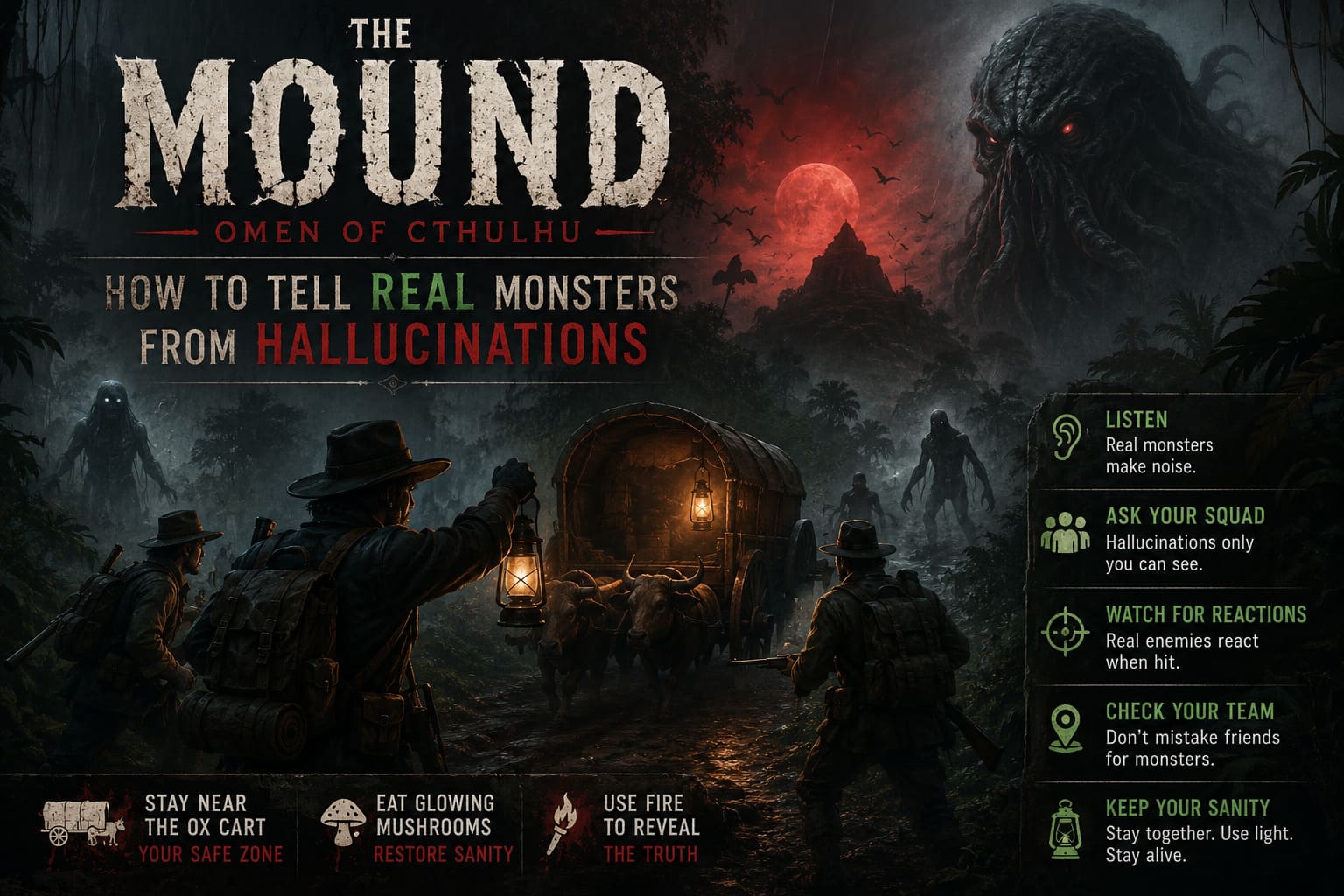
The longer your expedition lasts, the more your sanity drains. Once it drops far enough, your own senses become your greatest enemy.
Instead of simply adding visual filters or screen effects, the game starts rewriting reality.
You may experience:
- Fake monsters sprinting directly toward you.
- Disappearing jungle paths.
- Blood-red skies.
- Harmless terrain disguised as deadly hazards.
- Teammates appearing as grotesque creatures.
- Impossible environmental changes.
The brilliant part is that these hallucinations only exist for you.
Your friends could be looking at an empty trail while you’re desperately firing at something they can’t even see.
That design alone creates panic unlike almost anything else in cooperative horror.
How the Madness System Actually Works
Understanding insanity is far more valuable than memorizing enemy attack patterns.
Your sanity continuously drops whenever you remain away from safety, and several actions speed up the process considerably.
Some of the biggest sanity killers include:
| Action | Madness Impact |
|---|---|
| Wandering away from teammates | Very High |
| Leaving the ox cart behind | Very High |
| Frequently using the treasure medallion | High |
| Firing loud firearms repeatedly | Medium |
| Disturbing wildlife | Medium |
| Creating excessive noise | Medium |
The game rewards organized squads while punishing lone wolves.
If you’re the type of player who always says, “I’ll scout ahead,” you’ll quickly become the team’s biggest liability.
Isolation isn’t just dangerous because enemies become harder to fight.
Isolation literally changes what your brain sees.
The Fastest Ways to Identify a Real Monster
When something suddenly appears from the jungle, hesitation can get everyone killed.
Fortunately, real enemies almost always leave clues that hallucinations cannot replicate.
1. Listen Before You Shoot
This might sound obvious, but audio is surprisingly reliable.
Actual creatures interact with the environment.
You’ll hear:
- Heavy footsteps.
- Broken branches.
- Bushes moving.
- Vegetation shifting.
- Impact sounds during movement.
Hallucinations usually glide through the environment without affecting anything around them.
If a towering nightmare seems to float silently through dense jungle, your mind is probably inventing it.
2. Ask Your Squad Immediately
This is probably the single most important survival habit.
Hallucinations are generated individually.
Your teammates won’t automatically see what you see.
Instead of yelling:
“Monster!”
Try something much more useful:
“North side of the cart—does anyone see a creature?”
If everyone answers no, save your ammunition.
Simple communication prevents friendly fire more often than perfect aim.
3. Watch Your Weapon Feedback
The combat system quietly helps players avoid wasting shots.
Real enemies react when hit.
Depending on your weapon, you’ll usually notice:
- Impact sounds.
- Visible damage.
- Blood effects.
- Hit confirmation.
Hallucinations ignore all of it.
Bullets simply pass through them as if nothing exists.
If your perfectly aimed musket shot seems to disappear into thin air, you’re probably fighting your own imagination.
4. Don’t Forget Where Your Teammates Were Standing
One of the nastiest tricks the game plays is disguising allies as monsters.
The illusion feels incredibly convincing during stressful fights.
Before pulling the trigger, quickly check:
- Teammate markers.
- Compass direction.
- Player icons.
- Last known positions.
If the “monster” appears exactly where your friend was standing seconds earlier, stop shooting.
Your sanity—not your teammate—is the real problem.
5. Observe Enemy Behavior
Real predators want you dead.
Hallucinations often just want your attention.
Stationary figures hidden inside distant fog are usually psychological traps.
Many fake creatures:
- Never attack.
- Never react.
- Simply stare.
- Remain motionless.
- Disappear unexpectedly.
Real enemies constantly adjust their pathfinding and aggressively close the distance once they detect noise.
Movement tells you far more than appearance.
Best Ways to Reduce Hallucinations
The good news is that insanity isn’t permanent.
Good teams actively manage their sanity throughout every expedition instead of waiting until everything becomes impossible to trust.

Stay Close to the Ox Cart
The ox cart isn’t simply a mission objective.
It’s essentially your mobile safe zone.
Remaining nearby slows sanity loss and gives everyone more time before hallucinations begin appearing.
Whenever possible, treat the cart as the center of your entire operation.
Eat Glowing Mushrooms
These strange fungi are among the most valuable resources in the game.
Players often ignore them while chasing treasure.
That’s a mistake.
A quick sanity recovery can instantly remove active hallucinations and restore your ability to identify real threats.
Sometimes one mushroom saves more lives than an extra magazine of ammunition.
Use Fire to Reveal Reality
Lighting tools aren’t only useful against hostile vegetation.
Both lanterns and torches improve visibility in ways that make deception less effective.
Real enemies cast believable shadows and physically occupy space.
Hallucinations often feel visually “off” once strong lighting reaches them.
Experienced squads constantly rotate torch carriers for exactly this reason.
Never Split the Team
Every horror movie tells people not to separate.
This game finally gives you a mechanical reason to listen.
Solo exploration causes:
- Faster sanity loss.
- Increased hallucinations.
- Health pressure.
- Reduced verification from teammates.
Treasure isn’t worth risking an expedition over.
Moving together dramatically increases survival odds.
Create Voice Chat Rules Before the Mission
The best groups don’t improvise communication.
They establish short callouts before entering the jungle.
Good examples include:
- “Cart east.”
- “Visual confirmation?”
- “Need second opinion.”
- “False contact.”
- “Enemy confirmed.”
These quick phrases reduce confusion during chaotic fights and prevent unnecessary panic.
Common Mistakes That Get Entire Squads Killed
| Mistake | Why It Causes Problems |
|---|---|
| Shooting every moving object | Wastes precious ammunition. |
| Ignoring teammate confirmation | Leads to friendly fire. |
| Constant medallion usage | Accelerates madness dramatically. |
| Exploring alone | Rapid sanity collapse. |
| Forgetting environmental audio | Misses the easiest clue for identifying real enemies. |
| Panicking after seeing hallucinations | Creates chain reactions across the whole squad. |
The Mound Omen of Cthulhu: Conquistador Lore Guide and Gameplay Overview
Why Communication Beats Perfect Aim
One thing became obvious after dozens of encounters.
Your squad is actually your strongest anti-hallucination tool.
Even experienced FPS veterans eventually start doubting themselves once the madness system reaches higher levels.
That’s exactly what ACE Team wanted.
The game isn’t testing your reflexes nearly as much as it’s testing your trust.
When someone calmly says, “I don’t see anything there,” believe them.
That simple sentence often saves ammunition, healing supplies, and sometimes the entire expedition.
Final Thoughts
Most cooperative horror games challenge players with stronger enemies, limited resources, or complicated puzzles. The Mound: Omen of Cthulhu goes in a completely different direction by making information itself unreliable. Your own eyes become questionable, your ears start lying, and every decision carries the risk of hurting the people you’re supposed to protect.
That’s exactly why the insanity system feels so refreshing. It doesn’t rely on cheap jump scares—it creates genuine psychological tension that grows naturally throughout every expedition. Every encounter forces your squad to slow down, communicate, and verify what is actually happening instead of blindly reacting.
If you want consistent extractions, stop trusting your instincts alone. Listen to the environment, watch how enemies interact with the jungle, check teammate positions before firing, and verify every suspicious sighting over voice chat. The teams that master those habits quickly discover that the real battle isn’t against cosmic monsters lurking beneath the canopy—it’s against the lies their own minds are creating.
In The Mound: Omen of Cthulhu, surviving the jungle isn’t about becoming fearless. It’s about learning exactly when not to believe what you’re seeing.