Scarlet Deer Inn Ending Explained: The Full Plot Summary & Slavic Lore Breakdown
Some indie games entertain you for a weekend. Others stay in your head long after the credits roll. Scarlet Deer Inn absolutely belongs in the second category.
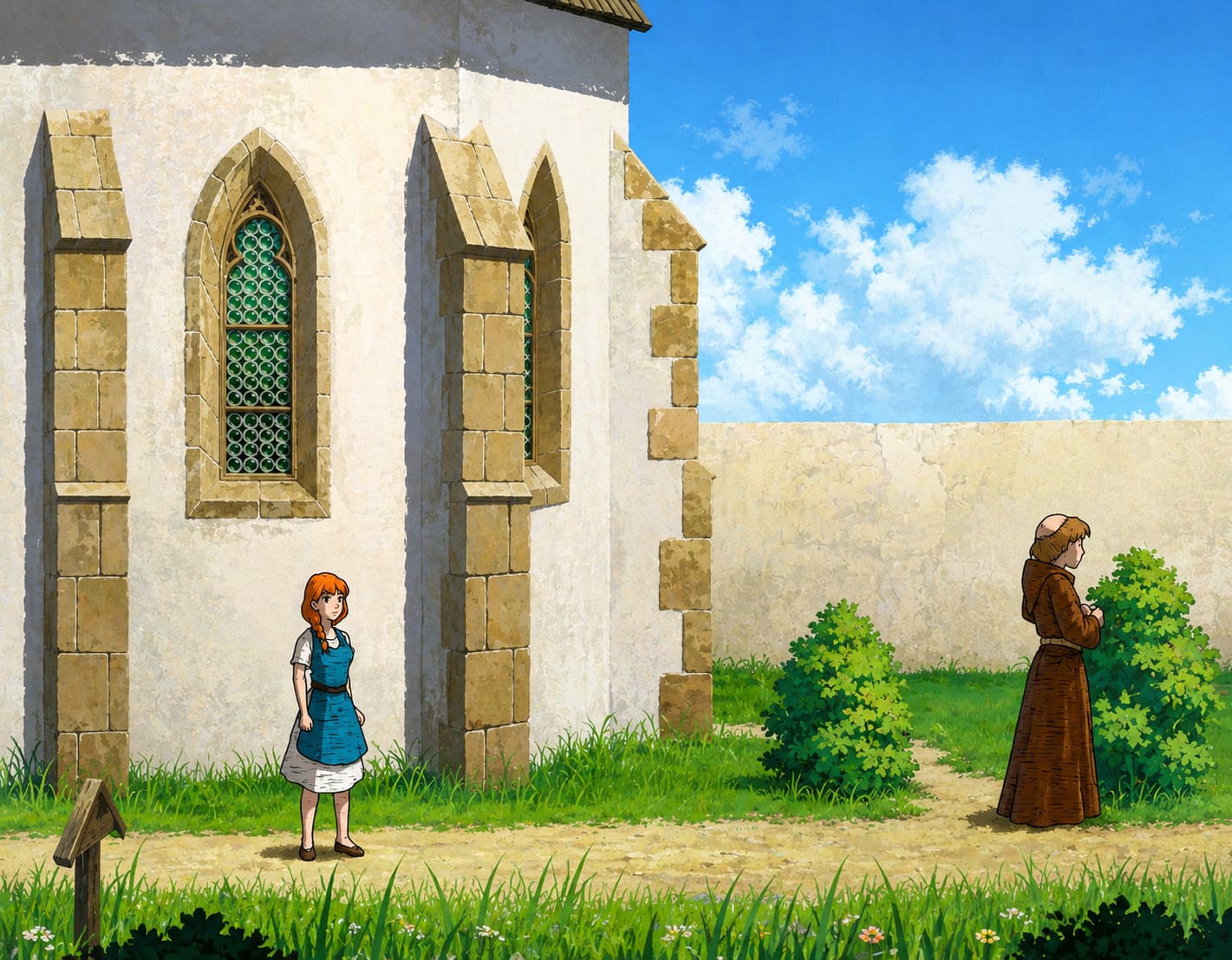
At first glance, Attu Games’ newest project looks like a peaceful medieval fairy tale with gorgeous hand-crafted visuals. Spend thirty minutes with it and you’ll probably think it’s another cozy adventure full of charming villagers and relaxing exploration. Spend a few more hours, though, and the illusion completely falls apart.
Underneath those embroidered characters and beautiful painted environments hides one of the darkest narrative-driven adventures released in recent years. The game quietly transforms into psychological horror, family drama, and a surprisingly authentic interpretation of Slavic mythology. It’s the kind of story that encourages players to immediately search for explanations after finishing it because the ending leaves plenty to unpack without ever feeling confusing.
If you just reached the credits and want to understand what really happened, here’s a full breakdown of the story, the ending, and the deeper symbolism hiding beneath Scarlet Deer Inn’s stitched surface.
Why Scarlet Deer Inn’s Story Feels Different
One thing became obvious during my playthrough: this isn’t a fantasy adventure interested in creating another chosen hero.
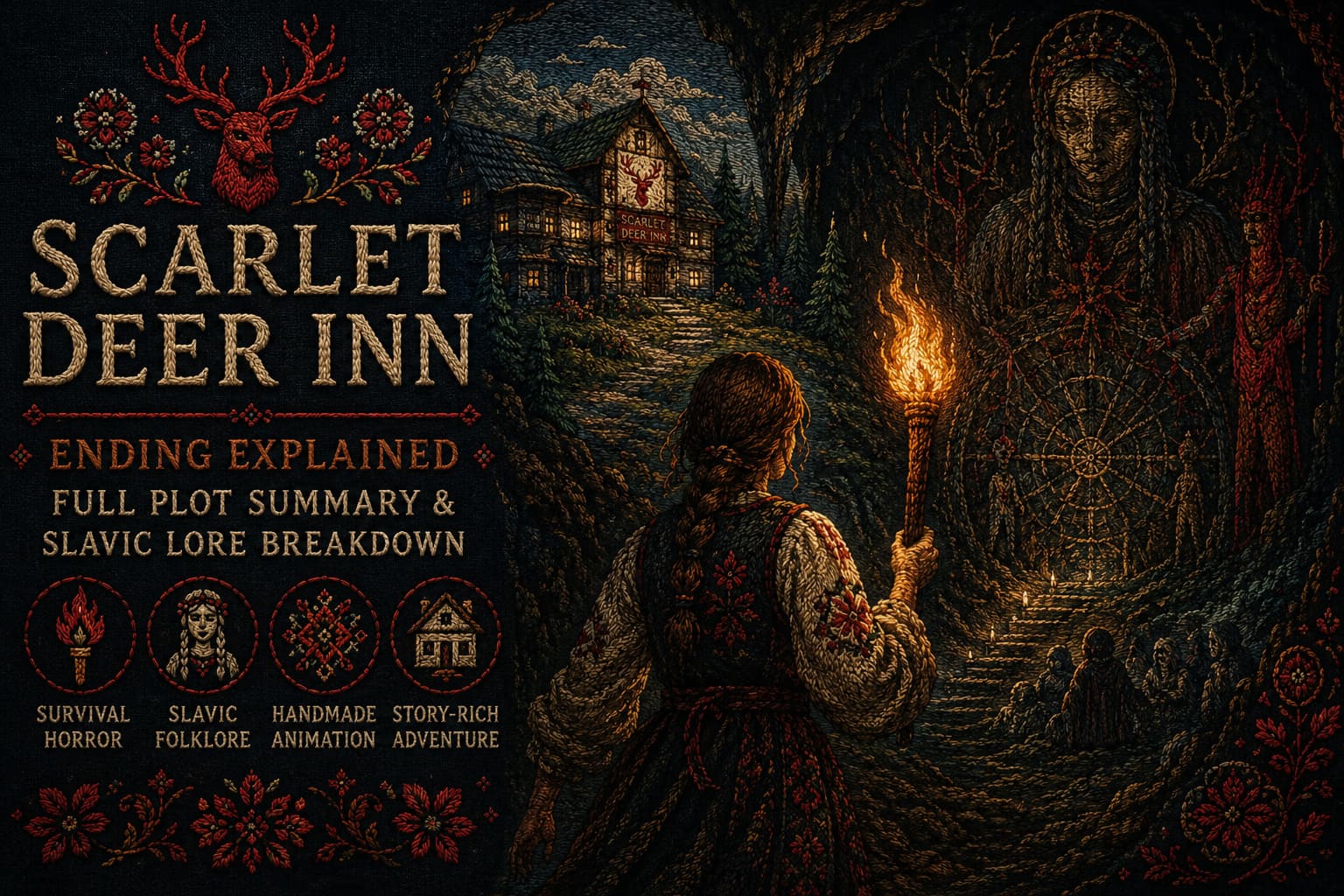
Elise isn’t a knight.
Elise isn’t gifted with magical abilities.
She doesn’t suddenly become an unstoppable warrior halfway through the campaign.
She’s simply a mother trying to protect her children.
That grounded approach changes everything. Every dangerous encounter feels stressful because you know you’re controlling someone completely unprepared for the nightmare unfolding beneath her village. Instead of empowering the player, the game constantly reminds you how fragile ordinary people really are.
That vulnerability is exactly what makes the emotional moments hit so much harder.
The Peaceful Beginning Is Meant to Fool You
The opening chapters almost feel deceptive.
Players spend their time running the Scarlet Deer Inn, serving travelers, helping neighbors, completing simple errands, and dealing with everyday parenting problems.
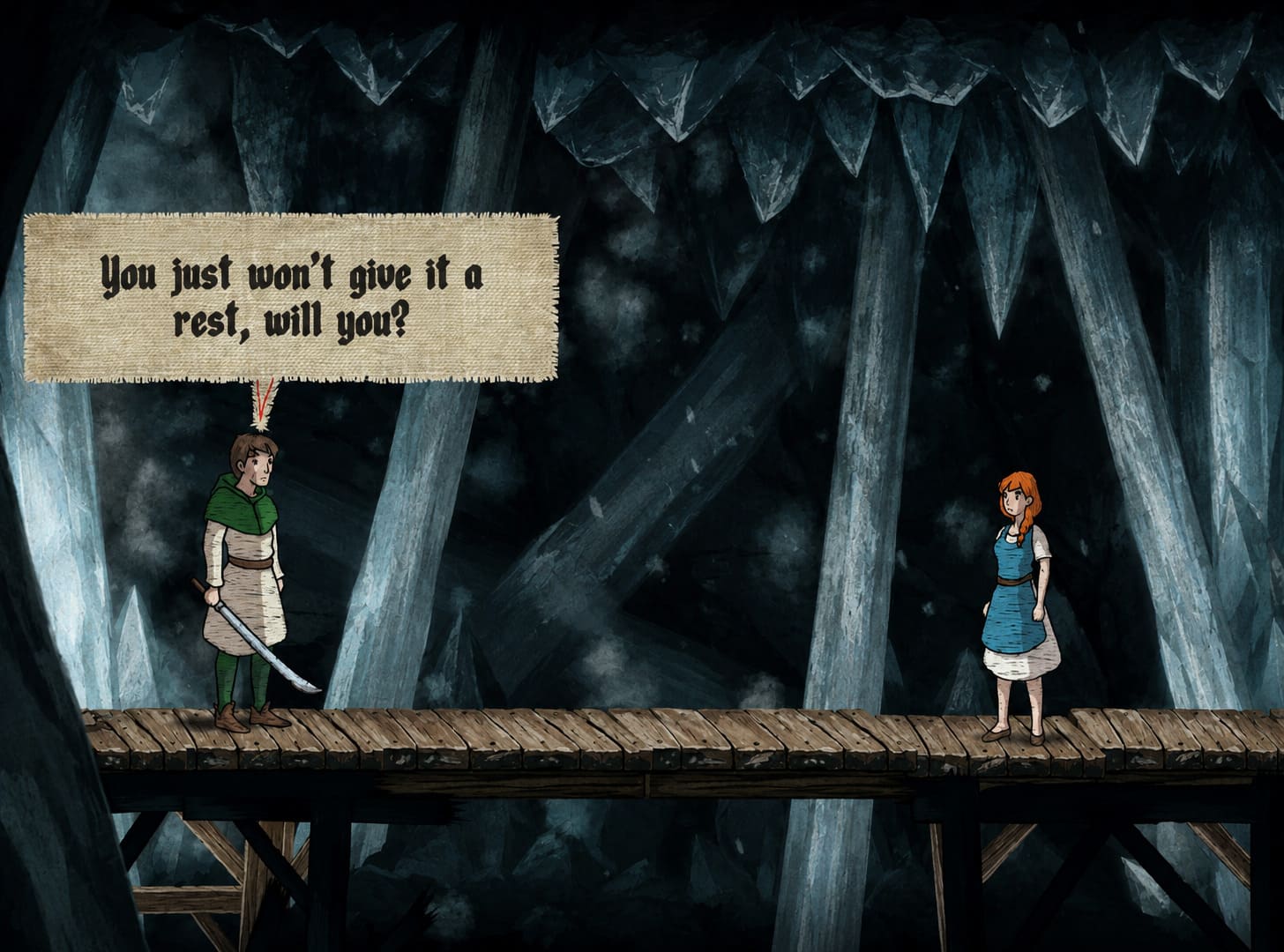
- Jimmy keeps losing his stuffed bear.
- Bridgette constantly asks uncomfortable questions.
- Villagers exchange harmless gossip over drinks.
- Life appears calm and predictable.
Looking back after finishing the story, it’s obvious the developers were quietly planting clues everywhere.
Several elderly villagers avoid discussing certain locations. Animals behave strangely around the forest. Conversations suddenly become awkward whenever ancient traditions are mentioned. None of these moments feel particularly suspicious on a first playthrough, but replaying the introduction reveals just how carefully everything was foreshadowed.
The Disaster That Changes Everything
The turning point arrives when Bridgette’s natural curiosity pushes her beyond boundaries the villagers have respected for generations.
That single decision destroys the comforting rhythm established during the opening hours.
Elise becomes separated from the safety of home and is forced underground into an enormous labyrinth that has existed beneath the valley for centuries.
From this moment onward, Scarlet Deer Inn almost feels like a different game. The peaceful management mechanics disappear. The atmosphere becomes oppressive. Every corridor feels hostile. Every shadow looks dangerous.
Unlike traditional horror games, however, survival isn’t about collecting stronger weapons. Instead, your greatest resource is something remarkably ordinary—a simple torch.
The torch becomes both a gameplay mechanic and one of the strongest narrative symbols in the entire experience.
Why the Torch Matters So Much
Mechanically, the torch keeps horrifying creatures at a distance.
Narratively, it represents something much deeper.
Its light reflects Elise’s determination to keep moving forward despite overwhelming fear. Every time its flame weakens, players feel genuine anxiety because darkness isn’t merely environmental decoration—it represents despair itself.
The developers could have handed players swords, spells, or crossbows. Instead, they chose light. That creative decision perfectly supports the central message of the story. Sometimes survival isn’t about overpowering evil. Sometimes it’s simply refusing to let hope disappear.
Slavic Mythology Shapes the Entire Narrative
Unlike many fantasy games borrowing heavily from Western medieval traditions, Scarlet Deer Inn embraces Slavic folklore with remarkable confidence.
Rather than relying on dragons or legendary knights, the world is built around ancient beliefs where spirits, forests, forgotten places, and humanity exist in constant balance.
Many creatures encountered underground aren’t random monsters at all.
- Living memories.
- Physical manifestations of guilt.
- Echoes of forgotten crimes.
- Punishments that generations failed to confront.
A popular interpretation shared across gaming communities suggests the underground isn’t simply a physical location. It’s the village’s buried conscience. Every secret ignored by previous generations gradually accumulated beneath the earth until it eventually became something tangible. The deeper Elise travels, the closer she moves toward centuries of hidden truth.
The Embroidery Isn’t Just Visual Style
It’s easy to assume the embroidered animation exists purely because it looks beautiful.
That couldn’t be further from the truth.
Every stitched character mirrors the game’s central themes.
Embroidery transforms loose threads into meaningful patterns through patience, repetition, and care. Elise’s journey follows exactly the same process.
Her family has been torn apart. Her community has been living inside a carefully stitched lie. Throughout the adventure, she’s forced to reconnect broken relationships while unraveling generations of deception.
Even much of the dialogue quietly references threads, weaving, destiny, and interconnected lives. Many players have connected these motifs with Mokosh, one of the most significant female figures in Slavic mythology—a guardian associated with fate, spinning, motherhood, and protection. Whether intentional or symbolic inspiration, the parallels feel impossible to ignore.
The Truth Behind the Village
Eventually, Scarlet Deer Inn reveals its biggest secret.
The peaceful valley wasn’t naturally blessed.
Its prosperity came with a horrifying cost.
Long before Elise’s lifetime, the village founders struck a supernatural agreement with entities dwelling beneath the earth.
The bargain was simple.
- Abundant harvests.
- Peaceful seasons.
- Protection from disaster.
- A sacrifice every few generations.
For decades nobody questioned the arrangement because the benefits were obvious. Fields flourished. Families survived. Life appeared comfortable.
Eventually, however, the debt returned.
Bridgette became the next chosen sacrifice.
Suddenly every mysterious tradition, every uncomfortable silence, and every warning from older villagers makes perfect sense. The community wasn’t protecting its children. It was protecting an ancient agreement.
Breaking the Curse
One aspect I genuinely appreciated is how the finale avoids the predictable boss battle that so many games rely upon.
There isn’t a legendary weapon waiting for Elise. She doesn’t suddenly unlock hidden supernatural powers.
Victory comes from understanding the rules governing the spirit world.
Instead of defeating ancient entities through brute force, Elise exploits symbolism itself.
The Scarlet Deer Inn has always represented shelter, warmth, stories shared between strangers, and human connection. Those concepts possess tremendous value within the spiritual laws established by the game’s mythology.
Using the final remnants of her torch alongside deeply personal pieces of her family’s history, Elise offers a symbolic exchange powerful enough to disrupt the ancient covenant. Rather than continuing the endless cycle of sacrifice, she forces the spirits into accepting something fundamentally different.
The centuries-old agreement collapses. The catacombs become sealed. Her children survive. But nothing returns to normal.
The Ending Explained
The closing sequence deliberately avoids presenting a perfect happy ending.
As dawn breaks, Elise, Bridgette, and Jimmy stand together overlooking the valley.
They’re alive.
The immediate supernatural threat has ended.
The Scarlet Deer Inn still stands, although heavily damaged.
Physically, they survived. Emotionally, they’re forever changed.
More importantly, the village itself must finally face reality. Without the cursed bargain, future harvests won’t arrive through supernatural intervention. Life will become harder. People will struggle. Yet for the first time in generations, they’ll be building their future honestly rather than depending upon innocent blood.
That’s why the ending feels hopeful without becoming overly sentimental. Freedom always comes with consequences.
Major Story Themes
| Theme | Meaning |
|---|---|
| Motherhood | Love becomes stronger than fear or violence. |
| Sacrifice | Every shortcut eventually demands payment. |
| Truth | Hidden history always resurfaces. |
| Community | Prosperity built on suffering cannot last forever. |
| Hope | Light survives even inside overwhelming darkness. |
Why Players Connected With Scarlet Deer Inn
Several factors explain why discussion around Scarlet Deer Inn exploded almost immediately after launch.
- Authentic Slavic folklore instead of recycled fantasy clichés.
- Extraordinary embroidered animation unlike anything else in modern gaming.
- A believable protagonist whose vulnerability constantly raises the tension.
- Environmental storytelling that rewards careful observation.
- An emotionally satisfying ending that values intelligence over spectacle.
In a gaming industry packed with increasingly cinematic adventures, Scarlet Deer Inn succeeds by staying remarkably personal. It never tries to overwhelm players with giant battles or endless exposition. Instead, it tells a deeply human story through atmosphere, symbolism, and carefully layered environmental details.
Scarlet Deer Inn Gameplay Review: Why This Hand-Embroidered Dark Folk Tale is 2026’s Best Indie Game
Final Thoughts
Scarlet Deer Inn proves that memorable storytelling doesn’t require blockbuster budgets or hundreds of hours of gameplay. What it needs is confidence in its own identity.
Attu Games took an enormous creative risk by combining historically inspired embroidery, psychological horror, grounded family drama, and authentic Slavic mythology into a single experience. Somehow, every one of those ideas supports the others instead of competing for attention.
By the time the credits roll, Scarlet Deer Inn isn’t really about defeating monsters anymore. It’s about confronting inherited guilt, breaking destructive traditions, and discovering that genuine courage rarely looks heroic. Sometimes courage is simply a parent refusing to surrender their child, even when the entire weight of history insists otherwise.
For players who enjoy narrative-heavy indie games with rich symbolism, layered world-building, and endings that spark hours of discussion, Scarlet Deer Inn stands as one of the most unforgettable storytelling experiences in recent memory. It’s haunting, emotionally honest, visually unlike anything else on the market, and the kind of game that deserves to be experienced twice—once for the mystery, and once to appreciate every subtle clue hiding in plain sight.