The Witcher 3: Songs of the Past – My Thoughts on the New Expansion
I’ve been around long enough in gaming to remember when The Witcher 3: Wild Hunt first came out in 2015 and completely reset what I expected from open-world RPGs.
After Blood and Wine, I genuinely believed Geralt’s journey was over. That ending in Toussaint felt like closure, like CD Projekt Red finally gave the White Wolf his peace.
So when rumors started turning into real announcements about The Witcher 3: Songs of the Past, I didn’t jump in with hype immediately.
I’ve seen too many “return to classics” projects fall apart. But the more details surfaced—official confirmations, studio involvement, and expansion scale—it became clear this isn’t just nostalgia bait. It’s something much bigger.
As a gamer who still boots up Witcher 3 just to wander around Velen at night, I can’t ignore it anymore.
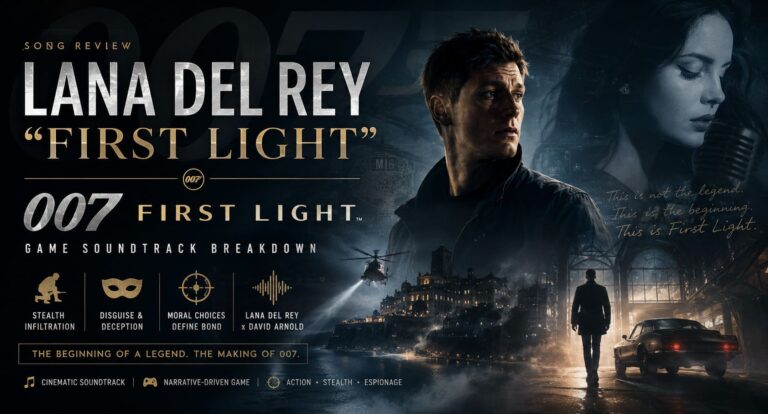
Lana Del Rey “First Light” Song Review – 007 First Light Game Soundtrack Breakdown
Release Window: 2027 and the Long Wait
CD Projekt Red has placed the release window for Songs of the Past in 2027. That alone tells you this isn’t a quick cash-in expansion. It’s being treated like a full production cycle experience.
From a player’s perspective, though, 2027 feels distant. We’re talking over a decade after the base game. That’s rare in modern gaming, especially for a title that already had two massive expansions.
Here’s the rough timeline for context:
- 2015 – The Witcher 3 launches
- 2016 – Blood and Wine releases
- 2022 – Next-gen update improves visuals
- 2026 – Songs of the Past announced
- 2027 – Planned release window
It’s unusual, but also kind of exciting in a way most modern games aren’t anymore.
Who Is Making It?
The expansion is being overseen by CD Projekt Red, but a large portion of development is handled by Fool’s Theory, a studio filled with developers who previously worked on The Witcher 3 itself.
That detail matters more than marketing ever could. When veteran devs return to their own creation, there’s a different kind of understanding of tone, pacing, and atmosphere.
Reports suggest around 190 developers are actively working on the project, making it a full-scale AAA production rather than a side DLC team.
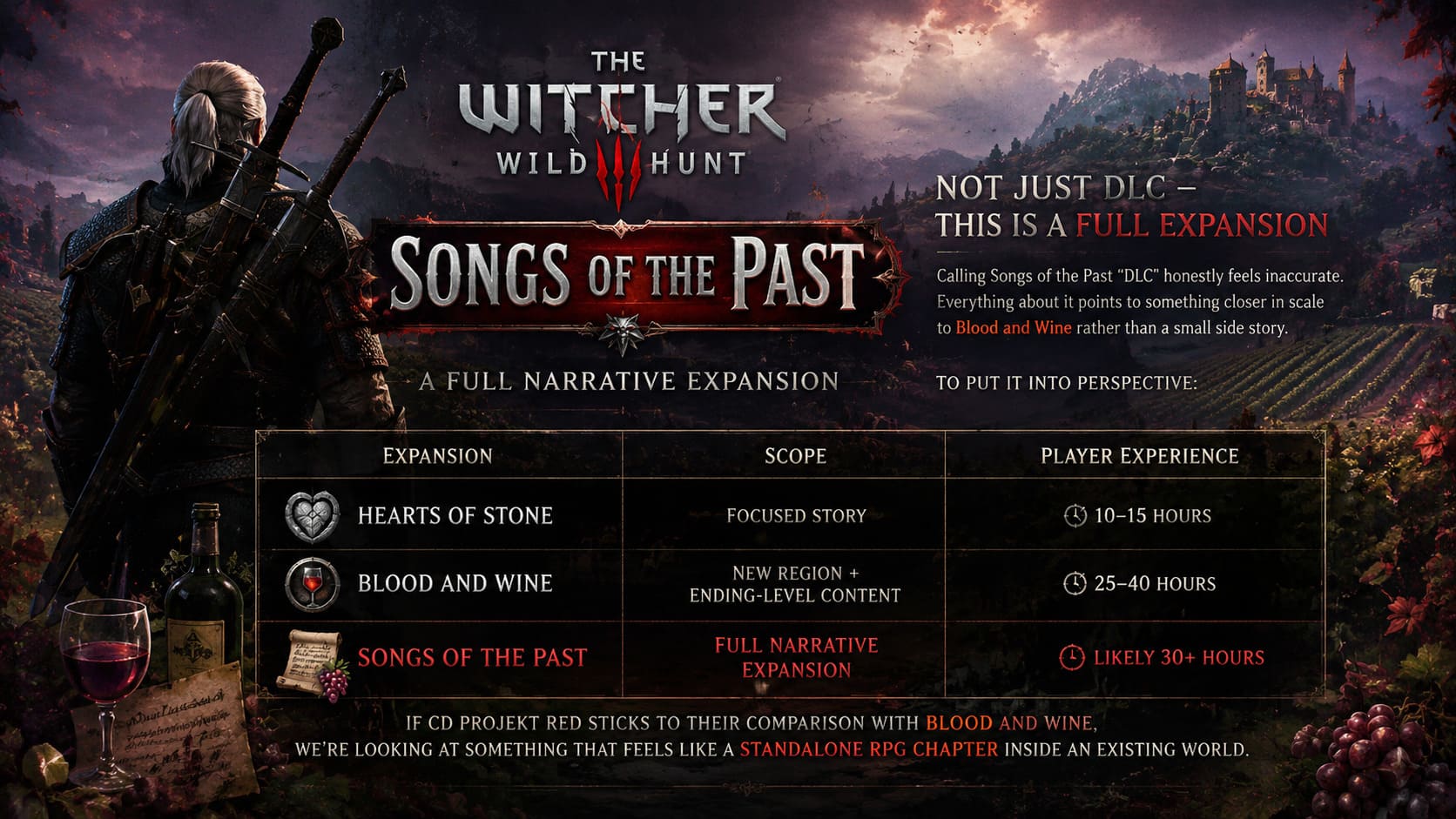
Not Just DLC – This Is a Full Expansion
Calling Songs of the Past “DLC” honestly feels inaccurate. Everything about it points to something closer in scale to Blood and Wine rather than a small side story.
To put it into perspective:
| Expansion | Scope | Player Experience |
|---|---|---|
| Hearts of Stone | Focused story | 10–15 hours |
| Blood and Wine | New region + ending-level content | 25–40 hours |
| Songs of the Past | Full narrative expansion | Likely 30+ hours |
If CD Projekt Red sticks to their comparison with Blood and Wine, we’re looking at something that feels like a standalone RPG chapter inside an existing world.
Technical Direction: Risk and Opportunity
One of the biggest changes is that Songs of the Past is designed exclusively for current-gen hardware. That means no PlayStation 4 or Xbox One support.
The game will launch on PlayStation 5, Xbox Series X, Xbox Series S, and PC, which immediately opens the door for deeper technical improvements.
Expected upgrades include denser cities, improved weather systems, more complex NPC behavior, and faster asset streaming that relies heavily on SSD performance.
As a player, I see both sides here. On one hand, The Witcher 3 deserves a modern technical refresh at full scale. On the other hand, part of its charm has always been how well it runs on surprisingly modest systems. Pushing too far could risk losing that balance.
Story Direction and What It Might Be About
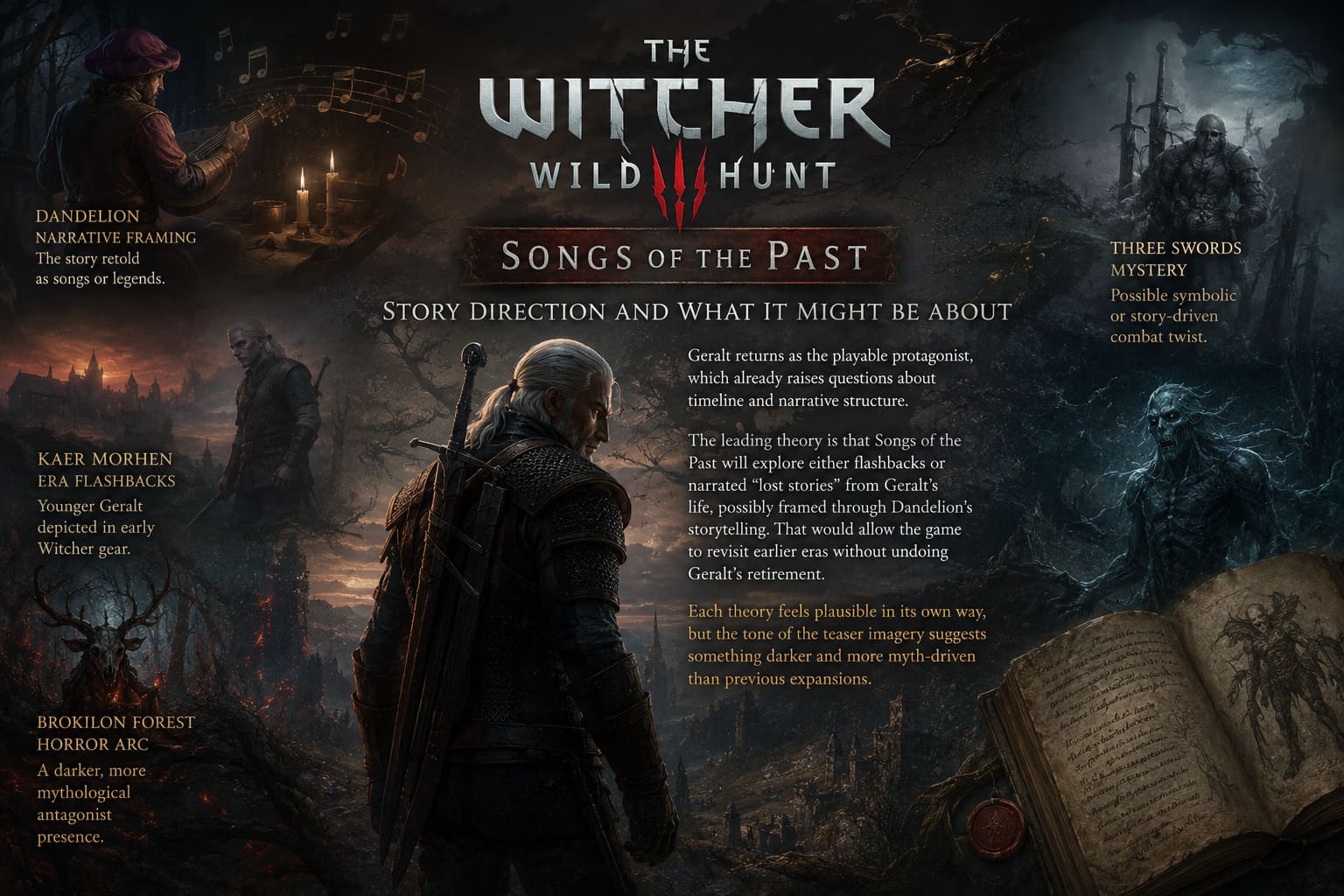
This is where things get really interesting. Geralt returns as the playable protagonist, which already raises questions about timeline and narrative structure.
The leading theory is that Songs of the Past will explore either flashbacks or narrated “lost stories” from Geralt’s life, possibly framed through Dandelion’s storytelling. That would allow the game to revisit earlier eras without undoing Geralt’s retirement.
Popular community theories include:
- Dandelion narrative framing – The story is retold as songs or legends
- Kaer Morhen era flashbacks – Younger Geralt depicted in early Witcher gear
- The three swords mystery – Possible symbolic or story-driven combat twist
- Brokilon Forest horror arc – A darker, more mythological antagonist presence
Each theory feels plausible in its own way, but the tone of the teaser imagery suggests something darker and more myth-driven than previous expansions.
The Three Swords Detail Everyone Is Talking About
One of the most debated elements is Geralt carrying three swords instead of the traditional two. Witchers typically use a steel sword for humans and a silver one for monsters, so a third blade immediately stands out.
Some players believe it represents Ciri’s involvement, others think it could be a magical artifact or narrative symbol rather than an actual gameplay mechanic. Personally, I lean toward it being symbolic rather than literal, but with CD Projekt Red, you never fully know until release.
My Personal Take as a Long-Time Player
I’ll be honest: I don’t think The Witcher 3 needed more content. Blood and Wine already felt like a perfect ending. Anything beyond that risks tampering with closure.
But at the same time, I can’t ignore how rare it is for a studio to return to a decade-old game with this level of ambition. This isn’t a remaster or a cash grab expansion pack. It feels more like a “lost chapter” they always wanted to tell but never got around to.
Still, I’m cautious. The gaming industry has taught me that ambition doesn’t always equal execution. This could become one of the greatest expansions ever made—or an unnecessary addition to a finished story.
Either way, I’ll play it. Because The Witcher universe is one of those rare worlds I always come back to, no matter how many new games I start.
When We’ll See More
More details, gameplay, and possibly a cinematic trailer are expected around late summer 2026, likely during major gaming showcases like Gamescom.
That’s when we’ll finally see whether this expansion is truly a narrative masterpiece in the making or just an ambitious idea still trying to find its final shape.
Final Thoughts
The Witcher 3: Songs of the Past sits in a strange but exciting place. It’s both a continuation and a reflection of a game that already defined an entire generation of RPGs.
If it succeeds, it could become one of the most important expansions in gaming history. If it doesn’t, The Witcher 3 will still remain untouched as one of the greatest games ever made.
Either way, the return of Geralt—even in any form—is enough to get long-time fans like me paying attention again.