Neverness to Everness Gacha System Explained: How the No 50/50 Rule and Dice Board Work
The gacha genre has trained many of us to expect disappointment. If you’ve spent years playing anime RPGs, you’ve probably experienced that painful moment when you finally reach pity, see the golden animation, and then lose the infamous 50/50 to a standard character you never wanted. I’ve been there more times than I’d like to admit, and it’s one of the biggest reasons many players slowly burn out.
That’s exactly why Neverness to Everness (NTE) immediately caught my attention.
At first I was interested because of the beautiful city, supernatural setting, and open-world exploration. But after learning how the summoning system actually works, I honestly believe this could become one of the most player-friendly gacha games released in recent years.
This isn’t because the rates are magically perfect or because every pull is generous. It’s because Hotta Studio seems to have looked at years of community complaints and actually tried to fix several of the biggest frustrations instead of pretending they don’t exist.
The Best Part? No More 50/50
If you’ve played enough gacha games, you already know the routine.
You save currency for weeks.
Maybe months.
Finally the banner arrives.
You hit pity…
…and then lose.
Instead of the limited character you’ve been waiting for, the game gives you someone from the standard pool.
Now you either spend more money or wait another several weeks.
Neverness to Everness completely changes that formula.
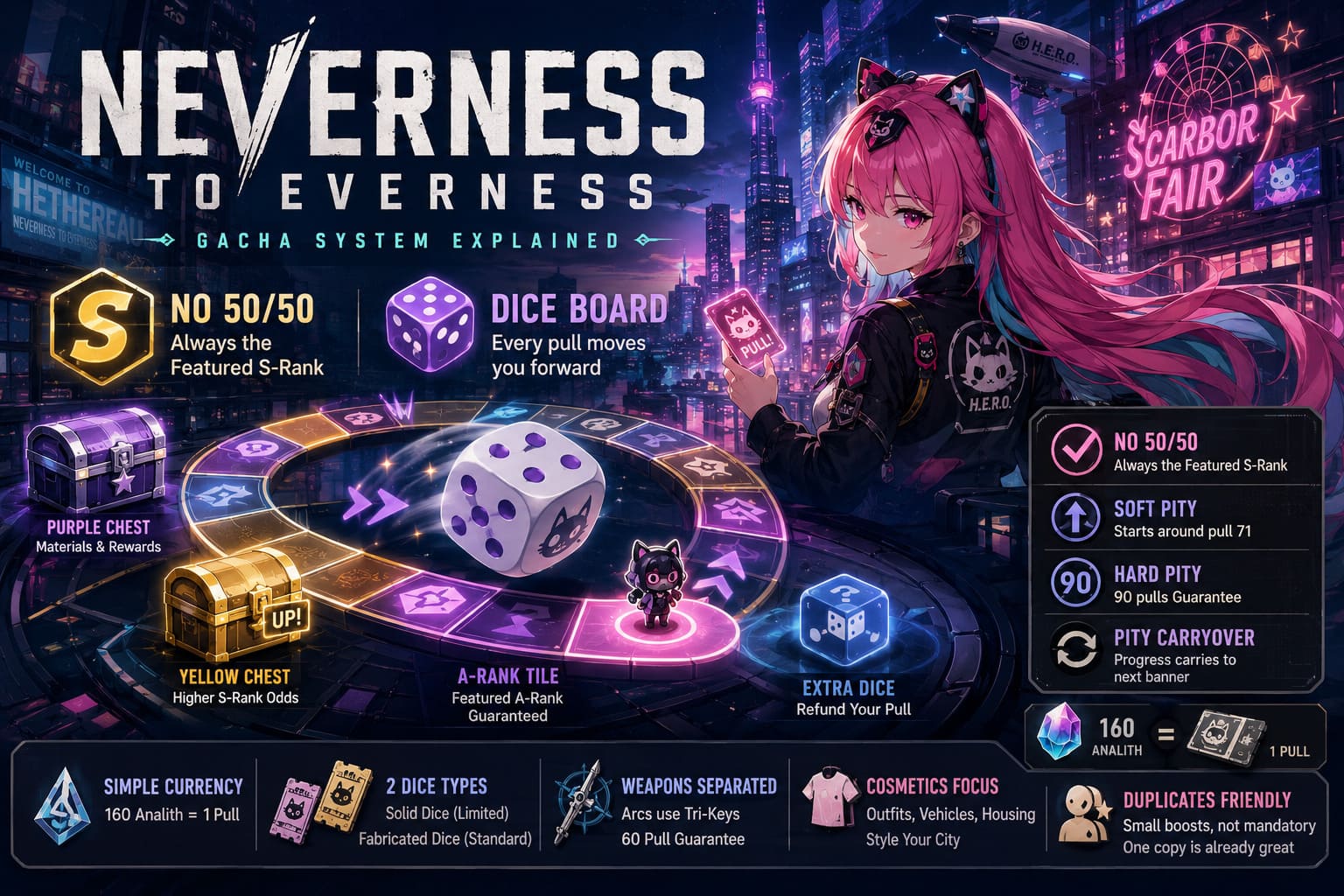
Whenever you obtain an S-Rank character from a limited banner, it is always the featured character.
There is no coin flip.
No hidden disappointment.
No “better luck next time.”
For me personally, this single design decision already makes planning much less stressful.
Instead of wondering whether my saved currency is enough for one pity or two, I know exactly what I’m working toward.
Predictable Progress Is Actually Exciting
One thing many people underestimate is how satisfying predictable progression can be.
Randomness is fun.
Uncertainty isn’t.
Knowing that every pull moves me toward a guaranteed character actually motivates me to keep playing events, exploring the world, and finishing daily content.
I don’t feel like I’m gambling.
I feel like I’m progressing.
That psychological difference is enormous.
Scarbor Fair Makes Pulling More Interesting
Most gacha games use almost identical summon animations.
Press button.
Watch animation.
Skip.
Repeat.
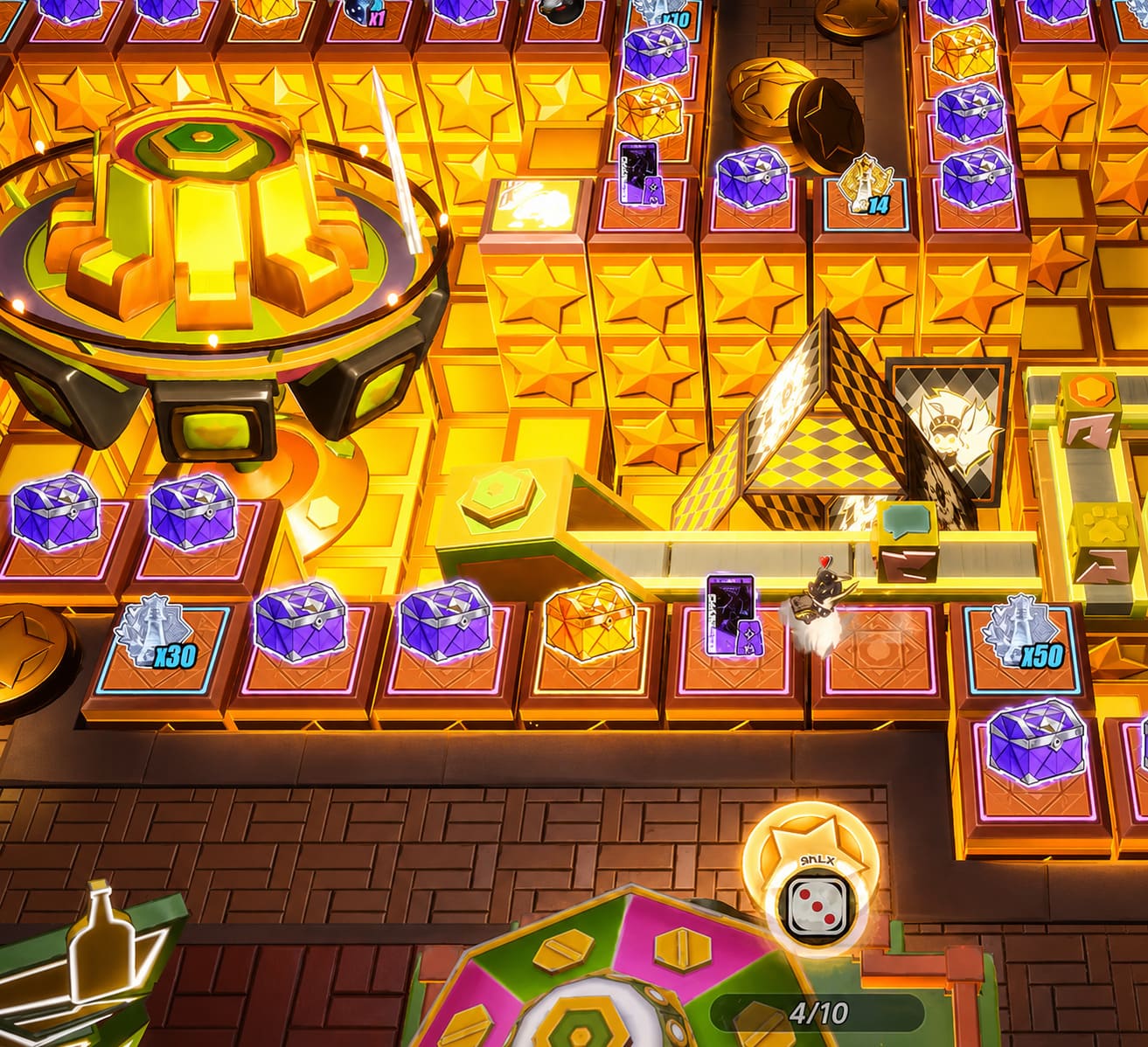
NTE introduces something called Scarbor Fair, which transforms every summon into a small interactive board game.
Instead of simply opening a menu, every pull rolls a digital die.
Your token moves across a board filled with different reward spaces.
It’s a surprisingly clever idea because even when you don’t hit the jackpot, something is still happening on screen.
Different tiles provide different rewards.
Some increase your chances.
Others refund pulls.
Some guarantee valuable characters.
Rather than staring at loading animations, you’re actively watching your progress across the board.
I honestly think this adds personality that many modern gacha systems lack.
Different Tile Types
During your journey across Scarbor Fair you’ll encounter several important spaces.
- Purple Chests offer regular materials alongside a chance at valuable rewards.
- Yellow Chests significantly improve the odds of obtaining an S-Rank character.
- A-Rank Character Tiles guarantee one of the featured A-Rank characters.
- Extra Dice Tiles effectively refund your pull by granting another roll.
The board also contains occasional surprises, including alternate paths and small interactive events that make summoning feel less repetitive than traditional banner systems.
Understanding the Main Rates
The board is entertaining, but numbers still matter.
| Feature | Value |
|---|---|
| Base S-Rank Rate | 0.99% |
| Overall Average S-Rank Rate | 1.88% |
| Base A-Rank Rate | 11.67% |
| Guaranteed A-Rank | Every 10 pulls |
| Hard Pity (S-Rank) | 90 pulls |
| Soft Pity Begins | Around pull 71 |
The most important part isn’t actually the base rate.
It’s the pity system.
Soft Pity Prevents Endless Bad Luck
Like many modern gachas, Neverness to Everness uses both soft pity and hard pity.
The difference is that the soft pity feels much more transparent.
For roughly the first seventy pulls, your odds remain fairly consistent.
Once you move beyond that point, your probability begins increasing rapidly.
By the time you’re approaching ninety pulls, your chances become extremely high.
If luck still refuses to cooperate, the ninetieth pull guarantees the featured S-Rank character.
Knowing there’s a clear finish line makes saving resources much easier.
Pity Carryover Is Exactly What Players Wanted
Another feature I really appreciate is permanent pity carryover.
Let’s imagine you’ve made 52 pulls but the banner ends.
Your progress doesn’t disappear.
When the next limited character arrives, your pity starts exactly where you left off.
That means your investment is never wasted.
Many veteran players consider this one of the healthiest systems a live-service game can offer because it respects long-term planning.
Premium Currency Is Easy to Understand
NTE keeps its currency system relatively straightforward.
The main premium resource you’ll collect through exploration, quests, events, and gameplay is Analith.
Every 160 Analith converts into one summon.
The game also separates summon tickets into two categories.
| Dice Type | Purpose |
|---|---|
| Solid Dice | Limited character banners |
| Fabricated Dice | Permanent standard banner |
This separation encourages players to avoid accidentally spending valuable resources on the wrong banner.
For beginners especially, that’s a welcome quality-of-life improvement.
The Beginner Banner Looks Worth Completing
One nice addition is the beginner progression on the permanent banner.
After enough pulls, players can select one standard S-Rank character instead of relying completely on luck.
For anyone starting a fresh account, that’s a fantastic way to build a balanced roster without rerolling endlessly.
It makes the opening hours feel much less frustrating.
The Weapon System Works Differently
Perhaps the biggest surprise is how Neverness to Everness approaches weapons.
Instead of forcing players into another expensive banner using the same premium currency, high-tier weapons—called Arcs—have their own progression path.
This immediately reduces one of the biggest financial traps found in many competing games.
Players use a separate resource known as Tri-Keys rather than spending the same currency needed for limited characters.
That alone makes resource management much less painful.
Weapon Progression Is More Forgiving
The Arc system also includes its own guarantee.
An S-Rank Arc is guaranteed within sixty pulls.
If the featured signature weapon doesn’t appear immediately, additional protection ensures it cannot evade you forever.
Compared to many popular weapon banners across the genre, this system feels dramatically less punishing.
Personally, I prefer developers encouraging players to enjoy their characters instead of making signature equipment feel mandatory.
Free-to-Play Players Still Need to Plan
Of course, no gacha system is perfect.
Removing the 50/50 means developers have to balance the economy elsewhere.
Many experienced players believe the monthly income of free currency may be slightly lower than in games where missing the featured character is common.
That seems like a reasonable compromise.
Instead of depending on unlucky coin flips, the game asks players to save more carefully.
Personally, I’d rather have predictable progress than random disappointment.
Cosmetics Appear to Be the Real Business Model
One aspect I actually like is where monetization seems to be heading.
Neverness to Everness features:
- Premium outfits
- Vehicle customization
- Urban housing cosmetics
- Stylish gliders
- City lifestyle upgrades
These are the kinds of purchases I don’t mind seeing.
They don’t prevent free players from clearing content.
Instead, they’re optional cosmetic rewards for players who enjoy supporting the game.
That’s a much healthier direction than locking combat strength behind expensive banners.
Duplicate Characters Aren’t Everything
Another welcome change is how duplicates are handled.
Many gacha games make extra copies almost mandatory because enormous power boosts hide behind multiple awakenings.
NTE appears to take a softer approach.
Duplicate copies unlock relatively modest improvements rather than completely transforming a character.
That means obtaining one copy of your favorite hero should already feel worthwhile.
As someone who rarely chases maximum constellations or awakenings, I think that’s fantastic.
How to Fix Audio Crackling and Lip Sync Delay in Diablo 4: Season of Death Awakening
My Overall Thoughts
After looking through everything currently known about Neverness to Everness, I’m honestly more optimistic than I expected.
No, the game won’t magically eliminate grinding.
It won’t suddenly make resource management disappear.
And players will still need patience if they want every limited character.
But the overall philosophy feels different.
Instead of asking players to fight against the system, Neverness to Everness seems designed to let them plan around it.
Removing the 50/50 alone dramatically reduces frustration.
Adding permanent pity carryover removes fear of unfinished banners.
The Scarbor Fair board gives summoning its own personality instead of another forgettable animation.
Separating weapons from the primary premium currency reduces pressure even further.
As someone who has played more gacha games than I’d probably like to admit, these changes genuinely make me excited.
For years the genre has relied on making players anxious.
Neverness to Everness appears to be experimenting with something much healthier—making players feel rewarded for simply sticking with the game.
If Hotta Studio delivers on everything promised, I wouldn’t be surprised if NTE becomes one of the most influential anime RPG releases of 2026 and sets a new benchmark for how future gacha systems should treat their communities.