Log Riders Full Walkthrough: All Levels & Hidden Secrets
I’ve played a lot of co-op games over the years, from chaotic party titles to hardcore tactical experiences, but Log Riders hits a very specific nerve.
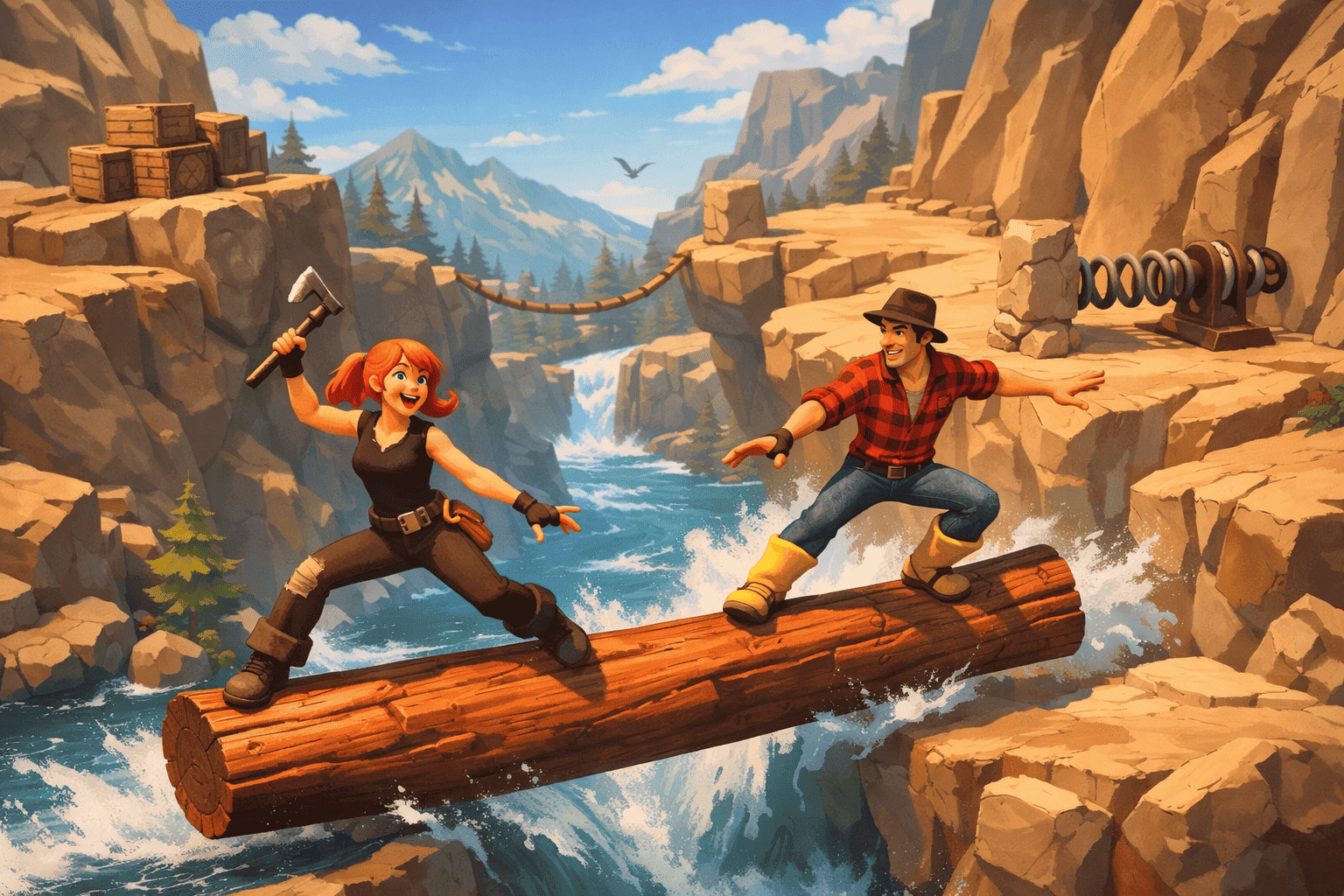
It’s one of those deceptively simple physics-based co-op puzzle games that looks almost silly at first glance—two players standing on a rolling log—but quickly turns into a masterclass in synchronization, timing, and controlled panic.
If you enjoy games that test both your mechanics and your friendship, this one deserves your attention.
Marathon 2026 Story vs Original Trilogy: Traxus and Durandal Connections

At its core, Log Riders is about balance—literally and figuratively. Every move you make affects not only the log’s momentum but also your partner’s stability. There’s no solo carry here. You either move as one, or you fall as two.
Understanding the Core Mechanics
Before even thinking about later levels, you need to internalize how the log behaves. Physics isn’t just a feature here—it’s the main character.
- Rolling: When both players roll in the same direction, the log gains serious speed. It feels powerful, but also dangerous if you don’t plan ahead.
- Rotating: Subtle horizontal adjustments can be the difference between gliding through a narrow path and spinning into the abyss.
- Counter-Roll: This is the technique that separates beginners from seasoned teams. If the log tips too far to one side, the player on that side must roll against the tilt while the partner stays neutral. It’s a delicate recovery move that feels incredibly satisfying when executed correctly.
What I love most is how these mechanics stay relevant throughout the entire game. Nothing becomes obsolete. Instead, each world layers new hazards on top of the same fundamental physics.
World 1: Learning to Trust the Physics
The first world acts as your training ground, but don’t underestimate it. Even the early levels will punish overconfidence.
In Levels 1–3, the biggest mistake is overcorrection. Players tend to panic and over-roll, causing the log to spin wildly. Staying centered and making micro-adjustments is the real lesson here.
Level 4 introduces your first gap. The trick isn’t just speed—it’s timing. Both players should roll forward together to build momentum, then instantly stop input the moment the log leaves the ramp. A flat landing dramatically reduces the risk of tipping on impact.
Level 5 narrows the path, forcing you to fully embrace rotation. Keep the log’s widest surface aligned perpendicular to the edges. It feels small, but it’s the first real coordination check.
World 2: Water Changes Everything
The Rapids world introduces buoyancy and drift, and suddenly the log feels alive in a completely different way. Momentum carries farther than expected, and surfaces are less forgiving.
Level 8’s slippery slopes are where teams often fall apart. My favorite strategy here is assigning roles: one player acts as a subtle brake, rolling slightly backward to control speed, while the other handles directional adjustments. It’s slower, but dramatically more stable.
The Whirlpool level demands counter-rotation against the water’s spin. Fighting the current feels wrong at first, but that resistance keeps you in the safe lane.
By Level 12, floating debris becomes a threat. Charging straight into objects kills your momentum and destabilizes the log. Instead, angle slightly and nudge obstacles with the side of the log. It’s controlled aggression rather than brute force.
World 3: Precision Under Pressure
The Mountain Pass is where Log Riders stops being forgiving. Steep inclines and falling rocks turn every mistake into a hard reset.
Level 15’s steep climb requires constant rolling from both players. If one hesitates, gravity wins instantly. Coordinated rolling bursts help maintain upward progress without overheating or losing rhythm.
In Level 18, audio cues matter. When you hear rumbling, don’t freeze—rotate quickly toward the edge and let the boulders crash through the center. It’s one of the few moments where avoidance feels almost cinematic.
The final bridge level rewards boldness. Speed is safer than hesitation. Micro-adjust only when the tilt becomes dangerous, otherwise commit forward. It’s a thrilling finish that perfectly tests everything you’ve learned.
Community-Tested Pro Strategies
After spending time experimenting and watching experienced teams, a few standout techniques consistently prove effective:
- Voice Countdown Sync: A simple “3-2-1 roll” keeps inputs aligned and prevents accidental imbalance.
- Controller for Precision: Analog input allows smoother micro-adjustments, especially in technical sections.
- Ghost Strategy: One player anchors and barely moves while the other handles most adjustments. Slower, but incredibly stable.
- Pivot Turn: One player rolls forward while the other rolls backward to spin the log in place. Perfect for tight corners.
These techniques transform the game from chaotic to strategic. Once both players commit to defined roles and communication, the difficulty feels fair instead of frustrating.
Handling Common Problems
If the log gets stuck between rocks, don’t panic. Rapid opposite rotations from both players create a vibration effect that often dislodges it. It looks ridiculous, but it works.
Online desync can be brutal in a physics-heavy multiplayer game. Even small latency differences can cause what I call “phantom flips,” where one player sees stability while the other sees disaster. Stable connections and low ping are more important here than in most casual co-op titles.
Why Log Riders Works So Well
What makes Log Riders special isn’t just its physics—it’s the shared responsibility. There’s no scoreboard hero, no carry potential. Every victory feels earned together. The game constantly forces communication, patience, and trust, which is rare even in modern multiplayer puzzle games.
If you enjoy physics-based co-op games, indie multiplayer challenges, or titles that reward synchronization over speed, Log Riders is absolutely worth mastering. It’s chaotic, strategic, and surprisingly deep for something built around a single rolling log. And honestly? Few games make a perfectly synchronized landing feel this good.
Riding the Chaos: My Personal Guide to Hidden Secrets and Smart Shortcuts in Log Riders
I have played a lot of physics-based games over the years, from chaotic ragdoll simulators to precision platformers, but Log Riders hits differently. At first glance, it feels like simple balance-and-survive fun. Then you start noticing strange ledges, suspicious waterfalls, oddly placed shadows — and suddenly the game transforms into a playground full of secrets. This is not just a guide. This is how I personally went from constantly wiping out to intentionally breaking the game in the best possible way.
Understanding the Physics Is Everything
The real magic of Log Riders is its physics engine. The ragdoll system is not just for laughs — it is your main tool for discovery. Once I stopped fighting the physics and started working with it, the hidden parts of the map began to reveal themselves.
- Momentum Jumps: Lean forward right as you hit a bump and you can launch yourself higher than the developers probably expected. Some of the highest ledges hide gold chests that most players never see.
- The “Lumberjack Lean”: Let your rider go loose for a split second near tight rock walls or waterfalls. Some surfaces have soft or missing collision, opening paths to secret caves tucked behind the scenery.
These mechanics feel accidental at first, but after experimenting for a few hours, you realize they are intentional playground systems waiting to be exploited.
Hidden Chests and Cosmetic Rewards
I am a sucker for cosmetics in games, and Log Riders does not disappoint. Coins are scattered everywhere, but the best rewards are never on the main path. If you are just rushing to the finish, you are missing half the fun.
- Level 3 Waterfall Secret: Instead of following the obvious route, hug the left wall behind the first waterfall. There is a hidden chest with a surprisingly generous coin boost.
- High-Branch Routes: In forest biomes, look up. Suspended logs connected by ropes usually form invisible parkour paths. If you manage to chain your jumps correctly, there is almost always a hidden chest waiting at the end.
Unlocking the iconic Handlebar Mustache cosmetic felt like a badge of honor. It is silly, yes — but that is exactly the charm.
Environmental Puzzles That Reward Curiosity
What surprised me most is how often Log Riders borrows subtle puzzle logic. Some shortcuts are not about speed — they are about observation.
- Shadow Alignment: In high-contrast levels, pay attention to tree shadows. Standing where specific shadows intersect can trigger platforms or hidden paths.
- Constellation Shortcuts: During night stages, glowing stars sometimes form patterns. Positioning your rider and log so they visually “connect” these stars can unlock secret routes that only appear in nighttime variants.
These moments made me slow down and explore instead of speedrun. The game rewards patience more than it first appears.
Advanced Tricks for Endless Points
Once you reach the later mountain courses, especially around mid-game progression, things get wild. The community discovered what players call the “Infinite Grind Log.” Near a set of contrasting arrow signs, performing a controlled nose-slide while facing left can lock your rider into a continuous grind loop that generates points indefinitely.
It feels almost like you are bending the rules of the game — but mastering it requires real control and timing.
Hidden Achievements and Easter Eggs
One of my favorite parts of modern indie titles is secret achievements, and Log Riders hides a few fun surprises.
- “Ragdoll Flight” Achievement: Earned by falling an impressive distance without dying or touching stable ground.
- Secret Companion Evolutions: In certain versions, biome management affects companion forms. Maxing out a biome’s cleanliness or capacity can unlock rare alternate appearances.
These discoveries feel organic — you stumble into them rather than checking a checklist.
Survival Tips That Saved My Progress
After dozens of wipeouts, I learned a few practical lessons:
- Activate Map Stones: They work as checkpoints even when your inventory is full. Never ignore them.
- The Quick Exit Safety Trick (PC): In rare cases, closing the game immediately after a disastrous mistake can roll back a couple of minutes of progress. It is not guaranteed, but it has saved me more than once.
Final Thoughts
Log Riders is far deeper than it first appears. It is chaotic, funny, slightly broken in the best way, and packed with hidden mechanics that reward experimentation. If you treat it like a simple balance simulator, you will finish it. But if you treat it like a sandbox full of secrets, you will uncover an entirely different game layered beneath the surface.
And honestly, that feeling — when you discover a shortcut that was hiding in plain sight the whole time — is why I keep coming back.