Gunman Contracts Stand Alone Weapon Customization Guide: All Attachments, Skins, and Audio Mods
Gunman Contracts Stand Alone is the kind of shooter that immediately makes me care about the guns. Not because it throws a giant number of weapons at you and expects you to grind through endless stat screens, but because the weapons actually feel like tools. You pick one up, manipulate it, change the setup, test it, and then take that configuration into a contract.
That feeling is especially important here because the game comes from ANB_Seth and 2080 Games as the standalone evolution of the well-known Half-Life: Alyx mod. The official release arrives on September 10, 2026, with support for both PCVR and traditional flat-screen play, including PC and Steam Deck.
And honestly, the customization system might be one of the most interesting parts of the whole package.
The big selling point for me isn’t simply adding a red dot or suppressor. Gunman Contracts Stand Alone lets you customize how a weapon looks and sounds while changing its tactical role at the same time. That makes the Gun Bench more than a cosmetic menu. It becomes part of the preparation loop.
The Hive Is Where Your Arsenal Comes Together
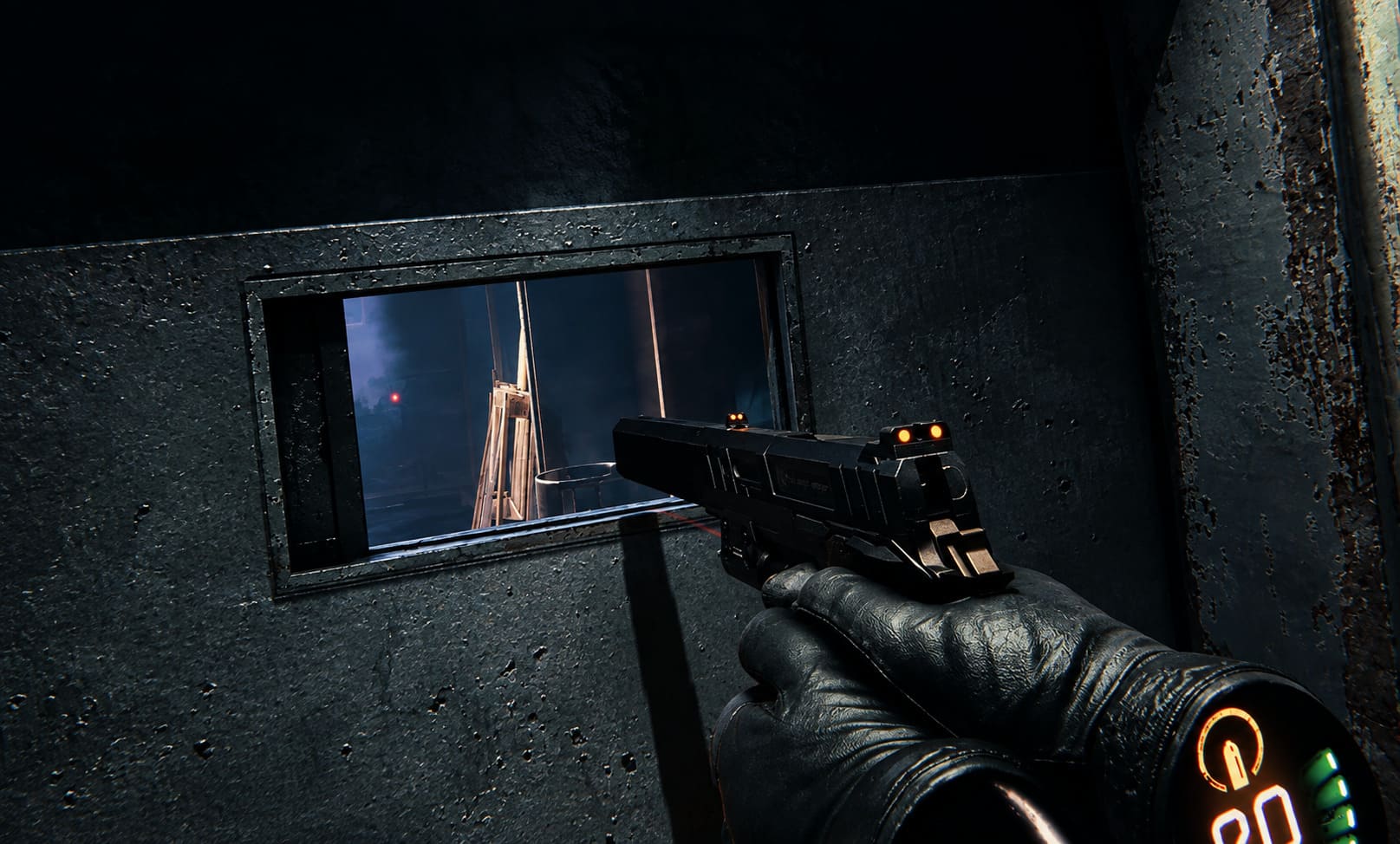
Before heading into a contract, you spend time in The Hive, the Gunman’s personal safehouse. This is where the game’s weapon systems start making sense.
There are three important areas to remember:
| Location | What You Use It For |
|---|---|
| Gunwall | Store and select your unlocked weapons |
| Gun Bench | Modify attachments, finishes, audio and other weapon options |
| Gun Range / Holo-Arena | Test recoil, optics and weapon handling |
The Gunwall is particularly satisfying because weapons aren’t just icons in a menu. You physically interact with your collection, which fits the game’s emphasis on tactile gunplay.
The Gun Bench is where things get much deeper. This is effectively your gunsmithing station, allowing you to turn a basic firearm into something much more specialized.
Then there’s the Gun Range. I strongly recommend testing a new setup before taking it into a difficult contract. A modification that looks great on paper can feel completely different once you’re actually moving, aiming and firing.
The Four Main Layers of Weapon Customization
Gunman Contracts Stand Alone separates customization into four broad categories: tactical attachments, cosmetics, audio, and ammunition.
That division makes the system easy to understand without making it feel simplistic.
1. Tactical Attachments
This is the traditional part of the system, but there are still plenty of useful choices.
Optics are designed around different engagement distances. A micro red dot such as an RMR-style sight is excellent for close-quarters encounters, while holographic sights offer a more general-purpose option. Magnified optics become useful when you’re dealing with longer sightlines, particularly in larger industrial environments.
Muzzle devices change the personality of a weapon even more:
- Compensators help control vertical muzzle movement.
- Flash hiders reduce visible muzzle flash.
- Suppressors are the obvious choice for stealth-oriented approaches.
Then you have the underbarrel options. Tactical flashlights are extremely useful in dark interiors, while red and green laser sights give you a visible hip-fire reference.
For flat-screen players, lasers can be especially interesting because they provide an additional visual reference while using the game’s controller-oriented aiming system.
Magazine choices are simpler but still important. Standard magazines generally keep handling straightforward, while extended magazines give you more ammunition before a reload at the cost of some handling efficiency.
2. Weapon Skins Actually Fit the Game
I’m usually not the person who gets excited about weapon skins in tactical shooters. Give me a good sight and suppressor and I’m happy.
But the visual customization here works because the aesthetic direction already fits the criminal-underworld atmosphere.
The available finishes include:
- Matte Black / Tactical Oxide
- Polished Chrome / Silver Agent
- Desert Tan / Urban Camouflage
- Carbon Fiber Weave
- Worn Patina / Battlefield Scarred
These finishes are tied to progression and achievement milestones, giving them more value than simply being something you buy from a cosmetic store.
Personally, the worn and battered finishes fit the game’s tone best. A pristine chrome weapon looks cool, sure, but there’s something much more appropriate about carrying a firearm that looks like it has already survived a few ugly contracts.
The Audio System Is the Part I Really Like
This is where Gunman Contracts Stand Alone starts doing something unusual.
Weapon sound is treated as a customization option rather than a fixed property.
According to the provided launch information, a single firearm can have access to a library of up to 74 distinct real-world and cinematic sound effects. That’s a surprisingly large amount of audio variety for something that many shooters would simply lock to one sound profile.
At the Gun Bench, you can customize several elements.
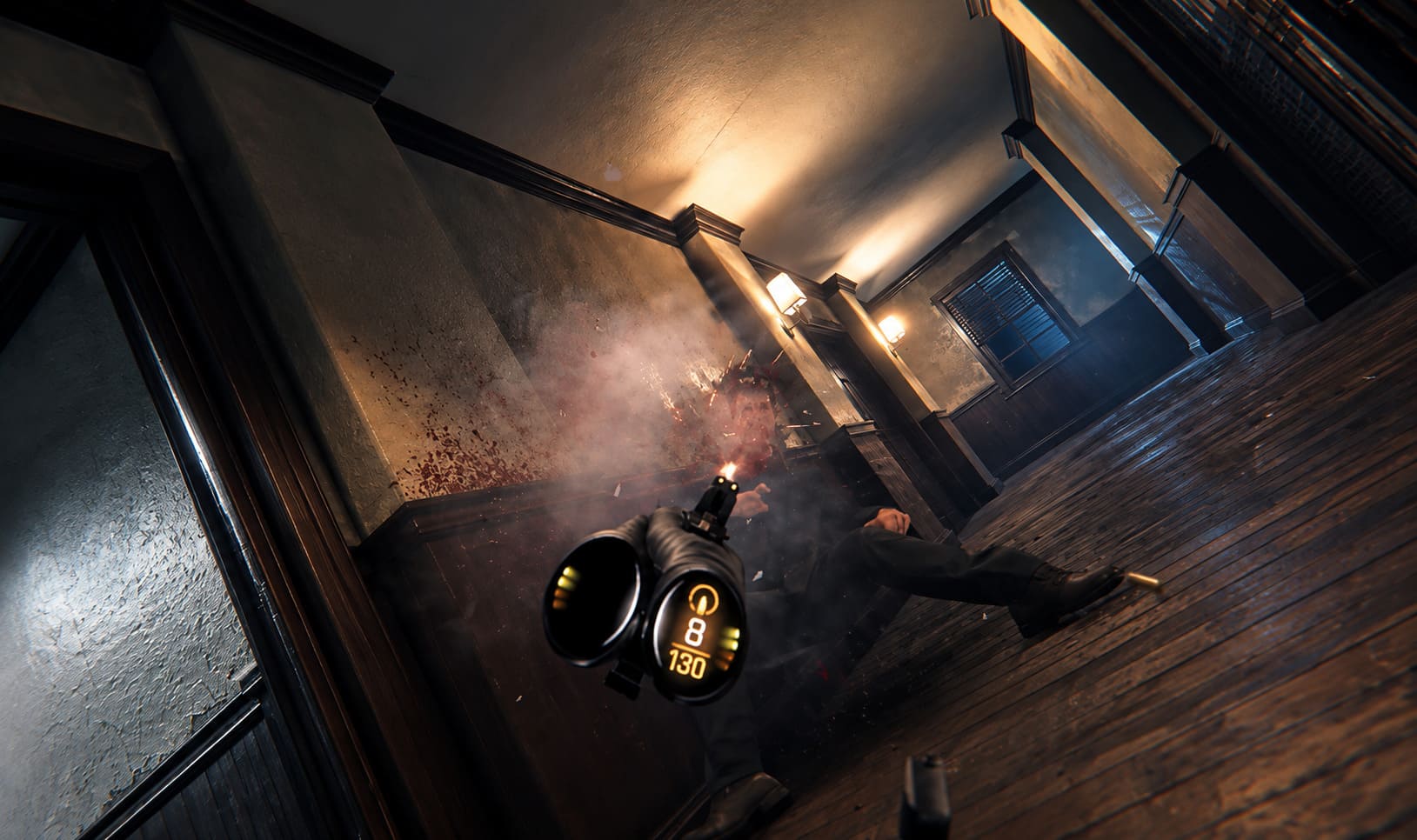
Unsuppressed Fire
You can choose between different styles of gunfire, including sharp metallic snaps, heavy cinematic reports and deeper low-frequency sounds.
This isn’t just about realism. Sound changes the character of a weapon.
A heavy boom makes a compact firearm feel like something entirely different from a weapon with a sharper, more aggressive crack.
Suppressed Fire
The difference is even more noticeable with suppressors.
You can choose a Hollywood-style quiet “pew” or a more pressurized tactical sound. I personally prefer the latter. The exaggerated movie-silencer effect is fun, but the heavier suppressed sound gives the weapon more physical presence.
Mechanical Audio
The system also covers handling sounds.
Slide racks, bolt releases and empty-magazine interactions can have different audio feedback. In a VR game, that’s particularly valuable because your ears become part of the feedback loop.
When you’re physically manipulating a weapon, the sound of the action can make the entire interaction feel more convincing.
Ammunition Can Change Your Approach
The ammunition system adds another tactical layer.
Standard full-metal-jacket ammunition remains the basic option, but specialized rounds provide different possibilities.
Incendiary ammunition can ignite targets and create damage-over-time effects while potentially forcing enemies out of cover.
Subsonic match ammunition is designed around suppressed weapons and stealth, reducing the sonic crack associated with conventional ammunition.
That creates an obvious stealth build: suppressed weapon + subsonic ammunition + appropriate optic.
Alternatively, you can completely abandon subtlety and build something designed to hit hard and make a lot of noise.
That’s exactly the kind of freedom I want from a tactical shooter.
Gunman Contracts Stand Alone Weapon Categories
The launch arsenal contains 18 base unlockable firearms, alongside specialized ranged and melee weapons.
The exact weapon roles are more important than simply counting guns because each category encourages a different style of play.
Pistols and Sidearms
Pistols are the foundation of close-range combat and support dual-wielding configurations.
- Custom Tactical Pistol — reliable semi-automatic sidearm with suppressor support and multiple optic mounting possibilities.
- Heavy Caliber Revolver — huge stopping power with equally serious recoil.
- Tactical Automatic Pistol — fully automatic machine pistol that benefits from laser-equipped configurations.
The revolver especially sounds like the kind of weapon I would keep around for contracts where subtlety has already gone out the window.
Rifles and Carbines
For more flexible engagements, rifles are the obvious choice.
The Modular Assault Rifle offers the broadest customization potential, particularly with optics, magazines and muzzle devices.
The Soviet Bloc Assault Rifle takes a heavier approach, offering strong penetration and its own distinctive mechanical sound profile.
The Tactical Carbine sits somewhere between the two, prioritizing maneuverability and quick transitions.
Shotguns
Shotguns are built for the moments when enemies get too close.
The Pump-Action Tactical Shotgun emphasizes manual operation and stopping power, while the Semi-Automatic Combat Shotgun gives you faster follow-up shots when several enemies push at once.
Shotgun audio customization also makes sense here. A heavy pump-action sound is practically part of the weapon’s identity.
The Compound Bow and Knife System Are Worth Remembering
Not every contract needs to end with a loud firefight.
The Compound Bow provides a completely silent ranged option. You manually nock, draw and release arrows, with projectile drop and flight behavior adding another layer to the weapon.
Then there are the combat knives.
Knives aren’t simply backup weapons. They can be used for slashing, stabbing and throwing, which gives them a surprisingly flexible role during stealth encounters.
There’s also a cool progression mechanic tied specifically to found knives.
If you get three kills with a particular found knife during a contract, that knife can be permanently added to your Gunwall collection.
That’s a small feature, but I love systems like this. It gives random weapons found during missions an actual reason to matter.
VR and Flat-Screen Players Get Different Experiences
One of the biggest strengths of Gunman Contracts Stand Alone is that it isn’t trying to make VR and traditional controls behave identically.
In VR, weapon handling is physical. You reach for your equipment, manipulate magazines, rack slides and interact with attachments directly.
That means customization feels like something you’re physically doing rather than simply selecting from a menu.
Flat-screen players get a cleaner interface built around mouse, keyboard and controller input. The game also uses a three-tier aim-assist system intended to make precise aiming more manageable on conventional hardware.
That’s important because VR aiming and mouse/controller aiming have completely different strengths.
I actually like this approach. Instead of pretending both versions work exactly the same way, the game adjusts its interaction model to suit the hardware.
Progression Gives Customization a Purpose
Weapon parts and finishes are connected to contract progression and achievements rather than being completely isolated from the main game.
The safehouse prologue, Warehouse operation and other contracts contribute to unlocking additional equipment and customization options.
There are also dedicated modes that reward high performance. Takedown Mode throws up to 30 aggressive AI enemies into a confined combat scenario, while Last Stand Mode focuses on surviving endless waves and dealing with explosive threats.
Strong leaderboard performances can provide cosmetic rewards, giving players another reason to revisit these modes after completing the main contracts.
Don’t Forget the Gunman’s Smartphone
There’s even a strange little personal touch hidden inside the safehouse systems.
Players can place their own .mp3 files into the appropriate local game directory and use the Gunman smartphone interface to play custom music through safehouse speakers or tactical earpieces.
It’s not directly related to weapon statistics, but features like this help The Hive feel like an actual personal base rather than another menu disguised as a room.
And yes, putting your own soundtrack on while modifying weapons at the Gun Bench sounds exactly like the kind of thing I’d end up doing for far too long.
How to Fix Gunman Contracts Stand Alone Crashing on Launch: Complete Troubleshooting Guide
My Recommended Customization Philosophy
If you’re just starting out, I wouldn’t try to build the most complicated weapon possible.
Instead, create setups around the type of contract you’re expecting.
| Playstyle | Suggested Setup |
|---|---|
| Stealth | Suppressor + Subsonic Ammo + Red Dot |
| CQB | Holographic Sight + Flashlight + Extended Magazine |
| Aggressive | Compensator + Extended Magazine + Fast Optic |
| Long Range | Magnified Optic + Compensator |
| Silent Hunter | Compound Bow + Knife |
The most important thing is to test everything at the Gun Range. Weapon customization is only useful when the configuration feels right in your hands.
Gunman Contracts Stand Alone Low FPS Fix: Performance Optimization Guide
Final Thoughts
Gunman Contracts Stand Alone could have easily treated customization as a standard checklist of sights, magazines and suppressors. Instead, it makes the weapon itself part of the game’s personality.
The Gun Bench, audio profiles, weapon finishes, ammunition options and physical VR interaction all reinforce the same idea: your loadout should feel like yours.
That’s what I find most appealing about this system.
I’m especially interested in the audio customization because it’s the sort of feature you don’t see pushed this far in many shooters. Being able to change not only the appearance and handling of a weapon but also its acoustic identity makes each configuration feel more personal.
Whether you build a quiet suppressed pistol for methodical infiltration, a brutal shotgun for close-quarters chaos, or a customized rifle designed to dominate longer sightlines, Gunman Contracts Stand Alone gives you plenty of room to experiment.
And for a game built around contract missions, that’s exactly what weapon customization should do: make you think about the job before you pull the trigger.