Esports Manager 2026 Tactic Creator Guide: Master the Playbook & Dominant the Meta
Winning in Esports Manager 2026 isn’t about signing five superstar players and hoping their ratings carry you to another championship. I learned that lesson the hard way after multiple failed tournament runs where my roster looked incredible on paper but completely collapsed against smarter opponents.
What surprised me most is how much the game’s Tactic Creator changes everything. Instead of simply choosing an aggressive or defensive style, you’re building an entire system that reacts to maps, economy, player personalities, and even momentum during a match.
After spending far too many late nights experimenting with different tactical combinations, I realized that successful teams don’t necessarily have the best players—they have the best preparation. Here’s the approach that consistently helped me outperform stronger lineups.
The Tactic Creator Is the Real Endgame
At first glance, the tactical editor can feel overwhelming.
There are assignments, player routes, economy presets, side-specific strategies, critical player settings, and dozens of tiny adjustments that don’t seem important until they suddenly decide an entire series.
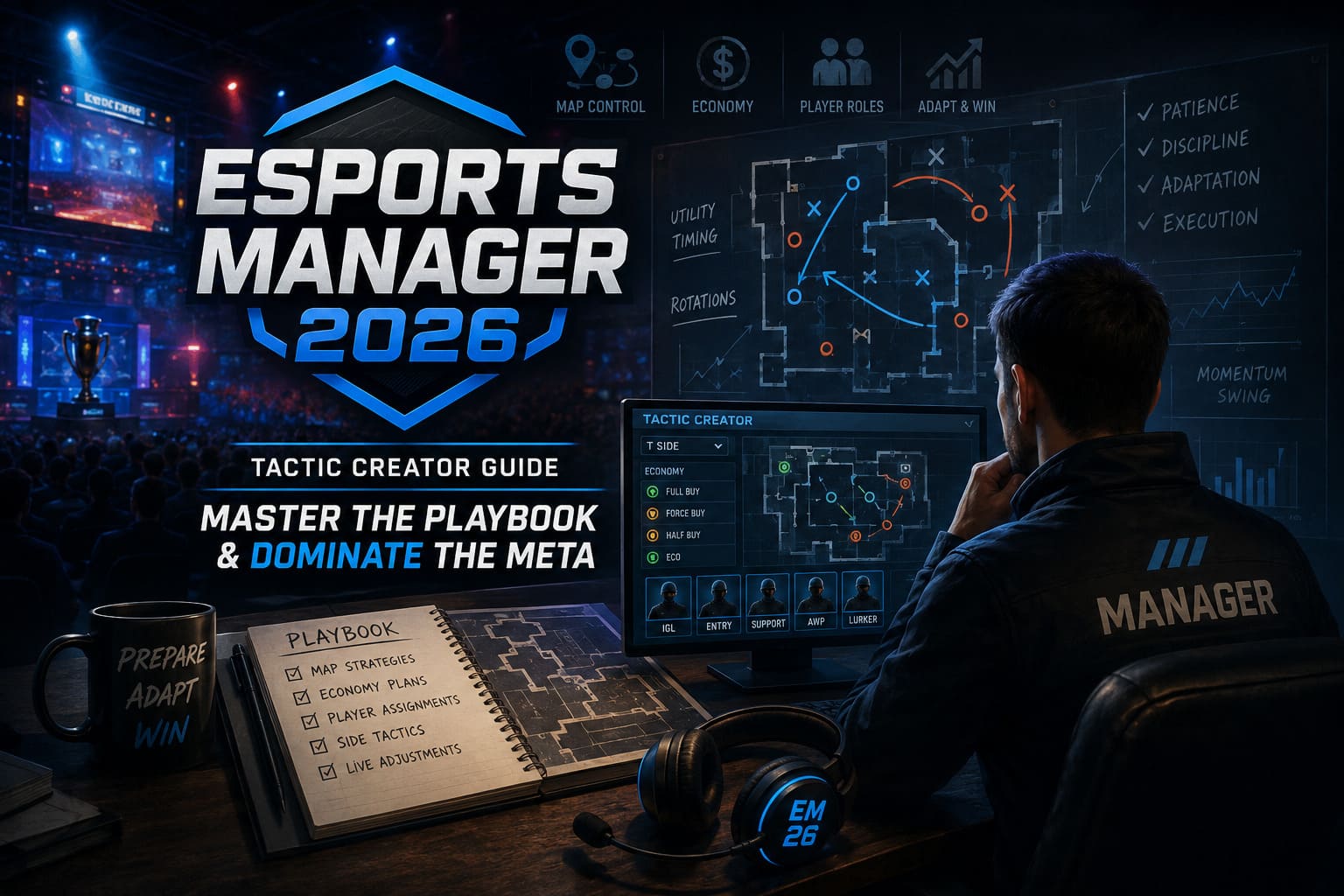
The mistake I made early was treating tactics like something I would create once and never touch again.
That simply doesn’t work.
Your playbook should constantly evolve as your roster develops, your opponents adapt, and new tournament challenges appear.
Instead of thinking about tactics as individual strategies, imagine them as a toolbox.
Different situations require different tools.
Every Map Deserves Its Own Identity
One of the biggest improvements I made was abandoning universal strategies.
Trying to force the same approach across every map almost always backfires.
Maps reward different styles of play, different timings, and completely different positioning.
Here’s the way I now organize my playbook:
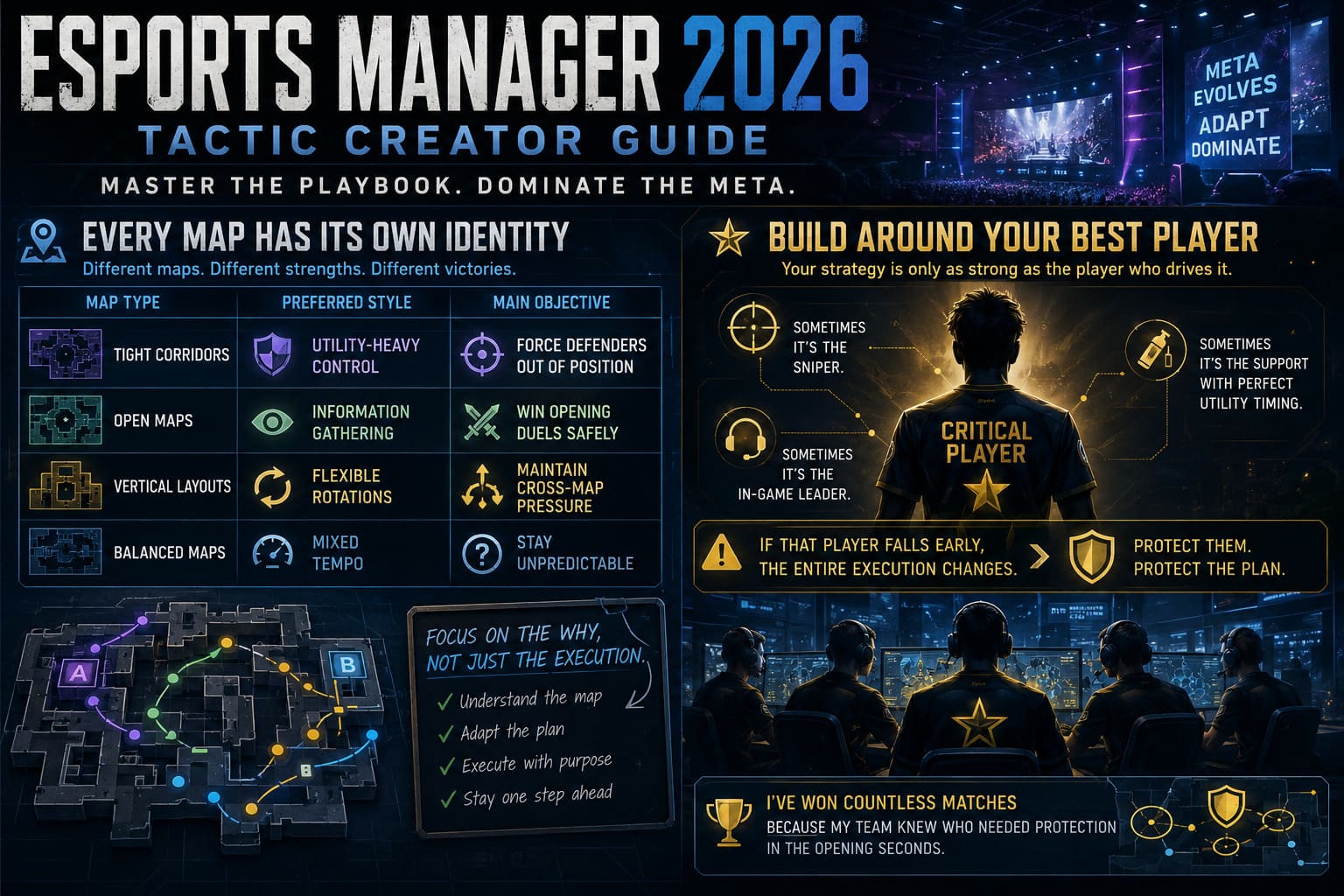
| Map Type | Preferred Style | Main Objective |
|---|---|---|
| Tight Corridors | Utility-heavy Control | Force Defenders Out of Position |
| Open Maps | Information Gathering | Win Opening Duels Safely |
| Vertical Layouts | Flexible Rotations | Maintain Cross-map Pressure |
| Balanced Maps | Mixed Tempo | Stay Unpredictable |
Instead of memorizing perfect executions, I focus on understanding why a strategy works on a particular map.
That mindset made adapting much easier.
Build Around Your Best Player
One feature I absolutely love is the ability to designate a Critical Player.
Many managers simply assign this role to their highest-rated player.
I don’t.
I assign it to the player who actually defines how my strategy functions.
Sometimes that’s the sniper.
Sometimes it’s the in-game leader.
Sometimes it’s even a support player responsible for critical utility timing.
If that player dies early, the entire execution changes, so protecting them becomes part of the strategy itself.
I’ve won countless matches simply because my team understood who needed protection during the opening seconds.
I Prefer Flexible Assignments Over Rigid Scripts
Early on, I hardcoded every player into specific roles.
It looked organized.
It also completely fell apart whenever someone died early.
Now I let my IGL handle many mid-round responsibilities.
The flexibility is worth far more than perfect scripting.
The AI generally makes surprisingly reasonable decisions when your tactical foundation is solid.
I only hard-lock assignments for:
- Opening sniper positions
- Entry fraggers
- Essential utility throws
- High-risk early aggression
Everything else benefits from adaptation.
The First 30 Seconds Decide More Rounds Than Most People Think
Watching my own match replays taught me something interesting.
Most rounds were practically decided before the first major engagement even happened.
Good opening movement creates pressure.
Bad opening movement creates hesitation.
Whenever I create a new tactic, I focus on three simple questions.
- Where is everyone moving?
- Who gathers the first information?
- Who is responsible for utility?
If those answers are clear, the rest of the round usually flows naturally.
Terrorist Side: Patience Wins More Than Speed
Many players love constant rushing.
I used to be one of them.
It works against weaker teams.
Against strong AI?
Not so much.
Nowadays my favorite approach is building slow defaults that gradually force defenders into uncomfortable decisions.
A typical round often looks like this:
- Spread across the map.
- Collect information.
- Force defensive utility.
- Wait for mistakes.
- Hit the weaker bombsite together.
Ironically, playing slower often leads to much faster victories because defenders eventually run out of resources.
Counter-Terrorist Side Is About Discipline
The defensive side rewards patience far more than flashy hero plays.
Whenever my roster struggles mechanically, I stop trying to contest every position.
Instead, I design defensive systems that emphasize:
- Safe positioning
- Efficient rotations
- Crossfires
- Late retakes
- Utility conservation
Retakes may feel risky, but coordinated retakes are usually better than losing two players trying to defend an impossible position.
Never Ignore Your Economy
This is probably the most underrated feature in the entire tactical system.
Too many managers create one perfect strategy without considering whether their team can actually afford to execute it.
I maintain separate tactical packages for every financial situation.
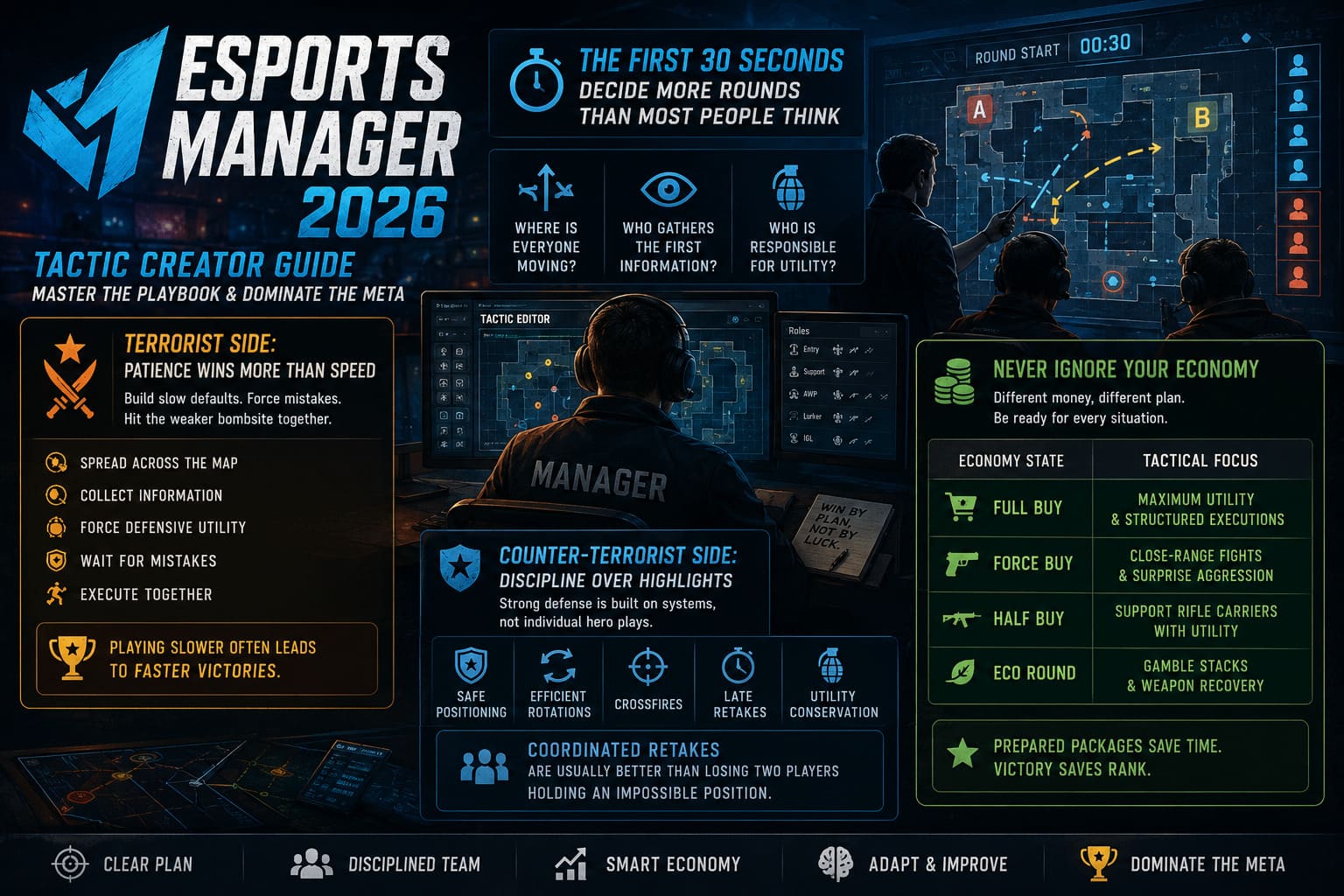
| Economy State | Tactical Focus |
|---|---|
| Full Buy | Maximum Utility and Structured Executions |
| Force Buy | Close-range Fights and Surprise Aggression |
| Half Buy | Support Rifle Carriers with Utility |
| Eco Round | Gamble Stacks and Weapon Recovery Attempts |
Having these ready before the match saves an incredible amount of time during live simulations.
Live Coaching Is Where Championships Are Won
The tactical editor gives you the foundation.
Live coaching finishes the job.
One habit I’ve developed is constantly watching for patterns instead of individual rounds.
If an opponent repeatedly pushes the same lane, I punish it.
If they refuse to contest map control, I take more space.
If their sniper dominates one angle, I simply stop giving him that fight.
Making small adjustments throughout a match has earned me far more victories than creating some mythical “perfect strategy.”
There isn’t one.
Halftime Is Your Opportunity to Surprise Everyone
One of my favorite tricks is intentionally changing the pace after halftime.
If I’ve spent the first half playing slowly, I’ll suddenly introduce fast executes.
If I’ve been aggressive, I’ll slow everything down.
The AI often struggles when forced to adjust to a completely different rhythm.
Even if your original strategy was working reasonably well, unpredictability can be an even stronger weapon.
Your Players Should Define Your Tactics
I see this mistake discussed constantly among the community.
Managers force players into systems that simply don’t suit them.
That almost never ends well.
Instead, I always build tactics around individual strengths.
| Player Type | Primary Focus |
|---|---|
| Aggressive Riflers | Confidence, Aim, Fast Reactions |
| Support Players | Positioning, Awareness, Utility Usage |
| Snipers | Space Control, Information, Angle Holding |
| Rookies | Simple Responsibilities and Veteran Support |
Trying to transform everyone into identical players usually reduces the entire team’s effectiveness.
Small Improvements Create Huge Results
One thing I genuinely appreciate about Esports Manager 2026 is that success rarely comes from one massive change.
It’s usually dozens of tiny optimizations.
Maybe you rotate one player slightly earlier.
Maybe you delay a smoke by two seconds.
Maybe you save instead of forcing.
Individually those decisions barely matter.
Together they completely change a tournament.
That’s what keeps me coming back.
Every new save feels like another puzzle waiting to be solved.
How to Fix Monopoly Star Wars Heroes vs Villains Connection Error and Black Screen
Final Thoughts
If there’s one lesson I’ve taken away from hundreds of simulated matches, it’s this:
The strongest roster doesn’t always win.
The smartest roster usually does.
The Tactic Creator rewards managers who constantly analyze, experiment, and refine their ideas instead of relying on default presets or copying someone else’s strategies.
Don’t be afraid to scrap an entire playbook if it stops working.
Test unusual ideas.
Watch your replays.
Pay attention to economy, player confidence, and map-specific tendencies.
Eventually you’ll build a tactical identity that feels uniquely yours—and that’s when Esports Manager 2026 becomes far more than a management simulator. It becomes one of the most satisfying strategy experiences in modern esports gaming.