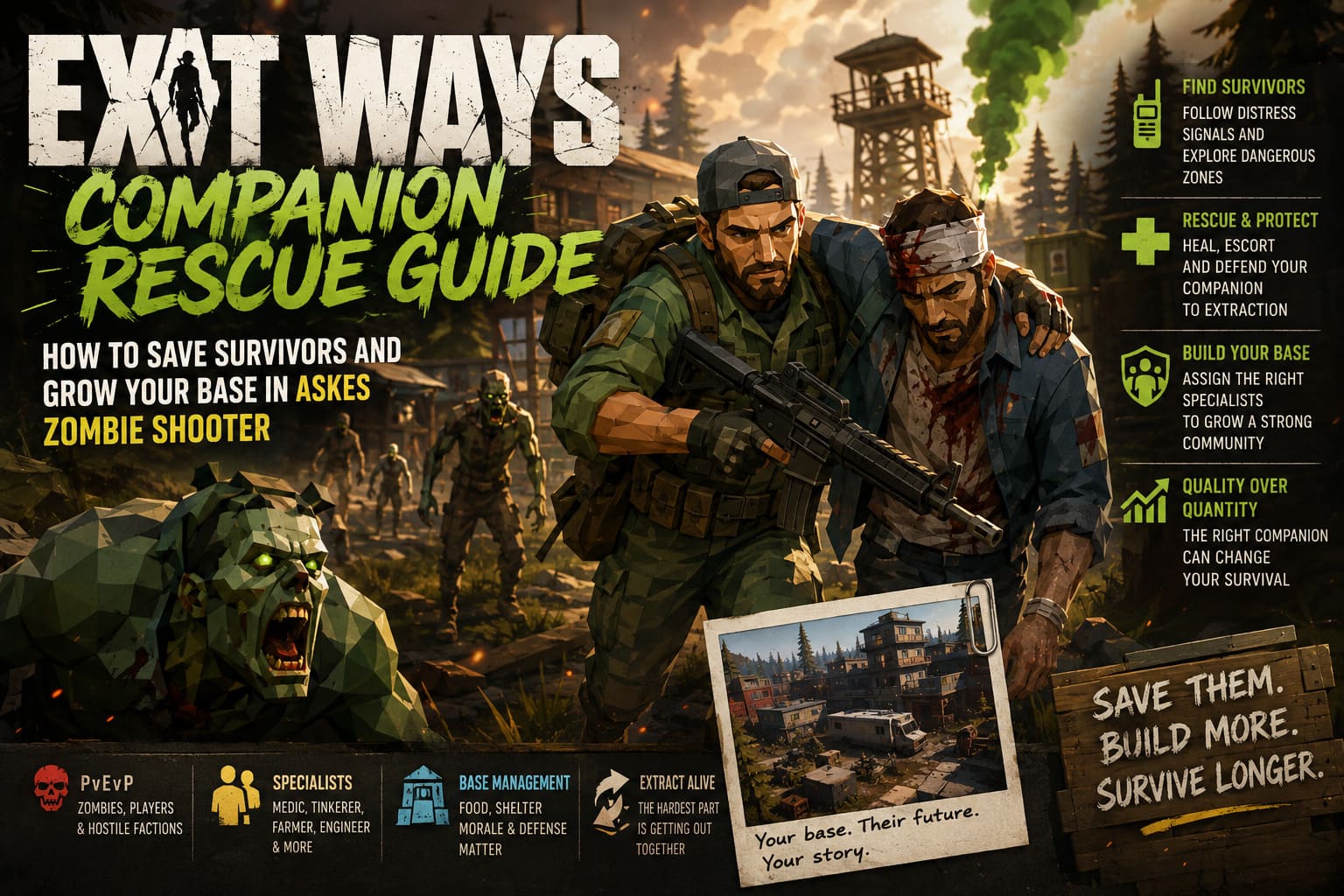
Exit Ways Companion Rescue Guide: How to Save Survivors and Grow Your Base in ASKES Zombie Shooter
Exit Ways is the kind of survival shooter that can make a simple trip for supplies feel like a terrible decision five minutes later. Developed and published by ASKES, the game mixes PvEvP extraction gameplay with zombies, hostile survivors, resource management, and a surprisingly important community system. You can spend an entire raid looking for weapons and valuable materials, only to discover that the most useful thing you can bring home is another human being.
That is where the companion system becomes so important. Rescued survivors are not just NPCs who stand around your base and make it look populated. They can become specialists, workers, defenders, and valuable contributors to your long-term progression. In my experience with survival games, systems like this are usually either forgettable side mechanics or something that completely changes how you approach the game. Exit Ways leans much closer to the second category.
Rescuing a companion, however, is considerably more complicated than simply finding an NPC and walking them to an extraction point. You have to locate them, keep them alive, manage their condition, survive the attention generated by the rescue, and then actually get both of you out. This Exit Ways Companion Rescue Guide explains how the system works, where survivors can appear, how to protect them during extraction, and how to turn rescued characters into useful members of your growing settlement.
Onimusha: Way of the Sword Steam Deck Best Settings Guide: Maximize Performance & Battery Life
Why Companions Matter So Much in Exit Ways
When you first start playing Exit Ways, it is tempting to think of every raid in the same way: enter the exclusion zone, grab whatever valuable loot you can carry, complete your objectives, and get out. That approach works for a while, but eventually the limits of your starting base become obvious. Better crafting, improved production, medical support, food generation, and defensive capabilities all depend on developing your community.
That makes survivors one of the most valuable forms of progression in the game. A good companion can provide benefits that are difficult to replace with ordinary loot. One survivor might be excellent at repairing equipment, while another could improve food production or medical efficiency. The randomized nature of their characteristics also means that two survivors with the same general profession are not necessarily equally useful.
Personally, this is one of the mechanics I find most interesting because it gives extraction runs a little more personality. Finding a rare weapon is satisfying, but finding a survivor with exactly the traits your settlement needs creates a completely different kind of tension. Suddenly, getting out alive matters for more than your inventory.
Where to Find Survivors
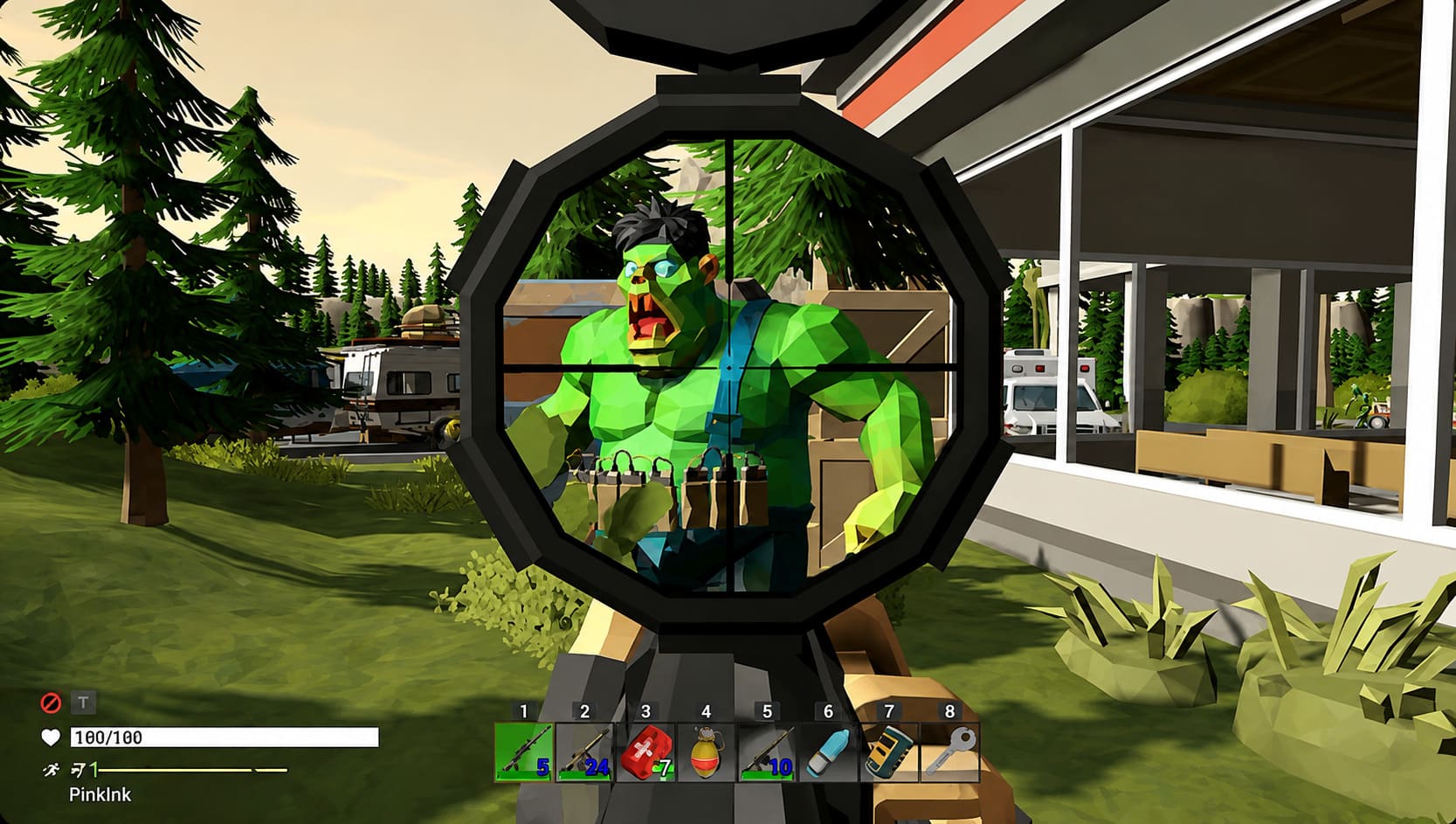
Survivors are generally not placed in completely obvious locations. You need to pay attention to environmental clues and the information the game gives you during a raid. Exploring every building randomly can work, but it is inefficient and can quickly burn through ammunition and healing supplies.
There are several important clues worth watching for when searching the exclusion zones:
- Distress signals: Radio transmissions, static, and SOS messages can indicate that a survivor is in trouble somewhere nearby. Treat these signals as opportunities rather than background noise.
- Barricaded locations: Reinforced doors, boarded windows, unusual camps, and other defensive structures can indicate that someone is hiding or trapped inside.
- Rogue faction camps: Some survivors may be held by hostile human NPCs. These encounters are generally more dangerous because you have to deal with armed enemies before you can even begin the rescue.
The important thing is not to sprint toward every signal immediately. A rescue location can be surrounded by infected, hostile AI, or players who have heard the same activity and decided to investigate. Sometimes the safest approach is to watch the area from a distance first and work out an escape route before interacting with the survivor.
Exit Ways Companion Rescue: The Safe Method
1. Clear the Area Before Starting the Rescue
The worst mistake you can make is reaching a survivor and immediately starting the interaction without checking the surroundings. Rescue events can create additional noise and attention, turning an otherwise quiet building into a combat zone. If there are zombies nearby, deal with the most dangerous ones before beginning the rescue.
Stealth is particularly useful here. A suppressed weapon, careful positioning, and patience can save a ridiculous amount of ammunition. If you have defensive equipment available, place it around obvious entrances or chokepoints. You do not need to turn the location into a fortress, but giving yourself a few seconds of warning can make the difference between a successful rescue and watching your companion collapse.
2. Check the Survivor’s Condition
Once you reach the survivor, do not assume they are ready to follow you. Some companions can be injured, exhausted, dehydrated, or suffering from other negative conditions. Starting the escort without dealing with those problems is asking for trouble.
I recommend keeping a small emergency supply specifically for rescue missions. A spare first-aid kit and some clean water might take up inventory space, but that space is worth it when you have just found an excellent specialist. There is nothing more frustrating than successfully clearing a dangerous location only to lose the survivor because you did not have enough medical supplies.
3. Keep the Companion Behind Cover
After the rescue begins, the survivor becomes a moving vulnerability. Companions generally cannot move as quickly or fight as efficiently as an experienced player, which means you have to change your normal movement strategy. Do not simply sprint toward extraction and expect the NPC to keep up.
Instead, think of yourself as a bodyguard. Move ahead when necessary, check corners, eliminate threats, and choose routes that provide cover. If enemies start attacking, your priority should be keeping pressure away from the companion rather than chasing every target. The goal is not to win every fight. The goal is to leave the zone alive.
The PvEvP Problem: Other Players Are the Real Danger
Zombies are predictable compared with human players. Once another player realizes you are escorting a survivor, your situation can change instantly. You are slower, your attention is divided, and you have an NPC who cannot necessarily react to an ambush the way you can.
This is why your extraction route should be planned before you start moving. Open roads and large fields may look like the fastest option, but they also give enemy players excellent sightlines. Whenever possible, use buildings, forests, underground routes, industrial structures, and other terrain that breaks long-distance visibility.
If you are playing with friends, divide responsibilities. One player can scout ahead while another stays close to the survivor. A third player, if available, can watch the rear. This simple formation makes the escort considerably safer because everyone knows what they are supposed to protect.
Extraction Is Not the Time to Relax
One of the biggest traps in extraction games is becoming careless once you reach the evacuation area. Getting there does not mean you are safe. In fact, the final extraction countdown can be one of the most dangerous moments of the entire raid.
Whenever possible, keep your companion in cover while you check the surrounding area. If the extraction point is exposed, use nearby buildings, walls, elevation, or other terrain to create a defensive position. Move the survivor toward the evacuation vehicle only when you are confident that the immediate area is reasonably secure.
Companion Roles and Base Management
Successfully extracting a survivor is only half the job. Once they arrive at your base, you need to turn that rescued NPC into a productive member of the community. This is where the companion system starts connecting directly with base building.
| Companion Type | Useful Assignment | Potential Benefit |
|---|---|---|
| Tinkerer | Workshop | Improved crafting and equipment production |
| Medic | Infirmary | Better medical support and recovery |
| Farmer | Hydroponics | Improved food production |
| Engineer | Resource Facilities | Better production efficiency |
| Combat Specialist | Base Defense | Stronger protection against threats |
The basic rule is simple: match the survivor to the job they are actually good at. Putting a specialist in the wrong workstation wastes the potential you risked your life to obtain. Before assigning anyone, look at their traits, profession, and statistics instead of automatically placing them wherever there is an empty slot.
Housing, Food, and Morale
A larger community also means a larger responsibility. Companions need somewhere to sleep, food to eat, and access to clean water. If your settlement cannot support its population, morale and productivity can suffer, turning your carefully rescued specialists into another resource problem.
This is why I would not recommend rescuing every survivor you encounter simply because the game allows it. More people are not automatically better. A poorly supplied base full of mediocre companions can be less efficient than a smaller settlement built around several highly useful specialists.
Think about your community as another economy. Every additional survivor consumes resources, but a good survivor should eventually provide more value than they cost to maintain. That balance becomes increasingly important as your settlement grows.
Leveling and Equipping Your Companions
Companions can become more valuable over time as they gain experience and develop their skills. That means a survivor who initially looks average may become much more useful after you invest in them. The same principle applies to equipment: a companion equipped with appropriate weapons and armor can become a meaningful defensive asset rather than just another NPC standing around the compound.
However, I would avoid spending your best equipment on every survivor. Give your strongest gear to characters who actually benefit from it, particularly specialists you plan to keep long term. When a companion has both strong traits and useful equipment, they can become an important part of your base’s defensive structure.
Negative Traits You Should Watch For
Not every survivor is worth the risk of extraction. This is an easy detail to overlook when you are excited about finding another potential recruit, but negative traits can dramatically change the value of a companion.
- Fragile: A vulnerable companion can be extremely difficult to protect during dangerous raids.
- Loud: Traits that increase attention or noise can make an already dangerous escort even worse.
- Low utility: A survivor with poor stats and no useful specialization may consume resources without providing enough value.
That does not mean you should automatically abandon anyone with a negative trait. Sometimes a survivor has one major weakness but an excellent profession or rare ability that makes the rescue worthwhile. The trick is evaluating the entire character rather than judging them by a single statistic.
My Best Tips for Successful Companion Rescues
After approaching the system like a traditional extraction mechanic, I found that the safest strategy is actually to slow down. The game rewards preparation much more than reckless aggression when a survivor is involved. A few extra minutes spent checking the area can save an entire raid.
- Carry dedicated medical supplies. Never assume the survivor will be healthy when you find them.
- Scout before interacting. Clear or observe the area before triggering the rescue event.
- Plan extraction backwards. Know where you want to go before the escort begins.
- Use cover constantly. Keep your companion away from open sightlines whenever possible.
- Prioritize quality over quantity. A rare specialist can be worth far more than several mediocre survivors.
There is also one lesson that applies to almost every extraction shooter: you do not have to take every fight. If another squad starts shooting at you from a distance, running may be the correct answer. Your objective is to extract your companion, not to prove that your loadout is better than theirs.
Is the Companion System Worth Focusing On?
Absolutely, especially once you move beyond the early stages of Exit Ways. The companion system gives the survival loop a much stronger sense of progression because every successful rescue can improve the way your base functions. Instead of simply collecting another pile of resources, you are building a community that makes future raids more efficient.
What I particularly like about this approach is that it creates stories naturally. A weapon can be replaced, ammunition can be crafted, and resources can be gathered again. A companion you risked everything to rescue feels different because their survival becomes part of your personal run history. When that character later helps produce equipment or defend the compound, the connection between the raid and your base becomes much more meaningful.
Final Thoughts
Mastering Exit Ways companion rescue is less about shooting everything in sight and more about understanding risk. You need to identify worthwhile survivors, prepare for their condition, control the route, protect them from infected enemies, and stay alert for hostile players. Every stage of the rescue creates another opportunity for something to go wrong.
But that is exactly what makes the system enjoyable. When you finally walk through the gates of your base with a valuable specialist alive, it feels like you actually accomplished something rather than simply completing another objective marker. Build your community carefully, invest in the survivors who bring real value, and treat every escort mission as a high-risk extraction rather than a simple fetch quest.
If you approach the system that way, your settlement can evolve from a fragile collection of basic facilities into a self-sufficient stronghold. And in a game where the next raid can go wrong in seconds, having a strong community behind you may be just as important as having a powerful weapon in your hands.