EMPULSE Early Access Roadmap 2026: Update Cadence, New Maps, and Mech Balancing Revealed
The multiplayer shooter genre has spent years chasing trends. Battle royales exploded, extraction shooters became the next big thing, and every major publisher seemed obsessed with seasonal battle passes and endless monetization systems. Meanwhile, fans of fast-paced movement shooters have been left searching for something that captures the magic that games like Titanfall once delivered.
That is exactly why EMPULSE has caught my attention.
After watching gameplay footage, reading developer updates, and following community discussions surrounding the June 2026 launch, I genuinely believe EMPULSE could become one of the most interesting multiplayer releases of the year. It is not trying to copy the latest trend. Instead, it focuses on speed, skill, movement, mechs, and player-driven progression.
More importantly, the developers at 1047 Games appear determined to build the game alongside the community rather than forcing players into a rigid live-service model.
Why EMPULSE Feels Different
The first thing that stands out about EMPULSE is its commitment to mobility.
Most modern shooters advertise movement systems, but few actually make movement the center of gameplay. In EMPULSE, movement is not just a tool for getting from one objective to another. It is the foundation of combat itself.
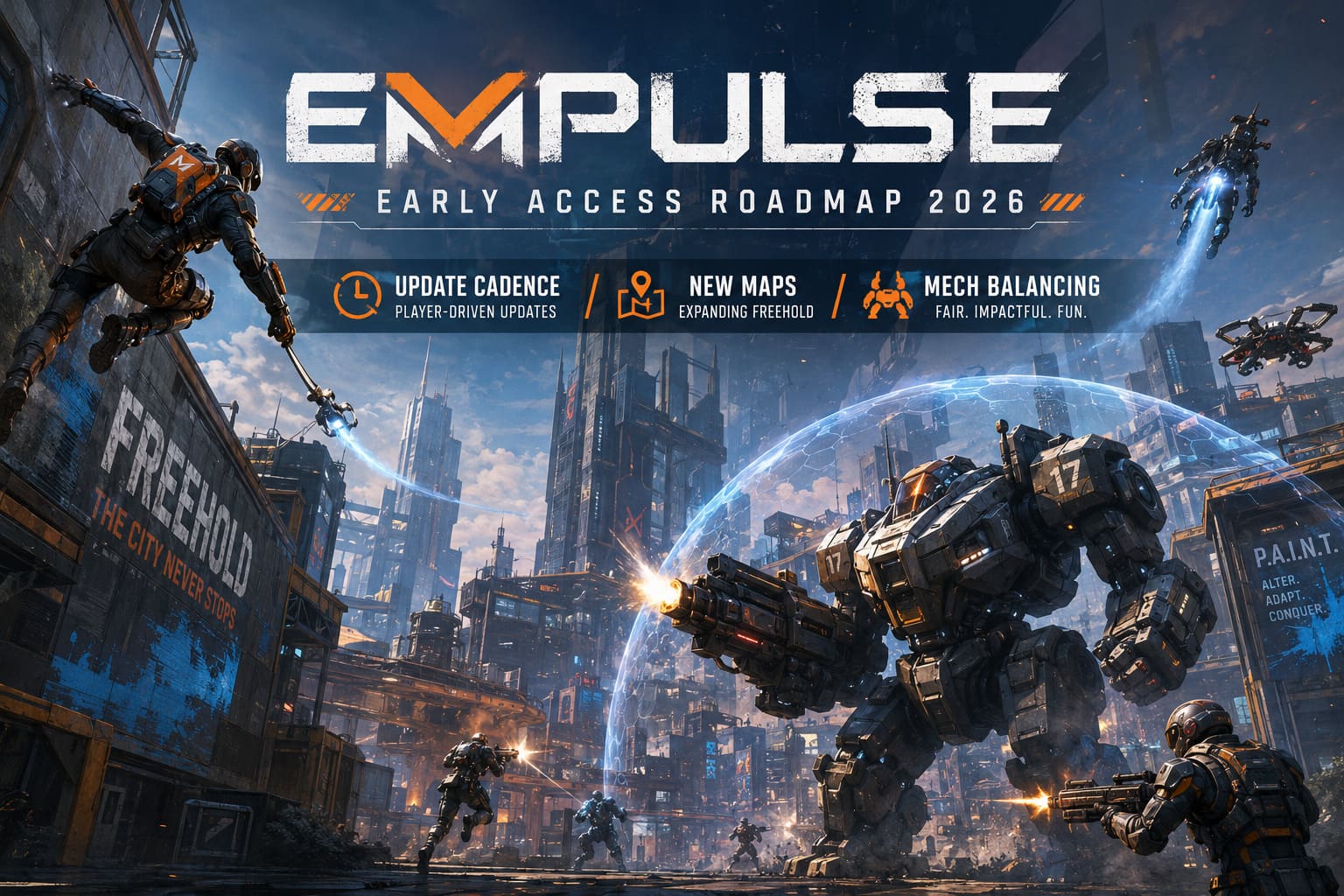
Players can chain together:
- Wall-running
- Grappling hook swings
- Jetpack boosts
- Momentum-based jumps
- Environmental traversal mechanics
The result is a battlefield that rewards creativity as much as aiming skill.
Watching experienced players navigate maps almost feels like watching a parkour competition mixed with an arena shooter. Instead of hiding behind cover and waiting for opportunities, players are constantly moving, flanking, repositioning, and creating unexpected attack angles.
As someone who misses the days when movement mastery could completely change the outcome of a match, this approach feels incredibly refreshing.
A Roadmap Without the Typical Roadmap
One of the most unusual aspects of EMPULSE is that there is no traditional seasonal content structure.
That may sound risky, but I actually think it is one of the smartest decisions the developers have made.
Rather than promising content six months in advance and locking themselves into deadlines, 1047 Games plans to react directly to player feedback.
This means updates can focus on whatever the community believes is most important at any given time.
Potential priorities include:
- Weapon balance changes
- New map additions
- Movement adjustments
- Server optimization
- Matchmaking improvements
- Competitive features
In theory, this should allow the game to evolve much faster than titles that follow strict seasonal schedules.
Of course, the success of this strategy depends on how quickly the developers can respond to feedback, but the philosophy itself is promising.
The Mech System Could Be a Game-Changer
Let’s be honest.
The biggest reason many players are paying attention to EMPULSE is the mech combat.
Large mechanical war machines have become surprisingly rare in modern multiplayer shooters, despite being one of the most exciting concepts in gaming.
EMPULSE brings them back in a way that feels meaningful.
Rather than handing every player a personal mech after earning a killstreak, mechs appear as contested objectives during matches. Teams must fight for control while also preventing opponents from claiming them.
This creates natural moments of tension and teamwork.
Once inside a mech, players gain access to devastating firepower, including:

| Mech Feature | Battlefield Impact |
|---|---|
| Heavy Chaingun | Sustained area suppression |
| Rocket Systems | High burst damage |
| Bubble Shield | Defensive protection |
| Charge Jump | Vertical repositioning |
| Massive Health Pool | Objective control |
What I particularly like is that mechs are powerful without necessarily becoming automatic win buttons.
Skilled pilots can dominate, but coordinated teams still have opportunities to counter them through movement and focused attacks.
That balance will be critical for long-term success.
Freehold Might Become One of the Genre’s Best Settings
Many shooters treat maps as simple arenas where combat happens.
EMPULSE appears to treat maps as active gameplay systems.
The city of Freehold serves as the game’s primary setting, offering dense urban environments filled with vertical pathways, rooftops, industrial structures, and traversal opportunities.
Future expansions are expected to introduce several distinct districts.
Industrial Zones
These environments focus on:
- Massive machinery
- Factory complexes
- Cargo transport routes
- Multi-level interiors
Such maps should create unique opportunities for grappling hooks and aerial movement.
Corporate Districts
These locations appear designed for extreme vertical combat.
Players will battle across:
- Rooftops
- Glass towers
- Elevated walkways
- High-risk traversal routes
Missing a jump could send players falling far below the action.
Interactive Terrain Systems
Perhaps the most innovative feature involves the game’s P.A.I.N.T. technology.
Players can temporarily alter surfaces to create movement boosts, defensive advantages, and entirely new traversal routes.
This means maps can effectively change throughout a match depending on player decisions.
That kind of dynamic battlefield design could separate EMPULSE from nearly every other arena shooter currently available.
Competitive Modes Have Real Potential
EMPULSE launches with several objective-focused modes that emphasize teamwork and movement.
The one that immediately caught my attention is Capture the Mech.
Instead of capturing a traditional flag, teams fight over massive mechanical assets that must be escorted back to base.

It sounds chaotic, strategic, and exactly the kind of mode that benefits from the game’s movement systems.
Another standout is Intel mode.
A valuable data core appears somewhere on the map, and teams compete to control it for a set period of time.
Unlike stationary objective modes, Intel constantly forces movement and adaptation.
Players cannot simply bunker down behind cover.
They must survive while navigating complex environments and avoiding coordinated enemy attacks.
These types of objectives naturally encourage aggressive gameplay, which fits perfectly with EMPULSE’s overall design philosophy.
The Surprising Monetization Approach
In an era where almost every multiplayer game launches with multiple premium currencies, cosmetic stores, and battle passes, EMPULSE is taking a dramatically different route.
The game launches with a single upfront purchase price.
That’s it.
No battle pass.
No premium shop.
No cosmetic bundles.
No paid progression shortcuts.
Everything from skins to customization options is earned through gameplay.
As a player, I find this incredibly appealing.
Modern multiplayer games often feel designed around monetization first and gameplay second.
EMPULSE appears to be reversing that formula.
Whether this business model remains sustainable over the long term remains to be seen, but it certainly creates a strong first impression.
EMPULSE Paint Bombs Guide: Mechanics, Meta Strategies, and Movement Combos Explained (2026)
Challenges the Developers Must Solve
Despite my excitement, EMPULSE is not guaranteed to succeed.
Several important challenges lie ahead.
Weapon Balance
Early impressions suggest certain weapons may outperform others in specific situations.
Shotguns, in particular, have generated discussion among testers regarding effectiveness at close range.
Balancing these tools will require constant monitoring.
Technical Performance
Cross-platform multiplayer is never easy.
Supporting:
- PC
- PlayStation 5
- Xbox Series X/S
while maintaining smooth performance and stable matchmaking is a major undertaking.
Server reliability will be closely watched during the first few weeks after launch.
Retention and Progression
A strong launch is only the beginning.
The real challenge is keeping players engaged for months.
Without battle passes driving daily engagement, the game must rely on rewarding progression systems, meaningful unlocks, ranked competition, and excellent gameplay.
Fortunately, those are exactly the areas where great multiplayer games should focus.
Best EMPULSE Steam Deck Settings: How to Get Smooth 60 FPS in 2026
Final Thoughts
After years of watching movement shooters struggle to find mainstream success, EMPULSE feels like a genuine attempt to revive a style of multiplayer gaming that many players have missed.
The combination of fluid traversal, objective-focused gameplay, giant mechs, community-driven development, and player-friendly monetization creates a package that stands out in today’s crowded market.
Will it immediately become the next major esports phenomenon?
Probably not.
Will it face balancing challenges, technical hurdles, and growing pains during Early Access?
Almost certainly.
But from everything I have seen so far, EMPULSE possesses something many modern shooters lack: a clear identity.
For fans of high-speed combat, mechanical skill expression, and old-school multiplayer design, this might be one of the most exciting Early Access launches of 2026.
And honestly, as someone who has been waiting years for a game willing to embrace movement and mechs without compromise, EMPULSE is already one of the titles I am most eager to play.