Xbox Cancels Project Fantasy: Inside Microsoft’s Strategic Reset and IO Interactive Layoffs
The gaming industry has a way of flipping from celebration to disruption in a matter of days. One moment a studio is riding the momentum of a breakout success, and the next it is forced to restructure its entire future because of shifting publisher priorities. That is exactly what happened when IO Interactive’s ambitious RPG Project Fantasy lost backing from Microsoft’s gaming division, triggering layoffs and raising new questions about the direction of modern AAA development.
As someone watching the industry evolve over the years, it feels like another example of how unstable big-budget game production has become. Even strong studios are no longer insulated when platform holders like Xbox start reshaping their investment strategy around internal franchises and long-term ecosystem control.
Xbox Bloodbath: Will Microsoft Cancel Marvel’s Blade and Close Arkane Lyon?
The Breaking Point: When Project Fantasy Lost Its Financial Anchor
Project Fantasy was IO Interactive’s attempt to step far outside its established identity. The studio, known globally for the Hitman series, was building a large-scale online fantasy RPG with persistent systems and multiplayer-driven progression.
Originally revealed in 2023, the project was widely believed to have external funding support from Microsoft. That kind of backing is essential for modern live-service RPGs, where development cycles stretch for years and costs escalate rapidly long before launch revenue appears.
When IO Interactive confirmed on June 30, 2026, that a key publishing relationship had ended, the industry quickly connected the implications. The withdrawal of support from Microsoft effectively removed the financial foundation of the project, forcing immediate internal restructuring and layoffs.
Despite the disruption, IO Interactive emphasized that the project itself is not canceled. The studio remains committed to continuing development, though now under very different financial conditions.
Success on One Side, Instability on the Other
The timing of the situation makes it particularly striking. IO Interactive had just achieved a major commercial and critical success with 007 First Light, which reportedly sold around three million copies in its early launch window and generated strong industry award buzz.
Normally, that level of success would lead to expansion, hiring, and increased creative freedom. Instead, the studio was forced to reduce staff due to the collapse of funding for a separate long-term project.
This highlights one of the core contradictions of modern AAA development: success in a single product does not necessarily stabilize a studio’s broader portfolio. Costs are distributed unevenly, and large-scale projects often rely on separate financial pipelines that are vulnerable to external changes.
Modern AAA Development Pressure
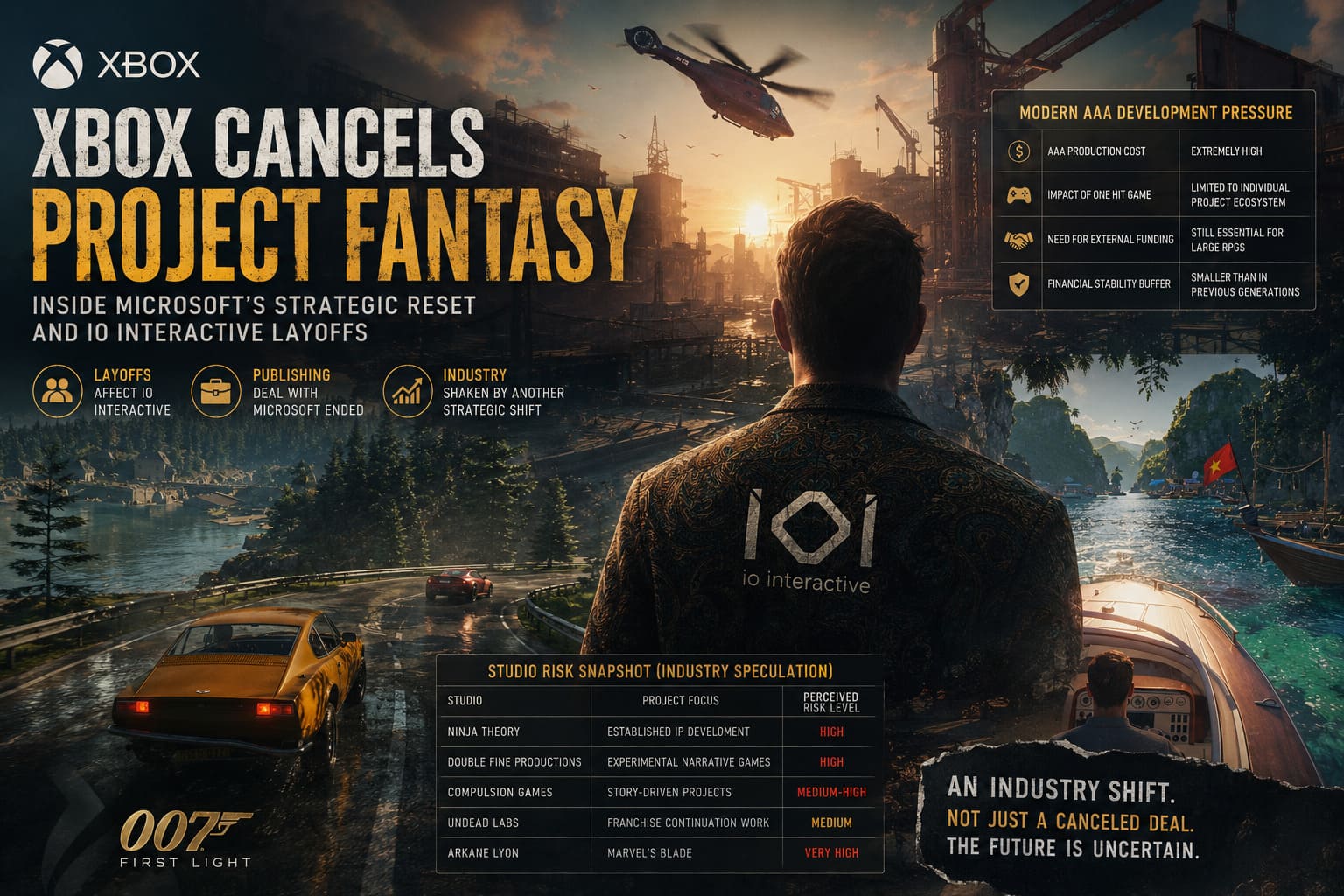
The situation can be summarized in a simple comparison:
| Factor | Current Industry Reality |
|---|---|
| AAA Production Cost | Extremely high, multi-year investment cycles |
| Impact of One Hit Game | Limited to individual project ecosystem |
| Need for External Funding | Still essential for large RPGs and live-service games |
| Financial Stability Buffer | Smaller than in previous console generations |
Even successful launches like 007 First Light cannot always sustain multiple simultaneous AAA pipelines without strong publisher backing.

Microsoft’s Position: Reallocation, Not Reduction
After public backlash began spreading across gaming communities and social media platforms, Microsoft issued statements emphasizing that its overall investment in gaming has not decreased. According to the company, resources are being redistributed rather than reduced.
From a corporate standpoint, the message is that Microsoft is focusing spending on higher-priority internal projects within Xbox Game Studios, while adjusting external partnerships based on strategic value.
However, this explanation has not fully reassured the community. Many players and analysts interpret the shift as a consolidation of resources around major franchises such as Call of Duty, Halo, and Bethesda’s large-scale RPG ecosystem, potentially leaving experimental or externally developed projects behind.
The Larger Xbox Restructuring Under New Leadership
The cancellation of the Project Fantasy funding agreement is widely seen as part of a broader restructuring effort within Microsoft’s gaming division. Under CEO Asha Sharma, Xbox is reportedly undergoing an internal reorganization focused on efficiency, profitability, and tighter project control.
Internal communications suggest a long-term shift toward streamlined operations within Xbox Game Studios, including possible consolidation or restructuring of several development teams.
While not officially confirmed, industry speculation has pointed to multiple studios being evaluated for restructuring or strategic repositioning, including:
- Ninja Theory
- Double Fine Productions
- Compulsion Games
- Undead Labs
- Arkane Lyon
Even high-profile projects are not entirely immune to reassessment, which reflects the scale of the ongoing internal shift.
Studio Risk Snapshot (Industry Speculation)
| Studio | Project Focus | Perceived Risk Level |
|---|---|---|
| Ninja Theory | Established IP development | High |
| Double Fine Productions | Experimental narrative games | High |
| Compulsion Games | Story-driven projects | Medium-High |
| Undead Labs | Franchise continuation work | Medium |
| Arkane Lyon | Marvel’s Blade | Very High |

Community Reaction: Frustration and Industry Fatigue
The response from gaming communities has been largely critical. Across platforms such as Reddit, ResetEra, and YouTube, players have expressed frustration with what they see as increasing instability in Xbox’s publishing ecosystem.
A recurring concern is the contrast between Microsoft’s massive acquisitions in recent years and the apparent reduction in support for mid-sized or experimental studios. Many players feel that the ecosystem that once made Xbox appealing—diverse, creative partnerships—is gradually narrowing toward safer, franchise-driven output.
There is also emotional backlash tied to IO Interactive’s situation. The idea that a studio could release a major success and still face layoffs due to unrelated funding decisions has intensified skepticism about publisher reliability in general.
What Happens to Project Fantasy Now?
Despite the loss of its original financial backing, IO Interactive is not abandoning the project. The studio has a track record of surviving major structural transitions, including its separation from Square Enix and its successful pivot toward self-publishing with the Hitman franchise.
Going forward, the studio has several possible paths. It may choose to self-fund development, seek a new publishing partner, or restructure the game’s scope to better fit internal resources.
Potential new partners could include major industry players such as Sony, Electronic Arts, or Tencent, all of whom have historically invested in large-scale multiplayer or RPG projects.
However, the most immediate challenge is not just financial—it is organizational. After layoffs and restructuring, maintaining momentum and team morale becomes as important as securing funding.
Conclusion: A Sign of a Changing Industry
The situation surrounding Project Fantasy reflects a broader trend in modern game development: increasing consolidation, rising costs, and growing dependence on platform-level decision making.
From a player’s perspective, it feels like fewer projects are being allowed to exist in the long-term experimental space that once defined the industry’s creativity. Even successful studios are navigating a landscape where financial stability is no longer guaranteed by performance alone.
IO Interactive is unlikely to disappear from the industry, and Project Fantasy may still find a path forward. But the journey ahead is now significantly more uncertain, shaped less by creative ambition and more by shifting corporate strategy.
And that is the real story here: not just a canceled deal, but an industry where even success no longer guarantees stability.