Path of Idle: Old Gods Rising Review 2026 – Is It Worth Buying?
I have played enough idle and incremental games to know the usual routine by heart. You click something, numbers go up, you unlock another upgrade, and eventually the game starts nudging you toward a shop button. The presentation changes, the currencies get renamed, but underneath it is often the same treadmill.
Path of Idle: Old Gods Rising immediately grabbed my attention because it takes that familiar formula and throws it into a grim Lovecraftian RPG wrapped in hand-drawn horror aesthetics.
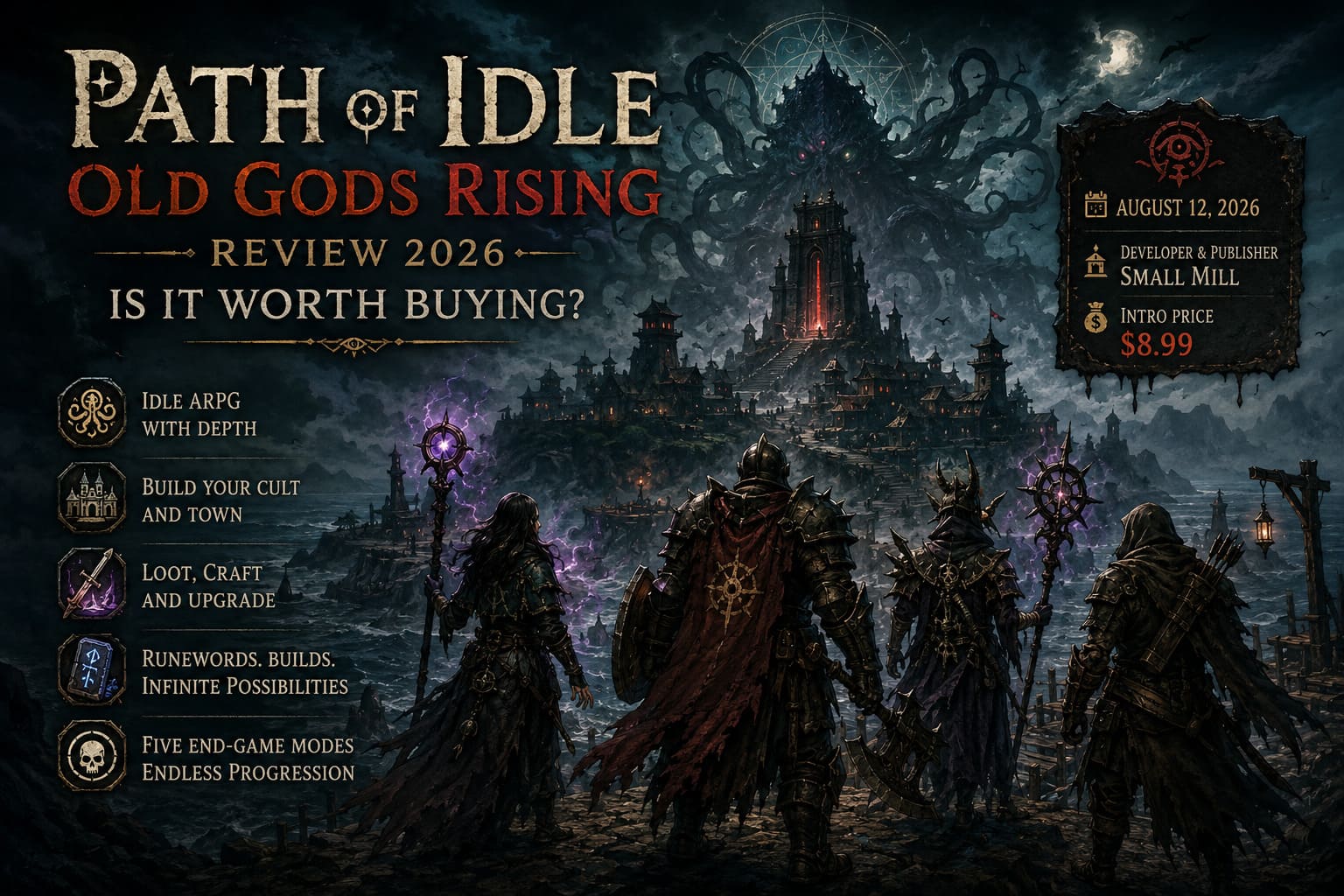
Released on August 12, 2026, by indie developer and publisher Small Mill, the game is an unusual combination of automated combat, town management, ARPG-style loot hunting, character progression, crafting, and cosmic horror. It is also a premium PC game rather than another free-to-play idle title built around energy meters and premium currency.
That distinction matters.
At its introductory price of $8.99, Path of Idle is trying to sell the idea that an idle RPG can be an actual game rather than a glorified storefront with numbers attached. After spending serious time digging into its progression systems, builds, loot, end-game modes, and post-launch balance changes, I think Small Mill is onto something.
The game isn’t perfect. Far from it. Its mid-game progression can suddenly slam the brakes, and there are stretches where you’re watching your party fight rather than actively playing. But when the systems start clicking, there is a surprisingly addictive loop underneath all that blood, bone, and eldritch nonsense.
What Exactly Is Path of Idle?
The premise is wonderfully ridiculous in the best possible way.
You play as a powerful cultist operating from Blackreef Isle, a place crawling with monsters, exiles, heretics, and ancient supernatural forces. Your job isn’t to save the world. You’re essentially building a functioning operation for an ancient god.
You recruit criminals from the town prison, turn them into loyal cultists, perform rituals, develop your settlement, collect resources, equip your followers, and send them into increasingly dangerous areas.
Your main combat squad is known as the Godsworn.
Once the initial setup is complete, the game becomes a constant cycle of:
- Recruiting and upgrading characters.
- Expanding your town infrastructure.
- Farming resources and equipment.
- Improving skills and builds.
- Pushing through new stages.
- Defeating bosses.
- Returning to older areas when your progression hits a wall.
- Turning better loot into even stronger characters.
This sounds like a standard incremental RPG on paper, but the difference is how much of the underlying progression is actually interconnected.
Your town isn’t just cosmetic. Your equipment isn’t just a pile of random stat sticks. Your character classes aren’t interchangeable damage machines.
There is real buildcraft here.
Automated Combat That Still Gives You Something to Do
Combat in Path of Idle: Old Gods Rising is fully automated. Your Godsworn move through stages, attack enemies, cast abilities, and collect loot without requiring you to manually control every attack.
If you’re coming from traditional action RPGs, that might initially sound boring.
And honestly, there are moments when it is.
But the game understands that idle combat isn’t supposed to replace active gameplay entirely. The interesting decisions happen around the battles.
You choose when to advance. You decide which equipment stays and which gets dismantled. You optimize skills, manage your town, determine which resources deserve priority, and build teams specifically for difficult encounters.
The actual combat presentation also helps considerably. This isn’t a screen filled with numbers and a progress bar. Characters have portraits, abilities trigger visually, enemies react to attacks, and area-of-effect spells create enough spectacle to make long farming sessions enjoyable.
It becomes the perfect second-monitor game.
Throw it beside a YouTube video, another game, a work window, or a Discord conversation, glance over occasionally, make a few decisions, and let the machine run.
That is exactly the kind of idle design I enjoy.
The Classes Are More Important Than They First Appear
One of the game’s strongest systems is its character customization.
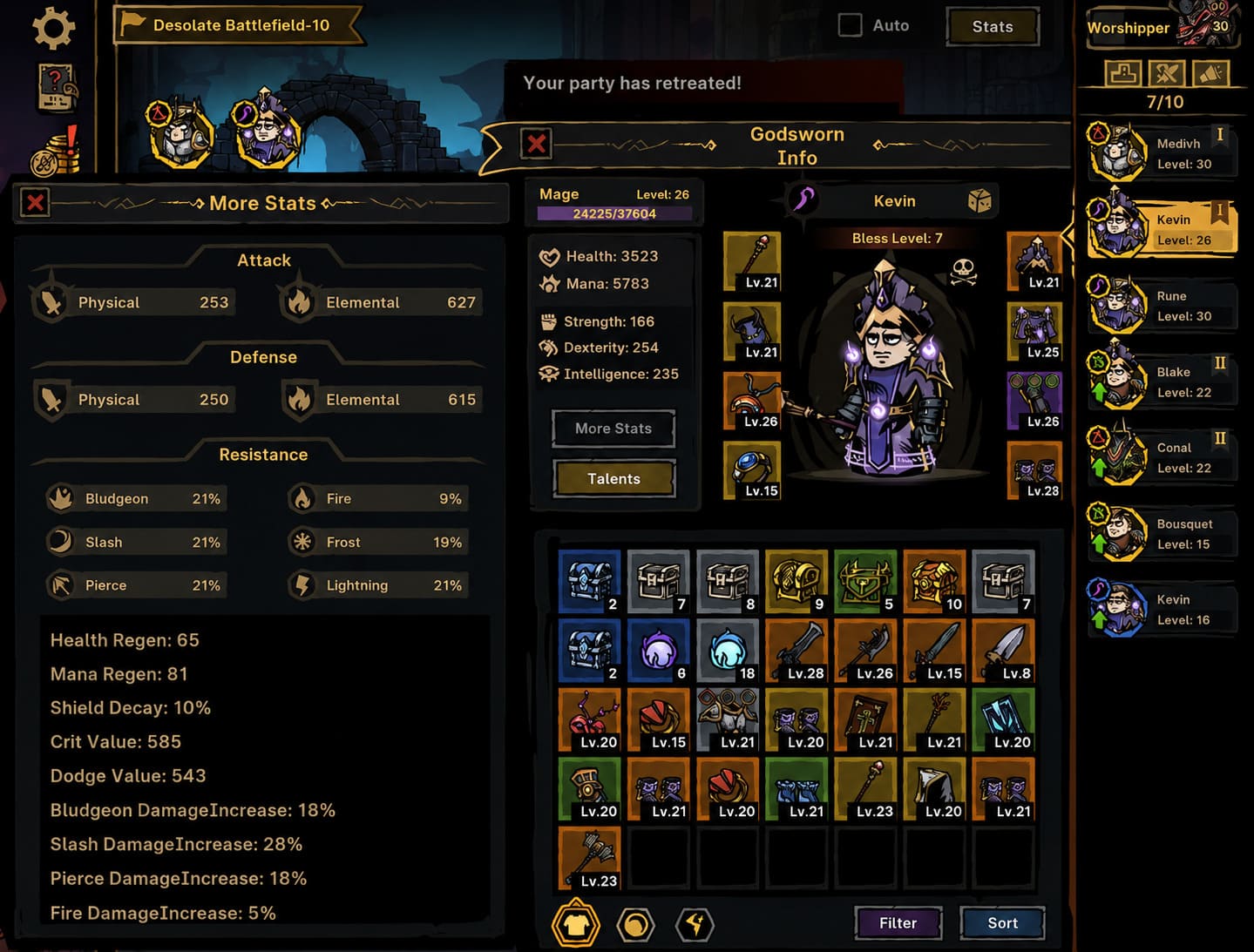
There are six classes, each with its own skill tree and specialization choices. Early on, you’ll probably gravitate toward a simple three-character setup built around a tank, damage dealer, and ranged specialist.
That basic structure works, but eventually you’ll realize the game wants you to think about synergy rather than individual power.
Warrior
The Warrior is your frontline bruiser and defensive anchor.
Skills such as Charged Smash allow the class to stagger multiple enemies while providing crowd-control utility. A well-built Warrior can absorb punishment while creating opportunities for the rest of your squad.
It’s not the most exciting class initially, but when enemies start hitting hard, you will appreciate having someone capable of standing between your fragile damage dealers and certain death.
Mage
The Mage is where things get spicy.
This is your high-output elemental caster, capable of delivering devastating area damage. Meteor is particularly satisfying when you have a packed group of enemies begging to be vaporized.
The catch is resource management.
A Mage without sufficient mana support can feel underwhelming, while a properly optimized Mage can completely change the speed of a farming run.
Hunter
The Hunter is probably the class that most clearly demonstrates how deep the game’s combat calculations can become.
Abilities such as Raptor Strike and Spike Bomb can shred armor and weaken enemy elemental resistances. That makes the Hunter valuable even when another character technically has higher raw damage.
Put an armor-shredding Hunter next to a strong elemental Mage and suddenly the entire squad starts hitting considerably harder.
That kind of interaction is what keeps Path of Idle from feeling like a simple “equip the item with the biggest number” RPG.
The Loot System Is Where This Game Gets Dangerous
And by dangerous, I mean dangerously addictive.
If you’ve played Diablo, Path of Exile, or other loot-heavy ARPGs, you’ll recognize the basic philosophy immediately.
Enemies drop equipment in different rarities, with stronger items carrying randomized stats and affixes. You can find gear with bonuses to damage, critical chance, health regeneration, mana recovery, and plenty of other useful properties.
The important part is that two pieces of equipment with similar item levels can still behave completely differently.
One might perfectly complement your Mage.
Another could completely transform your Hunter.
And suddenly you’re staring at a pile of loot thinking, “Okay, this garbage item is actually useful if I rebuild half my character.”
That is the good stuff.
Crafting and Town Progression
Your settlement functions as the backbone of your crafting ecosystem.
The Blacksmith and crafting stations allow you to forge equipment, upgrade items, and manipulate undesirable affixes. Meanwhile, structures such as the Monument and Temple contribute to long-term character progression through ascension and divine bonuses.
You also have resources such as bone and heart fragments that can be converted into permanent improvements.
This makes your town feel like more than a menu.
Every building contributes to the broader progression machine.
Runewords Add Another Layer of Buildcraft
The Runeword system is another feature I wasn’t expecting to enjoy as much as I did.
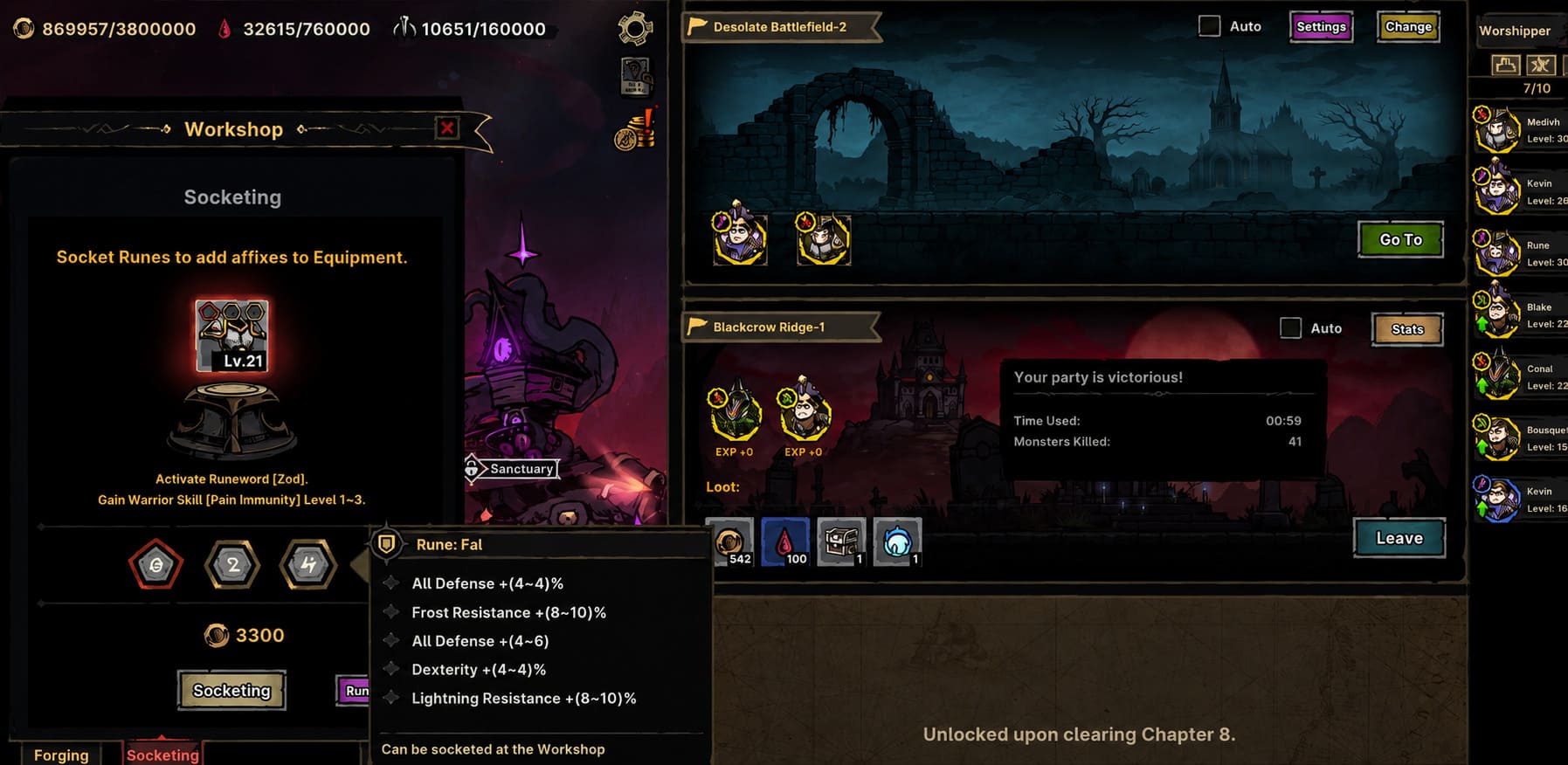
Players can discover rare runes throughout different adventure dimensions and place them into compatible equipment in specific combinations. Completing the correct arrangement unlocks additional properties.
If you’ve ever enjoyed experimenting with socket systems in classic ARPGs, this scratches the same itch.
The best part is that runewords encourage you to think beyond individual item stats. Sometimes the seemingly weaker piece becomes extremely valuable because it supports the right rune combination.
That’s exactly the kind of system that creates long-term farming goals.
The First Five Chapters Are Almost Too Generous
The opening portion of the game is extremely fast.
You unlock new mechanics, gain equipment, expand your town, improve your characters, and generally feel like you’re getting something every few minutes.
For an idle RPG, this is fantastic.
There is very little dead air during the early game. The progression keeps throwing rewards at you, which makes the first five chapters surprisingly difficult to put down.
Then Chapter 6 arrives.
And the game basically says:
“Okay, you’ve had your fun. Now prove you actually understand the systems.”
Chapter 6 Is Where the Grind Begins
This is easily my biggest criticism of Path of Idle.
Around Chapter 6, progression slows down dramatically.
Enemy stats begin climbing much faster. Character upgrades require considerably more resources. Gear that felt perfectly acceptable a few hours earlier suddenly looks terrible.
You can’t simply keep pushing forward.
Instead, you’re expected to return to previous stages, farm materials, improve your town, optimize affixes, and rethink your builds.
For players who enjoy incremental progression, this might be the moment when the game becomes truly addictive.
For everyone else, it could feel like hitting a brick wall.
Personally, I don’t mind the wall because there are enough systems underneath it to make optimization worthwhile. But I absolutely understand why a more casual player might bounce off the game here.
Five End-Game Systems Keep the Grind Interesting
Small Mill does a good job of preventing the late game from becoming one endless farming corridor.
Five major progression modes unlock as you advance:
| Mode | Main Purpose |
|---|---|
| Expedition | Alternative progression and resource acquisition |
| Exploration | Additional encounters and specialized rewards |
| Divine Tower | Challenging combat progression and powerful upgrades |
| Alternate Dimension | Different environments, enemies, and farming opportunities |
| Finality | High-end progression designed for optimized builds |
The important thing is that these modes aren’t simply five versions of the same activity.
They encourage different approaches, different farming priorities, and sometimes different character setups.
That matters enormously in an idle game because repetition is the genre’s biggest enemy.
Small Mill Deserves Credit for the Launch Support
Another thing that impressed me is the speed of the post-launch balancing.
Idle games live and die by numbers. If one skill becomes absurdly powerful, one farming route produces ten times the intended resources, or one affix completely breaks the economy, players will find it almost immediately.
Small Mill has been reacting quickly.
Performance updates introduced options to disable some heavy combat effects and removed certain Godsworn portrait animations that were contributing to unnecessary performance problems. This is especially useful during extended auto-battle sessions.
The economy has also received attention. Outlands Essence drop rates were doubled, helping reduce some of the resource pressure around mid-game town upgrades.
Several skills and affixes have been adjusted as well. Hunter’s Drive specialization and Raptor Strike’s resistance shredding were toned down, while problematic behavior involving Mage’s Meteor and Warrior’s Charged Smash received fixes.
The developers also capped Mythic affix modifiers at 150%, preventing some extreme scaling combinations from becoming completely ridiculous.
I would much rather see this kind of active balancing than a developer disappearing for months while the community discovers that one broken build is the only build worth playing.
The Monetization Is Refreshingly Simple
This might actually be one of Path of Idle’s biggest selling points.
The game costs $8.99 at launch and doesn’t bombard you with the usual free-to-play nonsense.
There are no energy timers.
There isn’t a premium currency maze.
There aren’t characters locked behind gacha.
There aren’t constant pop-ups telling you that your reward can be doubled for $1.99.
You buy the game and play it.
That’s it.
There is an optional Supporter Pack DLC, but it functions primarily as a quality-of-life package. It provides a Max Level Boon that generates equipment chests, increases offline progression storage to up to 48 hours, and provides a 30% offline reward bonus.
Importantly, the core experience doesn’t depend on it.
Even better, players coming from the public demo can carry their save progression into the full game. That removes one of the most annoying problems with demos for progression-heavy games: having to start from scratch after you’ve already invested several hours.
What I Love About Path of Idle
After looking at the whole package, several things stand out.
- The Lovecraftian presentation actually gives the game an identity. It doesn’t feel like another generic fantasy idle RPG.
- The loot system has real depth. Random affixes, crafting, rarities, and runewords create plenty of reasons to keep farming.
- Build synergy matters. Classes aren’t just cosmetic variations of the same damage dealer.
- The premium model is fantastic. At this price, the absence of aggressive monetization feels almost rebellious in the modern idle-game space.
- The end-game structure has variety. Five different progression modes give players something to work toward beyond simply reaching the next stage.
Path of Idle Old Gods Rising Black Screen Fix: Step-by-Step Technical Guide for PC
Where It Falls Short
The biggest issue is still the progression curve.
Chapter 6 is a serious slowdown. If you expect the early-game pace to continue indefinitely, you’re going to be disappointed.
The game also doesn’t offer as much direct interaction during combat as some players may expect. You’re primarily making strategic decisions before and around battles rather than controlling the action itself.
Localization is another weakness. At launch, support for multiple languages remains incomplete, including missing comprehensive French localization.
None of these problems destroys the experience, but they are worth knowing before buying.
Path of Idle Old Gods Rising Unique Items Drop Locations: Farming Guide (2026)
Final Verdict: 8.5/10
Path of Idle: Old Gods Rising is one of the more interesting idle RPG experiments I’ve played in 2026.
It understands what makes incremental games addictive, but it doesn’t stop there. The ARPG-inspired loot system, town management, class specialization, crafting, runewords, and multiple end-game modes give the game substantially more depth than its idle label suggests.
The first few chapters are almost absurdly satisfying. Watching your cult grow, seeing equipment improve, unlocking new mechanics, and turning a collection of disposable exiles into a terrifying Godsworn squad is exactly the kind of progression loop that can eat an evening without you noticing.
Then Chapter 6 punches you in the face with a grinding wall.
I actually think that’s where the game becomes more interesting, provided you’re the type of player who enjoys optimization. Farming isn’t just farming anymore. You’re hunting specific affixes, improving your town, experimenting with class combinations, and figuring out which systems can be squeezed for another few percent of efficiency.
And for $8.99, that’s a pretty compelling proposition.
If you want an action RPG where you’re manually dodging attacks and landing every hit yourself, this obviously isn’t it. If you want a completely brainless idle clicker, it may also be too complicated.
But if you’re looking for a dark idle RPG to keep running on a second monitor, something you can check between matches, during work breaks, or while grinding another game, Path of Idle: Old Gods Rising is an easy recommendation.
It has personality. It has surprisingly deep systems. It respects the player’s wallet. Most importantly, it gives you that wonderful ARPG feeling of seeing a new item drop and immediately wondering:
“Wait… is this actually better than what I’m wearing?”
That’s the hook.
And once Path of Idle gets its claws into you, escaping Blackreef Isle might be harder than escaping the Old God itself.